
5. Einstein--Maxwell--Dilaton Backgrounds and IR Scaling Geometries
Charged AdS black branes are the first grammar of holographic finite density. They teach how chemical potential, charge density, entropy, and near-horizon physics appear geometrically. But they are not the whole story. Many strongly coupled phases are not well captured by a constant gauge coupling and a rigid cosmological constant. Couplings run. Scalars flow. The effective number of active degrees of freedom may change with scale. The infrared may have nonrelativistic scaling or hyperscaling violation.
Einstein—Maxwell—Dilaton models are the simplest flexible framework for this physics. They couple a metric, a gauge field, and a scalar:
The scalar is the dilaton. The function controls the effective cosmological constant and scalar potential. The function controls the effective gauge coupling. When runs radially, the geometry can flow from a UV AdS region to a nontrivial IR scaling regime.
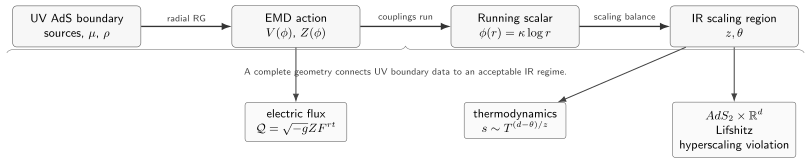
An EMD flow starts from UV AdS data, evolves through a running scalar and radial electric flux, and may approach an IR scaling regime. The functions and determine whether the infrared resembles , Lifshitz scaling, or a hyperscaling-violating geometry.
Why EMD models are needed
Section titled “Why EMD models are needed”The planar Reissner—Nordstrom AdS solution has an extremal near-horizon region
This region describes semi-local criticality: time scales but space does not. It is powerful, but it is also special. A broader class of compressible phases may have
with finite , or may violate hyperscaling through an exponent . To get these phases holographically, the bulk gauge coupling and scalar potential must often run in the IR. That is the role of the dilaton.
The EMD setup is therefore best viewed as a controlled language for scale-dependent effective couplings. In top-down examples, , , and may descend from supergravity compactification. In bottom-up work, they are chosen to realize desired scaling, stability, and transport properties.
The equations of motion
Section titled “The equations of motion”From the action above, the Maxwell equation is
The scalar equation is
The Einstein equation can be written schematically as
where
T_{MN}^{(\phi)}=\frac12\partial_M\phi\partial_N\phi- rac14g_{MN}(\partial\phi)^2,and
up to the convention used to distribute traces between the two sides of the Einstein equation. The essential point is that the scalar and gauge flux backreact on the metric together.
Radial electric flux and charge accounting
Section titled “Radial electric flux and charge accounting”For homogeneous finite-density backgrounds, take
The Maxwell equation implies that the radial electric displacement is conserved:
This quantity is the boundary charge density, up to normalization. It is also the cleanest way to ask where the charge lives.
If the electric flux continues through the horizon, part or all of the charge is fractionalized: it is carried by horizon degrees of freedom. If the flux is sourced by charged matter outside the horizon, such as a condensate, electron star, or brane source, the charge is more cohesive. In many solutions the charge is partly outside the horizon and partly behind it.
The useful schematic decomposition is
This is not merely semantics. The charge distribution affects low-energy spectra, Luttinger-counting questions, and whether the IR phase resembles a fractionalized metal, electron-star state, or condensate.
Lifshitz scaling
Section titled “Lifshitz scaling”A Lifshitz metric has the schematic form
with boundary-like UV direction at small in this convention. It is invariant under
For , this reduces to AdS scaling. For , time and space scale differently. Such geometries can be supported by massive vector fields, running dilatons, or EMD-like matter sectors.
A finite-temperature Lifshitz black brane has entropy density
This follows because the horizon scale transforms as and the horizon area scales as .
Hyperscaling violation
Section titled “Hyperscaling violation”A hyperscaling-violating geometry has an additional overall Weyl scaling. A common schematic form is
Under scaling, the metric is not invariant but transforms covariantly. The exponent modifies the effective dimension of thermodynamics. The entropy density then scales as
This formula is one of the main reasons these geometries are useful. It lets one model effective dimensional reduction, hidden Fermi-surface-like behavior, and nontrivial low-temperature entropy scaling.
Special cases include:
| Geometry | Effective exponents | Entropy scaling |
|---|---|---|
| AdS black brane | , | |
| Lifshitz | , | |
| Hyperscaling violating | , | |
| Semi-local critical | with suitable limit | often finite or slow entropy scaling |
Exponential potentials and scaling solutions
Section titled “Exponential potentials and scaling solutions”Many EMD scaling solutions arise when the IR potentials are approximately exponential:
Then one may look for scaling ansätze such as
with power-law metric functions and electric field. The exponents , , and the charge-scaling data are determined by , , and the spacetime dimension.
The detailed algebra depends on convention, but the conceptual point is simple: exponential couplings turn the scalar equation into an algebraic scaling-balance problem. The scalar keeps running, and its running supports a non-AdS IR geometry.
Null-energy constraints
Section titled “Null-energy constraints”Not every pair is physically sensible. A basic constraint comes from the null energy condition. For hyperscaling-violating metrics in common conventions, one obtains inequalities of the schematic form
and
The precise form can shift with metric convention and matter content, but the lesson is stable: scaling exponents are not arbitrary knobs. They must satisfy energy conditions, thermodynamic stability, fluctuation stability, and IR acceptability.
Good and bad singularities
Section titled “Good and bad singularities”Many scaling geometries are singular in the deep IR. This is not automatically fatal. An IR singularity may be acceptable if it can be resolved by finite temperature, embedded into a controlled higher-dimensional solution, or interpreted as the limit of a sensible phase.
A practical checklist is:
- Does finite temperature cloak the singularity with a regular horizon?
- Are thermodynamic quantities finite and stable?
- Are linearized fluctuations well behaved?
- Can the solution be embedded in a top-down construction or controlled effective theory?
- Does the IR require extra boundary conditions not specified by the UV theory?
If the answer to the last question is yes, the geometry may not define a predictive IR phase by itself.
Transport intuition
Section titled “Transport intuition”EMD models are widely used for transport because controls the effective gauge coupling at the horizon. In simple neutral or weakly momentum-relaxed settings, DC conductivities often contain factors such as
where is the scalar value at the horizon. If runs with temperature, the conductivity can inherit scaling from the IR geometry.
This is the origin of many scaling formulas in holographic strange-metal models. But the warning is crucial: a temperature exponent in is not a complete theory of transport. Momentum conservation, charge density, thermoelectric mixing, translation breaking, and magnetization currents may all matter.
Worked example: entropy scaling
Section titled “Worked example: entropy scaling”Assume a hyperscaling-violating geometry with horizon radius and scaling
Temperature scales as inverse time:
The entropy density scales like area density. Hyperscaling violation changes the effective spatial dimension from to , so
Using gives
This derivation is intentionally simple. It captures the scaling logic without committing to a particular radial convention.
Common pitfalls
Section titled “Common pitfalls”Pitfall 1: EMD means a unique theory. It does not. The functions and define a family of theories. The physics depends strongly on their UV and IR behavior.
Pitfall 2: IR scaling geometries are complete spacetimes. Usually they are approximate deep-interior regions of full flows.
Pitfall 3: any exponent fit is meaningful. Exponents must satisfy consistency conditions and must be tied to observables, not just metric powers.
Pitfall 4: finite horizon flux is always bad. Horizon flux indicates fractionalized charge in the large- description. Whether that is appropriate depends on the phase being modeled.
Pitfall 5: is always the final ground state. It may be unstable to scalar condensation, fermion fluid formation, translation breaking, or other IR reorganizations.
Exercises
Section titled “Exercises”Exercise 1: Entropy exponent
Section titled “Exercise 1: Entropy exponent”For , , and , determine the entropy scaling.
Solution
Use
Substituting , , and gives
Exercise 2: Conserved electric flux
Section titled “Exercise 2: Conserved electric flux”Starting from , explain why a homogeneous electric background has a radially conserved electric displacement.
Solution
For a homogeneous ansatz , the only nonzero field strength is . The Maxwell equation becomes
Therefore
is independent of . This conserved radial flux is identified with boundary charge density up to normalization.
Exercise 3: Why running matters
Section titled “Exercise 3: Why running Z(ϕ)Z(\phi)Z(ϕ) matters”Suppose at the horizon and the incoherent conductivity is proportional to . What is the temperature scaling of that contribution?
Solution
If
and
then
This is only the incoherent part. The full DC conductivity at finite density may also contain a momentum-drag contribution.
Exercise 4: IR region versus complete solution
Section titled “Exercise 4: IR region versus complete solution”Why is it dangerous to discuss a hyperscaling-violating metric without specifying its UV completion?
Solution
The IR metric determines scaling behavior, but not the full boundary theory. Without a UV completion one may not know the sources, normalizations, thermodynamic ensemble, allowed perturbations, or whether the IR singularity is acceptable. A complete holographic state requires a geometry connecting the UV boundary to the IR region with well-defined boundary conditions.
Further reading
Section titled “Further reading”Useful references include treatments of EMD models, hyperscaling violation, Lifshitz holography, semi-local criticality, and finite-density transport in Hartnoll—Lucas—Sachdev, Zaanen—Liu—Sun—Schalm, and the gauge/gravity duality literature on non-conformal holographic flows.