
Intersecting Branes and Preserved Supersymmetry
The annulus calculation for parallel D-branes has a wonderfully simple conclusion: identical BPS branes exert no static force on one another because open-string bosons and fermions cancel level by level. The next natural question is what happens when the two branes are not parallel.
The answer is controlled by one integer: the number of directions with mixed boundary conditions. These are the directions that are Neumann at one end of the open string and Dirichlet at the other. They are called ND or DN directions. Mixed directions change the oscillator moding, shift the NS zero-point energy, and modify the supersymmetry projection. This one integer explains why D1—D5 and D3—D7 systems are supersymmetric, why D0—D2 and D0—D6 systems are not, and why D0—D8 / D1—D9 systems are special.
We will mostly study flat branes at right angles in ten-dimensional type II string theory. Let the two branes be D and D, and suppose they share spatial directions. They share the time direction as well, so their intersection has dimension as a spacetime worldvolume. The number of mixed spatial directions is
For the common nested examples in which the smaller brane lies inside the larger one, , and this reduces to .
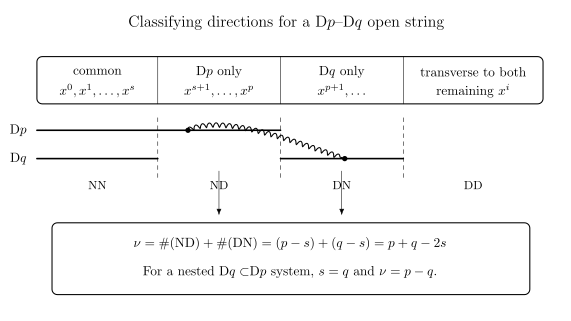
The open string sees four kinds of directions: NN along the common intersection, ND or DN along one brane but not the other, and DD transverse to both. The integer counts the mixed directions.
Boundary conditions and mixed directions
Section titled “Boundary conditions and mixed directions”Put the open string coordinate on . At each endpoint, every target-space direction is either Neumann or Dirichlet. In a Neumann direction the endpoint is free to move along the brane,
while in a Dirichlet direction the endpoint is fixed to a brane position,
For a string stretched between two different branes, a coordinate can have different boundary conditions at the two ends. The four cases are as follows.
| Direction type | At | At | Bosonic moding |
|---|---|---|---|
| NN | Neumann | Neumann | integer |
| DD | Dirichlet | Dirichlet | integer, plus possible stretching |
| ND | Neumann | Dirichlet | half-integer |
| DN | Dirichlet | Neumann | half-integer |
For example, an ND coordinate obeys
After subtracting the constant endpoint position, the oscillator expansion is
The half-integer moding is forced by the two boundary conditions: the cosine automatically satisfies the Neumann condition at , while requires .
The DN expansion is analogous, with instead of . The important point is that mixed bosons have no zero mode. A mixed coordinate is neither a center-of-mass coordinate of the stretched string nor a freely adjustable separation between the two branes.
For worldsheet fermions the moding is shifted in the opposite way. In NN and DD directions, the usual open-string fermions have half-integer modes in the NS sector and integer modes in the R sector. In ND and DN directions this assignment is reversed:
| Direction type | NS fermions | R fermions |
|---|---|---|
| NN or DD | half-integer | integer |
| ND or DN | integer | half-integer |
This reversal is the heart of the physics. It changes both the zero-point energy and the degeneracy of the ground states.
Supersymmetry projectors
Section titled “Supersymmetry projectors”A single flat BPS D-brane preserves half of the type II supercharges. In spacetime language, this is a linear projection on the two ten-dimensional supersymmetry parameters. A convenient abstract notation is
Here is built from the ten-dimensional gamma matrices along the brane worldvolume, together with the standard type-II matrix acting on the two supersymmetry parameters. Orientation reverses the sign of and turns a brane into an antibrane.
For two branes, a supersymmetry survives only if it satisfies both projections:
The product of the two projection conditions is governed by gamma matrices in the relative ND directions. For a nested D—D system, with D lying inside D, the relative matrix is essentially
Because the ND directions are spatial, the square is
Thus the relative projector can have real eigenvalues only when , namely for
The cleanest cases are and :
- gives parallel branes, preserving supercharges if their orientations agree.
- gives the standard quarter-BPS intersections, preserving supercharges.
The systems, such as D0—D8 and D1—D9, are more delicate. The algebraic projection can be compatible, but the annulus contains a constant long-range contribution tied to the background R—R charge of D8/O9 systems and to fundamental-string creation. They should not be treated as ordinary isolated two-brane no-force systems in flat space.
For or , the relative matrix squares to , so the two projections are incompatible over real Majorana spinors. The system is not supersymmetric.
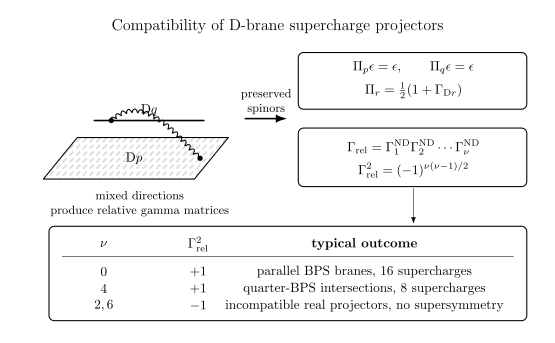
Each brane imposes a half-BPS projector. The compatibility of two projectors is controlled by the gamma-matrix product in the relative ND directions.
Open strings between D and D
Section titled “Open strings between Dppp and Dqqq”Let the two branes be separated by a vector in their common DD directions. The stretching contribution to the mass is the same as for parallel branes:
The oscillator part, however, now depends on . In light-cone gauge there are eight transverse bosons and eight transverse fermions. Split them into
In the NS sector, an ordinary transverse direction contributes
while a mixed direction contributes
Therefore the NS zero-point energy is
In the R sector the bosonic and fermionic zero-point energies cancel for both ordinary and mixed directions:
Thus the mass formulae are
These two equations are the quickest diagnostic for the physics of an intersecting-brane system.
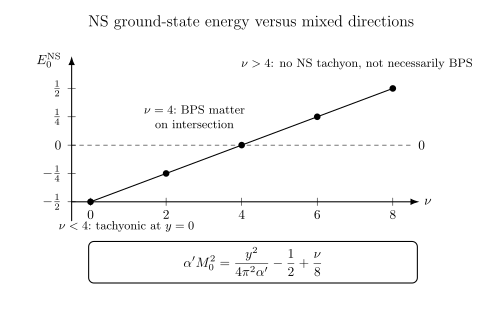
The NS zero-point energy increases by for each pair of additional mixed directions. At the NS ground state is massless at zero separation.
What the different values of mean
Section titled “What the different values of ν\nuν mean”At zero separation, the NS ground-state mass is
This gives a useful first classification.
: parallel branes
Section titled “ν=0\nu=0ν=0: parallel branes”This is the case studied in the previous page. Before the GSO projection, the NS ground state is tachyonic. For two identical BPS branes, the GSO projection removes it and produces the massless gauge multiplet on the brane. The annulus vanishes by Jacobi’s abstruse identity.
For a brane—antibrane pair, the R—R charge is reversed and the GSO projection in the stretched sector is reversed. The tachyon returns at small separation, signaling annihilation of the pair.
: nonsupersymmetric and tachyonic at short distance
Section titled “ν=2\nu=2ν=2: nonsupersymmetric and tachyonic at short distance”The NS ground state has
At zero separation it is tachyonic. At sufficiently large separation the stretching energy lifts the tachyon. The critical separation is
Geometrically, the tachyon says that the two-brane configuration is not a stable stationary point. In branes-at-angles language, it is the perturbative signal of recombination into a lower-energy smooth brane configuration.
: quarter-BPS intersections
Section titled “ν=4\nu=4ν=4: quarter-BPS intersections”For four mixed directions,
The NS ground state is massless at zero separation. The R ground state is also massless, and together they form a supersymmetric multiplet localized on the common intersection. This is the class of systems that includes
when the smaller brane lies inside the larger one. These systems preserve supercharges. The annulus vacuum energy vanishes, so the separation in the DD directions is a modulus.
A canonical example is the D1—D5 system. The — and — strings give hypermultiplets living on the common -dimensional intersection. This system later becomes one of the basic laboratories for black-hole microstate counting and two-dimensional CFT.
: nonsupersymmetric but not NS-tachyonic at zero separation
Section titled “ν=6\nu=6ν=6: nonsupersymmetric but not NS-tachyonic at zero separation”For six mixed directions,
The NS ground state is massive even at . The absence of an immediate NS tachyon does not mean the system is BPS. The supersymmetry projectors are incompatible, and the annulus is generically nonzero.
The R-sector ground states can be chiral on the common intersection because the R zero modes exist only in the ordinary transverse light-cone directions. This is the stringy origin of chiral fermions localized on certain brane intersections.
: special systems and chiral fermions
Section titled “ν=8\nu=8ν=8: special systems and chiral fermions”For eight mixed directions,
The R sector has the smallest possible set of zero modes and can produce chiral degrees of freedom on a low-dimensional intersection. The D1—D9 system is the prototype in type I language, where the D9-branes support spacetime gauge fields and the D1—D9 strings supply charged worldsheet fermions.
The D0—D8 system is also in this class. Its perturbative annulus contains a distance-independent force. In a complete massive-IIA or orientifold background this force is tied to R—R charge conservation and fundamental-string creation; the isolated two-brane flat-space intuition is insufficient.
The annulus with mixed directions
Section titled “The annulus with ν\nuν mixed directions”The open-channel annulus still has the Schwinger form
where is the common intersection volume and is the number of common NN spacetime directions. The oscillator factor depends on the mixed directions.
Let
For , the NS trace with vanishes because the ND fermions have zero modes in the NS sector. A useful oscillator expression is then
The first term is the NS contribution and the second term is the R contribution. For they are equal and cancel:
This is the oscillator-level statement that D—D systems are BPS. It is not the same theta-function identity as the parallel-brane case; it is an even simpler equality after the ND moding has reorganized the oscillator factors.
For or , is not zero. The two branes feel a static force. For a brane—antibrane pair, the relative sign of the R contribution is reversed, and tachyonic channels appear whenever the NS ground state is driven below zero by the zero-point energy and stretching contribution.
Localized fields on the intersection
Section titled “Localized fields on the intersection”A stretched open string has Chan—Paton labels at its two ends. For a stack of D-branes and a stack of D-branes, the — strings transform as bifundamentals,
while the opposite orientation gives
Their spacetime fields live only on the common intersection. This is because the string endpoints can move only in directions common to both branes. Momentum zero modes exist only in NN directions. Mixed directions have no zero modes, and DD directions describe separation rather than propagation.
For , the light fields are supersymmetric matter multiplets on the intersection. For example, the D3—D7 system gives four-dimensional fundamental hypermultiplets when D7-branes are added to D3-branes. In holography this is the standard way to add flavor branes.
For larger , especially and , the Ramond ground states can be chiral on the intersection. The chirality is determined by the GSO projection together with the Clifford algebra of the remaining R zero modes. This mechanism is one of the basic reasons intersecting-brane configurations are useful for engineering chiral gauge theories.
Branes at angles as a deformation of ND directions
Section titled “Branes at angles as a deformation of ND directions”Right-angle intersections are only a special point in a larger family. A brane rotated by an angle relative to another brane gives shifted oscillator modes
instead of strictly integer or half-integer modes. The ND case corresponds to .
Supersymmetry at angles requires a condition on the sum of angles, equivalent to the statement that the relative rotation lies in an subgroup rather than a generic subgroup. In the right-angle limit this reproduces the BPS intersections discussed above.
This viewpoint gives a useful geometric interpretation of tachyons. A tachyon between two angled branes is not mysterious; it is the infinitesimal mode that starts the recombination of two intersecting cycles into a smoother calibrated cycle.
Summary
Section titled “Summary”The physics of a D—D system at right angles is organized by the number of ND plus DN directions:
Mixed directions have half-integer bosonic modes and reversed fermionic moding. This shifts the NS zero-point energy to
while the R zero-point energy remains zero. The same integer controls the compatibility of spacetime supersymmetry projectors. The basic pattern is
| Supersymmetry and spectrum | |
|---|---|
| parallel BPS branes if orientations agree; no force | |
| nonsupersymmetric; NS tachyon at small separation | |
| quarter-BPS intersection; massless localized matter; no force | |
| nonsupersymmetric; massive NS ground state; possible chiral R modes | |
| special D0—D8/D1—D9-type systems; chiral modes and background-charge subtleties |
The slogan is simple but powerful: count the mixed directions. Once is known, the moding, zero-point energy, preserved supersymmetry, and qualitative force law are already largely determined.
Exercises
Section titled “Exercises”Exercise 1: Count the mixed directions
Section titled “Exercise 1: Count the mixed directions”For each system below, assume the smaller brane lies inside the larger one whenever possible. Compute and state whether the clean flat-space two-brane system is BPS.
- D1—D5
- D3—D7
- D0—D2
- D0—D4
- D0—D6
- D1—D9
Solution
For nested branes, with .
- D1—D5: . This is a quarter-BPS system preserving supercharges.
- D3—D7: . This is also quarter-BPS.
- D0—D2: . This is not supersymmetric and has a short-distance NS tachyon.
- D0—D4: . This is quarter-BPS.
- D0—D6: . This is not supersymmetric.
- D1—D9: . This is a special system. It produces chiral degrees of freedom, but the full force and supersymmetry discussion depends on the complete D9/O9 or massive-IIA background rather than on an isolated two-brane flat-space picture.
Exercise 2: Derive the half-integer bosonic modes
Section titled “Exercise 2: Derive the half-integer bosonic modes”Consider an ND coordinate with
Show that its normal modes are proportional to with .
Solution
The wave equation gives separated solutions of the form
The Neumann condition at gives , so is proportional to . The Dirichlet condition at then requires
Therefore
So ND bosons are half-integer moded.
Exercise 3: Compute the NS zero-point energy
Section titled “Exercise 3: Compute the NS zero-point energy”Using
derive
Solution
There are ordinary transverse directions and mixed transverse directions. Thus
Simplifying,
Exercise 4: Tachyon threshold for
Section titled “Exercise 4: Tachyon threshold for ν=2\nu=2ν=2”For a D—D system at separation , the NS ground-state mass is
Find the critical separation at which this mode becomes massless.
Solution
Set :
Multiplying by gives
Hence
For , the mode is tachyonic. For , the stretching energy lifts it above zero.
Exercise 5: D0—D4 projector compatibility
Section titled “Exercise 5: D0—D4 projector compatibility”Ignore type-specific chirality factors and use the simplified projections
Show that the D0—D4 system preserves supercharges.
Solution
Equating the two expressions for gives
Multiplying by and using the Clifford algebra gives, up to an orientation sign,
Since the four directions are spatial,
Thus has eigenvalues , and the equation imposes one additional half-projection on the supercharges already preserved by one brane. The result is preserved supercharges.
Exercise 6: The annulus cancellation
Section titled “Exercise 6: The ν=4\nu=4ν=4 annulus cancellation”For , use
Show that .
Solution
Set :
Both terms are the same product,
so they cancel exactly:
This is the open-string one-loop expression of the BPS no-force condition for a D—D intersection.
Exercise 7: R zero modes and chirality
Section titled “Exercise 7: R zero modes and chirality”Explain why increasing reduces the number of R-sector fermion zero modes. What happens when ?
Solution
In the R sector, fermions in NN and DD directions have integer modes and therefore zero modes. Fermions in ND and DN directions have half-integer modes and therefore no zero modes.
In light-cone gauge there are eight transverse fermions. If of them are mixed, only transverse R zero modes remain. These zero modes generate the Clifford algebra that determines the spinor degeneracy of the R ground state.
For , no transverse R zero modes remain. The R ground state is therefore as small as possible. In systems such as D1—D9, this produces chiral fermions on the common -dimensional intersection after the GSO projection.