
Fields in AdS and the Mass-Dimension Relation
The main idea
Section titled “The main idea”A local single-trace primary operator in a large- CFT is represented, at low bulk energies, by a field propagating in AdS. The first quantitative part of this statement is the mass-dimension relation:
Here is the CFT spacetime dimension, the bulk is AdS, is the AdS radius, is the bulk scalar mass, and is the scaling dimension of the dual scalar primary operator .
This relation is not an optional convention. It is forced by the way the AdS isometry group acts near the conformal boundary. The same relation can be derived in three equivalent ways:
- solve the scalar wave equation near in Poincaré AdS;
- identify the asymptotic scaling of the bulk field under AdS dilatations;
- quantize the scalar field in global AdS and match the lowest normal-mode energy to the CFT cylinder dimension.
The first route is the most useful for computations, so we begin there.
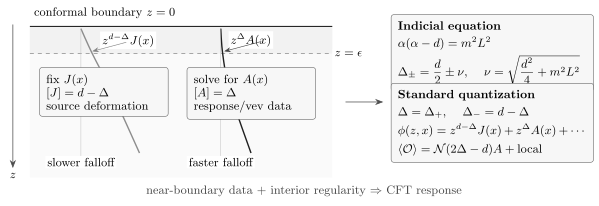
A scalar field in AdS has two independent near-boundary falloffs. In standard quantization, the less suppressed coefficient is the source for the operator , while the more suppressed coefficient is proportional, after holographic renormalization, to . The exponents are fixed by .
The conceptual punchline is:
The more massive the bulk excitation is in AdS units, the larger the dimension of the dual operator. But unlike flat space, AdS also allows a controlled range of negative . This is not a pathology by itself; stability is governed by the Breitenlohner-Freedman bound, not by .
Scalar field in Poincaré AdS
Section titled “Scalar field in Poincaré AdS”Use Euclidean Poincaré AdS,
The conformal boundary is at . The radial coordinate has the same scaling dimension as a boundary length. The AdS dilatation is
which is precisely the bulk realization of boundary scale transformations.
Consider a free scalar field with Euclidean action
so the equation of motion is
For the Poincaré metric, this becomes
Near , the boundary-derivative term is subleading compared with the radial terms. Therefore the leading asymptotic behavior is found by trying
Substitution gives the indicial equation
Thus the two exponents are
In standard quantization, one writes
and the near-boundary expansion takes the schematic form
The coefficient is the CFT source for . The coefficient is the response data. After adding the appropriate counterterms, it determines the expectation value .
A common normalization is
The local terms depend on the renormalization scheme and on whether is an integer. The universal message is scheme-independent: source data and response data are the two independent boundary coefficients of the bulk solution.
Why the source has dimension
Section titled “Why the source has dimension d−Δd-\Deltad−Δ”The source deformation of the CFT is
If has scaling dimension , then must have dimension
This matches the bulk expansion. Under the AdS dilatation , the leading term behaves as
For to transform as a scalar under the bulk isometry, the boundary coefficient must transform as a source of dimension . Thus the AdS asymptotic expansion knows the CFT engineering of source deformations.
This is one of the most beautiful features of the dictionary: the radial power of the bulk field is not an arbitrary boundary condition; it is the spacetime encoding of CFT scaling.
Source versus vev
Section titled “Source versus vev”The two asymptotic coefficients have different roles.
| Bulk coefficient | Standard CFT role | Meaning |
|---|---|---|
| source | changes the QFT Lagrangian or background | |
| response / vev data | determined by the state, IR condition, and source |
This distinction is operational. To compute correlation functions, one usually fixes , solves the bulk equation with a regularity or infalling condition in the interior, substitutes the solution into the renormalized on-shell action, and differentiates with respect to .
In Euclidean pure AdS, regularity in the interior uniquely determines the response coefficient as a nonlocal functional of the source:
In Lorentzian signature, the same near-boundary expansion holds, but the interior condition also chooses a state or real-time Green function. For example, infalling conditions at a black-hole horizon produce retarded correlators.
It is tempting to say that the source mode is “non-normalizable” and the vev mode is “normalizable.” This language is useful but imperfect. Outside the alternate-quantization window it is essentially correct. Inside that window both falloffs can be normalizable in the appropriate sense, and one must specify which coefficient is held fixed as the boundary condition.
The Breitenlohner-Freedman bound
Section titled “The Breitenlohner-Freedman bound”The quantity must be real if the field is to have stable asymptotic behavior:
Therefore
This is the Breitenlohner-Freedman bound. It is weaker than the flat-space condition . Negative mass-squared scalars can be stable in AdS because AdS acts like a gravitational box: the boundary conditions and the positive-energy theorem modify the stability criterion.
At the bound,
The two roots degenerate, and logarithmic behavior can appear:
with details depending on the precise boundary condition and counterterms.
If violates the BF bound, the dimensions become complex:
A complex scaling dimension is a sharp CFT signal of an instability or nonunitarity. In bulk language, the AdS vacuum is unstable to scalar condensation.
Alternate quantization
Section titled “Alternate quantization”The scalar unitarity bound in a -dimensional unitary CFT is
for scalar primaries other than the identity. The smaller root
satisfies this bound precisely when
Equivalently, the mass lies in the window
Away from endpoint subtleties, this is the alternate-quantization window. In this window one may choose the slower falloff to be the response and the faster falloff to be the source. The dual operator then has dimension
Standard and alternate quantization are not two arbitrary names for the same theory. They define different CFT boundary conditions, and their generating functionals are related by a Legendre transform. Double-trace deformations interpolate between them. Schematically,
corresponds to a mixed boundary condition relating the two asymptotic coefficients,
up to normalization and counterterm conventions.
A useful example is a scalar in AdS with
Then
Both quantizations are compatible with the scalar unitarity bound, so the same bulk scalar can represent either a dimension- operator or a dimension- operator, depending on the boundary condition.
Momentum-space solution and the first glimpse of correlators
Section titled “Momentum-space solution and the first glimpse of correlators”The near-boundary analysis determines the allowed powers of , but not the full relation between source and response. To see that relation, solve the scalar equation in momentum space.
Write
For Euclidean momentum , the regular solution in the interior is proportional to a modified Bessel function:
For noninteger , its small- expansion has the form
The nonlocal part of the response is therefore proportional to
Since , this implies that the momentum-space two-point function behaves as
Fourier transforming gives the conformal position-space behavior
The next correlator page will compute this more carefully from the renormalized on-shell action. Here the lesson is already visible: the Bessel equation in the radial direction knows the CFT two-point scaling law.
Global AdS interpretation
Section titled “Global AdS interpretation”There is also a Hamiltonian way to understand the same relation. In global AdS, normal modes of a scalar field have frequencies
where is the angular momentum on . The lowest mode has
On the CFT side, radial quantization maps local operators on to states on , and the energy of the state created by a primary operator is
Thus the same number appears in two ways: as the scaling dimension of a local primary and as the global-AdS energy of the corresponding one-particle bulk state.
This is a useful mental picture:
Multi-trace operators then correspond, at leading large , to multi-particle states.
Special cases and caveats
Section titled “Special cases and caveats”Massless scalar
Section titled “Massless scalar”For ,
In standard quantization, a massless scalar is dual to a marginal scalar operator of dimension . The constant mode is interpreted as the source. In string compactifications, such massless scalars often represent moduli or couplings, though whether the dual operator is exactly marginal depends on the full theory.
Integer and logarithms
Section titled “Integer ν\nuν and logarithms”When is an integer, the two independent asymptotic series can mix through logarithms. A typical structure is
The logarithmic coefficient is tied to conformal anomalies and local contact terms. It does not invalidate the mass-dimension relation; it means that holographic renormalization must be done with care.
Spinning fields
Section titled “Spinning fields”The scalar formula is for scalar fields and scalar primary operators. Other spins have analogous but different representation-theoretic relations. The most important protected examples are
for a bulk gauge field dual to a conserved current, and
for the bulk metric dual to the stress tensor. Conservation fixes these dimensions exactly.
The mass is measured in AdS units
Section titled “The mass is measured in AdS units”The dimension is controlled by , not by alone. A particle can be heavy in flat-space units but light in AdS units, or vice versa. In the canonical AdS example, Kaluza-Klein masses on are also measured in units of the common radius .
For stringy states at large ‘t Hooft coupling,
so their dimensions grow as
at strong coupling. This is why classical supergravity captures only the low-dimension protected sector and a sparse set of light operators.
Common mistakes
Section titled “Common mistakes”Mistake 1: “Negative means instability.”
In AdS, stability is controlled by the BF bound. Scalars with
can be perfectly stable.
Mistake 2: “The coefficient of is always simply the vev.”
It is proportional to the vev only after holographic renormalization, and local terms in the source can shift the precise expression.
Mistake 3: “Non-normalizable equals source in all cases.”
This is fine as a first slogan, but it becomes misleading in the alternate-quantization window, where both modes can be allowed and the choice of boundary condition defines the CFT.
Mistake 4: “The mass-dimension relation applies unchanged to gauge fields and gravitons.”
Conserved currents and the stress tensor are controlled by gauge invariance and diffeomorphism invariance. Their dimensions are protected by Ward identities.
Mistake 5: “ is determined by the near-boundary behavior alone, so the interior does not matter.”
The near-boundary equation determines the possible exponents. The interior condition determines the relation between source and response, hence the actual Green function in a chosen state.
Exercises
Section titled “Exercises”Exercise 1: Derive the indicial equation
Section titled “Exercise 1: Derive the indicial equation”In Euclidean AdS,
the scalar equation is
Assume near . Show that
Solution
Near , the term is subleading relative to the radial terms. Therefore
Substituting gives
The coefficient must vanish, so
Thus
Exercise 2: A scalar in AdS
Section titled “Exercise 2: A scalar in AdS4_44”Let and . Compute and . Is alternate quantization allowed?
Solution
For ,
Therefore
The alternate-quantization window is , ignoring endpoint subtleties. Since , both quantizations are allowed. The same bulk scalar can be dual either to a dimension- scalar operator in standard quantization or to a dimension- scalar operator in alternate quantization.
Exercise 3: Source dimension from the radial falloff
Section titled “Exercise 3: Source dimension from the radial falloff”In standard quantization,
Use the AdS dilatation to show that has source dimension .
Solution
The bulk field is a scalar, so its leading expression must transform consistently under
The factor scales as
Therefore the coefficient transforms as a source with scaling dimension :
or equivalently .
This agrees with the CFT deformation
because and .
Exercise 4: BF bound and complex dimensions
Section titled “Exercise 4: BF bound and complex dimensions”Suppose . Show that the dimensions are complex and explain why this signals a problem in a unitary CFT.
Solution
If , then
Thus
and
The dimensions are complex. In a unitary CFT, scaling dimensions of local operators are real because the dilatation operator is Hermitian in radial quantization. A complex dimension therefore indicates nonunitarity or an instability. In the bulk, this is the statement that the scalar violates the Breitenlohner-Freedman bound and destabilizes the AdS background.
Exercise 5: Momentum scaling of the two-point function
Section titled “Exercise 5: Momentum scaling of the two-point function”For noninteger , the regular Euclidean solution behaves near the boundary as
Use to infer the momentum scaling of the two-point function.
Solution
The response coefficient is proportional to
The one-point function in a source background is obtained from the response coefficient, so differentiating once more with respect to the source gives
Since
we get
This is precisely the Fourier-space scaling expected for a scalar primary with position-space two-point function
Further reading
Section titled “Further reading”- S. S. Gubser, I. R. Klebanov, and A. M. Polyakov, Gauge Theory Correlators from Non-Critical String Theory.
- E. Witten, Anti de Sitter Space and Holography.
- I. R. Klebanov and E. Witten, AdS/CFT Correspondence and Symmetry Breaking.
- P. Breitenlohner and D. Z. Freedman, Stability in Gauged Extended Supergravity, Annals of Physics 144 (1982) 249.
- K. Skenderis, Lecture Notes on Holographic Renormalization.