
Retarded Green Functions and Quasinormal Modes
The dynamical meaning of a horizon
Section titled “The dynamical meaning of a horizon”Equilibrium thermodynamics uses only a few pieces of horizon data. The entropy is area, the temperature is surface gravity, and the free energy is the Euclidean on-shell action. Real-time physics is more demanding. To ask how a thermal state reacts to a small disturbance, we must solve a Lorentzian initial-boundary-value problem.
The central lesson is simple:
Dissipation in the boundary theory is absorption by the black-hole horizon.
More precisely, the retarded Green function of a thermal CFT operator is obtained by solving the dual bulk fluctuation equation with a prescribed source at the AdS boundary and an infalling condition at the future horizon. The poles of this retarded Green function are the quasinormal frequencies of the black brane.
Schematically,
and
The same boundary value problem therefore gives both linear response and relaxation. A boundary perturbation excites a tower of damped collective modes,
where the mode closest to the real axis controls the latest-time exponential decay, unless a hydrodynamic pole or a branch cut dominates.
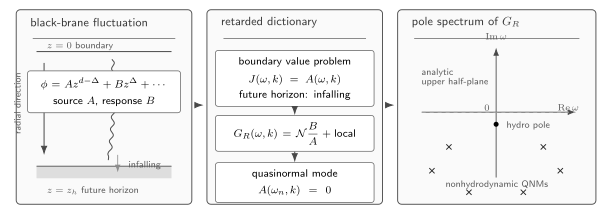
The retarded holographic problem has two ends. Near the boundary, the field has source and response coefficients and , with up to local counterterms. Near the future horizon, regularity in ingoing coordinates selects the infalling wave. Quasinormal modes satisfy the same infalling condition but have , so they appear as poles of in the lower half -plane.
This page completes the finite-temperature module. Later, in the transport module, we will use exactly this technology to compute conductivities, diffusion constants, shear viscosity, sound attenuation, and hydrodynamic dispersion relations.
Retarded correlators in thermal field theory
Section titled “Retarded correlators in thermal field theory”Let be a bosonic Heisenberg operator in a thermal state
The retarded Green function is
Its Fourier transform is defined by
The step function makes causal: it vanishes for . As a consequence, for a stable thermal state, is analytic in the upper half of the complex -plane. Singularities below the real axis encode the decay of disturbances.
The spectral density is
up to the sign convention used for Fourier transforms and operator ordering. For Hermitian bosonic operators one often chooses conventions for which is positive for in suitable channels. The exact normalization is less important than the analytic structure: poles, cuts, residues, and low-frequency slopes are physical.
A small source deformation
produces the linear response
The retarded function is therefore the object that answers the physical question: after a small perturbation, what does the plasma do?
Why Euclidean data are not enough by themselves
Section titled “Why Euclidean data are not enough by themselves”At finite temperature, Euclidean correlators are defined on a thermal circle. Their Fourier frequencies are discrete Matsubara values,
The retarded correlator is related to Euclidean data by analytic continuation, but this statement hides a real difficulty. Knowing a function only at discrete Matsubara frequencies is not the same as knowing its analytic continuation. In a holographic computation, Lorentzian signature gives a direct prescription: solve the bulk equations at complex with the correct horizon condition.
The practical rule is:
| Desired boundary object | Bulk prescription |
|---|---|
| Euclidean thermal correlator | smooth Euclidean field on the Euclidean black hole |
| retarded correlator | Lorentzian solution infalling at the future horizon |
| advanced correlator | Lorentzian solution outgoing at the future horizon |
| quasinormal frequency | infalling at horizon and source-free at boundary |
| normal mode of thermal AdS | regular in the interior and normalizable at boundary |
The difference between a Euclidean regularity condition and a Lorentzian infalling condition is not cosmetic. It is the difference between equilibrium data and causal response.
The scalar black-brane problem
Section titled “The scalar black-brane problem”Consider a scalar field of mass in the planar AdS black-brane geometry
The boundary is at , the horizon is at , and
Take a Fourier mode
The Klein-Gordon equation is
This is a second-order radial equation. The holographic computation of is a boundary value problem with two asymptotic conditions:
- near , specify the non-normalizable coefficient, interpreted as the boundary source;
- near , impose infalling behavior, interpreted as absorption into the future horizon.
Near the AdS boundary, the scalar behaves as
where
For standard quantization, is the source and is proportional to the expectation value. With a conventional bulk normalization,
where
and denotes contact terms fixed by counterterms and scheme choices. The ratio is the important nonlocal part.
The infalling condition
Section titled “The infalling condition”The horizon condition is easiest to derive using the tortoise coordinate. Near the horizon,
up to a positive constant depending on the precise radial coordinate convention. Define by
The minus sign is convenient because the coordinate increases inward. As , one then has , as in the usual Schwarzschild radial coordinate. The wave equation locally becomes
so
Introduce the ingoing Eddington-Finkelstein coordinate
The mode
is regular on the future horizon. This is the infalling solution. In Schwarzschild time coordinates, it appears as
The outgoing solution behaves as
The outgoing solution is regular on a past horizon, not on the future horizon. It computes the advanced correlator rather than the retarded correlator. This is one of the most common places to lose a sign.
There is also a cleaner modern phrasing: use ingoing Eddington-Finkelstein coordinates from the start. Then the retarded solution is simply the solution that is regular at the future horizon.
Canonical momentum and the Green function
Section titled “Canonical momentum and the Green function”The ratio is the simplest way to state the scalar result, but the variational formula is more general and more robust.
For a quadratic bulk action
the radial canonical momentum is
After solving the equation of motion, the on-shell action reduces to a boundary term,
The horizon term is handled by the causal prescription; the UV term is renormalized by adding local counterterms. The retarded Green function is then obtained from the renormalized momentum-to-field ratio,
The overall sign depends on the action and Fourier conventions. The invariant statement is that differentiating the renormalized Lorentzian on-shell action with infalling boundary conditions gives the retarded correlator.
A powerful observation, used constantly in transport computations, is that the imaginary part of the retarded correlator is related to radial flux. For a real-frequency solution, define the conserved Wronskian-like flux
Absorption by the horizon gives a nonzero imaginary part of . This is the bulk origin of dissipation.
Quasinormal modes as poles
Section titled “Quasinormal modes as poles”A quasinormal mode is a solution of the linearized bulk equations satisfying:
For the scalar expansion
the source-free condition is
But the retarded Green function has the form
Therefore, when vanishes and is nonzero, has a pole. The quasinormal spectrum is the pole spectrum of the retarded correlator:
In a stable black-brane background, these poles lie in the lower half of the complex frequency plane:
The sign has a direct physical meaning. With the convention ,
Thus gives decay for .
If a pole crosses into the upper half-plane, the background is linearly unstable. In holographic superconductors, for example, a charged scalar quasinormal mode becomes unstable below the critical temperature. The instability is not a pathology of AdS/CFT; it is the bulk signal that the thermal state wants to reorganize into a new phase.
Time-domain response and thermalization
Section titled “Time-domain response and thermalization”Suppose a small source perturbs the thermal state and is then turned off. The late-time response can be written by inverse Fourier transform:
For , one closes the contour in the lower half -plane. If the retarded Green function is meromorphic, the answer is a sum over residues of poles:
The mode with smallest dominates the latest exponential relaxation. This is why quasinormal modes are often called the ringdown spectrum of the black brane.
There are important qualifications:
- If the operator overlaps with a conserved density, hydrodynamic poles approach the origin as and dominate long-time, long-distance response.
- At finite or finite volume, exact CFT evolution is unitary and can include recurrences; the classical black-brane computation captures the large-, thermodynamic, coarse-grained response.
- Beyond the classical supergravity limit, branch cuts and multiparticle effects can modify the late-time analytic structure.
- Very late-time behavior can be sensitive to effects that are invisible in the leading saddle.
The safe statement is that classical quasinormal modes describe the leading large- linear relaxation of strongly coupled thermal states with a black-hole dual.
Hydrodynamic and nonhydrodynamic modes
Section titled “Hydrodynamic and nonhydrodynamic modes”Not all quasinormal modes are alike. The most important distinction is between hydrodynamic and nonhydrodynamic modes.
Hydrodynamic modes are forced by conservation laws. Their frequencies vanish as :
Examples include charge diffusion, shear diffusion, and sound:
| Channel | Hydrodynamic pole |
|---|---|
| conserved charge density | |
| transverse momentum density | |
| longitudinal energy-momentum |
For a neutral conformal plasma in boundary dimensions with a two-derivative Einstein gravity dual,
These formulas will be derived in the transport module. The point here is structural: hydrodynamic poles are quasinormal modes protected by conservation laws.
Nonhydrodynamic modes remain at complex frequencies of order the temperature when :
They are not captured by ordinary hydrodynamics. They encode microscopic relaxation at strong coupling. In a weakly coupled plasma one might look for quasiparticle poles near the real axis. In many classical holographic plasmas, by contrast, nonhydrodynamic poles are typically far from the real axis, reflecting rapid damping and the absence of long-lived quasiparticles.
Gauge-invariant perturbations
Section titled “Gauge-invariant perturbations”For scalar fields, the boundary value problem is straightforward. For currents and stress tensors, one must handle gauge redundancy carefully.
A bulk gauge field has gauge transformations
Metric perturbations have infinitesimal diffeomorphism redundancy,
Individual components such as or are therefore not automatically physical. The reliable procedure is to build gauge-invariant master fields or fix a gauge and then impose the constraint equations consistently.
For a perturbation with momentum along , the black-brane rotational symmetry decomposes fluctuations into channels:
| Channel | Typical boundary operators | Typical physics |
|---|---|---|
| scalar field channel | scalar operator | nonconserved relaxation |
| vector/current channel | charge diffusion, conductivity | |
| shear metric channel | , | momentum diffusion, shear viscosity |
| sound metric channel | , , , trace combinations | sound propagation |
The radial constraint equations are the bulk versions of Ward identities. For example, gauge invariance leads to current conservation, and diffeomorphism invariance leads to stress-tensor conservation. This is why hydrodynamic modes appear in current and stress-tensor channels but not for a generic nonconserved scalar operator.
A canonical example: massless scalar in AdS black brane
Section titled “A canonical example: massless scalar in AdS5_55 black brane”For the AdS black brane, a convenient radial coordinate is
For a massless scalar, dual to an operator of dimension , define
The radial equation takes the standard form
where primes denote derivatives with respect to . The infalling behavior at is
with regular at . Near the boundary,
The logarithmic terms occur because for a massless scalar in AdS; they contribute local contact terms. The nonlocal retarded correlator is still read from the ratio after holographic renormalization.
The numerical computation is conceptually simple:
- factor out the infalling behavior;
- impose regularity of at ;
- integrate to the boundary;
- extract and ;
- compute or find zeros of to obtain quasinormal frequencies.
The practical computation can be done by shooting, Frobenius series, spectral collocation, or determinant methods. In serious applications, one checks convergence by increasing resolution, verifies gauge-invariant variables, and confirms that residual gauge modes are absent.
Poles, peaks, and spectral functions
Section titled “Poles, peaks, and spectral functions”A pole of the retarded Green function near the real axis often produces a peak in the spectral density. But a peak is not the same thing as a pole, and absence of a narrow peak does not mean absence of a mode.
Near a simple pole,
If
then the time-domain contribution is
A small produces a long-lived excitation and a sharp spectral feature. A large produces rapid decay and a broad response. Strongly coupled holographic plasmas often have broad spectral functions because their excitations decay on timescales of order .
For conserved currents and stress tensors, the small-frequency part of the spectral function determines transport coefficients through Kubo formulas. For example, shear viscosity is extracted from
The next module will turn this equation into a computation.
Quasinormal modes versus normal modes
Section titled “Quasinormal modes versus normal modes”At zero temperature in global AdS, regularity in the interior and normalizability at the boundary lead to real normal-mode frequencies. These modes correspond to stable oscillations of the CFT on the cylinder.
At finite temperature with a black-hole horizon, the boundary condition changes. The future horizon absorbs energy. The spectrum becomes complex:
This is the real-time version of the difference between a box and an absorber. AdS still reflects waves at the boundary, but the black hole supplies a dissipative sink in the interior.
For thermal AdS without a horizon, there is no classical absorption and no black-hole quasinormal spectrum. For an AdS black brane, the horizon is essential. This is why the Hawking-Page transition is not merely thermodynamic; it changes the analytic structure of real-time correlators at leading order in large .
What QNMs do and do not prove
Section titled “What QNMs do and do not prove”Quasinormal modes are extraordinarily useful, but their interpretation should be precise.
They do tell us:
- the pole spectrum of leading large- retarded correlators;
- linear relaxation times of small perturbations around a thermal state;
- hydrodynamic dispersion relations in conserved channels;
- stability or instability of a chosen black-hole background;
- how horizon absorption appears as boundary dissipation.
They do not by themselves tell us:
- the full nonlinear thermalization process;
- finite- recurrence physics;
- the complete late-time behavior when branch cuts or nonperturbative effects matter;
- that a narrow quasiparticle exists;
- that every broad spectral feature should be interpreted as a particle.
A mature use of holography keeps the hierarchy clear: QNMs are the correct language for linear response about a black-hole saddle.
Common mistakes
Section titled “Common mistakes”Mistake 1: using the outgoing mode for a retarded correlator. The retarded prescription uses the future horizon, hence infalling or regular in ingoing coordinates. The outgoing condition gives the advanced correlator.
Mistake 2: confusing source-free with field-free. A quasinormal mode is not zero at the boundary in every coefficient. It has zero non-normalizable/source coefficient and generally nonzero normalizable/response coefficient.
Mistake 3: reading physical poles from gauge-dependent variables. For currents and stress tensors, use gauge-invariant combinations or impose constraints carefully.
Mistake 4: treating contact terms as relaxation physics. Local polynomial terms in and can shift real parts of correlators but do not create dissipative poles.
Mistake 5: assuming Euclidean smoothness automatically gives the retarded answer. Euclidean data require analytic continuation. The Lorentzian prescription directly selects the causal Green function.
Mistake 6: overinterpreting the leading saddle. Classical black-hole QNMs are leading large- objects. Exact finite- CFT evolution is unitary.
Exercises
Section titled “Exercises”Exercise 1: The infalling exponent
Section titled “Exercise 1: The infalling exponent”Consider a black-brane horizon with
Using the tortoise coordinate , show that an infalling scalar mode behaves as
Solution
Near the horizon,
Therefore
Since is proportional to , the infalling Eddington-Finkelstein coordinate is
A regular infalling wave is
Thus the radial factor is
This is exactly the exponent used in the retarded prescription. The outgoing mode has the opposite exponent.
Exercise 2: Why QNMs are poles
Section titled “Exercise 2: Why QNMs are poles”Suppose the infalling solution near the boundary has the expansion
Assume standard quantization and no degeneracy. Explain why implies that has a pole at .
Solution
In standard quantization, the coefficient is the source and is proportional to the response. The retarded Green function is the linear response coefficient,
A quasinormal mode is an infalling solution with no source at the boundary, so
If and the zero of is simple, then near ,
so
This is a simple pole.
Exercise 3: Decay from a complex pole
Section titled “Exercise 3: Decay from a complex pole”Let a retarded correlator have a pair of poles at
What is the qualitative time dependence of the corresponding contribution to the response?
Solution
A pole at contributes
A pole at contributes
For a real perturbation, the two contributions combine into a damped oscillation,
where depends on the residues and the source. The damping time is .
Exercise 4: The shear diffusion pole
Section titled “Exercise 4: The shear diffusion pole”For a neutral conformal plasma with a two-derivative Einstein gravity dual in boundary dimensions, use
to show that the shear diffusion constant is
Solution
The shear diffusion constant is
For a thermal state with no chemical potential,
Therefore
The corresponding hydrodynamic quasinormal mode is
Exercise 5: Normal modes versus quasinormal modes
Section titled “Exercise 5: Normal modes versus quasinormal modes”Explain why a scalar field in global thermal AdS has real normal-mode frequencies at leading classical order, while a scalar field on an AdS black-brane background has complex quasinormal frequencies.
Solution
In global thermal AdS there is no horizon. The radial problem is like a reflecting box: impose regularity in the interior and normalizability at the boundary. The resulting linear operator has a self-adjoint structure under suitable boundary conditions, so the frequencies are real. The dual CFT on the cylinder has stable oscillatory modes at leading large .
In an AdS black-brane background there is a future horizon. The retarded problem imposes infalling boundary conditions at the horizon. Energy can be absorbed by the black hole, so the boundary perturbation decays. The radial problem is not a self-adjoint normal-mode problem with reflecting conditions at both ends. The frequencies are complex,
for a stable black brane.
Further reading
Section titled “Further reading”- G. T. Horowitz and V. E. Hubeny, Quasinormal Modes of AdS Black Holes and the Approach to Thermal Equilibrium.
- D. Birmingham, I. Sachs, and S. N. Solodukhin, Conformal Field Theory Interpretation of Black Hole Quasinormal Modes.
- D. T. Son and A. O. Starinets, Minkowski-space Correlators in AdS/CFT Correspondence: Recipe and Applications.
- P. K. Kovtun and A. O. Starinets, Quasinormal Modes and Holography.
- C. P. Herzog and D. T. Son, Schwinger-Keldysh Propagators from AdS/CFT Correspondence.
- K. Skenderis and B. C. van Rees, Real-time Gauge/Gravity Duality.