
M2-Branes, ABJM, and AdS4/CFT3
The main idea
Section titled “The main idea”The D3-brane example taught us the cleanest form of AdS/CFT:
M2-branes give the next great example, and it is different in almost every useful way. The boundary theory is three-dimensional rather than four-dimensional, the gravity dual is naturally eleven-dimensional M-theory rather than perturbative string theory, and the number of degrees of freedom scales as rather than .
The central duality is the ABJM correspondence:
Here is an integer Chern-Simons level. The same theory has a second large- limit, the planar ‘t Hooft limit,
in which the dual description becomes type IIA string theory on
This page has three goals. First, it explains why M2-branes lead naturally to a three-dimensional Chern-Simons-matter CFT rather than an ordinary Yang-Mills theory. Second, it derives the geometric dictionary between , , the M-theory radius, the type IIA coupling, and the curvature scale. Third, it explains the famous scaling, one of the sharpest lessons that AdS/CFT teaches beyond the matrix-large- intuition of D-branes.
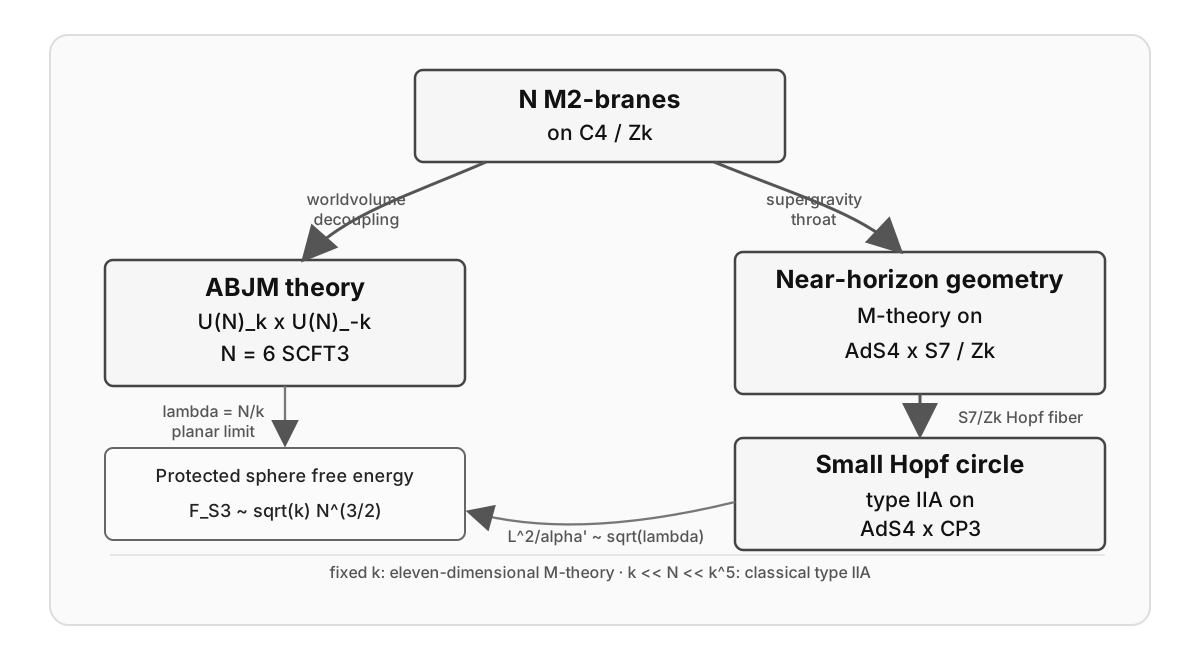
The ABJM correspondence has two useful gravity languages. At fixed and large , the natural bulk theory is eleven-dimensional M-theory on . In the planar limit with fixed, the Hopf fiber of becomes the M-theory circle, and the dual becomes type IIA string theory on .
The slogan is:
The difference is structural. D3-branes give a four-dimensional Yang-Mills theory with a marginal coupling. M2-branes give a three-dimensional SCFT whose natural weakly described Lagrangian uses Chern-Simons gauge fields, bifundamental matter, and discrete level .
Why M2-branes are different from D3-branes
Section titled “Why M2-branes are different from D3-branes”A single M2-brane in flat eleven-dimensional spacetime has a -dimensional worldvolume and eight transverse scalar fields. For one brane this is simple: the low-energy theory is a free theory of eight scalars and eight fermions. For many coincident M2-branes, however, the interacting theory is much subtler than the D-brane gauge theories discussed earlier.
For D-branes, open strings end on the branes. The massless open-string sector gives a dimensional supersymmetric Yang-Mills theory, with coupling
For D3-branes, is dimensionless. That is why the D3-brane system naturally leads to a conformal gauge theory. For D2-branes, by contrast,
Three-dimensional Yang-Mills theory is not conformal in the ultraviolet or infrared by simple dimensional analysis. It can nevertheless flow to a strongly coupled infrared fixed point. Physically, this infrared fixed point is the theory of M2-branes, because D2-branes lift to M2-branes when the M-theory circle decompactifies.
The question is then:
Can one write a useful Lagrangian for the interacting multiple-M2-brane fixed point itself?
The answer is yes, but not as an ordinary Yang-Mills theory. In three dimensions there is another natural gauge interaction: the Chern-Simons term
The coefficient is dimensionless and quantized. A pure Chern-Simons gauge field has no local propagating degrees of freedom, so coupling it to matter can produce a scale-invariant interacting theory without introducing a dimensionful Yang-Mills coupling. This is the basic reason ABJM theory is a Chern-Simons-matter theory.
The supergravity throat of M2-branes
Section titled “The supergravity throat of M2-branes”Before introducing the boundary Lagrangian, let us recall the gravity side. The extremal M2-brane solution of eleven-dimensional supergravity has metric
with harmonic function
The four-form flux is electrically sourced by the M2-branes. Flux quantization fixes
for M2-branes in flat transverse space , where is the eleven-dimensional Planck length.
In the near-horizon region ,
and the metric becomes
After a simple radial redefinition and a rescaling of the boundary coordinates, this is
The factor of between the radius and the AdS radius is not a convention-free detail that can always be ignored. It matters in precise Kaluza-Klein spectra, flux quantization, and comparisons of protected operator dimensions.
The ABJM generalization replaces the transverse space by an orbifold
The near-horizon geometry becomes
Because the internal volume is divided by , flux quantization gives
Thus is the flux through , while controls the orbifold action and, after reduction, the size of the M-theory circle.
The Hopf fibration and the type IIA limit
Section titled “The Hopf fibration and the type IIA limit”The seven-sphere can be viewed as a circle fibration over complex projective space:
The quotient acts along the Hopf fiber, so the circle becomes shorter:
The radius of the M-theory circle is schematically
If this circle is large in eleven-dimensional Planck units, the proper description is M-theory. If this circle is small, one should reduce to type IIA string theory on the base .
Using
one finds
Therefore:
while
In the type IIA regime it is natural to define the ABJM ‘t Hooft coupling
The string-frame curvature radius and string coupling scale as
Thus classical type IIA supergravity requires
The first inequality suppresses stringy corrections. The second suppresses string loops and keeps the M-theory circle small enough for the IIA reduction.
This is already a major conceptual difference from the D3-brane case. In AdS/CFT, large and large lead directly to weakly curved classical type IIB supergravity. In ABJM theory, there are two distinct strong-coupling gravity regimes:
| Limit | Boundary variables | Bulk description | Expansion |
|---|---|---|---|
| M-theory limit | , fixed | M-theory on | quantum M-theory corrections |
| Planar string limit | , fixed | type IIA string theory on | genus expansion plus corrections |
| Classical IIA supergravity | , | two-derivative type IIA supergravity | small and small curvature |
| Weak planar ABJM | , | perturbative Chern-Simons-matter | weak planar field theory |
The ABJM field theory
Section titled “The ABJM field theory”ABJM theory is a three-dimensional superconformal Chern-Simons-matter theory with gauge group
The two subscripts denote opposite Chern-Simons levels. The opposite signs are essential: a single Chern-Simons term violates parity, but the ABJM theory has a parity symmetry that combines spatial reflection with exchange of the two gauge fields.
The field content can be summarized as follows:
| Field | Representation | Role |
|---|---|---|
| adjoint of first | Chern-Simons gauge field at level | |
| adjoint of second | Chern-Simons gauge field at level | |
| , | four complex scalar fields | |
| fermionic partners | ||
| conjugates | complete bifundamental matter multiplets |
The matter fields transform under
for generic , and the theory has explicit superconformal symmetry. For , the supersymmetry is enhanced to , and the full R-symmetry becomes
as expected for M2-branes in flat space or on the mild orbifold.
A schematic form of the action is
The ellipsis includes Yukawa couplings fixed by supersymmetry. The scalar potential is sextic, not quartic, as required in three dimensions: a scalar has engineering dimension , so a classically marginal scalar potential has degree six.
There is no continuous Yang-Mills coupling. The parameter is discrete. The continuous-looking coupling appears only in the large- planar expansion.
Moduli space and the meaning of
Section titled “Moduli space and the meaning of C4/Zk\mathbb C^4/\mathbb Z_kC4/Zk”A decisive check of ABJM theory is its moduli space. The moduli space should describe the positions of indistinguishable M2-branes moving in the transverse orbifold :
Let us first consider . The gauge group is . The matter fields are charged under the relative but neutral under the diagonal . The Chern-Simons terms imply that after gauge identifications the scalar coordinates are subject to
Thus the moduli space is
For general , one can diagonalize the scalar matrices on the moduli space. The eigenvalues describe branes, and permutation of eigenvalues by the Weyl group gives the symmetric product.
This simple statement hides one of the characteristic subtleties of three-dimensional gauge theory: monopole operators. In three dimensions, local disorder operators can insert magnetic flux through a small two-sphere surrounding the insertion point. In Chern-Simons theory, magnetic flux carries electric charge because the Chern-Simons equation of motion schematically relates charge and flux:
Therefore monopole operators in ABJM theory are not optional exotic decorations. They are needed for the full operator spectrum, for the correct moduli-space interpretation, and for supersymmetry enhancement at .
A useful rule of thumb is:
For example, momentum along the M-theory circle is not visible as an ordinary polynomial in the elementary bifundamental fields. It is encoded by monopole sectors.
Symmetries and the AdS/CFT dictionary
Section titled “Symmetries and the AdS4_44/CFT3_33 dictionary”The bosonic symmetry of a three-dimensional CFT is
which matches the isometry group of . The internal symmetry of the round is , matching the symmetry of the M2-brane theory. After orbifolding by , the manifest internal symmetry is reduced to
matching the generic ABJM global symmetry. In the type IIA description, this is the geometric symmetry of together with the remnant associated to the M-theory circle.
The basic dictionary is:
| CFT object | Bulk object |
|---|---|
| Stress tensor | AdS graviton |
| currents | gauge fields from isometries of or |
| Chiral primary operators | Kaluza-Klein modes on the internal space |
| Monopole operators | states carrying M-theory circle momentum or wrapped-brane charges |
| Wilson loops | fundamental strings in IIA, or M2-branes wrapping the M-circle in M-theory |
| partition function | Euclidean AdS on-shell action |
| Thermal state on | planar AdS black brane |
| Supersymmetric black-hole index | BPS AdS black-hole microstate counting |
In a three-dimensional CFT there is no ordinary Weyl anomaly on a closed manifold, so one does not use four-dimensional central charges and . Two especially useful measures of degrees of freedom are:
Here normalizes the stress-tensor two-point function, and is the sphere free energy. In holographic CFT theories both scale like
For ABJM, this gives the famous scaling
More precisely, at leading order for ABJM on the round three-sphere,
in the M-theory large- regime.
This result is not a minor numerical curiosity. It shows that the fundamental degrees of freedom of coincident M2-branes are not counted by adjoint matrices in the same way as D3-branes. The law is one of the clearest signatures of M-theoretic holography.
Where the scaling comes from
Section titled “Where the N3/2N^{3/2}N3/2 scaling comes from”Let us derive the scaling from the bulk. The four-dimensional Newton constant is obtained by reducing eleven-dimensional supergravity on :
The AdS radius is , up to the fixed factor . Therefore the dimensionless gravitational strength is
Using flux quantization,
we obtain
Thus
For , this is simply . Compare this with the D3-brane case:
The difference is not merely the boundary dimension. It is a difference between the large- physics of D-branes and M-branes.
Localization and exact tests
Section titled “Localization and exact tests”ABJM theory is strongly coupled in the M-theory regime, but supersymmetry makes some exact computations possible. Supersymmetric localization reduces the partition function of ABJM theory to a finite-dimensional matrix model. At large , this matrix model reproduces the gravity prediction
Even more impressively, the matrix model can be reorganized as a Fermi gas. In that formulation, the large- expansion has an Airy-function structure, and certain quantum corrections become calculable with remarkable precision.
The conceptual lesson is important for the whole course:
In AdS/CFT, the canonical theory SYM has many exact tools, especially integrability and localization. ABJM theory has its own exact toolkit: supersymmetric localization, matrix models, Fermi-gas methods, superconformal indices, topologically twisted indices, and protected Wilson loops. These tools have made AdS/CFT one of the best laboratories for studying quantum M-theory.
Comparison with the D3-brane duality
Section titled “Comparison with the D3-brane duality”It is useful to compare the canonical examples side by side.
| Feature | D3-branes | M2-branes / ABJM |
|---|---|---|
| Boundary dimension | ||
| Canonical CFT | SYM | ABJM Chern-Simons-matter theory |
| Gauge structure | or Yang-Mills | Chern-Simons |
| Coupling | in planar limit | |
| Bulk at strong planar coupling | type IIB on | type IIA on |
| Bulk at fixed discrete parameter | still type IIB | M-theory on |
| Degree scaling | ||
| Internal symmetry | , enhanced to for | |
| Exact tools | integrability, localization | localization, Fermi gas, indices, integrability in planar IIA regime |
Two morals are worth isolating.
First, AdS/CFT is not synonymous with gauge theory in four dimensions. It is a broader mechanism relating quantum gravity in asymptotically AdS spaces to nongravitational CFTs in one lower dimension.
Second, the classical-gravity limit is not always a string-theory limit. In ABJM at fixed , the correct large- bulk is eleven-dimensional M-theory. This is why ABJM is often the cleanest example for asking questions about genuinely M-theoretic quantum gravity.
A quick guide to the ABJM regimes
Section titled “A quick guide to the ABJM regimes”The following diagnostic is useful in practice.
Start from and . Define
Then ask:
- Is ? If not, there is no classical bulk limit.
- Is fixed or at least ? Then the natural bulk is eleven-dimensional M-theory.
- Is ? Then the M-theory circle is small, so reduce to type IIA.
- In the type IIA regime, is ? Then the string-frame curvature is small.
- Is ? Then the string coupling is small.
This gives:
Do not compress this to “large means gravity.” Large by itself does not tell you whether the correct weakly curved description is type IIA or eleven-dimensional M-theory.
Common mistakes
Section titled “Common mistakes”Mistake 1: Treating ABJM as ordinary Yang-Mills. The ABJM gauge fields are Chern-Simons gauge fields. There is no Maxwell kinetic term in the conformal theory. Adding a Yang-Mills term is an irrelevant deformation that can be useful as a regulator or as a route from D2-branes, but it is not part of the fixed-point definition.
Mistake 2: Forgetting that is quantized. The Chern-Simons level is an integer. The parameter becomes continuously useful only in a large- limit.
Mistake 3: Assuming all large- holographic CFTs have degrees of freedom. Matrix gauge theories often have scaling, but M2-branes have scaling. M5-branes, discussed next, have scaling.
Mistake 4: Confusing the M-theory and type IIA limits. The fixed- large- regime is not planar string theory. It is an eleven-dimensional regime.
Mistake 5: Ignoring monopole operators. Many important ABJM states and symmetries are invisible if one only writes polynomial traces of elementary fields. Monopole sectors are central to the theory.
Mistake 6: Dropping the radius factor . For qualitative discussions this often does no harm. For spectra and precision matching, it matters.
Exercises
Section titled “Exercises”Exercise 1: Why Chern-Simons, not Yang-Mills?
Section titled “Exercise 1: Why Chern-Simons, not Yang-Mills?”In three dimensions, determine the mass dimension of in a Yang-Mills action
Explain why this makes Yang-Mills theory unsuitable as the fundamental conformal interaction of M2-branes.
Solution
The action is dimensionless and has mass dimension . In dimensions, . Therefore in ,
The Yang-Mills coupling is dimensionful, so it introduces a scale. Three-dimensional Yang-Mills theory can flow to a nontrivial infrared fixed point, but the Yang-Mills term itself is not a marginal conformal interaction. A Chern-Simons term has dimensionless quantized level , so Chern-Simons-matter theory is the natural Lagrangian framework for a three-dimensional gauge-theoretic SCFT.
Exercise 2: The near-horizon M2-brane geometry
Section titled “Exercise 2: The near-horizon M2-brane geometry”Starting from
show that the near-horizon metric is with .
Solution
Substituting gives
Thus
Let
Then
and the first term is , up to a constant rescaling of the boundary coordinates. Therefore the four-dimensional part is Poincaré AdS with radius , while the internal sphere has radius .
Exercise 3: The scaling from flux quantization
Section titled “Exercise 3: The N3/2N^{3/2}N3/2 scaling from flux quantization”Use
to show that
Solution
The four-dimensional gravitational strength scales as
From flux quantization,
Therefore
Since holographic CFT observables such as and scale as , they scale as .
Exercise 4: Classify the bulk regime
Section titled “Exercise 4: Classify the bulk regime”For each pair , determine whether the natural strong-coupling bulk description is M-theory or type IIA, assuming is large.
- , .
- , .
- , .
Solution
The key comparison is versus .
- For , , so . This is the M-theory regime.
- For , , so . The M-theory circle is small, so the natural description is type IIA. Since and , the inequalities are satisfied. This is a clean classical type IIA supergravity regime.
- For , , so the circle is very small, but . This may be in the type IIA string regime with small string coupling, but the curvature is only moderately small. It is not as clean a classical supergravity limit as case 2.
Exercise 5: The moduli space
Section titled “Exercise 5: The N=1N=1N=1 moduli space”Explain why the moduli space of the ABJM theory is rather than simply .
Solution
The four complex scalars are coordinates on before gauge identifications. In the theory, the diagonal decouples from the matter, while the relative acts by a common phase rotation on the . Because of the Chern-Simons level , the residual gauge identification is a discrete phase rotation
Therefore the physical moduli space is
For branes one then obtains the symmetric product .
Further reading
Section titled “Further reading”- O. Aharony, O. Bergman, D. L. Jafferis, and J. Maldacena, Superconformal Chern-Simons-Matter Theories, M2-Branes and Their Gravity Duals.
- I. R. Klebanov and G. Torri, M2-Branes and AdS/CFT.
- K. Hosomichi, M2-Branes and AdS/CFT: A Review.
- I. R. Klebanov and A. A. Tseytlin, Entropy of Near-Extremal Black p-Branes.
- A. Kapustin, B. Willett, and I. Yaakov, Exact Results for Wilson Loops in Superconformal Chern-Simons Theories with Matter.
- N. Drukker, M. Mariño, and P. Putrov, From Weak to Strong Coupling in ABJM Theory.
- M. Mariño, Lectures on Localization and Matrix Models in Supersymmetric Chern-Simons-Matter Theories.
- D. Martelli and J. Sparks, Moduli Spaces of Chern-Simons Quiver Gauge Theories and AdS/CFT.
- J. Bagger and N. Lambert, Gauge Symmetry and Supersymmetry of Multiple M2-Branes.
- A. Gustavsson, Algebraic Structures on Parallel M2-Branes.