
10. Electron Stars, Dirac Hair, and Fractionalized Charge
Page 09 treated bulk fermions as probes. A charged spinor was placed in a charged black-brane background, the Dirac equation was solved with infalling boundary conditions, and the answer was interpreted as the retarded Green’s function of a boundary fermionic operator. That calculation is powerful, but it does not answer a deeper finite-density question:
Who carries the charge density of the state itself?
In a Reissner—Nordstrom AdS black brane, the charge density is measured by radial electric flux. At extremality, much of the finite-density physics is controlled by the charged horizon and its throat. Probe fermions may reveal poles in , but the background charge can still be hidden behind the horizon. In that case the visible fermionic poles do not automatically account for the total charge.
This page studies the next step: backreacted fermion matter. Instead of asking what a chosen fermionic operator sees in a fixed background, we ask whether a macroscopic population of charged bulk fermions can itself source the geometry and gauge field. The two classic limits are:
- Electron stars: many occupied bulk fermion states are coarse-grained into a charged degenerate fluid.
- Dirac hair: one or a few normalizable charged spinor wavefunctions carry macroscopic charge.
These are not two unrelated ideas. They are opposite limits of the same broad problem: constructing finite-density holographic phases in which explicit charged matter outside the horizon carries some or all of the conserved charge.
The guiding distinction is:
Here is the total boundary charge density, is charge carried by bulk fermion matter outside the horizon, and is electric flux that continues through a horizon. A phase with is often called cohesive. A phase with charge hidden behind a horizon is fractionalized. A phase with both is partially fractionalized.
This language is not cosmetic. It determines what kind of infrared geometry appears, what sort of Luttinger count one should expect, and why a list of visible Fermi momenta is not the same thing as a full account of charge.
What this page explains
Section titled “What this page explains”By the end of this page you should be able to answer the following questions.
- What is the difference between a probe fermion and backreacted fermion matter?
- Why is the local chemical potential the key quantity in electron-star physics?
- What is the Thomas—Fermi approximation in the bulk?
- Why does an electron star fill only a finite radial region?
- What does it mean for charge to be cohesive, fractionalized, or partially fractionalized?
- How are electron stars and Dirac hair related?
- Why can an electron-star background contain many visible Fermi surfaces?
- What survives of Luttinger’s theorem in holography?
- Why does backreacted fermion matter not by itself guarantee finite DC transport?
- Which lessons are robust, and which are model-dependent?
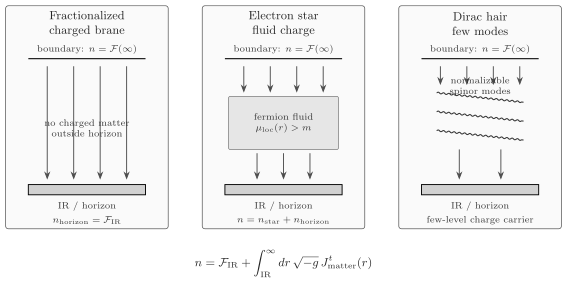
Electron stars convert part of the radial electric flux into explicit charged fermion matter outside the horizon. The condition determines where the fluid exists. Dirac hair is the few-mode limit of backreacted fermion matter, while a Thomas—Fermi electron star is the many-mode coarse-grained limit. The total charge splits schematically as .
Conventions and setup
Section titled “Conventions and setup”We use a boundary theory with spatial dimensions and one time dimension. The bulk therefore has spacetime dimensions. The radial coordinate is called ; the precise convention for whether increases or decreases toward the boundary is not important for the conceptual discussion. We use mostly-plus signature, so outside a horizon.
The conserved boundary charge is dual to a bulk gauge field . For a static, homogeneous state,
and the boundary chemical potential is the gauge-invariant potential difference between the boundary and the regular interior endpoint. In a gauge where vanishes at a regular horizon,
up to charge-normalization conventions.
A bulk fermion of mass and charge is governed microscopically by an action of the schematic form
where
In a probe calculation, this spinor does not backreact. In an electron star or Dirac-hair solution, it does.
From probe response to backreacted charge
Section titled “From probe response to backreacted charge”The probe-fermion calculation computes a two-point function. It answers:
If the state is already given, what is the spectral response of a chosen fermionic operator?
Backreacted fermion matter asks:
Can charged fermions themselves form part of the state, source the bulk fields, and account for some of the boundary charge density?
This difference is easy to miss because both problems involve a charged spinor. But physically they are very different.
A probe spinor can have a Fermi momentum even if it carries no appreciable fraction of the total charge density. The pole says that a particular operator has low-energy spectral weight. It does not say that the entire finite-density state is built from those excitations.
Backreacted fermion matter, by contrast, contributes to the Maxwell equation and Einstein equation. It changes the radial electric flux and changes the geometry. This is a statement about the state itself, not merely about a diagnostic operator.
The essential bookkeeping comes from Gauss’s law. Define the radial electric flux
where in minimal Einstein—Maxwell theory and more generally allows a dilaton-dependent gauge coupling. The Maxwell equation gives
Thus the flux can change with radius only when charged matter is present. The boundary charge density is
If there is a horizon, the flux entering the horizon is
The charge carried explicitly by matter outside the horizon is then
so that
For an electron star, is carried by a degenerate fermion fluid. We will often call it .
The local chemical potential
Section titled “The local chemical potential”The heart of the electron-star construction is the local chemical potential. A static observer at radius uses an orthonormal time coordinate. The local energy of a charged fermion is shifted by the locally measured electrostatic potential,
Since
we get
This quantity is not the same as the boundary chemical potential . The boundary chemical potential is a source in the field theory. The local chemical potential is the locally redshifted energy available to populate bulk charged states.
At zero temperature, a local fermion fluid forms only where
Equivalently, the local Fermi momentum is
When , there is no local Fermi surface and no fermion fluid. The equality
defines the edge of the star.
This gives electron stars an intuitive shape. Near the asymptotic boundary, redshift typically drives to zero. Deep in the interior, depending on the IR geometry and gauge field, may rise above . The star occupies the radial region where this happens.
The Thomas—Fermi approximation
Section titled “The Thomas—Fermi approximation”Solving the full quantum many-fermion problem in curved spacetime is hard. The electron-star approximation replaces the microscopic fermions by a locally homogeneous degenerate Fermi fluid.
This is a bulk Thomas—Fermi approximation. It assumes that many local fermion levels are occupied and that the background varies slowly on the local Fermi wavelength scale. In that regime the fermion distribution can be treated thermodynamically at each radial position.
Let be the local particle number density, the local charge density, the local energy density, and the local pressure. The fluid stress tensor and current are
with static velocity
The local equation of state is that of a degenerate relativistic Fermi gas in the local tangent frame. If the bulk has local spatial directions, then schematically
and
The pressure follows from the zero-temperature thermodynamic relation
More explicitly, up to spin degeneracy and volume factors,
whenever , and otherwise.
The fluid then sources the coupled Einstein—Maxwell system:
The geometry, electric field, local chemical potential, and fermion density must be solved self-consistently. That is the essence of an electron star.
Why the star is radial
Section titled “Why the star is radial”A boundary metal has Fermi surfaces in momentum space. An electron star has an additional radial structure. The radial direction geometrizes energy scale, so different radial regions represent different scales of the finite-density state.
The star is not a literal ball of electrons in ordinary space. It is a radial distribution of bulk charge. Its edge is not a physical surface in the boundary spatial directions. It is the locus in the emergent dimension where the local redshifted chemical potential crosses the local mass threshold.
The star can be thought of as a stack of local Fermi seas along the radial direction. From the boundary viewpoint, this radial stack often gives rise to many fermionic normal modes and hence many visible Fermi momenta.
This is one reason electron stars are attractive as models of compressible phases: they provide a classical bulk way to encode a large number of Fermi surfaces or Fermi-surface-like degrees of freedom.
Electron stars and infrared scaling
Section titled “Electron stars and infrared scaling”The extremal Reissner—Nordstrom AdS black brane has a near-horizon geometry
This IR region has semi-local criticality: time scales but space does not. It also has a finite two-derivative zero-temperature entropy density, which is often viewed as a warning sign that the simplest geometry is incomplete as a ground state.
Electron stars show one way the IR can reorganize. Once charged fermion matter carries charge outside the horizon, the deep interior can become Lifshitz-like:
with
The value of is determined by the equation of state and couplings. The exact formula is model-dependent, but the conceptual lesson is robust:
once charge is carried by explicit fermion matter outside the horizon, the IR fixed point can differ from the throat of the charged black brane.
This does not mean every charged black brane must become an electron star. It means that the RN-AdS throat is a candidate IR saddle, not automatically the final ground state when light charged matter is present.
Cohesive, fractionalized, and partially fractionalized charge
Section titled “Cohesive, fractionalized, and partially fractionalized charge”The most useful language introduced by electron stars is charge accounting.
Fractionalized charge
Section titled “Fractionalized charge”If the radial electric flux reaches the horizon, then some charge is stored in horizon degrees of freedom. This is called fractionalized charge.
The name is motivated by the idea that the charge is not carried by gauge-invariant quasiparticles visible as ordinary boundary Fermi surfaces. It is hidden in the strongly coupled large- sector represented geometrically by the horizon.
Schematic condition:
Cohesive charge
Section titled “Cohesive charge”If all the boundary charge is carried by explicit bulk matter outside the horizon, then no electric flux enters the horizon. This is called a cohesive phase.
Schematic condition:
Electron stars are the classic example of such a phase when the charged matter is fermionic.
Partially fractionalized charge
Section titled “Partially fractionalized charge”At finite temperature, or in some zero-temperature solutions, both forms of charge can coexist:
This is a partially fractionalized phase.
The classification is not a statement about ordinary fractional electric charge. It is a statement about where the conserved charge is stored in the bulk radial direction.
Dirac hair
Section titled “Dirac hair”Electron stars are not the only way to backreact fermions. In the opposite limit, the charge can be carried by one or a small number of normalizable bulk spinor wavefunctions. This is called Dirac hair.
The contrast is:
| construction | bulk description | useful limit |
|---|---|---|
| probe spinor | spinor solves Dirac equation on fixed background | spectral diagnostic |
| Dirac hair | one or few spinor modes backreact | few occupied levels |
| electron star | many modes coarse-grained into a fluid | Thomas—Fermi limit |
Dirac hair is closer to solving the Einstein—Maxwell—Dirac system directly. It keeps wavefunction structure that the fluid approximation erases. Electron stars are more classical and coarse-grained: they replace many occupied fermion wavefunctions by local thermodynamic functions.
A useful mental picture is:
The arrow is not a theorem in every model. It is a physical organizing limit.
Many Fermi surfaces from radial quantization
Section titled “Many Fermi surfaces from radial quantization”A probe spinor in a charged background can show a finite set of Fermi momenta. In an electron-star background, there are typically many such momenta. The reason is radial quantization.
The local Fermi sea inside the star supports many radial wavefunctions. Each radial excitation can appear as a distinct boundary Fermi surface. In a WKB approximation, the Fermi momenta are approximately determined by a radial quantization condition of the form
where and are turning points and is the local radial momentum. Each integer labels a radial mode.
The important point is qualitative:
an electron star can produce many boundary Fermi surfaces because a radial continuum of bulk fermion states is being coarse-grained.
This is very different from a single weakly coupled electron band in a crystal. Holographic Fermi surfaces are operator singularities in a large- strongly coupled system, not automatically literal electron pockets.
Luttinger count and the horizon deficit
Section titled “Luttinger count and the horizon deficit”In an ordinary Fermi liquid, Luttinger’s theorem relates the total charge density to the volume enclosed by Fermi surfaces, up to degeneracy and normalization factors. In holography the corresponding question is:
does the sum of visible Fermi-surface volumes account for the total boundary charge?
The answer depends on horizon flux.
A schematic holographic Luttinger relation has the form
where
is the charge associated with visible Fermi surfaces and is the charge hidden behind the horizon.
The precise prefactors depend on spin degeneracy, charge normalization, boundary spatial dimension, and whether one counts particles relative to a filled reference sea. But the physical statement is clean:
- If , visible charge can satisfy a Luttinger-like count.
- If , visible Fermi surfaces undercount the total charge.
This is why fractionalized phases are so important. They are compressible phases in which charge can exist without being visible through ordinary gauge-invariant Fermi-surface volumes.
Finite temperature
Section titled “Finite temperature”At nonzero temperature the sharp zero-temperature distinction between a horizonless star and a charged horizon is softened. A small horizon can sit inside or behind the star region. The charge decomposition becomes
As , different models can approach different limits. Some become mostly cohesive. Some remain partially fractionalized. Some develop competing instabilities before the electron-star phase becomes the true ground state.
Thermodynamic observables should therefore be interpreted with care. A finite-temperature electron-star geometry is not just a hot Fermi liquid. It is a large- gravitational saddle with a charged fluid, possible horizon degrees of freedom, and model-dependent IR scaling.
Transport: what electron stars do not solve by themselves
Section titled “Transport: what electron stars do not solve by themselves”It is tempting to think that because an electron star resembles a Fermi sea, it automatically gives ordinary metallic transport. This is not correct.
If the boundary theory has exact translational symmetry at finite density, then momentum is conserved. The electric current overlaps with momentum, and the uniform DC conductivity has a delta function at zero frequency. This remains true even if the charge is carried by an electron star.
The clean-limit conductivity has the schematic form
where is the part of the current not protected by momentum conservation. To obtain finite DC conductivity, one still needs momentum relaxation, a lattice, disorder, impurities, explicit axions, spontaneous translation breaking with phase relaxation, or some other mechanism.
Thus:
electron stars reorganize charge; they do not by themselves remove the momentum bottleneck.
This is one of the most common conceptual pitfalls in finite-density holography.
Relation to strange metals and non-Fermi liquids
Section titled “Relation to strange metals and non-Fermi liquids”Electron stars are sometimes presented as holographic Fermi liquids, but that phrase needs care.
They can exhibit many Fermi surfaces and charge accounting reminiscent of Luttinger’s theorem. They can also support low-energy fermionic spectral features with long-lived behavior in some regimes. But the background remains a large- gravitational phase, and the spectrum also contains strongly coupled collective modes and possible horizon contributions.
A safer statement is:
electron stars are holographic compressible phases in which bulk fermion matter carries charge outside the horizon and can produce Fermi-surface-like spectral signatures.
Whether they are best interpreted as Fermi-liquid-like, non-Fermi-liquid-like, or something more exotic depends on the IR geometry, the visible spectral widths, the charge decomposition, and the transport sector.
Instabilities and competition with other phases
Section titled “Instabilities and competition with other phases”Backreacted fermion matter is not always the endpoint of a charged black brane. Competing instabilities can intervene.
A charged scalar may condense and form a holographic superfluid. A charged vector or tensor may condense. Translation symmetry may break spontaneously. Fermions may pair. The region of an extremal black brane can violate a BF bound for some field before the electron-star construction becomes dominant.
The lesson is not that electron stars are universal. The lesson is that they expose a possible charge-carrying channel that must be compared with other channels in the phase diagram.
In a fully specified model, one should compare free energies, check linear stability, and verify boundary conditions. A beautiful electron-star solution is not automatically the preferred ground state.
Worked example: why the star has an edge
Section titled “Worked example: why the star has an edge”Consider a static charged geometry in which vanishes at a regular horizon and approaches a fixed chemical potential near the boundary. The local chemical potential is
Near the AdS boundary, typically diverges in standard radial coordinates, while approaches a finite source. Hence
near the boundary. The fermion fluid cannot extend all the way to the boundary unless the asymptotics are modified.
Near an extremal charged horizon, both and vanish linearly in a regular gauge, and their ratio can approach a finite value. If that value exceeds in appropriate units, a fluid can exist in the deep interior.
Therefore can be below near the boundary, rise above in the interior, and possibly approach a finite IR value. The star then occupies a finite radial region bounded by one or more surfaces where
The star edge is thus a redshift and threshold effect, not an arbitrary cutoff.
Common pitfalls
Section titled “Common pitfalls”| Pitfall | Better statement |
|---|---|
| “A holographic Fermi surface means the charge is carried by fermions.” | Probe poles show spectral response. Charge accounting requires backreaction and Gauss’s law. |
| “Electron stars are ordinary electron gases in the bulk.” | They are coarse-grained charged fermion fluids in the emergent holographic direction. |
| “Fractionalized means fractional electric charge.” | Here it means charge carried by horizon flux rather than visible gauge-invariant matter outside the horizon. |
| “The star automatically gives finite DC conductivity.” | Exact translations still produce a momentum-protected delta function. Momentum relaxation is still needed. |
| “The RN-AdS throat is always the true IR.” | Light charged matter can reorganize the IR into a star, scalar hair, Dirac hair, or another phase. |
| “Dirac hair and electron stars are unrelated.” | They are few-mode and many-mode limits of backreacted fermion matter. |
| “Many Fermi surfaces imply an ordinary Fermi liquid.” | Many visible poles can occur in a large- gravitational phase with additional collective and horizon degrees of freedom. |
Summary
Section titled “Summary”Electron stars and Dirac hair refine the finite-density holographic dictionary. They separate three questions that are often blurred:
- Spectral question: does a chosen fermionic operator have Fermi-surface-like poles?
- Charge question: where is the conserved charge density stored in the bulk?
- IR question: what geometry and low-energy scaling follow from that charge distribution?
Probe spinors answer the first question. Electron stars and Dirac hair address the second and third.
The central formulas are:
The most important conceptual lesson is that a finite-density holographic phase can hide charge behind a horizon, carry it in explicit bulk matter, or split it between the two. That is the meaning of fractionalized, cohesive, and partially fractionalized charge.
Exercises
Section titled “Exercises”Exercise 1: Derive the local chemical potential
Section titled “Exercise 1: Derive the local chemical potential”A static observer at radius has orthonormal time vector . Show that a charge- fermion sees the local electrostatic chemical potential
Solution
The local energy shift of a charged particle is the contraction of its charge with the gauge potential in the local orthonormal frame:
The orthonormal component is
For a diagonal static metric, the unit timelike vector is
Therefore
The factor is the gravitational redshift. It converts a boundary-coordinate potential into the locally measured energy available to populate charged fermion states.
Exercise 2: Star edge from the mass threshold
Section titled “Exercise 2: Star edge from the mass threshold”At zero temperature a local relativistic fermion gas has local Fermi momentum
Explain why the electron star exists only where and why the equality defines the edge of the star.
Solution
For a fermion of mass , the minimum local energy of a one-particle state is . At zero temperature, states are filled up to the local chemical potential. A Fermi surface exists only if the chemical potential is larger than the rest mass:
The local Fermi momentum follows from
Thus
If , the expression is imaginary and no physical local Fermi sea exists. At , the local Fermi momentum vanishes. This is the edge of the star.
Exercise 3: Gauss law and charge decomposition
Section titled “Exercise 3: Gauss law and charge decomposition”Let
Using the Maxwell equation, show that the total boundary charge can be decomposed as
Solution
The Maxwell equation is
For a static homogeneous ansatz, the component becomes a radial Gauss-law equation:
Integrating from the horizon to the boundary gives
The boundary flux is the total charge density,
The horizon flux is
and the matter charge outside the horizon is
Therefore
Exercise 4: Density of a local degenerate fermion fluid
Section titled “Exercise 4: Density of a local degenerate fermion fluid”In local spatial dimensions, show that a zero-temperature relativistic fermion fluid has particle density scaling as
when .
Solution
At zero temperature, all momenta with are filled. The local Fermi momentum is
The number density is proportional to the volume of an -dimensional ball in momentum space:
Substituting the expression for gives
The proportionality constant depends on spin degeneracy and the volume of the unit -sphere.
Exercise 5: Luttinger deficit from horizon flux
Section titled “Exercise 5: Luttinger deficit from horizon flux”Suppose the visible Fermi surfaces of boundary fermionic operators account for charge density . Explain why a nonzero horizon flux implies a Luttinger-counting deficit.
Solution
The total charge density is measured by electric flux at the boundary:
If some flux reaches the horizon, then
Visible Fermi surfaces can account only for charge carried by gauge-invariant fermionic excitations outside the horizon. Schematically,
If the outside matter is fully visible, then . But if , then
The visible Fermi surfaces undercount the total charge. This undercount is the holographic Luttinger deficit associated with fractionalized horizon charge.
Further reading
Section titled “Further reading”For the broad holographic quantum matter perspective on compressible phases, bulk fermions, Luttinger counting, electron stars, and transport, see Sean A. Hartnoll, Andrew Lucas, and Subir Sachdev, Holographic Quantum Matter.
For a condensed-matter-facing treatment of holographic photoemission, Reissner—Nordstrom metals, electron stars, and holographic Fermi liquids, see Jan Zaanen, Yan Liu, Ya-Wen Sun, and Koenraad Schalm, Holographic Duality in Condensed Matter Physics.
For textbook background on finite-density holography, probe branes, fermions, superconductors, hyperscaling violation, and condensed-matter applications, see Martin Ammon and Johanna Erdmenger, Gauge/Gravity Duality: Foundations and Applications.