
Causal Structure and the Cylinder
The main idea
Section titled “The main idea”Anti-de Sitter space is not just a negatively curved spacetime. It is a spacetime with a timelike conformal boundary. Light rays can reach the boundary in finite global coordinate time, even though the boundary is infinitely far away in physical proper distance. This single fact is responsible for several features that are easy to underestimate:
- AdS is not globally hyperbolic unless boundary conditions are specified.
- Bulk fields have a discrete global normal-mode spectrum in empty global AdS.
- Boundary time evolution is naturally the Hamiltonian evolution of the CFT on .
- Boundary conditions at infinity are not optional technicalities; they are part of the definition of the theory.
The slogan is:
The box is not made of a hard wall in the interior. It is made of the conformal boundary and the boundary conditions imposed there.
Global AdS and its conformal compactification
Section titled “Global AdS and its conformal compactification”The global AdS metric can be written as
It is often better for causal questions to use a compact radial coordinate defined by
Then
The conformally related metric
has a boundary at . This boundary has induced conformal metric
Thus the conformal boundary of global AdS is the cylinder
The CFT naturally lives on this cylinder. The generator of translations in is the CFT Hamiltonian on .
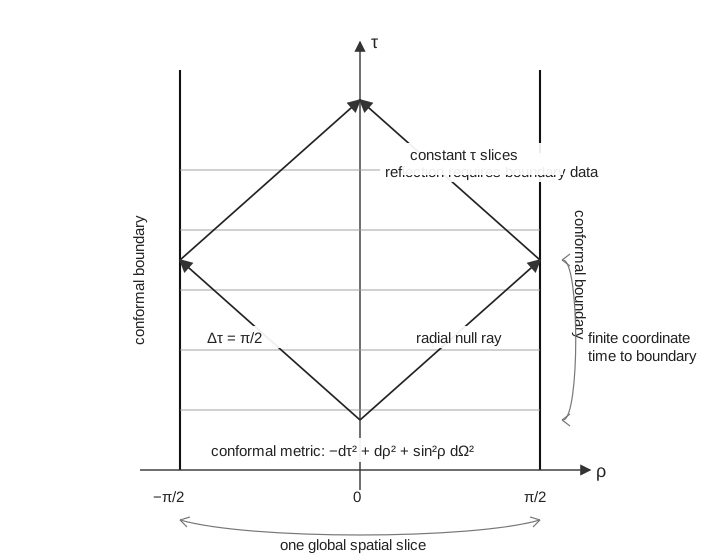
In conformal coordinates, radial null rays satisfy and reach the boundary at in finite global time. The timelike AdS boundary requires boundary conditions; with reflecting boundary conditions, perturbations return to the bulk.
The universal cover
Section titled “The universal cover”The hyperboloid definition of AdS contains a periodic global time coordinate. The embedded hyperboloid has closed timelike curves if this periodicity is kept. The physical spacetime used in AdS/CFT is the universal cover of the hyperboloid, obtained by unwrapping the time coordinate:
When people say “global AdS,” they almost always mean this universal covering space. This is not a pedantic distinction. The boundary cylinder is , not , unless one has explicitly Wick-rotated or thermally identified time.
Radial null rays reach the boundary
Section titled “Radial null rays reach the boundary”For radial null motion in the conformally compactified metric,
Therefore
A radial null ray sent from the center at time reaches the boundary at
A reflected ray returns to the center after an additional interval . Thus a complete center-boundary-center trip takes
This is the simplest way to see that global AdS behaves like a finite causal box.
At the same time, the physical proper radial distance to the boundary is infinite:
So there is no contradiction. The boundary is infinitely far in the physical metric, but it is at finite location in the conformal metric that controls causal diagrams.
The boundary is timelike
Section titled “The boundary is timelike”The conformal boundary metric is Lorentzian:
This means the boundary itself has a time direction. Signals can arrive at the boundary, interact with boundary conditions, and return. This is very different from asymptotically flat spacetime, where null infinity is null, and from de Sitter spacetime, where future infinity is spacelike.
The timelike nature of the boundary is the reason that an initial data surface in the bulk is not enough to determine future evolution. One must also state what happens when waves reach infinity.
AdS is not globally hyperbolic by itself
Section titled “AdS is not globally hyperbolic by itself”A spacetime is globally hyperbolic if appropriate initial data on a Cauchy surface determine the solution everywhere. Empty AdS with no boundary condition at infinity fails this property. Initial data in the interior do not determine what boundary data might enter from infinity at later times.
For a field equation such as
one must choose an allowed boundary condition at the AdS boundary. In holography, this is not an arbitrary mathematical afterthought. The leading near-boundary data are CFT sources, and the allowed variational problem specifies the dual theory.
In Poincaré coordinates,
a scalar field near behaves as
where
For standard quantization, is the source for the CFT operator , and determines the expectation value after renormalization. Choosing Dirichlet, Neumann, or mixed boundary conditions corresponds to choosing different boundary dynamics or deformations.
Reflecting boundary conditions and energy flux
Section titled “Reflecting boundary conditions and energy flux”A useful intuition is that ordinary AdS boundary conditions are reflecting. Energy does not disappear through the boundary; rather, the boundary data define how the field is reflected back.
For a scalar field, the radial flux associated with the Klein-Gordon current is schematically
A well-defined self-adjoint time evolution requires boundary conditions that make the symplectic flux through the boundary vanish or match the chosen boundary dynamics. In AdS/CFT, turning on a nonzero source is not “leakage” in the same sense; it is changing the boundary Hamiltonian by adding
The important distinction is between a closed system with fixed boundary sources and a driven system with time-dependent boundary sources.
Global normal modes
Section titled “Global normal modes”Because global AdS acts like a box, free fields have discrete normal modes. For a scalar field of dimension in global AdS, regularity at the origin and standard boundary conditions give frequencies
This spectrum has a direct CFT interpretation. The state created by a primary operator on the cylinder has energy
and descendants have energies shifted by integers. The global AdS spectrum is therefore not a random property of a curved box. It is the bulk representation of radial quantization in the CFT.
This is one of the cleanest examples of how geometry and CFT representation theory fit together:
Poincaré patch versus global AdS
Section titled “Poincaré patch versus global AdS”The Poincaré metric
covers only a patch of global AdS. Its boundary is conformal to Minkowski space rather than the full cylinder. It is perfect for CFT on , scattering-like correlators, black branes, and finite-density systems.
But not all global causal questions are visible in one Poincaré patch. For example, a null ray can pass through the Poincaré horizon and still remain in global AdS. The Poincaré horizon is a coordinate horizon of the patch, not necessarily a physical black-hole horizon.
This is a recurring theme:
The distinction matters in real-time holography. In empty Poincaré AdS, the deep interior condition is usually regularity or normalizability. In an AdS black brane, the future horizon condition for retarded correlators is infalling regularity.
Boundary causality
Section titled “Boundary causality”AdS/CFT also imposes constraints on how fast bulk signals can connect boundary points. In pure AdS, null geodesics through the bulk connect boundary points at the same causal speed as boundary null geodesics. In physically reasonable asymptotically AdS spacetimes obeying suitable energy conditions, the bulk should not allow boundary observers to send signals faster than allowed by the boundary CFT causal structure.
This idea is often called boundary causality. Violations of boundary causality are strong evidence that a proposed bulk effective theory is inconsistent or requires additional degrees of freedom, higher-derivative corrections, or modified boundary conditions.
The moral is sharp: the boundary CFT has an exact causal structure, and the bulk is not allowed to beat it.
The cylinder Hamiltonian and radial quantization
Section titled “The cylinder Hamiltonian and radial quantization”A CFT on flat Euclidean space can be mapped to a theory on the cylinder by writing
where is a point on . Under this conformal map,
Dilatations on flat space become time translations on the cylinder. A primary operator of dimension creates a cylinder state of energy :
This is why global AdS is so natural for spectroscopy. Bulk energy in global time is matched to CFT scaling dimension.
Common mistakes
Section titled “Common mistakes”Confusing infinite proper distance with infinite causal time
Section titled “Confusing infinite proper distance with infinite causal time”The AdS boundary is infinitely far in the physical metric. But after conformal compactification, null rays reach it in finite global coordinate time. Causal diagrams use the conformal metric, not physical proper distance.
Forgetting boundary conditions
Section titled “Forgetting boundary conditions”AdS by itself is not a complete initial value problem. Boundary conditions at infinity are part of the definition of the theory. In holography, they encode CFT sources, deformations, and quantization choices.
Treating the Poincaré horizon as a black-hole horizon
Section titled “Treating the Poincaré horizon as a black-hole horizon”The Poincaré patch has a coordinate horizon. It is not the same thing as the event horizon of a thermal black brane. The boundary conditions used at the two horizons have different physical meanings.
Ignoring the universal cover
Section titled “Ignoring the universal cover”The original hyperboloid has closed timelike curves because global time is periodic. The AdS spacetime used in holography is the universal cover with unwrapped time.
Assuming all AdS boundary conditions are Dirichlet
Section titled “Assuming all AdS boundary conditions are Dirichlet”Standard quantization uses Dirichlet-like source fixing, but alternate and mixed boundary conditions are important, especially in the Breitenlohner-Freedman window and in multi-trace deformations.
Exercises
Section titled “Exercises”Exercise 1: Radial null travel time
Section titled “Exercise 1: Radial null travel time”Using the conformal global metric
show that a radial null ray sent from the center reaches the boundary after global time .
Solution
For a radial null ray, and . Hence
so
For an outgoing ray from to ,
Exercise 2: Infinite physical distance
Section titled “Exercise 2: Infinite physical distance”Show that the physical proper radial distance from the center of global AdS to the boundary is infinite, even though the conformal coordinate range is finite.
Solution
At fixed and fixed angles,
Therefore
The integrand diverges as , since . Thus
The conformal metric removes the divergent Weyl factor and reveals the finite causal coordinate distance.
Exercise 3: Boundary data and non-global hyperbolicity
Section titled “Exercise 3: Boundary data and non-global hyperbolicity”Explain why initial data for a scalar field on a bulk spatial slice are not enough to determine the future solution in AdS unless boundary conditions are specified.
Solution
Because the AdS boundary is timelike, signals can enter the bulk from infinity. If no boundary condition is specified, future evolution can depend on arbitrary incoming data from the boundary, which are not contained in the initial data on the interior spatial slice.
A well-defined evolution requires a rule at the boundary: for example fixing the leading mode, imposing a normalizable condition, or imposing mixed boundary conditions. In AdS/CFT, these choices correspond to specifying sources, quantization, or deformations of the boundary theory.
Exercise 4: Normal modes and CFT dimensions
Section titled “Exercise 4: Normal modes and CFT dimensions”A scalar field in global AdS has frequencies
What is the CFT interpretation of the lowest mode with and ?
Solution
The lowest mode has energy
In the CFT on the cylinder, a primary operator of scaling dimension creates a state with cylinder energy :
Thus the lowest global AdS mode is dual to the primary state; modes with larger and correspond to descendants and angular excitations.
Further reading
Section titled “Further reading”- G. W. Gibbons, “Anti-de-Sitter spacetime and its uses,” arXiv:1110.1206.
- A. Ishibashi and R. M. Wald, “Dynamics in non-globally-hyperbolic static spacetimes. III. Anti-de Sitter spacetime,” arXiv:hep-th/0402184.
- S. Gao and R. M. Wald, “Theorems on gravitational time delay and related issues,” arXiv:gr-qc/0007021.
- V. Balasubramanian, S. B. Giddings, and A. E. Lawrence, “What is a boundary theory?” arXiv:hep-th/9902052.
- O. Aharony, S. S. Gubser, J. Maldacena, H. Ooguri, and Y. Oz, “Large Field Theories, String Theory and Gravity,” arXiv:hep-th/9905111.