
Sources and Generating Functionals
The previous page introduced the stress tensor and conserved currents as responses to background fields. This page turns that idea into a systematic tool.
A local operator is not just something we insert into a correlation function. It is something we can source. If is a local operator, then a background function coupled to lets us define a generating functional. Differentiating this generating functional with respect to creates insertions of .
That sounds like a formal trick. In AdS/CFT it becomes physical:
The source formalism is therefore not optional background technology. It is the CFT half of the holographic dictionary.
The source convention used in this course
Section titled “The source convention used in this course”We work mostly in Euclidean signature. Let denote all microscopic fields of the theory. For scalar operator sources , background gauge fields , and a background metric , define
with
The dots include possible higher-spin sources, fermionic sources in supersymmetric theories, and local counterterms needed to define the theory. The source is a background gauge field for a global symmetry; it is not integrated over in the CFT path integral.
We define the Euclidean connected generating functional by
This is the convention already used in the previous page. Many QFT texts instead define . That convention is also fine, but every sign in the derivative formulas below changes. Here we use because it is the convention naturally matched to a Euclidean on-shell bulk action:
The vacuum normalization is often irrelevant. One may use
when only connected correlators with operator insertions are desired.
One-point functions as responses
Section titled “One-point functions as responses”The defining property of is that its first variation gives one-point functions in the presence of sources:
Equivalently,
These expectation values are evaluated in the theory with the sources turned on. This matters. The symbol
means the one-point function in the deformed background, not necessarily the vacuum one-point function of the original flat-space CFT.
For most flat-space CFTs on , one-point functions of non-identity primary operators vanish when all sources are set to zero:
But they need not vanish in a nontrivial state, on curved space, at finite temperature, in the presence of defects, or when sources are nonzero.
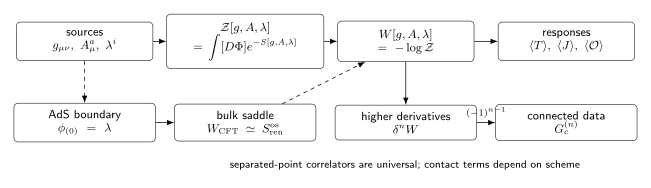
Background sources define the Euclidean functional . First derivatives of give one-point responses such as , , and . Higher derivatives give connected correlators, up to the sign in the convention . In AdS/CFT, sources are boundary values of bulk fields and is computed by the renormalized on-shell bulk action in the classical limit.
Full correlators versus connected correlators
Section titled “Full correlators versus connected correlators”The partition function generates ordinary, not necessarily connected, correlation functions. The functional generates connected correlation functions.
To see the sign carefully, consider a single scalar source coupled as
Then
The second derivative gives the linear response:
At separated points, and when the operator itself has no explicit source dependence,
More generally,
at separated points. Here .
Equivalently, the expansion of around zero source is
The alternating sign is not physics. It is a bookkeeping consequence of the Euclidean convention and .
What sources know about dimensions
Section titled “What sources know about dimensions”If is a scalar primary of scaling dimension , then the source has engineering dimension
This follows from the requirement that the deformation
be dimensionless. A constant source is therefore:
| Operator dimension | Source type | Interpretation |
|---|---|---|
| relevant | drives the CFT away from the fixed point in the IR | |
| marginal | may preserve conformality if the beta function vanishes | |
| irrelevant | grows toward the UV and usually requires extra UV data |
The source can also be position-dependent. A position-dependent source is not simply a coupling constant; it is a background field. If the source is varied in space, translation invariance is explicitly broken, and the stress tensor Ward identity notices this.
For example, with scalar sources turned on, the diffeomorphism Ward identity has the schematic form
This equation says exactly what it should say. A background gauge field can exert a force on the CFT, and a spatially varying scalar source can inject momentum.
Source transformations and Ward identities
Section titled “Source transformations and Ward identities”The cleanest derivation of Ward identities is not to insert currents manually. It is to demand that be invariant under transformations of the background sources.
Background gauge transformations
Section titled “Background gauge transformations”Suppose the CFT has a global symmetry group . We couple its current to a background gauge field . If the scalar sources transform in some representation of , then under an infinitesimal background gauge transformation,
where the sign is a convention for the representation matrices . Gauge invariance of gives
when there is no anomaly. Integrating by parts gives
If the scalar sources vanish, this reduces to current conservation:
If there is an anomaly, the right-hand side receives an additional local functional of the background fields:
An anomaly is not a failure of the method. It is exactly what the source formalism is designed to expose.
Weyl transformations
Section titled “Weyl transformations”A CFT should also know how to respond to a Weyl rescaling of the background metric. Let
If is a primary operator of dimension , its source transforms as a spurion of dimension :
Then the Weyl variation of gives
At a conformal fixed point with all scalar sources turned off, the right-hand side is zero in odd dimensions on a topologically trivial flat background, and equals the Weyl anomaly in even dimensions on curved backgrounds:
In flat space with no anomaly and no sources,
This is the source-functional version of the stress-tensor tracelessness condition.
Contact terms are part of the theory
Section titled “Contact terms are part of the theory”A common mistake is to think that contact terms are ignorable technicalities. They are not. Contact terms are exactly where background-field definitions, anomalies, and Ward identities live.
For example, the separated-point two-point function of scalar primaries is fixed by conformal symmetry:
But the full distribution may also contain terms supported at , such as derivatives of delta functions. These are contact terms. In the generating functional, they arise from local terms in :
Differentiating gives contributions only when insertion points collide. Such terms are usually scheme-dependent, because one may add finite local counterterms. But not all contact terms are arbitrary. Anomalous contact terms can be protected and physically meaningful.
In AdS/CFT this distinction is mirrored by holographic renormalization. Divergent local terms must be subtracted by boundary counterterms. Finite local counterterms change scheme-dependent contact terms. The nonlocal part of the renormalized on-shell action gives separated-point CFT correlators.
Sources, states, and boundary conditions
Section titled “Sources, states, and boundary conditions”A source is not the same thing as a state.
A source changes the action or background:
A state specifies which expectation values are taken. In Lorentzian QFT, states are selected by initial conditions, density matrices, or operator insertions. In Euclidean QFT, states can be prepared by path integrals with specified boundary conditions or insertions.
This distinction becomes essential in holography. Near the AdS boundary, a scalar bulk field dual to an operator of dimension behaves schematically as
The coefficient is the source. The coefficient is related to the expectation value , after holographic renormalization. The precise normalization depends on conventions, counterterms, and possible logarithmic terms, but the conceptual split is robust:
This is the standard quantization statement. In the Breitenlohner-Freedman window where alternate quantization is allowed, the two independent asymptotic coefficients can exchange roles after an appropriate Legendre transform. We will return to that refinement later.
This is one of the reasons generating functionals are the natural language of AdS/CFT.
Legendre transforms and effective actions
Section titled “Legendre transforms and effective actions”Although the connected generating functional is the main object for AdS/CFT, it is useful to know the related effective action. Define the source-dependent one-point function
A Legendre transform exchanges the source for the response . With our sign convention, a natural definition is
where is eliminated in favor of . Then
This object is useful when discussing spontaneous symmetry breaking, effective potentials, double-trace deformations, and alternative quantization in AdS. But for the basic holographic dictionary, is primary: the boundary value of the bulk field is the source, and differentiating gives the response.
Double-trace deformations as a preview
Section titled “Double-trace deformations as a preview”The source formalism also makes multi-trace deformations almost automatic. Suppose a large- CFT contains a single-trace scalar operator . A double-trace deformation has the form
This is not a linear source, but it can be studied by introducing an auxiliary field :
up to contour and sign conventions. The double-trace deformation is thereby converted into a source problem for . In AdS/CFT, double-trace deformations correspond to mixed boundary conditions for the dual bulk field. This will become important later, especially in large- CFT.
Holographic checkpoint
Section titled “Holographic checkpoint”The source formalism is the sharpest way to state the AdS/CFT dictionary:
In the classical bulk limit,
Therefore,
in the convention of this course. Higher functional derivatives of give connected CFT correlators at leading order in the bulk saddle expansion.
This is why so much of practical AdS/CFT consists of the following steps:
- Choose boundary sources.
- Solve bulk equations with those boundary conditions.
- Renormalize the on-shell action.
- Differentiate with respect to the sources.
All four steps are just the source-response logic of QFT written geometrically.
Common pitfalls
Section titled “Common pitfalls”Pitfall 1: confusing and
Section titled “Pitfall 1: confusing Z\mathcal ZZ and WWW”The partition function generates full correlators. The functional generates connected correlators, with the sign in the convention used here.
Pitfall 2: forgetting the sign convention
Section titled “Pitfall 2: forgetting the sign convention”If one defines and couples sources as , connected correlators are derivatives of without the alternating signs above. Both conventions are common. Mixing them is the real danger.
Pitfall 3: treating all contact terms as meaningless
Section titled “Pitfall 3: treating all contact terms as meaningless”Many contact terms are scheme-dependent. Some are anomaly-related and physical. The source functional is the right place to tell the difference.
Pitfall 4: mistaking a source for a dynamical field
Section titled “Pitfall 4: mistaking a source for a dynamical field”In the CFT, , , and are background sources. They are not integrated over. In the bulk dual, the fields whose boundary values equal these sources are dynamical in the interior, but their boundary values are fixed when computing .
Pitfall 5: thinking the source is the vev
Section titled “Pitfall 5: thinking the source is the vev”The source is boundary data. The vev is the response. In AdS language, the source and response are usually the two independent asymptotic coefficients of a bulk field.
Summary
Section titled “Summary”Sources turn local operators into functional derivatives:
The connected generating functional in this course is
Therefore separated-point connected correlators obey
Background gauge invariance, diffeomorphism invariance, and Weyl covariance of generate the current, stress-tensor, and trace Ward identities. Contact terms are controlled by local terms in .
In AdS/CFT,
so the QFT source-response formalism becomes the practical prescription for computing holographic one-point functions and correlators.
Exercises
Section titled “Exercises”Exercise 1 — The sign of the connected two-point function
Section titled “Exercise 1 — The sign of the connected two-point function”Let
Assume has no explicit dependence on . Show that
Solution
First,
Since
we get
Now differentiate once more:
The derivative of the numerator gives
The derivative of gives
Therefore
Exercise 2 — Source dimension
Section titled “Exercise 2 — Source dimension”Let be a scalar primary of dimension in a -dimensional CFT. Show that the source in
has dimension . Then classify the deformation as relevant, marginal, or irrelevant.
Solution
The action is dimensionless. Since
we need
Thus
so
If , then and the deformation is relevant. If , it is marginal. If , it is irrelevant.
Exercise 3 — Gauge Ward identity with charged sources
Section titled “Exercise 3 — Gauge Ward identity with charged sources”Assume
Under a background gauge transformation,
Derive the Ward identity for assuming no anomaly.
Solution
Gauge invariance says . Therefore
Integrate the first term by parts:
assuming the boundary term vanishes. Then
Since is arbitrary,
When , this reduces to current conservation.
Exercise 4 — Weyl Ward identity with scalar sources
Section titled “Exercise 4 — Weyl Ward identity with scalar sources”Assume
Under a Weyl transformation,
Show that the Weyl variation of is
Solution
Insert the Weyl variations into the first-variation formula. The metric term gives
The scalar-source term gives
Adding both terms yields
If the theory is Weyl invariant and has no anomaly, the bracket must vanish.
Exercise 5 — Holographic one-point function from an on-shell action
Section titled “Exercise 5 — Holographic one-point function from an on-shell action”Suppose the renormalized Euclidean bulk on-shell action for a scalar source has the quadratic form
with . In the convention , compute and the connected two-point function.
Solution
The one-point function is the first functional derivative:
Using the symmetry of ,
Thus
The second derivative of is
But with the convention and , the connected two-point function is minus the second derivative of :
In other sign conventions, the final sign may be absorbed into the definition of the source coupling or of the generating functional. The invariant statement is that the kernel of the quadratic on-shell action determines the two-point function.