
Scalar Two-Point Functions
The main idea
Section titled “The main idea”The first real calculation in AdS/CFT should be as simple as possible, but not simpler. We take a scalar primary operator in a -dimensional CFT and its dual scalar field in Euclidean . The goal is to compute the leading large- two-point function
from the classical bulk action.
The answer has to take the conformal form
where is the scaling dimension of . What holography adds is a way to determine from the bulk mass and from the normalization of the bulk action.
The calculation is the cleanest illustration of the GKPW prescription:
where solves the bulk equation of motion with boundary source . Defining the connected generating functional by
we extract correlators by functional differentiation:
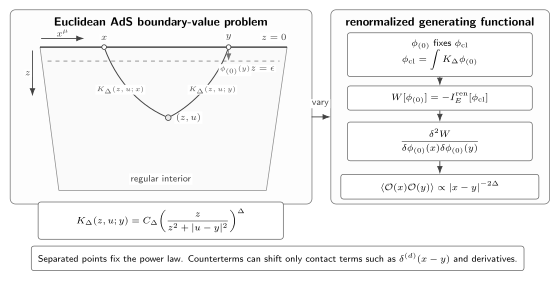
A scalar source on the boundary determines a regular classical bulk solution through the bulk-to-boundary propagator . The renormalized on-shell action is then differentiated twice to obtain the separated-point correlator .
There are three morals to keep in mind from the start. First, the power law comes from the near-boundary scaling of the bulk field, not from putting conformal invariance in by hand. Second, the coefficient is not universal until the normalization of in the bulk action is fixed. Third, the on-shell action is divergent and must be renormalized before it is a CFT generating functional.
This page performs the calculation in Euclidean signature. Lorentzian real-time correlators require additional information about the interior or horizon boundary condition and will be treated later.
The bulk problem
Section titled “The bulk problem”Work in Euclidean Poincare AdS,
The conformal boundary is at . The bulk action for a scalar field is
Here is an overall normalization. In a top-down compactification it is determined by the ten- or eleven-dimensional action and the normalization of the Kaluza-Klein mode. In a bottom-up model it is a parameter. The cutoff regulates the infinite volume near the boundary, and contains local counterterms on that cutoff surface.
The equation of motion is
With the Poincare metric this becomes
Near , the -derivatives are subleading compared with radial derivatives. Trying gives
It is convenient to define
Then
and the two independent near-boundary behaviors are
For standard quantization, the coefficient of the slower falloff is the source and the coefficient of the faster falloff is related to the expectation value:
The dots denote derivative corrections determined locally by , and sometimes logarithmic terms. At separated points, the nonlocal part of is the part that matters for the two-point function.
The bulk-to-boundary propagator
Section titled “The bulk-to-boundary propagator”The regular Euclidean solution with boundary source can be written as
where the scalar bulk-to-boundary propagator is
with
This normalization is chosen so that
as a distribution. The expression looks as though it vanishes like at fixed , but near it becomes sharply peaked. This is the familiar approximate-identity mechanism behind the delta function.
The constant follows from the integral
Indeed,
The propagator also makes conformal covariance manifest. Under the scaling
one has
which is precisely the scaling expected for a boundary operator of dimension .
The on-shell action is a boundary term
Section titled “The on-shell action is a boundary term”For a solution of the equation of motion, the bulk action reduces to a boundary term plus counterterms. Integrating by parts gives
At the cutoff surface, the induced metric is
For the region , the outward-pointing unit normal points toward decreasing :
Thus
Substituting the near-boundary expansion produces divergent local terms. The leading divergence is removed by a counterterm of the schematic form
The derivative counterterms are local functions of and the cutoff metric . They are essential for a fully finite variational principle, but they only change contact terms in the separated-point two-point function.
After renormalization, the variation of the on-shell action has the universal form
Since , the CFT one-point function in the source background is
The word “local” is doing important work here. Local terms are polynomials in derivatives acting on the source. After differentiating again, they produce contact terms supported at . They do not affect the separated-point correlator.
Extracting the two-point function
Section titled “Extracting the two-point function”The bulk-to-boundary solution has the near-boundary expansion
where the first term is meant distributionally. Therefore the nonlocal part of is
Differentiating the one-point function gives the Euclidean two-point function at separated points:
for , in the normalization of the scalar action written above.
This is the first “full-stack” AdS/CFT computation in the course:
The power is fixed by conformal invariance. The coefficient is dynamical, because it knows the normalization inherited from the bulk theory.
A useful shorthand is
However, is not invariant under the rescaling
Only after the source normalization is fixed by a physical convention, for example by embedding the scalar into a known supergravity mode dual to a specified single-trace operator, does the absolute coefficient become meaningful.
Momentum-space viewpoint
Section titled “Momentum-space viewpoint”The same calculation is often cleaner in momentum space. Write
The radial equation becomes
The solution regular in the Euclidean interior is
where is the modified Bessel function. The normalization is chosen so that the leading near-boundary behavior is
For noninteger , the small-argument expansion gives
Thus
The momentum-space two-point function has the nonlocal structure
again up to convention-dependent constants and local analytic terms. This is the Fourier transform of .
When is an integer, the expansion of contains logarithms. The nonlocal momentum-space term becomes schematically
This is not a pathology. It is the momentum-space avatar of the distribution when is an integer, together with the conformal anomaly and scheme-dependent contact terms.
Example: a massless scalar in AdS
Section titled “Example: a massless scalar in AdS5_55”For AdS/CFT, take . A massless scalar has
The standard quantization root is
The leading behavior is
where logarithmic terms may appear in the complete expansion when derivatives of the source are included. The separated-point two-point function scales as
This is the correct scaling for a marginal scalar operator in four dimensions, such as a protected operator in the same supergravity sector as the dilaton. In the canonical example, the overall coefficient is proportional to before one rescales the operator to unit two-point normalization, because the classical five-dimensional action carries an overall factor
That is not an accident; it is the number of adjoint degrees of freedom in the large- gauge theory and the inverse strength of bulk quantum gravity.
Example: the BF-window ambiguity in AdS
Section titled “Example: the BF-window ambiguity in AdS4_44”Consider AdS, so , and a scalar with
Then
Both choices are allowed because the mass lies in the Breitenlohner-Freedman window
In standard quantization, the dual operator has and
In alternate quantization, the dual operator has and
The same bulk mass therefore does not always specify the CFT by itself. One must also specify the boundary condition, or equivalently which mode is treated as the source.
Why the calculation is classical at large
Section titled “Why the calculation is classical at large NNN”The result above comes from the quadratic classical action. In the large- expansion, this is the leading connected two-point function of a single-trace operator, in the normalization where the source couples to an unnormalized single-trace operator.
Schematically,
for matrix large- theories with Einstein-like duals. Thus
for unnormalized single-trace operators. If instead one defines a unit-normalized operator
then
Bulk loop corrections are suppressed by powers of . Stringy corrections modify the bulk action and propagator at finite ‘t Hooft coupling, and are suppressed only when the AdS radius is large compared with the string length.
Relation to the geodesic approximation
Section titled “Relation to the geodesic approximation”For a heavy operator, , the bulk-to-boundary propagator can be written as an exponential:
At large , the path integral for the bulk field is dominated by a worldline saddle. The two-point function is then approximated by
where is the renormalized length of the spacelike geodesic connecting the two boundary points. This reproduces
and hence
The geodesic calculation is useful intuition, but the scalar field calculation is more general. It works for arbitrary above the unitarity and stability bounds, fixes the normalization, and gives the correct contact-term structure after renormalization.
What is universal, and what is not
Section titled “What is universal, and what is not”The scalar two-point function teaches a useful separation between universal structure and convention-dependent data.
| Quantity | Status | Bulk origin |
|---|---|---|
| The power $ | x-y | ^{-2\Delta}$ |
| The relation | Universal for scalars | Near-boundary radial equation |
| The coefficient | Normalization-dependent | Overall kinetic term and field/operator normalization |
| Contact terms | Scheme-dependent | Local counterterms at |
| Alternate quantization | Boundary-condition-dependent | Choice of source mode in the BF window |
| Lorentzian pole prescription | State- and contour-dependent | Interior or horizon boundary condition |
This is a theme throughout holographic correlator calculations. The bulk geometry fixes much of the answer, but a precise CFT observable requires precise boundary conditions, precise normalization, and precise renormalization.
Common mistakes
Section titled “Common mistakes”Mistake 1: treating as if it simply vanishes near the boundary. At fixed , goes like , but distributionally it contains the source term .
Mistake 2: forgetting the counterterms. The bare on-shell action diverges. Even if one only wants separated-point correlators, the correct finite answer is defined by the renormalized variational problem.
Mistake 3: confusing the two roots for . The equation has two roots. In standard quantization . Alternate quantization is available only in the appropriate BF window.
Mistake 4: dropping the overall bulk normalization. The coefficient of the two-point function is not fixed by the mass alone. It depends on and on how the boundary operator is normalized.
Mistake 5: using Euclidean regularity as a real-time prescription. Euclidean regularity is enough for Euclidean correlators. Retarded, advanced, Feynman, and thermal correlators require Lorentzian contour and interior boundary data.
Exercises
Section titled “Exercises”Exercise 1: The scalar wave equation in Poincare AdS
Section titled “Exercise 1: The scalar wave equation in Poincare AdS”Starting from
show that the scalar equation becomes
Then insert near the boundary and derive
Solution
For the metric,
The Laplacian is
The radial part is
while the boundary derivative part is
Multiplying by gives the desired equation. Near , take and ignore the -derivative term. Then
Therefore .
Exercise 2: Normalizing the bulk-to-boundary propagator
Section titled “Exercise 2: Normalizing the bulk-to-boundary propagator”Show that
obeys
provided
Solution
Test the distribution against a smooth function :
Set . Then , so
As , , and the limit is
Using
the limit equals precisely for the stated .
Exercise 3: Extracting the two-point coefficient
Section titled “Exercise 3: Extracting the two-point coefficient”Assume that the nonlocal part of the near-boundary coefficient is
Using
derive the separated-point two-point function.
Solution
Differentiate the one-point function with respect to the source:
Since
away from coincident points, one obtains
Substituting gives the boxed result in the main text.
Exercise 4: Momentum-space nonanalyticity
Section titled “Exercise 4: Momentum-space nonanalyticity”For noninteger , use the expansion
to show that the nonlocal part of the momentum-space two-point function scales as
Why do integer values of require special care?
Solution
The regular solution normalized to the source is
Using the expansion of , the leading term is
The subleading nonlocal term is
Thus , and the two-point function is proportional to , up to local terms and normalization constants.
When is an integer, logarithms appear in the Bessel expansion. The nonlocal term is then of the form , while polynomial terms in are contact terms that depend on the renormalization scheme.
Exercise 5: Alternate quantization in the BF window
Section titled “Exercise 5: Alternate quantization in the BF window”Let a scalar in AdS have
Show that both
satisfy the scalar mass-dimension relation. What changes in the two-point function when one uses alternate quantization?
Solution
Both roots satisfy
because they are the two roots of the same quadratic equation. In standard quantization, the source is the coefficient of and the operator has dimension . The two-point function scales as
In alternate quantization, the role of source and response is exchanged by a Legendre-transform-type boundary condition. The dual operator has dimension , and the two-point function scales as
The bulk differential equation is the same, but the boundary condition and therefore the CFT are different.
Further reading
Section titled “Further reading”- S. S. Gubser, I. R. Klebanov, and A. M. Polyakov, “Gauge Theory Correlators from Non-Critical String Theory”.
- E. Witten, “Anti De Sitter Space and Holography”.
- D. Z. Freedman, S. D. Mathur, A. Matusis, and L. Rastelli, “Correlation Functions in the CFT/AdS Correspondence”.
- E. D’Hoker and D. Z. Freedman, “Supersymmetric Gauge Theories and the AdS/CFT Correspondence”.
- K. Skenderis, “Lecture Notes on Holographic Renormalization”.