
Open String Field Theory and Tachyon Condensation
Perturbative string theory is usually presented as a first-quantized theory: choose a worldsheet conformal field theory, insert vertex operators, integrate over moduli space, and obtain an -matrix. This is beautiful, but it hides one thing that ordinary quantum field theory makes manifest: an off-shell space of fields and an action whose classical solutions represent different vacua.
String field theory restores that viewpoint. Instead of describing only on-shell vertex operators, we assemble the entire open-string Fock space into one huge spacetime field. The basic variable is not a scalar, vector, or spinor, but a string field
where is the state space of the boundary conformal field theory describing open strings on a chosen D-brane background. The payoff is enormous: unstable D-branes, tachyon condensation, and D-brane descent become classical solutions of a single action.
On this page we focus on bosonic open string field theory, where the structure is cleanest. Superstring field theory exists, but picture number, Ramond-sector constraints, and contact terms make the construction more delicate. The conceptual lessons are already visible in Witten’s cubic bosonic theory.
Backgrounds, boundary conditions, and why open SFT is useful
Section titled “Backgrounds, boundary conditions, and why open SFT is useful”A perturbative string background is specified by a worldsheet CFT. For closed strings, the bulk CFT encodes the spacetime metric, -field, dilaton, and other closed-string background data. For open strings, one must also specify boundary conditions. These boundary conditions are the worldsheet avatar of D-branes.
| Worldsheet object | Spacetime interpretation |
|---|---|
| Bulk CFT | closed-string background |
| Boundary CFT | D-brane or collection of D-branes |
| Open-string Hilbert space | fluctuations living on that D-brane background |
| BRST cohomology | physical open-string spectrum |
| Classical SFT solution | a new boundary condition in the same closed-string background |
Thus open string field theory is not initially a theory of all possible closed-string backgrounds. It starts with a fixed closed-string CFT and a chosen boundary CFT. Within that setting it gives an off-shell theory whose classical solutions can describe the disappearance, recombination, or descent of D-branes.
This is exactly what one needs for the open-string tachyon. A tachyon is not a small nuisance in the spectrum; it is a signal that the boundary condition is unstable. Ordinary on-shell amplitudes do not tell us where the system goes. String field theory does.
The open string field
Section titled “The open string field”Let be the full matter-plus-ghost state space of the open-string BCFT. The open string field is a ghost-number-one state,
For a space-filling bosonic D25-brane, a useful schematic expansion is
The coefficient is the open-string tachyon field. The coefficient is the gauge field. The ellipsis contains the infinite tower of massive open-string fields, together with auxiliary and gauge degrees of freedom. For a D-brane one restricts the continuous momentum to the Neumann directions; transverse scalar fields appear among the massless coefficients.
The phrase “string field” is therefore literal but dangerous if taken too naively. is a spacetime field with infinitely many components, one for each basis state of the open-string Fock space. The field theory is local on the worldsheet, not local in the ordinary spacetime sense.
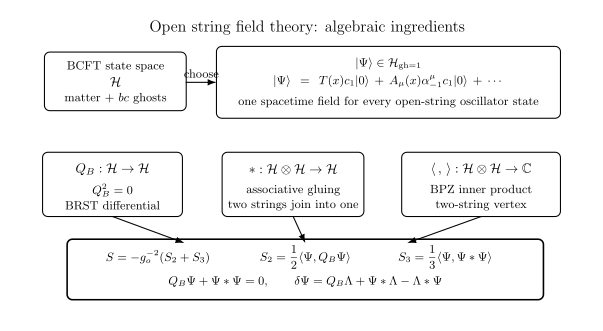
Open string field theory is built from three pieces of worldsheet data: the BRST differential , Witten’s star product , and the BPZ inner product . Together they define a gauge-invariant cubic action.
The physical open-string spectrum is recovered by linearizing around the perturbative vacuum . At the free level the equation is
and the gauge redundancy is
Thus the free spectrum is BRST cohomology at ghost number one, exactly as in the first-quantized description. The nontrivial content of string field theory is the nonlinear completion of this equation.
BPZ inner product and surface states
Section titled “BPZ inner product and surface states”The BPZ inner product is the two-string vertex. If and are open-string states, then is computed as a disk or upper-half-plane correlation function after applying the BPZ conformal map to one of the states.
Ghost number is important. For the bosonic open string, a nonzero disk correlator must soak up three -ghost zero modes. Therefore
Since has ghost number one and raises ghost number by one, the kinetic term has total ghost number three. Likewise, because the star product adds ghost number, is also allowed.
A particularly useful language is that of surface states. Given a Riemann surface with one open-string puncture and a local coordinate map around that puncture, one defines a state by
Here is any test state, represented by a local operator inserted at the puncture. This turns a worldsheet surface into a vector in the open-string Hilbert space. Surface states are the natural bridge between the CFT picture and the algebraic star-product picture.
Witten’s cubic action
Section titled “Witten’s cubic action”Witten’s open bosonic string field theory has the action
Here is the open-string coupling. The string field is Grassmann odd and has ghost number one. The BRST operator has ghost number one. The star product is an associative product on open-string states:
Varying the action gives
so the classical equation of motion is
The nonlinear gauge transformation is
where is a ghost-number-zero gauge parameter. This is the stringy analogue of
The analogy is not cosmetic. The equation
is a Maurer—Cartan equation in a differential graded algebra. The BRST operator acts like a differential, and the star product acts like a noncommutative multiplication.
The algebraic identities needed for gauge invariance are
and cyclicity,
together with the BPZ property of ,
Here denotes the Grassmann parity of . These identities are not added by hand. They are consequences of BRST invariance and sewing of worldsheet surfaces.
Geometry of the star product
Section titled “Geometry of the star product”The star product is defined geometrically. Think of an open string as an interval. Split each string into left and right halves. Then glue the right half of the first string to the left half of the second string. The output is a new open string made from the left half of the first string and the right half of the second string.
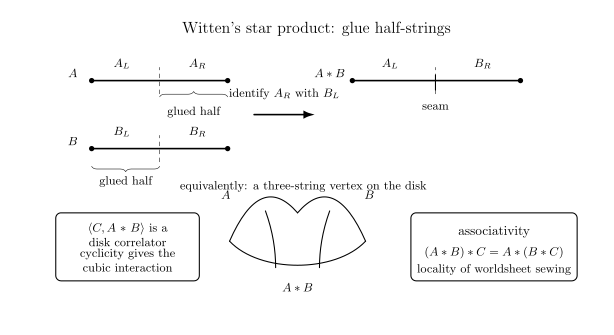
Witten’s star product glues the right half of one open string to the left half of another. Equivalently, is a disk correlator with three open-string insertions.
This half-string gluing is the reason the action is cubic. Higher open-string tree amplitudes are generated by cubic vertices connected by propagators, just as in ordinary cubic field theory. The difference is that the propagator includes an integral over a strip length. In Siegel gauge,
the propagator is formally
which can be written as an integral over worldsheet proper time,
The parameter is precisely the length of the strip glued between cubic vertices. In this way Feynman diagrams of open SFT cover the moduli spaces of bordered Riemann surfaces. This is the worldsheet origin of the spacetime Feynman rules.
There are subtleties at the open-string midpoint, especially in superstring field theory and in singular analytic solutions. But for the basic bosonic theory the geometric message is robust: the product is worldsheet sewing.
Wedge states and the sliver
Section titled “Wedge states and the sliver”A simple and powerful class of surface states is formed by wedge states. Let denote a strip-like surface of width , with the convention
where is the identity string field. The star product simply adds widths:
In this convention is the -invariant vacuum state, and the limit
is the sliver state. Because adding an infinite strip to an infinite strip still gives an infinite strip, the sliver is a projector:
Projectors are important because they behave like classical solitons in noncommutative field theory. Indeed, before the full analytic tachyon-vacuum solution was found, projector-like surface states already gave strong evidence that D-brane decay and D-brane descent could be described within the star algebra.
It is also useful to package wedge states as
where is the generator of translations in strip width. Then
This notation leads naturally to the subalgebra.
The algebra
Section titled “The K,B,cK,B,cK,B,c algebra”Many analytic solutions of open SFT live in a small subalgebra generated by three string fields:
Geometrically, is a line integral of the stress tensor along the strip, is a corresponding line integral of the ghost, and is a boundary -ghost insertion. Their algebra is
The BRST operator acts as
This is the string-field-theoretic analogue of choosing a clever coordinate system on the space of gauge fields. The full string field is infinite-dimensional, but the tachyon vacuum can be written in terms of wedge states and a small number of ghost insertions.
A typical building block has the schematic form
where is a wedge state. The derivative measures how the state changes as the strip width changes. Schnabl’s analytic tachyon-vacuum solution can be written schematically as
The final term is often called a boundary or phantom term. It is essential: without it, the limiting expression has the right formal shape but the wrong gauge-invariant observables. This is a recurring theme in string field theory: states that look harmless algebraically may encode singular worldsheet limits.
Tachyon condensation
Section titled “Tachyon condensation”The bosonic open string on a D-brane has a tachyon. In the first-quantized spectrum this is simply a state with
In spacetime language it means that the perturbative vacuum is unstable. The central question is: what is the endpoint?
Sen’s answer is one of the most important insights into D-brane physics:
- The open-string tachyon condenses to a classical solution whose energy cancels the D-brane tension.
- Around this endpoint there are no perturbative open-string excitations.
- Lower-dimensional D-branes appear as solitonic lump solutions of the tachyon field.
In open SFT the energy density of a static classical solution is
where is the worldvolume volume. The perturbative D-brane is normalized to have in the open-string field theory action. Sen’s first conjecture says
Thus the total energy of the original D-brane plus the tachyon condensate is zero. The brane has disappeared, leaving the closed-string vacuum of the same bulk background.
For the bosonic space-filling D25-brane, in the conventional normalization ,
and the exact analytic solution gives
This is an exact cancellation of the D-brane tension. It is not merely a qualitative picture.
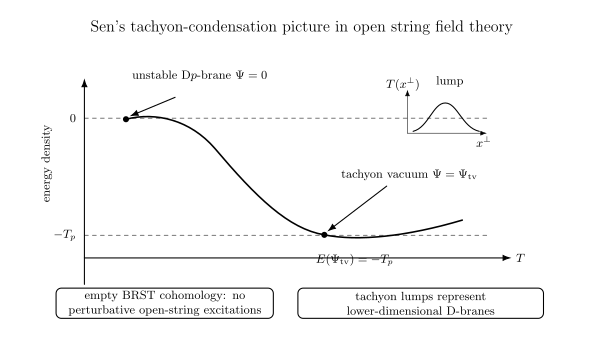
The perturbative open-string vacuum describes an unstable D-brane. At the tachyon vacuum the energy shift is , canceling the brane tension. Localized tachyon profiles represent lower-dimensional D-branes.
No open strings at the tachyon vacuum
Section titled “No open strings at the tachyon vacuum”Let be any classical solution,
Write fluctuations around it as
The quadratic part of the shifted action is governed by a new BRST operator
The equation of motion for implies
So the physical open-string spectrum around the new solution is the cohomology of .
For the tachyon vacuum , Sen’s second conjecture states that this cohomology is empty. In analytic solutions this can be shown by constructing a homotopy operator satisfying
If , then
up to the standard graded signs. Therefore every closed state is exact, and the cohomology vanishes. This is the precise mathematical version of the slogan: after the D-brane decays, no open strings remain.
Closed strings are not gone. The tachyon vacuum is the closed-string background without the original D-brane. Open-string degrees of freedom were tied to the brane; once the brane disappears, their perturbative spectrum disappears with it.
D-brane descent as tachyon lumps
Section titled “D-brane descent as tachyon lumps”Sen’s third conjecture says that lower-dimensional D-branes arise as localized solitons of the tachyon field. For example, on an unstable space-filling brane one can look for a tachyon profile depending on one transverse coordinate such that
but with a localized defect near . This defect carries the tension and open-string spectrum of a D-brane of one lower dimension.
The expected descent relation is
More generally, a codimension- tachyon lump on a space-filling brane represents a D-brane. The lump is not an extra object inserted by hand; it is a classical solution in the original open string field theory.
This is conceptually striking. A theory formulated using the open strings of one D-brane contains, nonperturbatively, other D-branes as solitons. In modern language, D-brane charge is encoded in the topology of the open-string tachyon configuration, closely related to K-theory.
Level truncation and the meaning of exactness
Section titled “Level truncation and the meaning of exactness”Before analytic solutions were known, tachyon condensation was tested by level truncation. One truncates the string field to oscillator level and keeps interaction terms up to some maximum level. At the crudest level one keeps only the tachyon mode,
and obtains a cubic potential with an unstable critical point. Adding more and more massive fields rapidly improves the approximation to
The convergence was one of the early triumphs of open SFT: the infinite tower of string modes is not decorative. Massive fields are essential for quantitatively correct off-shell physics.
The analytic tachyon-vacuum solution made the story exact. It showed that Witten’s cubic action, despite its compact form, contains the full nonperturbative physics of D-brane annihilation in a fixed closed-string background.
What open SFT does and does not claim
Section titled “What open SFT does and does not claim”Open string field theory around a given BCFT is a theory of open strings on that boundary condition. Classical solutions can represent new boundary conditions, including the absence of the original brane. But the closed-string bulk CFT is held fixed in the simplest formulation.
This distinction matters. If one wants a fully dynamical theory in which closed-string backgrounds themselves change, one needs closed string field theory or open-closed string field theory. These are more complicated because the moduli spaces of closed Riemann surfaces have more intricate decomposition properties.
Still, open SFT is one of the sharpest laboratories for nonperturbative string theory. It gives an honest action, exact classical solutions, gauge-invariant observables, and quantitative control of D-brane decay.
Exercises
Section titled “Exercises”Exercise 1: Varying Witten’s cubic action
Section titled “Exercise 1: Varying Witten’s cubic action”Starting from
show that the equation of motion is
Solution
Use the BPZ property of and cyclicity of the cubic vertex. The variation of the kinetic term is
Because is Grassmann odd and is BPZ odd, the second term equals the first. Thus
For the cubic term, cyclicity gives three equal contributions:
Therefore
Since is arbitrary, the equation of motion is
Exercise 2: Ghost number bookkeeping
Section titled “Exercise 2: Ghost number bookkeeping”Show that the kinetic and cubic terms in the open bosonic SFT action have the correct total ghost number on the disk.
Solution
The bosonic open-string field has ghost number one:
The BRST charge has ghost number one, so
Thus the kinetic pairing has total ghost number
For the cubic term, the star product adds ghost number:
Then
This is exactly the required ghost number for a nonzero disk correlator, because three -ghost zero modes must be saturated.
Exercise 3: Linearized spectrum as BRST cohomology
Section titled “Exercise 3: Linearized spectrum as BRST cohomology”Linearize the open SFT equation of motion around and show that the physical free spectrum is BRST cohomology at ghost number one.
Solution
The full equation is
Near , the quadratic term is negligible, so the free equation is
The gauge transformation is
so at the linearized level
Thus physical free fluctuations are BRST-closed states modulo BRST-exact states:
at ghost number one. This is precisely the first-quantized open-string physical-state condition.
Exercise 4: Wedge-state semigroup and the sliver projector
Section titled “Exercise 4: Wedge-state semigroup and the sliver projector”Assume wedge states obey
Show that is the identity and that is a projector.
Solution
Set . Then
So acts as the identity string field.
Now define
Then
Therefore is a projector. This infinite-width wedge state is called the sliver.
Exercise 5: The shifted BRST operator squares to zero
Section titled “Exercise 5: The shifted BRST operator squares to zero”Let satisfy the classical equation
Define
Show that .
Solution
The operator is the covariantized BRST operator. A direct computation using the derivation property of and associativity of gives
with the appropriate graded signs included in the second term.
Since solves
both terms vanish. Hence
for every fluctuation .
Exercise 6: Trivial cohomology from a homotopy operator
Section titled “Exercise 6: Trivial cohomology from a homotopy operator”Suppose there exists a string field such that
Show that the cohomology of is trivial.
Solution
Let be a closed state:
Since is the identity string field,
Using , we get
Because is a derivation and , this can be written as
up to the standard sign determined by the Grassmann parity of . Hence every closed state is exact. The cohomology is empty.
Exercise 7: D-brane descent and tension ratios
Section titled “Exercise 7: D-brane descent and tension ratios”Using the descent relation
show that a codimension- tachyon lump on a D-brane has the expected tension of a D-brane.
Solution
Apply the descent relation repeatedly. For one codimension,
For two codimensions,
Continuing times gives
Therefore a codimension- tachyon lump has exactly the tension expected for a D-brane, provided the SFT solution has the correct descent normalization.