
7. Momentum Relaxation, Lattices, Q-Lattices, and Disorder
A clean finite-density holographic metal has an immediate problem: it usually conducts too well. If spatial translations are exact, the total momentum is conserved. At nonzero charge density, the electric current overlaps with momentum, so a homogeneous electric field can accelerate the whole fluid. The DC conductivity then contains a zero-frequency singularity even if the system has no quasiparticles and locally equilibrates rapidly.
The previous page separated two pieces of finite-density transport:
- a momentum-drag channel, controlled by the overlap of current with the conserved momentum,
- an incoherent channel, controlled by the part of the current orthogonal to momentum.
This page asks the next question: how do holographic models make the measured DC conductivity finite? The answer is not just “add a lattice.” There are several physically different ways to break translations, and they lead to different interpretations of the same-looking transport formulas.
The central lesson is this:
A finite DC conductivity is not a microscopic scattering time by itself. It is the endpoint of a chain: translations are broken, momentum decays or is pinned, slow modes reorganize the low-frequency response, and the bulk encodes this through boundary conditions plus horizon regularity.
We will study four levels of translation breaking.
- Weak explicit breaking, where memory-matrix and hydrodynamic formulas are controlled.
- Homogeneous holographic lattices, such as linear axions and Q-lattices, where translations are broken but the bulk equations remain ordinary differential equations.
- Genuine inhomogeneous lattices and disorder, where the bulk geometry depends on boundary spatial coordinates.
- Spontaneous translation breaking, where momentum relaxation, pinning, and phase relaxation must be distinguished.
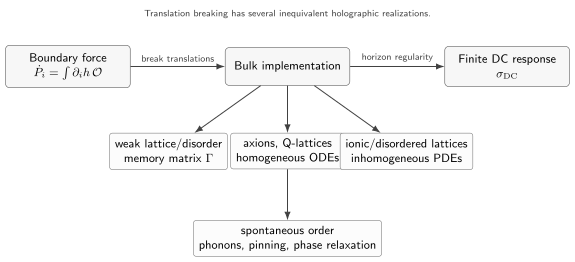
Translation breaking in holographic quantum matter has several regimes. Weak explicit breaking gives a memory-matrix relaxation rate . Homogeneous axion and Q-lattice models keep the bulk equations tractable and often give horizon DC formulas. Ionic lattices and disorder are genuine inhomogeneous bulk boundary-value problems. Spontaneous translation breaking introduces a sliding mode, so pinning and phase relaxation are extra data rather than synonyms for momentum relaxation.
The boundary Ward identity is the starting point
Section titled “The boundary Ward identity is the starting point”Let the boundary theory contain a conserved current , stress tensor , and a scalar operator sourced by a spatially dependent coupling . In the presence of an external gauge field and a scalar source, the spatial Ward identity has the schematic form
The first term is the Lorentz force. In a homogeneous state with electric field , it gives the familiar force density
when no other sources vary in space. The second term is the force exerted by the spatially varying coupling. If is constant, it does not break translations. If varies, the background itself can absorb momentum.
At the level of the Hamiltonian, a weak source deformation can be written as
The momentum operator generates translations, so the deformation implies
up to a sign convention. This formula is the seed of the memory-matrix result. Momentum decays because the Hamiltonian contains a spatial pattern that can absorb it.
Notice that the operator is not necessarily a density of impurities in the everyday sense. It can be any operator sourced by a lattice, disorder field, strain, ionic potential, scalar deformation, or holographic axion sector. What matters is that the source carries spatial momentum.
Weak explicit breaking and the memory-matrix rate
Section titled “Weak explicit breaking and the memory-matrix rate”Suppose translations are broken weakly enough that momentum remains a long-lived mode. Then the low-frequency response is controlled by a small momentum-relaxation rate . In the simplest isotropic case,
where is the thermal driving field. Combining this with charged hydrodynamics gives the pole structure
This is Drude-like, but it is not necessarily quasiparticle Drude theory. The pole appears because momentum is long-lived, not because electrons are long-lived.
The memory-matrix formalism gives a more microscopic expression for that does not assume quasiparticles. For a weak source coupled to , one obtains schematically
Here in a relativistic fluid. The formula is conceptually powerful because it says that momentum relaxation is controlled by the low-frequency spectral weight of the operator that breaks translations.
For a one-dimensional periodic lattice,
the Fourier transform has support only at . The relaxation rate is therefore proportional to
For weak random disorder with
the same expression becomes disorder-averaged:
The same logic unifies weak lattices and weak disorder. The difference is the distribution of wavevectors carried by the source.
Coherent and incoherent transport
Section titled “Coherent and incoherent transport”The dimensionless measure of coherence is not simply whether the DC conductivity is large. A cleaner criterion asks whether the low-frequency response contains an isolated pole whose width is parametrically smaller than the local equilibration scale. If
then the optical conductivity typically has a narrow Drude-like peak. Transport is coherent: it is dominated by a slow momentum mode.
If is comparable to the microscopic or quantum-critical equilibration scale, then the low-frequency response may not have a sharply isolated pole. Transport is incoherent: the current relaxes through strongly coupled dynamics without a long-lived momentum bottleneck.
A useful schematic expression is
When the second term dominates, the resistivity tracks :
When the first term dominates, the resistivity is controlled mainly by the intrinsic conductivity , not by momentum drag. A holographic model can therefore have finite resistivity without a meaningful quasiparticle scattering time and without a sharply Drude-shaped peak.
This is the first diagnostic to apply to any holographic lattice paper: ask whether the state is coherent, incoherent, or mixed.
Homogeneous holographic lattices: the trick
Section titled “Homogeneous holographic lattices: the trick”A genuine lattice makes the state depend on boundary position, which usually turns the bulk problem into nonlinear partial differential equations. Homogeneous holographic lattices avoid this by breaking translations while preserving enough generalized symmetry that the background fields depend only on the radial coordinate.
This is a computational trick, but a valuable one. It lets one study finite DC transport, metal-insulator transitions, and scaling regimes without solving a full inhomogeneous bulk geometry.
The two most important homogeneous mechanisms are:
- linear axions, where shift-symmetric scalar fields are proportional to boundary coordinates,
- Q-lattices, where a complex scalar has a spatially modulated phase but a radial amplitude.
These models do break translations in the boundary theory. They are not coordinate artifacts. But because the stress tensor of the bulk matter fields can be homogeneous, the metric and gauge field can remain functions of the radial coordinate alone.
The price is interpretational. A homogeneous holographic lattice is not a microscopic crystal with Bloch bands. It is a large- effective model of momentum relaxation.
Linear axion models
Section titled “Linear axion models”The simplest isotropic axion model in boundary spacetime dimensions uses scalar fields with shift symmetries,
and background profiles
A common bulk action is
Even though depends explicitly on , the combination can be homogeneous. The background ansatz can remain
The parameter controls the strength of explicit translation breaking. In the boundary theory, the scalar sources are linear functions of position. Because the bulk scalars have shift symmetries, this is compatible with a homogeneous stress tensor.
The cleanest result is the horizon DC conductivity. For many isotropic Einstein-Maxwell-dilaton-axion models, one finds
Here and are the horizon values of and , and is the entropy density.
The structure is exactly what the boundary theory expects.
- The term is the intrinsic horizon conductivity.
- The term proportional to is momentum drag.
- As , the DC conductivity diverges because translations are restored.
The formula is beautiful because it turns a transport calculation into horizon data. But it should not be overread. The DC formula alone does not say whether the optical conductivity is Drude-like; one must examine the quasinormal spectrum.
Q-lattices
Section titled “Q-lattices”A Q-lattice uses an internal global symmetry to make a spatially modulated source compatible with homogeneous bulk equations. The simplest version has a complex scalar
If the bulk action depends on only through phase-invariant combinations such as and , then the stress tensor is independent of . The phase winds in space, but the geometry remains homogeneous.
In the boundary theory, this corresponds to a source whose phase rotates in space. The wavevector sets the lattice scale, while the UV amplitude of sets the lattice strength. Q-lattices are especially useful because they can realize metallic and insulating regimes in relatively simple ordinary differential equations.
The interpretation is similar to axion models but not identical. Linear axions are often maximally efficient toy models of momentum relaxation. Q-lattices are closer to periodic scalar deformations, because they contain a length scale and a source amplitude. But neither model captures all features of an ordinary crystal.
In particular, a homogeneous Q-lattice does not automatically give:
- Bloch bands,
- Brillouin-zone folding,
- sharp Umklapp surfaces,
- localized impurity physics,
- or a microscopic ionic potential.
It gives a controlled large- holographic mechanism for degrading momentum and studying the resulting transport.
Ionic lattices and genuine inhomogeneous geometries
Section titled “Ionic lattices and genuine inhomogeneous geometries”A more literal holographic lattice is an explicitly position-dependent chemical potential, for example
Equivalently, the boundary value of the bulk gauge field is
Now the bulk metric, gauge field, and possibly other fields depend on both and . The problem is no longer an ordinary differential equation. It is a nonlinear elliptic boundary-value problem for an inhomogeneous black brane.
The advantage is physical fidelity. Genuine inhomogeneous lattices can capture effects that homogeneous models wash out:
- spatially varying charge density,
- Brillouin-like structure in spectral functions,
- local current patterns,
- anisotropic conductivities,
- commensurability effects,
- and possible formation of striped or crystalline phases.
The disadvantage is computational cost. One typically needs numerical methods for stationary gravitational solutions. Boundary conditions must be imposed at the AdS boundary, the horizon, and any axes or periodic directions. Gauge fixing, horizon regularity, and extraction of one-point functions all become more delicate.
For a lecture-note-level mental model, the important distinction is:
Homogeneous lattices are efficient models of momentum relaxation. Inhomogeneous lattices are closer to literal spatial potentials.
Both are useful. They answer different questions.
Disorder
Section titled “Disorder”Disorder is translation breaking without periodicity. In field theory, one might source an operator by a random function . The weak-disorder memory-matrix rate was already written above. At stronger disorder, the full problem becomes a random inhomogeneous black-brane geometry.
Disorder raises special conceptual issues.
First, the relevant observables are usually disorder-averaged quantities. One may care about
where the overline means an average over disorder realizations. At large , some quantities can become self-averaging, but this should be checked, not assumed.
Second, disorder can be relevant or irrelevant in the renormalization-group sense. A weak random source for an operator may grow toward the IR, die away, or flow to a disordered fixed point. The holographic geometry must know which case it is.
Third, disorder is not the same as a relaxation-time approximation. A random source can produce momentum relaxation, but it can also produce new low-energy structure, rare-region effects, localization tendencies, glassiness, or emergent inhomogeneous phases. Classical large- holography is often best at capturing coarse-grained dissipative effects; it is less automatically trustworthy for phenomena that rely on strong mesoscopic fluctuations.
In short: holographic disorder is powerful, but the epistemic status should be stated carefully. Weak disorder is well organized by memory matrices. Strong disorder is a hard gravitational boundary-value problem and should not be reduced to a single number unless the dynamics actually supports that reduction.
Massive gravity and effective momentum relaxation
Section titled “Massive gravity and effective momentum relaxation”Another route introduces bulk terms that break diffeomorphism invariance in a controlled effective way, often described as massive gravity. In the boundary theory this mimics momentum nonconservation. Such models were historically important because they produced simple finite DC conductivities and clear Drude-to-incoherent crossovers.
The useful viewpoint is not that “the graviton literally has a mass in the microscopic dual.” Rather, massive-gravity-type terms can be an effective description of translation breaking after some degrees of freedom have been integrated out.
The warning is obvious but important:
Massive gravity is a model of momentum relaxation, not automatically a top-down derivation of a lattice.
For the purposes of this section, massive gravity belongs in the same conceptual family as homogeneous momentum-relaxing models: useful, efficient, and sometimes universal in the IR, but requiring care when interpreted microscopically.
Explicit versus spontaneous translation breaking
Section titled “Explicit versus spontaneous translation breaking”A density wave, stripe, or crystal can break translations spontaneously. This is physically different from putting an explicit lattice or disorder source in the Hamiltonian.
If translations are broken spontaneously, the system has a sliding mode: a phonon or phason. A uniform shift of the pattern costs no energy. Therefore spontaneous breaking alone does not necessarily make the DC conductivity finite. The sliding collective mode can still carry current without dissipation.
To obtain a finite DC response in a charge-density-wave-like state, one often needs:
- explicit pinning, which gives the sliding mode a finite pinning frequency,
- phase relaxation, which lets the phase of the density wave decay through defects, dislocations, or other processes,
- or coupling to other momentum-relaxing sectors.
The optical conductivity of a pinned density wave is not just an ordinary Drude peak. It can contain a pinned collective resonance. A schematic pinned-mode denominator has the form
where is a pinning frequency and is a phase-relaxation rate. This is a different structure from
This distinction will matter later for spatially modulated phases. The safe rule is:
Explicit translation breaking relaxes momentum directly. Spontaneous translation breaking creates new collective modes. Pinning and phase relaxation are additional mechanisms.
How horizon DC formulas work
Section titled “How horizon DC formulas work”Horizon DC formulas arise because zero-frequency bulk perturbation equations often contain radially conserved quantities. The logic is as follows.
Apply a constant electric field and thermal gradient at the boundary. In the bulk this corresponds to linear perturbations such as
and metric perturbations that implement the thermal source. At zero frequency, the equations imply that certain radial fluxes are conserved:
The boundary values of and are the electric and heat currents. Since the fluxes are radially conserved, one may evaluate them at the horizon instead. Horizon regularity then determines them algebraically in terms of and .
This is why the DC conductivities can be horizon data. It is not magic; it is radial conservation plus regularity.
However, this works specifically for DC transport. For finite frequency, the perturbations propagate nontrivially between boundary and horizon. One must solve the full fluctuation equations, impose ingoing boundary conditions, and extract retarded Green’s functions.
A practical classification of holographic translation-breaking models
Section titled “A practical classification of holographic translation-breaking models”The following table is a useful calculation-time guide.
| Model type | Bulk difficulty | What it captures well | Main caveat |
|---|---|---|---|
| Linear axions | ODE | finite DC transport, coherent/incoherent crossover, horizon formulas | not a literal periodic lattice |
| Q-lattice | ODE | periodic scale, metal-insulator tendencies, homogeneous momentum relaxation | no full Bloch-band structure |
| Helical/Bianchi lattice | ODE | anisotropic homogeneous translation breaking | restricted symmetry pattern |
| Ionic lattice | PDE | literal periodic potential, spatial charge modulation, spectral folding | computationally expensive |
| Random disorder | PDE or perturbative | disorder-averaged momentum relaxation, inhomogeneous response | rare-region/localization physics is subtle |
| Massive gravity | ODE | effective momentum relaxation | microscopic interpretation may be unclear |
| Spontaneous stripes/crystals | PDE or special ansatz | ordered phases and sliding modes | needs pinning/phase relaxation for finite DC |
This table is not a hierarchy from “bad” to “good.” It is a map of questions. If the question is the general fate of the Drude pole, axions may be ideal. If the question is Bloch-like spectral structure, a real lattice is needed. If the question is spontaneous spatial order, explicit lattices are the wrong starting point.
Worked example: axion DC conductivity and the clean limit
Section titled “Worked example: axion DC conductivity and the clean limit”Consider a four-dimensional bulk dual to a -dimensional boundary theory, with two axions
Assume a simple model with and . The horizon formula gives
This expression already contains the physical decomposition.
The first term is intrinsic:
It remains finite at zero density and is controlled by horizon absorption of the gauge-field perturbation.
The second term is momentum drag:
It diverges when , because the translation-breaking deformation is being removed. It also vanishes at , because momentum no longer drags electric current in a particle-hole symmetric state.
Matching to the hydrodynamic formula
suggests
in the weak-breaking regime of this simple model. The exact coefficient can depend on conventions and model details, but the scaling is the point:
Small translation breaking gives a long momentum lifetime.
Common pitfalls
Section titled “Common pitfalls”| Pitfall | Better statement |
|---|---|
| “The black-hole horizon makes the DC conductivity finite.” | Horizons dissipate locally, but exact momentum conservation still gives infinite DC conductivity at finite density. |
| “A Drude peak means quasiparticles.” | A narrow Drude-like pole can come from slow momentum, even without quasiparticles. |
| “Axion models are ordinary lattices.” | Linear axions break translations homogeneously; they model momentum relaxation, not Bloch-band physics. |
| “Q-lattices capture all periodic effects.” | Q-lattices contain a wavevector and amplitude, but the background remains homogeneous. |
| “Spontaneous translation breaking relaxes momentum.” | Spontaneous breaking gives phonons or phasons; finite DC response needs pinning, phase relaxation, or another relaxation mechanism. |
| “The DC formula determines the optical conductivity.” | DC horizon formulas give zero-frequency response only; finite-frequency transport requires solving fluctuations. |
| “Disorder is just a number .” | Weak disorder may reduce to ; strong disorder can create new IR structure. |
| “Finite resistivity measures a quasiparticle lifetime.” | In holographic matter, resistivity may measure momentum relaxation, incoherent conductivity, horizon data, or a mixture. |
Takeaways
Section titled “Takeaways”Translation breaking is not one idea; it is a family of mechanisms.
At finite density, exact translations make the DC conductivity singular because current overlaps with momentum. Weak explicit breaking turns the singularity into a Drude-like pole with width , and the memory-matrix formalism expresses through the spectral weight of the translation-breaking operator.
Holography gives several ways to implement this physics. Linear axions and Q-lattices keep the bulk homogeneous and often give simple horizon DC formulas. Ionic lattices and disorder are more literal but require inhomogeneous geometries. Massive gravity is an effective model of momentum relaxation. Spontaneous stripes or crystals require a separate treatment because they introduce sliding modes, pinning, and phase relaxation.
The best way to read any holographic translation-breaking model is to ask four questions:
- Is translation breaking explicit, spontaneous, or both?
- Is momentum long-lived or strongly relaxed?
- Is the response coherent, incoherent, or mixed?
- Is the model intended as a top-down construction, a controlled effective model, or a phenomenological analogue?
If those questions are answered clearly, finite DC transport becomes a diagnostic rather than a slogan.
Exercises
Section titled “Exercises”1. Ward identity and momentum decay
Section titled “1. Ward identity and momentum decay”Let
where is translationally invariant. Use the fact that generates translations to show that is proportional to .
Solution
For a local operator, the momentum generator obeys
up to the sign convention for commutators. Since is translationally invariant, . The deformation gives
Using the translation property gives
Integrating by parts and ignoring boundary terms,
Depending on the convention for and the sign of the deformation, the overall sign may change. The physical statement is invariant: momentum changes only if the source has spatial gradients.
2. Periodic lattice and the memory-matrix rate
Section titled “2. Periodic lattice and the memory-matrix rate”For
explain why the weak-breaking relaxation rate is proportional to
Solution
The Fourier transform of has support at . The memory-matrix formula contains the factor
Since the only nonzero Fourier components are at , the integral over reduces to those wavevectors. Both have , and is proportional to . Thus
up to normalization conventions for Fourier transforms.
3. Drude pole without quasiparticles
Section titled “3. Drude pole without quasiparticles”Assume
and
Derive the electric conductivity. Why does this derivation not require quasiparticles?
Solution
Solving the first equation for the fluid velocity gives
Substituting into the current,
Therefore
The derivation uses only hydrodynamic variables and conservation laws: charge density, momentum density, enthalpy, and a momentum-relaxation rate. It does not assume a distribution of long-lived quasiparticles. The pole is due to slow momentum, not particle kinetics.
4. Axion horizon formula and the clean limit
Section titled “4. Axion horizon formula and the clean limit”In a simple axion model,
Identify the intrinsic and momentum-drag terms. What happens as ? What happens at ?
Solution
The intrinsic term is
It remains finite even without charge density. The momentum-drag contribution is
As , translations are restored and the drag term diverges. This reproduces the infinite DC conductivity of a clean finite-density system. At , the drag term vanishes because current no longer overlaps with momentum in the same way; the DC conductivity reduces to the intrinsic horizon value .
5. Why Q-lattices can be homogeneous
Section titled “5. Why Q-lattices can be homogeneous”Consider a complex scalar
with an action depending only on and . Explain why the stress tensor can be independent of .
Solution
The modulus is
which is independent of . The spatial derivative is
so
also independent of . Radial derivatives similarly give
Therefore the phase depends on , but phase-invariant quantities entering the stress tensor depend only on . The scalar source breaks translations, yet the bulk background can remain homogeneous.
6. Explicit versus spontaneous translation breaking
Section titled “6. Explicit versus spontaneous translation breaking”Why does spontaneous translation breaking not automatically produce a finite DC conductivity? What additional ingredients can make the DC response finite?
Solution
Spontaneous translation breaking produces a Goldstone mode: a phonon or phason corresponding to sliding the pattern. If the pattern can slide freely, it can carry current without dissipation. Thus the conductivity may still contain a zero-frequency singularity.
A finite DC response requires additional mechanisms such as explicit pinning, phase relaxation, or coupling to another momentum-relaxing sector. Pinning gives the sliding mode a finite restoring force; phase relaxation allows the phase of the density wave to decay through defects or dislocations. These are extra slow-mode data, not synonyms for spontaneous order.
7. Choosing the right holographic model
Section titled “7. Choosing the right holographic model”You want to study the temperature dependence of the DC resistivity in a strongly coupled metal without caring about Brillouin-zone structure. Which model class is likely to be efficient? What if you instead want spectral functions showing lattice momentum mixing?
Solution
For the DC resistivity and coherent/incoherent crossover, homogeneous models such as linear axions or Q-lattices are efficient. They break translations while keeping the background equations ordinary differential equations, and they often give analytic horizon DC formulas.
For spectral functions with lattice momentum mixing, a genuine inhomogeneous lattice is needed. A boundary chemical potential such as forces the bulk fields to depend on both and , but it can capture effects such as Brillouin-like folding and spatially modulated charge density.
References and further reading
Section titled “References and further reading”For the logic of momentum relaxation, memory matrices, and holographic transport, useful starting points include:
- Sean A. Hartnoll, Andrew Lucas, and Subir Sachdev, Holographic Quantum Matter.
- Jan Zaanen, Yan Liu, Ya-Wen Sun, and Koenraad Schalm, Holographic Duality in Condensed Matter Physics.
- Martin Ammon and Johanna Erdmenger, Gauge/Gravity Duality: Foundations and Applications.
- Tom Andrade and Benjamin Withers, “A simple holographic model of momentum relaxation.”
- Aristomenis Donos and Jerome P. Gauntlett, “Thermoelectric DC conductivities from black hole horizons.”
- Richard A. Davison, “Momentum relaxation in holographic massive gravity.”
- Sean A. Hartnoll, “Theory of universal incoherent metallic transport.”
- Andrew Lucas and Subir Sachdev, “Memory matrix theory of transport in strange metals.”
- Blaise Gouteraux, “Charge transport in holography with momentum dissipation.”