
How to Compute a Holographic Observable
The main idea
Section titled “The main idea”A holographic calculation is not a spell of the form “write down a black hole and read off the answer.” It is a controlled boundary-value problem whose output is a CFT observable.
The exact statement is a statement about quantum theories:
Almost every practical calculation in this course uses a semiclassical limit:
or its Lorentzian real-time version. The job is then to solve a bulk variational problem with the right asymptotic boundary conditions, the right interior or horizon conditions, the right counterterms, and the right normalization. The observable is obtained by differentiating, extremizing, or evaluating the renormalized bulk answer.
A good holographic calculation therefore has the following skeleton:
The skeleton is simple. The craft lies in the details.
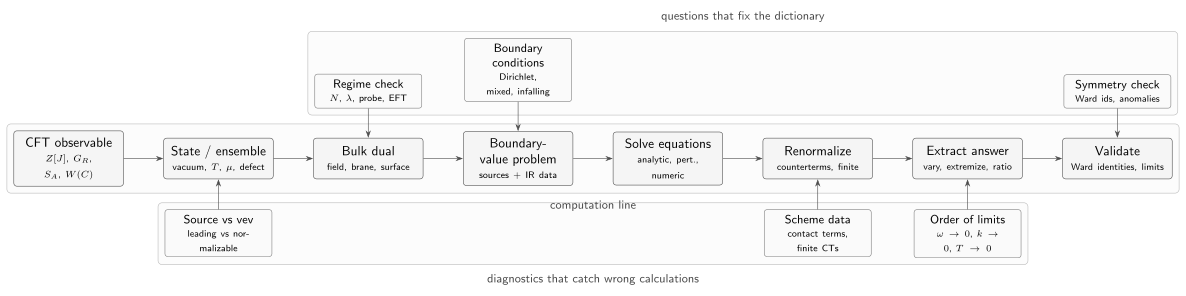
A practical workflow for holographic calculations. The central line is the computation; the side boxes are the checks that prevent many wrong answers. The same logic applies to local correlators, thermal free energies, Wilson loops, transport coefficients, probe-brane observables, and RT/HRT entanglement entropy.
This page is deliberately procedural. It is the page to consult when you know what you want to compute but are unsure how to turn the dictionary into a reliable calculation.
Step 1: identify the boundary observable
Section titled “Step 1: identify the boundary observable”Start on the field-theory side. Do not start by guessing a metric.
Ask what the actual observable is:
| CFT object | Typical notation | Bulk object |
|---|---|---|
| partition function | string/gravity partition function with boundary sources | |
| one-point function | normalizable coefficient or radial canonical momentum | |
| Euclidean correlator | Euclidean boundary-value problem | |
| retarded correlator | Lorentzian problem with infalling horizon condition | |
| current response | , , | Maxwell perturbations and radial electric flux |
| stress-tensor response | , sound modes | metric perturbations and Brown-York tensor |
| Wilson loop | fundamental string worldsheet ending on | |
| entanglement entropy | extremal surface or quantum extremal surface | |
| defect observable | defect one-point data, meson spectra | probe-brane embedding and fluctuations |
| thermal free energy | renormalized Euclidean action of a saddle |
The precise definition matters. For example, the words “conductivity” could mean optical conductivity at zero momentum,
DC conductivity,
or an incoherent conductivity with the momentum-overlap contribution removed. These are different observables, and in a translationally invariant finite-density system the distinction is not cosmetic: the ordinary DC conductivity contains a delta function because momentum cannot decay.
Similarly, the phrase “entropy” could mean thermal entropy, coarse-grained black-hole entropy, fine-grained entanglement entropy, generalized entropy, or the entropy density of a black brane. The right bulk calculation depends on which one you mean.
Step 2: specify the state, ensemble, and sources
Section titled “Step 2: specify the state, ensemble, and sources”A CFT observable is not just an operator. It is an operator evaluated in a state or ensemble, possibly with sources turned on.
Common choices are:
| boundary situation | bulk saddle or condition |
|---|---|
| vacuum on | Poincaré AdS |
| vacuum on | global AdS |
| thermal state on | planar AdS black brane |
| thermal state on | thermal AdS or global AdS-Schwarzschild |
| finite chemical potential | charged AdS black hole or black brane |
| relevant deformation | scalar source and backreacted domain wall |
| expectation-value flow | normalizable scalar profile with vanishing source |
| defect CFT | probe brane or interface geometry |
| real-time response | Lorentzian geometry with causal boundary conditions |
For a single-trace scalar operator, a source deformation has the schematic form
The bulk scalar near the boundary behaves as
where is proportional to the source in standard quantization. A common mistake is to compute a beautiful bulk solution and only afterward ask whether the non-normalizable coefficient was actually zero. That changes the CFT problem.
For a conserved current,
and sources . A chemical potential is boundary data for , but it is also a choice of ensemble and gauge. For a static charged black hole one usually imposes regularity at the Euclidean horizon, which sets the contractible thermal-cycle holonomy in the correct gauge.
For the stress tensor,
and is the background metric of the CFT. Varying it gives and stress-tensor correlators.
Step 3: choose the bulk dual and approximation
Section titled “Step 3: choose the bulk dual and approximation”The dictionary is not only a list of fields. It is also a statement about approximation schemes.
For the canonical duality,
the main parameters are
Thus the hierarchy is:
| approximation | field-theory meaning | bulk meaning |
|---|---|---|
| exact AdS/CFT | exact finite- CFT | full quantum string theory |
| large | factorization, planar expansion | suppressed bulk loops |
| large | strong coupling, large gap | suppressed stringy corrections |
| classical supergravity | and | two-derivative gravity plus light fields |
| probe limit | or small backreaction | brane or matter fields on fixed geometry |
| derivative expansion | long wavelength | hydrodynamics or fluid/gravity |
| semiclassical worldsheet | saddle-point string worldsheet |
A calculation should state its approximation explicitly. The answer
is not a theorem about every quantum field theory. It is the leading classical two-derivative Einstein-gravity answer. Higher-derivative terms, finite coupling, anisotropy, nonminimal matter couplings, or broken assumptions can change it.
Likewise, the RT formula
is the leading large- classical answer. At the next order one must use generalized entropy,
The “bulk dual” of an observable is therefore a pair:
Step 4: formulate the variational problem
Section titled “Step 4: formulate the variational problem”For local operators, the basic object is the renormalized on-shell action. Consider a bulk field with action
On shell, the variation reduces to boundary terms:
where is the radial canonical momentum. After adding counterterms and taking the cutoff to the boundary, the renormalized momentum gives the one-point function.
For a scalar in standard quantization,
up to the sign convention chosen in the Euclidean generating functional. The sign is not universal because authors define
The physics is independent of this bookkeeping, but mixing conventions halfway through a calculation is poison.
For gauge fields and metrics, the corresponding definitions are usually written as
and
again with sign conventions depending on Euclidean versus Lorentzian definitions.
For nonlocal observables, the variational problem changes:
| observable | variational problem |
|---|---|
| Wilson loop | minimize or extremize the string action with worldsheet boundary |
| baryon vertex | wrapped brane plus attached strings, with worldvolume Gauss law |
| defect free energy | probe-brane DBI/WZ action plus counterterms |
| RT/HRT entropy | extremize area subject to anchoring and homology |
| QES entropy | extremize generalized entropy, not just area |
| quasinormal spectrum | solve homogeneous linearized equations with source-free boundary data and infalling horizon behavior |
The unifying principle is not “differentiate the action” but solve the correct variational problem with the correct boundary conditions.
Step 5: impose boundary and interior conditions
Section titled “Step 5: impose boundary and interior conditions”Boundary conditions are part of the observable. They are not an afterthought.
Asymptotic AdS boundary
Section titled “Asymptotic AdS boundary”Near a Fefferman-Graham boundary,
the cutoff surface regulates the gravitational IR divergence, which is the CFT UV divergence. Sources are specified by leading coefficients at this boundary. Vevs are extracted from subleading coefficients after renormalization.
Euclidean interiors
Section titled “Euclidean interiors”In Euclidean black-hole geometries, regularity at the origin of the thermal cigar fixes the period of Euclidean time. For a nonextremal horizon,
smoothness requires
Gauge fields must also be regular on the contractible thermal circle. This is why one often chooses a gauge in which vanishes at the Euclidean horizon.
Lorentzian horizons
Section titled “Lorentzian horizons”For retarded correlators at finite temperature, impose infalling boundary conditions at the future horizon. Near the horizon,
in Schwarzschild-like coordinates. Equivalently, the solution should be regular in ingoing Eddington-Finkelstein coordinates. The outgoing solution gives the wrong causal Green function.
Normalizable modes
Section titled “Normalizable modes”For spectra and quasinormal modes, one usually imposes vanishing source at the boundary. In the simplest scalar case, this means setting the non-normalizable coefficient to zero. A nontrivial solution then exists only for special frequencies or masses.
This is the logic behind normal modes in global AdS, glueball spectra in hard-wall models, meson spectra on probe branes, and quasinormal-mode poles of thermal retarded correlators.
Step 6: solve the bulk equations
Section titled “Step 6: solve the bulk equations”There are four common solution regimes.
Analytic exact solutions
Section titled “Analytic exact solutions”Some backgrounds and probes are exactly solvable: pure AdS scalar wave equations, planar black-brane thermodynamics, geodesics in AdS, simple RT surfaces, and near-boundary expansions.
Exact examples are valuable because they expose normalization and boundary-condition issues without numerical noise.
Perturbation theory
Section titled “Perturbation theory”Many useful calculations are perturbative. Examples include:
- small source expansions around AdS,
- linear response around a black brane,
- hydrodynamic expansions in and ,
- near-boundary recursive Fefferman-Graham expansions,
- probe-brane fluctuations around a classical embedding,
- geodesic corrections for heavy operators.
For a fluctuation around a background,
the quadratic on-shell action gives two-point functions, while cubic and quartic terms give higher-point functions through Witten diagrams.
Matched asymptotics
Section titled “Matched asymptotics”Finite-density AdS throat calculations often use matched asymptotic expansions. One solves the near-horizon IR problem, solves the UV problem, and matches them in an overlap region. The resulting Green function often has the structure
where is controlled by the AdS scaling exponent. This expression is not magic; it is just linear ODE matching.
Numerical boundary-value problems
Section titled “Numerical boundary-value problems”For backreacted RG flows, inhomogeneous lattices, holographic superconductors, nontrivial probe embeddings, and many real-time problems, numerical methods are unavoidable. The same workflow still applies:
For static gravitational boundary-value problems, the Einstein-DeTurck method is often useful. It replaces the Einstein equation by a gauge-fixed elliptic problem and then requires checking that the DeTurck vector vanishes in the solution.
Step 7: renormalize
Section titled “Step 7: renormalize”The bare on-shell action almost always diverges near the AdS boundary. Holographic renormalization removes these divergences by adding local covariant counterterms on the cutoff surface.
The regulated action has the form
The renormalized action is
The counterterm action is local in the induced fields at the cutoff surface:
The ellipsis includes curvature terms, matter terms, logarithmic counterterms in even boundary dimension, finite scheme-dependent terms, and terms required for a well-posed variational principle.
Two lessons are crucial.
First, counterterms are not optional decorations. Without them, functional derivatives of the action are usually divergent or scheme-confused.
Second, counterterms determine contact terms and scheme-dependent local pieces. They do not change separated-point nonlocal correlators, pole locations, entropy density, or other genuinely nonlocal data, except when finite counterterms represent physical choices of scheme or ensemble.
For a scalar, after renormalization one often finds schematically
where the coefficient depends on normalization of the bulk scalar action. The phrase “up to local terms” is not a license to ignore contact terms; it means one should state what data are scheme-independent.
Step 8: extract the observable
Section titled “Step 8: extract the observable”Different observables require different extraction rules.
One-point functions
Section titled “One-point functions”For a scalar source,
For currents and stress tensors,
Euclidean correlators
Section titled “Euclidean correlators”Connected correlators come from differentiating
in Euclidean signature, modulo the chosen source-sign convention.
A scalar two-point function is obtained by solving the linearized equation with source , substituting into the quadratic on-shell action, and differentiating twice:
Retarded correlators
Section titled “Retarded correlators”For a linearized Lorentzian fluctuation , the retarded Green function is read from the ratio of renormalized response to source, with infalling horizon conditions:
more precisely after accounting for mixing, indices, counterterms, and normalization. For coupled fields this ratio becomes a matrix.
Free energy and thermodynamics
Section titled “Free energy and thermodynamics”For a Euclidean saddle,
Then
in the grand-canonical ensemble. In the canonical ensemble, one performs the appropriate Legendre transform.
Wilson loops
Section titled “Wilson loops”At leading large ,
where at the boundary. For a rectangular loop of time length and spatial separation ,
The straight-string self-energy subtraction is part of the renormalization of the heavy external quarks.
Entanglement entropy
Section titled “Entanglement entropy”At leading classical order,
where is anchored on and satisfies the homology condition. At quantum order,
The symbol is doing real work: it includes higher-derivative entropy functionals and renormalization subtleties.
Step 9: take limits in the right order
Section titled “Step 9: take limits in the right order”Holographic observables often depend on noncommuting limits. Order matters.
Examples:
| problem | dangerous limits |
|---|---|
| DC conductivity | versus ; momentum conservation versus relaxation |
| hydrodynamic poles | with fixed or not fixed |
| extremal black holes | versus |
| quasinormal modes | ingoing horizon condition before source-free boundary condition |
| entanglement transitions | large saddle competition before smoothing |
| Wilson loops | before extracting |
| Euclidean-to-Lorentzian continuation | analytic continuation after choosing the correct thermal contour |
| probe limit | before backreaction effects are interpreted |
A compact way to state the rule is:
For instance, the diffusion constant is defined from a hydrodynamic pole,
not from an arbitrary independent small-, small- limit. The shear viscosity is defined by
where the spatial momentum is set to zero before the frequency limit in the usual Kubo formula.
Step 10: validate the answer
Section titled “Step 10: validate the answer”A holographic result should be checked from several angles.
Symmetry checks
Section titled “Symmetry checks”Does the answer transform correctly under conformal symmetry, gauge symmetry, rotations, translations, parity, time reversal, or supersymmetry? A scalar two-point function in a CFT must scale as
A stress tensor one-point function in a homogeneous thermal CFT must obey the conformal equation of state,
unless sources or anomalies break conformal invariance.
Ward identities
Section titled “Ward identities”Gauge and diffeomorphism constraints in the bulk become Ward identities on the boundary. With no explicit symmetry-breaking source,
With sources, the Ward identities acquire source terms. For a scalar source ,
The trace Ward identity has the schematic form
where is the conformal anomaly when present.
Thermodynamic checks
Section titled “Thermodynamic checks”For a black brane, verify the first law,
and the correct relation between pressure and grand potential,
In a conformal plasma, verify scaling with temperature. For example, in boundary dimensions,
Causality and positivity checks
Section titled “Causality and positivity checks”Retarded Green functions must be analytic in the upper half of the complex plane. Spectral densities should satisfy positivity conditions for physical operators, such as
with the appropriate sign convention and support properties. Higher-derivative models must be checked for causality, ghosts, and consistency with known CFT positivity constraints.
Dimensional checks
Section titled “Dimensional checks”If the only scale is , dimensional analysis is powerful. A conductivity in a -dimensional CFT has dimension . A viscosity has dimension . A charge density has dimension . A scalar one-point function has dimension .
Many wrong formulas fail this test before any physics is needed.
Limit checks
Section titled “Limit checks”Does the answer reduce to a known result in a controlled limit?
Examples:
- Pure AdS correlators should reproduce conformal two- and three-point structures.
- Black-brane thermodynamics should reproduce area-law entropy.
- Hydrodynamic correlators should have diffusion or sound poles.
- The Wilson-loop potential in a conformal theory should scale as .
- RT surfaces for intervals in AdS should reproduce .
Good holographic practice is not merely solving equations. It is solving equations and then trying hard to disprove your result.
Worked template A: scalar one-point function in a deformed CFT
Section titled “Worked template A: scalar one-point function in a deformed CFT”Suppose a CFT is deformed by a scalar source for a single-trace scalar operator .
Boundary problem
Section titled “Boundary problem”Choose a bulk scalar with mass
and impose near-boundary behavior
If is constant and the deformation backreacts significantly, solve the coupled Einstein-scalar system. If is infinitesimal, solve the scalar equation on the undeformed background.
Renormalization
Section titled “Renormalization”Add counterterms, including a scalar term of the schematic form
The precise coefficient and additional terms depend on conventions, derivative terms, and resonances.
Extraction
Section titled “Extraction”Read
up to the normalization of the bulk scalar kinetic term.
Checks
Section titled “Checks”Verify the trace Ward identity,
and make sure any claimed spontaneous vev has .
Worked template B: retarded correlator and conductivity
Section titled “Worked template B: retarded correlator and conductivity”Suppose you want the optical conductivity of a homogeneous thermal state.
Boundary observable
Section titled “Boundary observable”At zero spatial momentum,
Bulk problem
Section titled “Bulk problem”Use a Maxwell fluctuation
on the relevant black-brane background. The quadratic Maxwell action has radial canonical momentum
where is a possible gauge kinetic function.
Boundary conditions
Section titled “Boundary conditions”Impose infalling behavior at the horizon and source normalization at the boundary:
Extraction
Section titled “Extraction”The retarded Green function is
Then use the Kubo formula for .
Checks
Section titled “Checks”At finite charge density, ask whether mixes with metric perturbations. If translations are unbroken, expect a delta function in from momentum conservation. If you obtain a finite ordinary DC conductivity without momentum relaxation, something is probably missing.
Worked template C: a holographic Wilson loop
Section titled “Worked template C: a holographic Wilson loop”Suppose you want the potential between a heavy external quark and antiquark separated by .
Boundary observable
Section titled “Boundary observable”Use a rectangular Wilson loop with temporal extent :
Bulk object
Section titled “Bulk object”Find a classical string worldsheet ending on the rectangle at the boundary. The leading action is
Renormalization
Section titled “Renormalization”Subtract the self-energy of two isolated straight strings, or equivalently add the appropriate boundary counterterm for the open string.
Extraction
Section titled “Extraction”Compute
Checks
Section titled “Checks”In pure AdS, conformal invariance requires
In a confining geometry, the large- behavior can become
if the string-frame geometry satisfies the confinement criterion.
Worked template D: entanglement entropy
Section titled “Worked template D: entanglement entropy”Suppose you want the entanglement entropy of a spatial region in a large- holographic CFT.
Boundary observable
Section titled “Boundary observable”Define
Bulk problem
Section titled “Bulk problem”At leading classical order, find a codimension-two extremal surface such that
and is homologous to .
Extraction
Section titled “Extraction”Compute
At quantum order, replace area by generalized entropy and extremize over quantum extremal surfaces.
Checks
Section titled “Checks”The answer should satisfy entropy inequalities at leading classical order under the appropriate conditions. In AdS/CFT, for an interval of length in vacuum,
If you miss the homology constraint, you will get wrong answers for thermal states and black holes.
A compact dictionary of extraction rules
Section titled “A compact dictionary of extraction rules”| task | solve | impose | extract |
|---|---|---|---|
| scalar one-point | nonlinear or linear scalar equation | source and regular IR | |
| Euclidean two-point | linear Euclidean fluctuation | prescribed boundary source, regular interior | second derivative of |
| retarded two-point | linear Lorentzian fluctuation | source at boundary, infalling at horizon | response/source ratio |
| quasinormal modes | homogeneous fluctuation equation | source-free boundary, infalling horizon | discrete complex frequencies |
| conductivity | Maxwell or coupled Maxwell-metric perturbations | electric source, infalling horizon | |
| stress tensor | asymptotic metric expansion | fixed boundary metric | Brown-York tensor plus counterterms |
| thermal entropy | black-hole saddle | smooth Euclidean cigar | area law or |
| Wilson loop | string worldsheet | boundary contour | |
| meson spectrum | probe-brane fluctuation | normalizable boundary data, regular brane interior | normal-mode eigenvalues |
| entanglement entropy | extremal surface | anchoring and homology | area or generalized entropy |
Common mistakes
Section titled “Common mistakes”Mistake 1: confusing source and vev
Section titled “Mistake 1: confusing source and vev”For a scalar, the leading and subleading coefficients have different interpretations. In standard quantization,
A solution with a nonzero non-normalizable mode is not a spontaneous state. It is a deformed theory.
Mistake 2: using Euclidean regularity for a retarded correlator
Section titled “Mistake 2: using Euclidean regularity for a retarded correlator”Euclidean regularity computes Euclidean correlators. Retarded correlators require Lorentzian causal boundary conditions, usually infalling behavior at a future horizon.
Mistake 3: omitting counterterms
Section titled “Mistake 3: omitting counterterms”The divergent pieces are not harmless. They affect the variational principle, one-point functions, Ward identities, and contact terms.
Mistake 4: forgetting operator mixing
Section titled “Mistake 4: forgetting operator mixing”At finite density or in symmetry-broken phases, Maxwell, scalar, and metric perturbations can mix. Reading a Green function from a single decoupled-looking equation may miss constraints or contact terms.
Mistake 5: treating a bottom-up model as a top-down theorem
Section titled “Mistake 5: treating a bottom-up model as a top-down theorem”A phenomenological action can be useful, but its predictions are only as reliable as the assumptions built into the model: field content, potentials, gauge kinetic functions, IR boundary conditions, and higher-derivative terms.
Mistake 6: ignoring ensemble dependence
Section titled “Mistake 6: ignoring ensemble dependence”Fixing computes the grand-canonical ensemble. Fixing charge density requires a Legendre transform or different boundary term. The same bulk solution can represent different thermodynamic ensembles depending on boundary conditions.
Mistake 7: trusting a numerical solution without residual checks
Section titled “Mistake 7: trusting a numerical solution without residual checks”For numerical gravity, check constraints, convergence, boundary falloffs, regularity, gauge conditions, and thermodynamic identities. A smooth-looking plot is not a solution.
A research-level checklist
Section titled “A research-level checklist”Before presenting a holographic computation, be able to answer the following questions.
Observable
Section titled “Observable”What exact CFT quantity is being computed? Is it Euclidean, Lorentzian, thermal, entanglement, transport, a spectrum, or a nonlocal observable?
Dictionary
Section titled “Dictionary”Which bulk field, brane, surface, or geometry is dual to it? What is the normalization of the source and the operator?
What boundary state or ensemble is being used? Vacuum, thermal, finite density, deformed, defect, time-dependent, or mixed?
Approximation
Section titled “Approximation”Which limits are assumed? Large , large , probe limit, derivative expansion, small source, classical gravity, or linear response?
Boundary conditions
Section titled “Boundary conditions”What data are fixed at the AdS boundary? What regularity or causal condition is imposed in the interior?
Renormalization
Section titled “Renormalization”Which counterterms are included? What terms are scheme-dependent? Are finite counterterms physically relevant?
Extraction
Section titled “Extraction”Is the observable a derivative of the on-shell action, a response/source ratio, an extremal area, a worldsheet action, a pole, or an eigenvalue?
Checks
Section titled “Checks”Which Ward identities, thermodynamic identities, positivity constraints, scaling laws, and limiting cases are satisfied?
This checklist is not bureaucratic. It is how one prevents “holographic numerology,” where a bulk model produces a number but the boundary meaning is unclear.
Exercises
Section titled “Exercises”Exercise 1: classify the observable
Section titled “Exercise 1: classify the observable”For each boundary question below, identify the bulk object and the extraction rule.
- What is in a CFT deformed by ?
- What is the retarded current correlator in a thermal state?
- What is the heavy quark-antiquark potential ?
- What is the entropy of a region in a large- vacuum state?
Solution
-
Use the bulk scalar dual to . Fix the non-normalizable coefficient , solve with regular interior conditions, renormalize the on-shell action, and compute .
-
Use the bulk gauge field dual to . Turn on a linearized fluctuation , impose an infalling horizon condition, extract the renormalized radial momentum over the boundary source, and read .
-
Use a classical fundamental string worldsheet ending on a rectangular Wilson loop. Compute and take .
-
Use the RT/HRT prescription. Find the extremal surface anchored on and homologous to , then compute at leading classical order.
Exercise 2: source or vev?
Section titled “Exercise 2: source or vev?”A scalar in AdS has near-boundary expansion
In standard quantization, which coefficient corresponds to the source? What condition should be imposed for a spontaneous expectation value with no explicit source?
Solution
In standard quantization, the coefficient of the non-normalizable mode is the source, up to normalization. The coefficient is related to the expectation value, again up to normalization and possible local terms.
A spontaneous expectation value with no explicit source requires
One must also check regularity in the interior and, in a backreacted solution, the gravitational constraints and Ward identities.
Exercise 3: why the horizon condition matters
Section titled “Exercise 3: why the horizon condition matters”Near a nonextremal black-brane horizon, a scalar fluctuation behaves as
Which coefficient should be set to zero for a retarded Green function in Schwarzschild-like coordinates?
Solution
For a retarded Green function, impose infalling boundary conditions at the future horizon. With the convention shown, the infalling mode is
so one sets
Equivalently, the solution should be regular in ingoing Eddington-Finkelstein coordinates. The outgoing mode corresponds to the wrong causal prescription.
Exercise 4: conductivity and momentum conservation
Section titled “Exercise 4: conductivity and momentum conservation”A translationally invariant finite-density CFT has charge density and momentum density . Explain why the ordinary DC conductivity is infinite even if the system is strongly interacting.
Solution
An electric field accelerates the charge density. If translations are exact, momentum cannot decay. Since the electric current generally overlaps with momentum at finite charge density, the current has a component protected from relaxation. This produces a delta function in and a pole in .
To obtain finite ordinary DC conductivity, one must relax momentum, for example by lattices, disorder, axions, Q-lattices, or explicit translation-breaking boundary conditions. Alternatively, one can study an incoherent conductivity in a current orthogonal to momentum.
Exercise 5: finite counterterms
Section titled “Exercise 5: finite counterterms”Suppose a scalar two-point function in momentum space contains
Assume are analytic local terms allowed by finite counterterms. Which part is scheme-independent at separated points?
Solution
The nonanalytic term
is the scheme-independent separated-point contribution, assuming is not an even integer that produces logarithmic subtleties. The analytic polynomial terms Fourier transform to contact terms and derivatives of contact terms. They can be shifted by finite local counterterms.
Exercise 6: design a computation
Section titled “Exercise 6: design a computation”You want to compute the shear viscosity of a strongly coupled plasma dual to a two-derivative Einstein black brane. Write the minimal sequence of steps.
Solution
A minimal sequence is:
- Identify the Kubo formula
-
Turn on the metric fluctuation around the black-brane background.
-
Expand the Einstein-Hilbert action to quadratic order. For two-derivative Einstein gravity, this transverse graviton behaves like a minimally coupled massless scalar.
-
Impose infalling boundary conditions at the horizon and fix the boundary source .
-
Evaluate the renormalized canonical momentum and compute the retarded Green function.
-
Take the Kubo limit and divide by the entropy density .
-
For Einstein gravity, obtain
One should state that this result assumes classical two-derivative Einstein gravity and can receive higher-derivative or finite-coupling corrections.
Further reading
Section titled “Further reading”- S. S. Gubser, I. R. Klebanov, and A. M. Polyakov, Gauge Theory Correlators from Non-Critical String Theory.
- E. Witten, Anti De Sitter Space and Holography.
- O. Aharony, S. S. Gubser, J. Maldacena, H. Ooguri, and Y. Oz, Large Field Theories, String Theory and Gravity.
- K. Skenderis, Lecture Notes on Holographic Renormalization.
- D. T. Son and A. O. Starinets, Minkowski-space Correlators in AdS/CFT: Recipe and Applications.
- N. Iqbal and H. Liu, Universality of the Hydrodynamic Limit in AdS/CFT and the Membrane Paradigm.
- V. E. Hubeny, M. Rangamani, and T. Takayanagi, A Covariant Holographic Entanglement Entropy Proposal.