
Type I Strings, Orientifolds, and Chan--Paton Factors
So far the superstring theories have been oriented. Closed strings have distinguishable left- and right-moving sectors, and open strings have oriented boundaries. There is another important operation: worldsheet parity. It reverses the orientation of the string worldsheet and exchanges left and right movers.
Projecting by worldsheet parity produces unoriented strings. Applied to Type IIB, and supplemented by open strings, this gives Type I string theory. The open strings carry endpoint labels called Chan—Paton factors, and their massless modes become spacetime gauge fields.
This page explains the basic projections and the origin of the Type I gauge group.
Type 0 projections
Section titled “Type 0 projections”Before discussing Type I, it is useful to separate two different uses of GSO projections. Type II theories use a chiral GSO projection that removes the NS tachyon and produces spacetime supersymmetry. There are also non-supersymmetric closed-string theories called Type 0 theories.
Their sectors can be organized schematically as follows:
The sector contains a tachyon. Therefore Type 0 theories are not supersymmetric and are perturbatively unstable around flat space. They are nevertheless useful as a clean example of how different modular-invariant projections produce different closed-string theories.
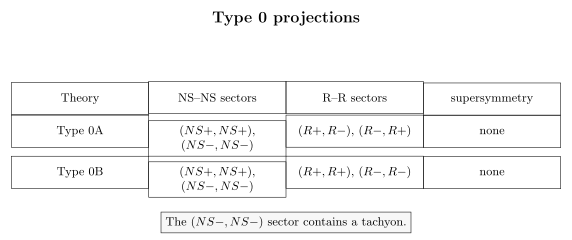
Type 0 projections keep the NS tachyon and double the R—R sector. Type 0A and Type 0B differ in how the two Ramond chiralities are paired.
Worldsheet parity
Section titled “Worldsheet parity”For a closed string, worldsheet parity reverses the spatial coordinate on the string:
It exchanges left and right movers:
and similarly for the fermions,
up to signs that depend on the spin structure and detailed convention.
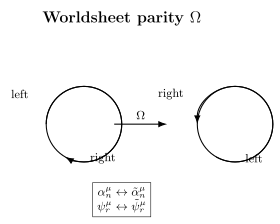
Worldsheet parity reverses the orientation of the closed string and exchanges left-moving and right-moving oscillators.
A closed-string state survives the unoriented projection only if it is invariant under .
Type I as an orientifold of Type IIB
Section titled “Type I as an orientifold of Type IIB”Type IIB is special because its left and right sectors have the same chirality. This makes it possible to quotient by . The resulting closed unoriented theory keeps the -even states and removes the -odd states.
In the NS—NS sector, the projection keeps
and removes the antisymmetric tensor
In the R—R sector, the projection keeps the two-form potential and removes the R—R scalar and the self-dual four-form in the simplest Type I projection. The closed-string sector is therefore ten-dimensional supergravity.
But the orientifold projection also produces tadpoles. Consistency requires adding open strings ending on D9-branes. Tadpole cancellation selects the celebrated gauge group
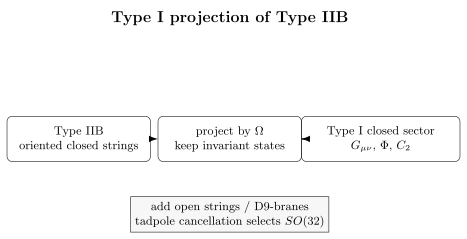
Type I string theory is obtained from Type IIB by worldsheet parity, together with open strings. The perturbatively consistent ten-dimensional theory has gauge symmetry.
Thus Type I theory contains both closed and open strings. Its low-energy limit is ten-dimensional supergravity coupled to super Yang—Mills theory.
Chan—Paton labels
Section titled “Chan—Paton labels”An oriented open string can carry labels at its two endpoints:
A state is then written as
Equivalently, one attaches a matrix to the vertex operator:
The massless vector states are
in the bosonic string, or
in the NS superstring. Their Chan—Paton matrices become spacetime gauge fields,
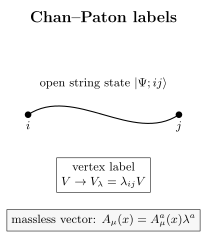
Chan—Paton labels live at the endpoints of open strings. The corresponding matrices become nonabelian gauge indices in spacetime.
For oriented open strings, the natural gauge group is : the Chan—Paton matrices span the algebra of Hermitian matrices.
Orientation reversal and projections
Section titled “Orientation reversal and SO/SpSO/SpSO/Sp projections”For unoriented open strings, worldsheet parity also acts on the Chan—Paton labels:
More generally, one may include a unitary matrix acting on Chan—Paton space:
The sign depends on the worldsheet oscillator part of the state. The massless vector projection gives either an orthogonal or symplectic Lie algebra:
or
where is the symplectic form. In ten-dimensional Type I string theory, the consistent choice is .
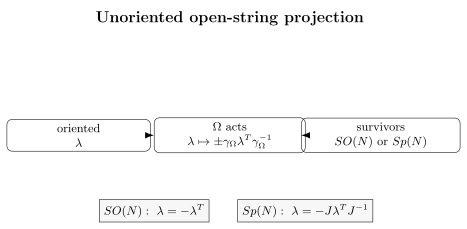
Worldsheet parity transposes Chan—Paton matrices. Depending on the orientifold action, the surviving massless vectors generate an or gauge algebra.
This is the string-theoretic origin of nonabelian gauge symmetry: gauge indices are not put into the worldsheet action as local fields; they arise as labels on open-string endpoints.
Color ordering on the disk
Section titled “Color ordering on the disk”Disk amplitudes know about Chan—Paton matrices through the cyclic order of boundary insertions. For oriented open strings, an -point amplitude decomposes as
where is a color-ordered partial amplitude. The trace records the order in which vertex operators appear around the disk boundary.
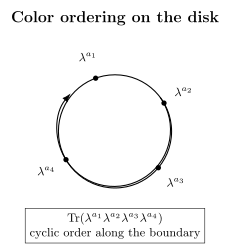
Open-string disk amplitudes produce cyclic traces of Chan—Paton matrices. This is the worldsheet origin of color ordering.
For unoriented strings, one must also include the reversed ordering. This is why the projection to or gauge groups is naturally tied to worldsheet parity.
Gauge-boson vertices with Chan—Paton factors
Section titled “Gauge-boson vertices with Chan—Paton factors”The NS open-string gauge-boson vertex in the picture becomes
In the zero picture,
The Chan—Paton matrix is carried along as an external label. Its algebra determines the spacetime gauge group, while the worldsheet correlator determines the kinematic partial amplitude.
The Type I low-energy theory
Section titled “The Type I low-energy theory”The massless Type I spectrum is the field content of ten-dimensional supergravity coupled to super Yang—Mills:
The number is
The same number appears in anomaly cancellation. This is one of the first signs that string consistency is much more restrictive than ordinary quantum field theory.
Exercises
Section titled “Exercises”Exercise 1
Section titled “Exercise 1”Show that the adjoint dimension of is .
Solution
The Lie algebra consists of antisymmetric real matrices. The number of independent entries is the number of unordered pairs with :
For ,
Exercise 2
Section titled “Exercise 2”For an oriented open-string four-point amplitude, write the Chan—Paton factor associated with the cyclic ordering .
Solution
The cyclic ordering contributes the trace
Because the disk boundary is cyclic, this is equivalent to cyclic rotations such as
The reversed ordering is distinct for oriented open strings but is paired by in unoriented theories.
Exercise 3
Section titled “Exercise 3”Explain why the antisymmetric tensor is projected out by the simplest Type I worldsheet-parity projection.
Solution
The NS—NS massless polarization decomposes into symmetric traceless, antisymmetric, and trace parts:
Worldsheet parity exchanges left and right movers, so it transposes the two polarization indices:
The symmetric graviton and trace dilaton are even. The antisymmetric part changes sign, so it is odd under and is projected out.
Exercise 4
Section titled “Exercise 4”Why do Chan—Paton factors produce nonabelian gauge symmetry rather than merely many copies of a photon?
Solution
The open-string vertex operators carry matrices . Disk amplitudes contain ordered products and traces of these matrices:
The noncommutativity of matrix multiplication produces the structure constants of a nonabelian Lie algebra. Equivalently, the massless vector field is matrix-valued,
and its low-energy field strength contains
The commutator term is the hallmark of nonabelian gauge theory.