
Type IIB S-Duality, (p,q) Strings, and the D3-Brane
The previous page derived a striking fact directly from the D-string worldvolume: electric flux on a D1-brane produces a bound state carrying both fundamental-string charge and D-string charge. At its tension is
This formula is too rigid to be an accident. It is the first visible sign of an exact nonperturbative symmetry of type IIB string theory. Type IIB has a special feature not shared by type IIA: it contains both the NS—NS two-form and an R—R two-form , so it can have two different kinds of strings. The fundamental string couples electrically to , while the D-string couples electrically to . The full theory says that these strings are not separate species in the deepest sense. They are different primitive charge vectors in one integral lattice.
The symmetry that acts on this lattice is
Perturbative string theory sees only one corner of this symmetry, because it expands in powers of . S-duality relates that weak-coupling expansion to a strong-coupling expansion in a different set of variables. This is why D-branes are not optional decorations: they are needed for the duality to have anything to act on.
The axio-dilaton and the type IIB coupling
Section titled “The axio-dilaton and the type IIB coupling”The type IIB scalar fields are the dilaton and the R—R axion . They combine into the complex axio-dilaton
in a constant background. The upper half-plane is the natural parameter space. The discrete duality group acts by fractional linear transformations,
Two generators are enough:
They act as
At , the transformation sends to , hence
So is a strong/weak duality. The transformation is the axion shift . The shift is discrete rather than continuous because R—R charge is quantized; changing by one unit is analogous to shifting a four-dimensional theta angle by .
The continuous type IIB supergravity equations have a larger classical covariance, but quantum string theory keeps only . The reason is the same as in electromagnetism with monopoles: once electric and magnetic charges are quantized, only transformations preserving the integral charge lattice survive.
The charge lattice of F1 and D1 strings
Section titled “The charge lattice of F1 and D1 strings”A string carries units of NS—NS string charge and units of R—R string charge. Equivalently, it couples electrically to
Thus
In the convention used here, a charge column transforms as
Therefore the generator maps
which is the F-string/D-string exchange, up to orientation. The generator maps
In particular, a D-string becomes a string after an axion shift. This is the string-theory version of the Witten effect: a magnetic object acquires electric charge when the theta angle is shifted.
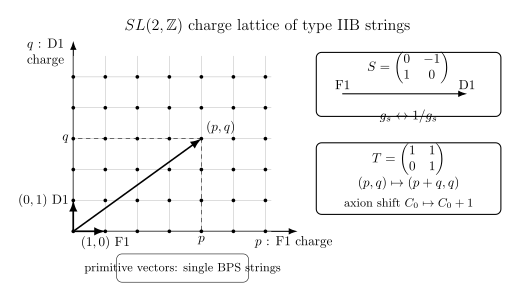
The F1 and D1 charges span an integral lattice. The generator exchanges the two basis directions, while shears the lattice by .
A primitive lattice vector, , labels a single half-BPS bound string. A nonprimitive vector is at threshold for splitting into identical primitive strings. This distinction is important: preserves primitivity, so it maps single BPS strings to single BPS strings.
The string tension
Section titled “The (p,q)(p,q)(p,q) string tension”The general BPS tension formula is most transparent in terms of . With the charge convention above, the string-frame tension is
Equivalently,
At this reduces to
which is exactly the tension obtained from electric flux on D-strings.
There is a small but important subtlety. S-duality acts most simply on the Einstein-frame metric
In Einstein frame, the BPS tension is
This expression is invariant under the simultaneous transformation
Indeed,
The numerator and denominator transform by the same factor, so is unchanged.
The lesson is worth emphasizing. In string frame, the F1 tension is independent of and the D1 tension scales as . In Einstein frame, the two are exchanged by . Duality is not just a relabeling of charges; it also knows how the metric is normalized.
Type IIB field doublets
Section titled “Type IIB field doublets”The same that acts on string charges also acts on the type IIB fields. A convenient convention is
Then the electric coupling is invariant when the charge vector transforms as above. The three-form field strengths form the same doublet, up to the standard axion-modified definition of the R—R field strength:
The Einstein-frame metric and the self-dual five-form field strength are invariant:
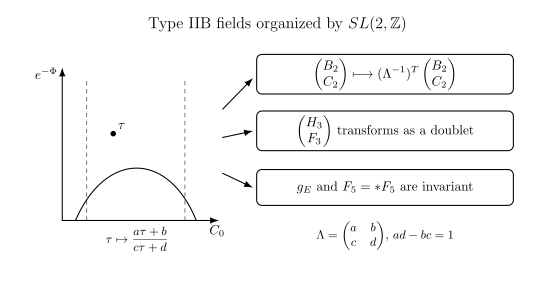
The axio-dilaton transforms by fractional linear transformations. The NS—NS and R—R two-forms form an doublet, while the Einstein metric and self-dual five-form are invariant.
This field organization is one of the cleanest ways to remember the IIB spectrum. Type IIA has R—R potentials of odd degree and no analogous self-dual acting on a pair of two-forms. Type IIB has a chiral field content, a self-dual five-form, and exactly the two two-forms needed for the F1/D1 charge lattice.
Why the D3-brane is self-dual
Section titled “Why the D3-brane is self-dual”The D3-brane is the distinguished brane of type IIB S-duality. A D-brane couples electrically to and magnetically to . For , electric and magnetic descriptions involve the same four-form potential because the five-form field strength is self-dual:
Thus a D3-brane is mapped to a D3-brane under , not to a different-dimensional brane.
The tension also has a special property. The D3-brane string-frame action contains
Using , the four-dimensional volume element contributes a factor . This cancels the explicit in the DBI action, so the Einstein-frame D3 tension is
independent of . This is precisely what one expects for an object invariant under strong/weak duality.
The D3-brane Wess—Zumino coupling also displays the same structure:
The worldvolume gauge field is not inert. Under S-duality it undergoes four-dimensional electric-magnetic duality. This is why the D3-brane can be self-dual even though its worldvolume action contains an ordinary-looking gauge potential : the duality acts nonlocally on but locally on the pair of electric and magnetic field strengths.
D3-branes and super-Yang—Mills
Section titled “D3-branes and N=4\mathcal N=4N=4 super-Yang—Mills”A stack of coincident D3-branes supports four-dimensional super-Yang—Mills theory with gauge group ; the center-of-mass often decouples, leaving the interacting theory. In the conventional normalization used in the AdS/CFT literature,
Therefore the Yang—Mills complex coupling is
So the type IIB predicts the Montonen—Olive duality of super-Yang—Mills:
On the Coulomb branch, separate two D3-branes by a distance . A fundamental string stretched between them is a massive electrically charged -boson with mass
A D-string stretched between them is a magnetic monopole with mass
More generally, a string stretched between the branes is a BPS dyon with mass
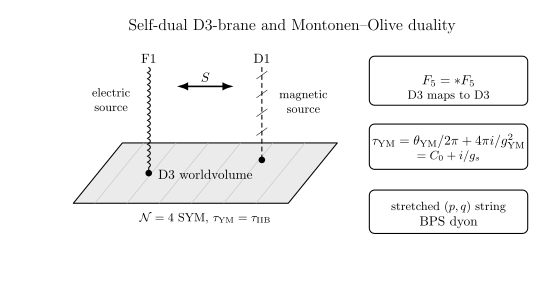
On a D3-brane, F-string endpoints are electric sources and D-string endpoints are magnetic sources. S-duality of type IIB becomes electric-magnetic duality of super-Yang—Mills.
This brane construction turns a deep field-theory statement into a geometric one. Electric particles, magnetic monopoles, and dyons are all the same kind of object in ten dimensions: strings with different charges ending on or stretching between D3-branes.
There is also an instanton entry in the dictionary. D-branes bound to D3-branes correspond to Yang—Mills instantons. Their action is proportional to , matching the instanton factor
This is another reason the equality is not merely a matter of convention; it organizes perturbative gauge fields, monopoles, dyons, and instantons into one duality-covariant structure.
S-duality as a nonperturbative organizing principle
Section titled “S-duality as a nonperturbative organizing principle”S-duality should be used with the right level of respect. It is not visible term by term in the fundamental-string perturbation expansion, because it maps small to large . Nevertheless, it is extremely powerful because many quantities are protected by supersymmetry and charge conservation.
The protected data include:
| Object or datum | Duality-covariant meaning |
|---|---|
| coordinate on the IIB coupling upper half-plane | |
| string | primitive vector in the F1/D1 charge lattice |
| BPS central-charge magnitude | |
| two-form doublet coupling to string charges | |
| D3-brane | self-dual source of |
| SYM on D3 | worldvolume realization of Montonen—Olive duality |
This is also a useful warning about terminology. T-duality is a perturbative worldsheet equivalence associated with compact directions and winding. S-duality is a nonperturbative spacetime equivalence associated with the coupling constant and charge lattice. Both are exact string dualities, but they arise from very different physics.
The next step is to describe D-branes not only by their worldvolume theories but also by the spacetime fields they source. That leads to the supergravity -brane solutions, harmonic functions, near-horizon throats, and eventually to the D3-brane geometry behind AdS/CFT.
Exercises
Section titled “Exercises”Exercise 1: the generator exchanges F1 and D1
Section titled “Exercise 1: the SSS generator exchanges F1 and D1”Let
Show that maps the F-string charge to a D-string charge and maps to when .
Solution
The charge vector transforms as
For the F-string,
which is a D-string. For ,
The transformation gives
so
Thus exchanges weak and strong coupling while also exchanging F1 and D1 charges.
Exercise 2: the general tension at nonzero axion
Section titled “Exercise 2: the general (p,q)(p,q)(p,q) tension at nonzero axion”Starting from
show that
Solution
Substitute the definition of :
The absolute value of a complex number is . Therefore
Multiplying by gives the stated tension.
Exercise 3: invariance of the Einstein-frame tension
Section titled “Exercise 3: invariance of the Einstein-frame tension”Let
Prove that
Solution
Using and ,
Put everything over the common denominator :
The numerator simplifies using :
Hence
Also,
Taking the square root of the second equation gives the same factor in the denominator, so the ratio is invariant.
Exercise 4: the generator and the Witten effect
Section titled “Exercise 4: the TTT generator and the Witten effect”For
show that a D-string charge is mapped to a charge. Explain why this is analogous to the Witten effect.
Solution
The charge transformation is
Therefore
The transformation also shifts . Since is the string-theory analogue of a theta angle for D-string charge, a magnetically charged object acquires one unit of electric charge under a unit theta-angle shift. This is the same logic as the Witten effect in four-dimensional gauge theory.
Exercise 5: why the D3 tension is S-duality invariant
Section titled “Exercise 5: why the D3 tension is S-duality invariant”The D3 DBI action in string frame contains
Use to show that the corresponding Einstein-frame tension is independent of .
Solution
If , then the induced four-dimensional metric on the D3 worldvolume obeys
Taking the square root gives
The DBI prefactor includes , so
Thus the Einstein-frame D3 tension is simply , independent of . This is consistent with the D3-brane being self-dual under .
Exercise 6: D3-branes and the Yang—Mills coupling
Section titled “Exercise 6: D3-branes and the Yang—Mills coupling”Using the standard D3-brane normalization
show that
equals the type IIB axio-dilaton.
Solution
Substitute the two relations:
Therefore
The action on the type IIB axio-dilaton is therefore the Montonen—Olive duality action on the super-Yang—Mills coupling.
Exercise 7: dyons from stretched strings
Section titled “Exercise 7: dyons from stretched (p,q)(p,q)(p,q) strings”Two parallel D3-branes are separated by distance . Explain why a stretched string gives a BPS dyon of mass
Solution
A string stretched between two D3-branes has length in the transverse direction. Since the string is BPS, its energy is its tension times its length:
For a string, the relevant tension is , so
Its endpoints on the D3-branes carry electric charge and magnetic charge under the worldvolume gauge theory. Thus the stretched string appears as a four-dimensional BPS dyon. The special cases and are the electrically charged -boson and the magnetic monopole, respectively.