
3. Horizons, Dissipation, and Quantum Critical Transport
The previous page introduced quantum critical matter as the cleanest many-body setting where holography becomes useful: the boundary theory has no intrinsic scale, finite temperature is the only infrared scale, and the gravitational dual is a neutral AdS black brane. This page explains why that black brane is not just a convenient thermal geometry. It is the mechanism by which the boundary theory dissipates.
The central idea is:
This is one of the main reasons holographic quantum matter is powerful. Many strongly coupled quantum systems have no long-lived quasiparticles, but they still have sharply defined response functions. Holography computes those response functions by solving wave equations in a black-brane geometry. The future horizon imposes a causal boundary condition. The flux into the horizon becomes spectral weight. The damped normal modes of the black brane become poles of retarded Green’s functions. The slowest poles reproduce hydrodynamics.
This page develops that logic carefully. It is the bridge from the static dictionary of quantum critical matter to the real-time transport calculations that dominate holographic condensed matter.
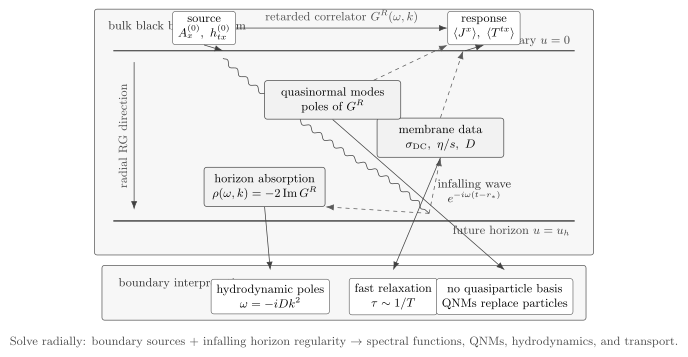
A boundary source creates a bulk perturbation such as or . The retarded prescription fixes the source near the AdS boundary and imposes infalling behavior at the future horizon. Horizon absorption gives spectral weight, while quasinormal frequencies give poles of .
Scope and conventions
Section titled “Scope and conventions”We assume familiarity with the basic source/operator dictionary, finite-temperature black branes, and the idea that retarded correlators are computed by infalling horizon boundary conditions. The quantum-matter-specific ingredients are developed here when needed.
We use the same dimension convention as the previous page:
| Symbol | Meaning |
|---|---|
| number of boundary spatial dimensions | |
| boundary spacetime dimension | |
| bulk spacetime dimension | |
| AdS radius | |
| radial coordinate, with boundary at | |
| horizon radius | |
| boundary temperature |
The main background is the neutral planar AdS black brane,
The temperature and entropy density are
This page focuses on zero-density or particle-hole symmetric quantum critical transport. Finite density is postponed to later pages because, at finite density, electric current overlaps with momentum and the DC transport problem changes qualitatively. At zero density, the core horizon logic is already visible without that extra complication.
What transport measures
Section titled “What transport measures”A transport experiment asks a causal question. Apply a small source, wait, and measure the response. If a source couples to an operator through
then linear response is governed by the retarded Green’s function
The step function is the point. It enforces causality. Retarded response knows about what happens after the source is applied, not before.
The spectral density is
up to the sign convention for Fourier transforms. For positive frequency, the spectral density measures the ability of the thermal state to absorb energy from the perturbation.
For a conserved current, the optical conductivity is obtained from
possibly after subtracting contact terms. For the stress tensor, the shear viscosity is
These are field-theory definitions. Holography turns them into gravitational boundary-value problems.
The horizon as a causal boundary condition
Section titled “The horizon as a causal boundary condition”Let be a bulk fluctuation dual to some boundary operator . We take a Fourier mode
The bulk equation has two kinds of boundary data. Near , the leading term fixes the source and the subleading term fixes the response. Near , the physical retarded solution must be smooth on the future horizon.
To see what this means, define the tortoise coordinate by
Near the horizon, set
Since , we obtain
The ingoing Eddington-Finkelstein coordinate is
A mode smooth on the future horizon behaves as . Therefore, in the original Schwarzschild-like coordinates,
The outgoing solution behaves as
The retarded prescription chooses the first one. This is not an arbitrary convention. It is the bulk expression of causality: the future horizon absorbs perturbations. It does not emit a response to a source placed on the boundary.
From the on-shell action to
Section titled “From the on-shell action to GRG_RGR”Near the boundary, a scalar fluctuation dual to an operator of dimension has the schematic expansion
The retarded Green’s function is obtained by solving the radial equation with:
- fixed source at the boundary,
- infalling behavior at the future horizon,
- holographic renormalization near .
Schematically,
A more invariant formulation uses radial canonical momentum. Suppose the quadratic action for a fluctuation has the form
The radial canonical momentum is
After counterterms are included, the renormalized one-point function is obtained from the boundary value of this canonical momentum:
Thus
This viewpoint is especially useful for transport. In low-frequency limits, the radial flow of often simplifies, and horizon data become enough to determine DC coefficients.
Spectral weight as horizon absorption
Section titled “Spectral weight as horizon absorption”For a scalar fluctuation, the radial flux has the schematic form
The flux is conserved radially when the fluctuation equation is real and linear. Evaluating it at the boundary relates it to the imaginary part of . Evaluating it at the horizon shows that infalling waves carry flux into the black brane.
Thus
This is why black branes are dissipative objects. A perturbation sent from the boundary can disappear through the horizon. In the boundary theory, the same process is thermal absorption and loss of phase coherence.
The Euclidean problem hides this. Euclidean regularity is enough for thermal equilibrium quantities and Matsubara correlators, but real-time transport requires a Lorentzian causal prescription. The future horizon supplies it.
Current response and quantum critical conductivity
Section titled “Current response and quantum critical conductivity”Consider a conserved current in a neutral quantum critical state. The dual field is a bulk Maxwell field with action
At zero density, the background gauge field vanishes:
To compute the optical conductivity, perturb
Near the boundary, is the source. The electric field is
with our Fourier convention . The response is . Therefore
At zero density, does not overlap with the conserved momentum in the way it does at finite density. Therefore a perfectly translation-invariant quantum critical state can have finite DC conductivity. This is a major conceptual point:
For the simple Maxwell action above, the membrane formula gives
Since ,
This agrees with dimensional analysis. In spatial dimensions, conductivity is dimensionless:
For a Maxwell field in , electromagnetic self-duality gives a stronger leading-order result:
at zero momentum. This frequency independence is special to the simplest model. It is not a universal prediction of holography. Higher-derivative interactions, charged matter, finite density, finite coupling corrections, and finite- corrections can all modify it.
Diffusion from conductivity and susceptibility
Section titled “Diffusion from conductivity and susceptibility”Charge conservation gives
At long wavelengths, a neutral system has Fick’s law
Together these imply
so the retarded density correlator has a diffusion pole
The diffusion constant is related to the conductivity by the Einstein relation
For the neutral black brane with the Maxwell action above, the static Maxwell equation gives, for ,
The charge density is the radial electric flux. With the normalization above,
so
Using the horizon conductivity,
The scaling is the key point. A diffusion constant has dimensions of length squared over time. In a relativistic critical theory, the velocity scale is order one and the only time scale is .
Stress-tensor response and shear viscosity
Section titled “Stress-tensor response and shear viscosity”The stress tensor is dual to the metric. To compute shear viscosity, perturb the metric by
At zero spatial momentum, this fluctuation obeys the same equation as a minimally coupled massless scalar in the black-brane background. The Kubo formula is
For two-derivative Einstein gravity with a regular horizon, the result is
This result is famous, but it should be interpreted with care. It is not a theorem about all quantum field theories. It is a universal result for a broad class of holographic theories whose bulk dynamics is governed by two-derivative Einstein gravity. Higher-derivative corrections, anisotropy, explicit symmetry breaking, and finite-coupling effects can change it.
The robust lesson is that a strongly coupled quantum critical plasma can behave as an almost perfect fluid. The viscosity is not set by a long quasiparticle mean free path. It is set by entropy density and the thermal time scale.
Hydrodynamic quasinormal modes
Section titled “Hydrodynamic quasinormal modes”Hydrodynamics is the effective theory of conserved quantities. In the bulk, hydrodynamic modes are black-brane quasinormal modes whose frequencies approach zero as .
Charge diffusion
Section titled “Charge diffusion”The charge diffusion pole is
It is a Maxwell quasinormal mode. It is slow because charge is conserved.
Shear diffusion
Section titled “Shear diffusion”A transverse momentum perturbation has
At zero chemical potential,
For two-derivative Einstein gravity,
Longitudinal energy and momentum perturbations produce sound:
For a conformal fluid in boundary spacetime dimensions,
The bulk viscosity vanishes in a conformal fluid. With the convention above for ,
for the simplest Einstein holographic plasma at zero density.
These hydrodynamic poles are universal in form. Their coefficients encode the dynamics.
Quasinormal modes are not quasiparticles
Section titled “Quasinormal modes are not quasiparticles”The terminology is treacherous. A quasinormal mode is a damped solution of a black-brane fluctuation equation satisfying boundary normalizability and infalling horizon conditions. It is a pole of a retarded Green’s function.
A quasiparticle is a long-lived excitation that can be counted approximately as a particle. A quasiparticle pole lies close to the real axis:
Generic black-brane quasinormal modes do not have this property. Their real and imaginary parts are both of order , or they may even be purely damped:
Hydrodynamic modes become long-lived as , but that is because conservation laws protect them. It is not evidence of weak coupling.
Thus holographic quantum matter replaces a quasiparticle expansion with a different analytic structure:
Scaling forms for quantum critical transport
Section titled “Scaling forms for quantum critical transport”At a relativistic quantum critical point, temperature is the only infrared scale. Dimensional analysis then fixes the form of many transport functions.
Conductivity has dimension in spatial dimensions. Therefore
Diffusion constants scale as
Viscosity scales like entropy density:
These scaling laws do not determine the full functions . They only constrain them. Holography computes the functions by solving radial equations in the black-brane background.
This distinction matters. Scaling can tell us that is dimensionless in dimensions. It cannot tell us whether is constant, has peaks, has zeros, or receives large corrections from irrelevant operators. The geometry supplies the missing dynamical information.
Horizon universality and its limits
Section titled “Horizon universality and its limits”Many DC transport coefficients can be written in terms of horizon data. This is the membrane paradigm in holographic language. The radial flow from the boundary to the horizon becomes especially simple at low frequency, and regularity at the future horizon fixes the answer.
Typical examples are:
| Boundary quantity | Bulk fluctuation | Horizon input |
|---|---|---|
| at zero density | effective Maxwell coupling at the horizon | |
| horizon area density | ||
| sector | plus susceptibility | |
| hydrodynamic damping | metric/gauge perturbations | horizon regularity plus constraints |
But horizon universality has limits. The horizon often controls dissipation, but the full geometry controls sources, responses, susceptibilities, counterterms, operator normalizations, and UV completion. A horizon formula without the dictionary is not yet a field-theory answer.
Worked example: charge diffusion in the neutral black brane
Section titled “Worked example: charge diffusion in the neutral black brane”The simplest complete example is charge diffusion. Start from
The horizon formula gives
To compute , solve the static equation for with and regularity :
The solution is
The radial electric flux gives
hence
Therefore
This example shows the division of labor:
- horizon data fix ,
- the bulk radial profile fixes ,
- hydrodynamics fixes .
A trustworthy holographic calculation is usually a chain of such steps, not a single isolated formula.
Common pitfalls
Section titled “Common pitfalls”Pitfall 1: treating the infalling condition as arbitrary
Section titled “Pitfall 1: treating the infalling condition as arbitrary”The infalling condition is the Lorentzian causal prescription for retarded response. Outgoing behavior computes a different analytic object. A mixed boundary condition corresponds to a different real-time setup.
Pitfall 2: confusing zero-density conductivity with metallic DC transport
Section titled “Pitfall 2: confusing zero-density conductivity with metallic DC transport”At zero density, current can relax without momentum relaxation because it need not overlap with total momentum. At finite density, current generally overlaps with momentum, and a perfectly translation-invariant metal has a singular DC response.
Pitfall 3: calling all quasinormal modes quasiparticles
Section titled “Pitfall 3: calling all quasinormal modes quasiparticles”A quasinormal mode is a pole of . A quasiparticle is a long-lived particle-like excitation. Most black-brane quasinormal modes are not quasiparticles.
Pitfall 4: overgeneralizing
Section titled “Pitfall 4: overgeneralizing η/s=1/(4π)\eta/s=1/(4\pi)η/s=1/(4π)”The ratio is universal in two-derivative Einstein gravity with regular horizons. It is not universal in arbitrary quantum field theories or arbitrary holographic models.
Pitfall 5: saying that the horizon determines everything
Section titled “Pitfall 5: saying that the horizon determines everything”The horizon controls many dissipative quantities. The boundary conditions, counterterms, susceptibilities, and operator normalizations still require the full bulk solution.
Summary
Section titled “Summary”The main lessons are:
- A thermal quantum critical state is represented by a neutral black brane.
- Retarded response is computed by imposing infalling behavior at the future horizon.
- The imaginary part of is tied to flux into the horizon.
- Quasinormal modes are poles of retarded correlators.
- Hydrodynamic QNMs are slow because of conservation laws.
- Generic nonhydrodynamic QNMs are fast, damped thermal excitations rather than quasiparticles.
- At zero density, a translation-invariant quantum critical state can have finite DC conductivity.
- In simple Einstein-Maxwell holography,
- In two-derivative Einstein gravity,
The next major step is finite density. Then the black brane becomes charged, current overlaps with momentum, and transport develops Drude weights, incoherent conductivities, and new infrared scaling structures.
Exercises
Section titled “Exercises”Exercise 1: the infalling exponent
Section titled “Exercise 1: the infalling exponent”Near the horizon, let and . Derive
Solution
The tortoise coordinate is defined by
Near the horizon, , so and . Hence
Integrating,
using . The infalling coordinate is . A smooth infalling wave is , so
Exercise 2: conductivity scaling
Section titled “Exercise 2: conductivity scaling”Show by dimensional analysis that a relativistic quantum critical theory in spatial dimensions has
Solution
The current couples as
The gauge potential has dimension , since it appears in . The integral has dimension . Therefore .
The electric field has dimension , since . Ohm’s law gives
At a relativistic fixed point, is the only infrared scale and has energy dimension one. Therefore
Exercise 3: diffusion from conductivity and susceptibility
Section titled “Exercise 3: diffusion from conductivity and susceptibility”Using
show that
Solution
The Einstein relation gives
Substitution gives
Since ,
Therefore
Exercise 4: shear diffusion
Section titled “Exercise 4: shear diffusion”For a neutral conformal plasma, use
to derive .
Solution
Using ,
Then
With ,
Exercise 5: why hydrodynamic poles are long-lived
Section titled “Exercise 5: why hydrodynamic poles are long-lived”Explain why the diffusion pole
is long-lived at small even in a strongly coupled theory without quasiparticles.
Solution
A conserved density obeys
If the constitutive relation is , then
For a Fourier mode ,
so
As , the decay rate goes to zero because a homogeneous conserved density cannot relax. This long lifetime follows from conservation, not from weakly coupled quasiparticles.
Further reading
Section titled “Further reading”For broader context, see Sean Hartnoll, Andrew Lucas, and Subir Sachdev, Holographic Quantum Matter; Jan Zaanen, Yan Liu, Ya-Wen Sun, and Koenraad Schalm, Holographic Duality in Condensed Matter Physics; Martin Ammon and Johanna Erdmenger, Gauge/Gravity Duality: Foundations and Applications; and Makoto Natsuume, AdS/CFT Duality User Guide.
The conceptual chain to remember is: