
15. Anomalies, Weyl Semimetals, and Chiral Transport
A magnetic field can produce ordinary Hall response even when every current is conserved. An anomaly is different. It says that a symmetry that appears to exist classically is not a true quantum symmetry once the theory is coupled to background fields. In quantum matter this is not merely a formal ultraviolet statement. It can determine real low-energy transport coefficients.
The canonical example is the chiral anomaly. In a relativistic theory with vector and axial currents, a parallel electric and magnetic field can pump axial charge:
This equation is the seed of the chiral magnetic effect, chiral vortical effect, anomalous Hall response, and the anomaly-induced contribution to longitudinal magnetoconductivity in Weyl semimetals. Holographically, the same information is encoded by Chern-Simons terms in the bulk action. A five-dimensional Chern-Simons coupling is not a decorative higher-derivative correction. It is the bulk memory of a boundary triangle anomaly.
This page follows the magnetic-response page. That page treated ordinary Hall and magnetotransport. This page treats anomaly-induced transport. The distinction matters:
whereas
The prerequisite is the standard AdS/CFT dictionary and the earlier pages on finite density, transport, and magnetic response.
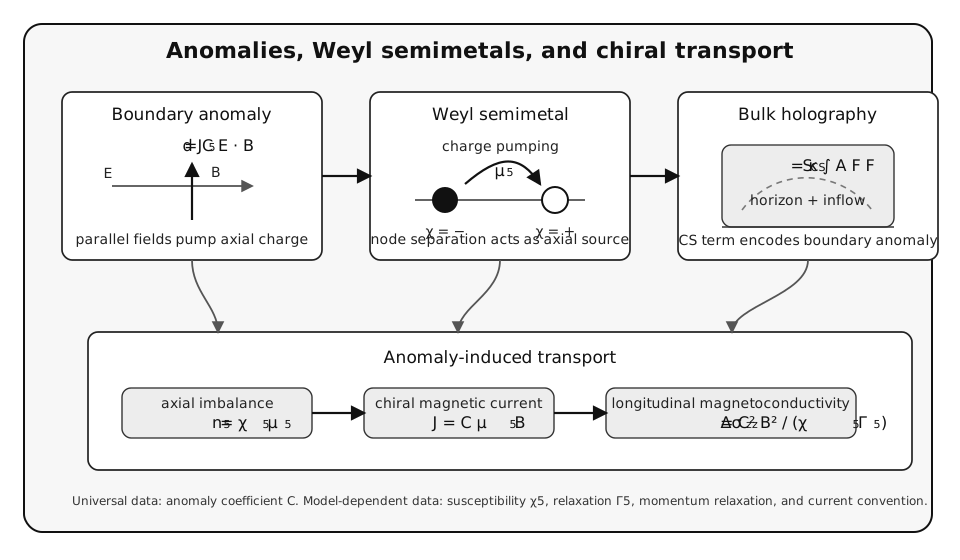
Anomaly-induced transport has three linked descriptions. In the boundary theory, parallel and pump axial charge. In a Weyl semimetal, this is the charge transfer between Weyl nodes. In the bulk, a Chern-Simons term couples radial flow, horizon regularity, and boundary anomalous currents.
1. What is the physical question?
Section titled “1. What is the physical question?”A clean relativistic plasma at finite density already has complicated transport. With magnetic field, conductivity becomes a tensor. With momentum conservation, DC transport can be singular. With disorder or lattices, momentum can relax. All of that was already present before anomalies entered.
Anomalies add a new kind of structure. They say that some transport coefficients are constrained by short-distance quantum data. In particular, if a current has an anomaly, the divergence of that current is not zero in background gauge fields. For an axial current in dimensions, the schematic form is
Here is the anomaly coefficient. In condensed-matter language, this equation appears in Weyl semimetals as charge pumping between Weyl nodes of opposite chirality. In holography, it appears because the bulk Maxwell equations are modified by a Chern-Simons term.
The basic questions are:
- Which current is anomalous?
- Which current is exactly conserved?
- Which response is fixed by the anomaly coefficient?
- Which response also depends on relaxation, disorder, horizon dynamics, or the thermodynamic ensemble?
- Which object is a contact term, and which object is a transport coefficient?
A trustworthy treatment of anomalous transport answers all five questions. Most mistakes in this subject come from answering only the third.
2. Vector and axial currents
Section titled “2. Vector and axial currents”The simplest anomaly setup has two symmetries. One is a vector symmetry, whose charge is the physical electric charge. The other is an axial symmetry, whose charge distinguishes left-handed and right-handed fermions.
It is useful to define right- and left-handed currents and , then
The corresponding sources are a vector gauge field and an axial gauge field . Their field strengths are
In a relativistic high-energy theory, may be dynamical electromagnetism or a background source. In holographic condensed-matter applications, it is usually treated as a background field for a global symmetry, unless one explicitly gauges the boundary . Either way, the vector current is the physical electric current and must usually be conserved:
The axial current need not be conserved. In the presence of vector electric and magnetic fields,
The ellipsis can include axial gauge-field contributions, explicit axial-symmetry breaking, and mixed gauge-gravitational anomaly terms. In a material, axial charge is also relaxed by scattering between Weyl nodes, so the effective low-energy equation is often
Here is axial charge density and is an axial charge relaxation rate. The anomaly pumps axial charge. Relaxation removes it. Both are necessary for finite steady-state magnetotransport.
3. The anomaly as a quantum statement
Section titled “3. The anomaly as a quantum statement”Classically, a massless Dirac fermion in four dimensions has independent phase rotations of its right- and left-handed components. The vector and axial currents are both conserved at the classical level. Quantum mechanically, this cannot remain true once the fermion is coupled to background gauge fields. The triangle diagram forces an anomaly.
For a single Dirac fermion of unit vector charge, the familiar normalization is often written as
up to conventions for the current normalization and gauge coupling. More generally, the right side is , with determined by the charges and representations of the microscopic fermions.
The important point is not the particular convention-dependent prefactor. The important point is that is not a phenomenological relaxation parameter. It is a quantum anomaly coefficient. In a consistent theory it is fixed once the microscopic charges are specified.
This has two consequences.
First, an anomaly coefficient is robust. It cannot be continuously renormalized by interactions in the same way as a scattering time.
Second, an anomaly equation is not by itself a full transport formula. To get a measured conductivity, one must also know susceptibilities, relaxation rates, thermodynamic conditions, and whether momentum is conserved. Anomalies fix part of the answer, not every piece of the experiment.
4. Weyl semimetals as anomaly laboratories
Section titled “4. Weyl semimetals as anomaly laboratories”A Weyl semimetal is a gapless phase in which low-energy bands touch at isolated Weyl nodes. Near a node, the effective Hamiltonian has the form
where is the chirality of the node, is momentum measured from the node, and is a velocity. A lattice theory cannot have an isolated single Weyl node; nodes come in pairs or larger sets with total chirality zero.
If two Weyl nodes of opposite chirality are separated in momentum space by , the low-energy description contains an axial background field. Roughly,
If they are separated in energy by , then
The vector electromagnetic field couples equally to both nodes. The axial field couples with opposite signs. In this language, the Weyl-node separation is not an ordinary charge density. It is a background source that encodes the relative displacement of left- and right-handed low-energy fermions.
A parallel electric and magnetic field pumps charge from one node to the other:
This is the condensed-matter realization of the chiral anomaly. The process is intuitive in the lowest Landau level: the magnetic field produces one-dimensional chiral channels, and the electric field accelerates charges along those channels. The direction of propagation depends on chirality.
The anomaly is exact, but a real material is not an isolated pair of perfectly conserved Weyl cones. Lattice regularization, disorder, phonons, finite chemical potential, finite temperature, and intervalley scattering all matter for transport. Holography is useful because it gives controlled strongly coupled models where these ingredients can be separated.
5. Chiral magnetic and chiral separation effects
Section titled “5. Chiral magnetic and chiral separation effects”The chiral magnetic effect is the statement that an axial chemical potential can induce a vector current along a magnetic field:
The chiral separation effect is the companion statement that a vector chemical potential can induce an axial current along a magnetic field:
Here
These equations are best understood as constitutive relations in anomalous hydrodynamics. They say that, once the system has chemical potentials and a magnetic field, symmetry and the anomaly allow nondissipative currents along .
The word nondissipative is important. These currents are not ordinary Ohmic currents of the form . They are equilibrium or near-equilibrium currents constrained by anomaly data. However, in a finite sample or lattice model, one must be precise about equilibrium currents, transport currents, and boundary conditions. Some apparent chiral magnetic currents vanish in strict equilibrium after the correct current definition and regularization are used. Nonequilibrium axial imbalance, by contrast, gives a robust transport mechanism.
The safest practical statement is:
In a steady state created by , this becomes a contribution to longitudinal magnetoconductivity.
6. Anomaly-induced longitudinal magnetoconductivity
Section titled “6. Anomaly-induced longitudinal magnetoconductivity”The cleanest derivation of anomaly-induced magnetoconductivity uses a rate equation. Consider a -dimensional system with electric and magnetic fields parallel to the direction:
The anomaly pumps axial charge:
In a steady state,
For small axial chemical potential,
where is the axial susceptibility. Therefore
The chiral magnetic effect gives
Thus the anomaly-induced contribution to longitudinal conductivity is
This formula is conceptually valuable because every factor has a clear meaning:
| Factor | Meaning |
|---|---|
| anomaly coefficient | |
| magnetic-field enhancement of axial pumping and chiral magnetic current | |
| thermodynamic cost of creating axial imbalance | |
| axial charge relaxation rate |
The formula also shows what the anomaly does not determine. It does not determine by itself. It does not determine by itself. It does not determine the ordinary conductivity background. It gives a universal structure that becomes a measured response only after the slow variables and relaxation channels are specified.
In a clean translationally invariant charged system, one must additionally confront momentum conservation. The total DC conductivity may already be singular because current overlaps with momentum. The anomaly-induced contribution above is most cleanly isolated when momentum relaxation is present or when one studies an incoherent current that does not overlap with momentum.
7. Vorticity and the chiral vortical effect
Section titled “7. Vorticity and the chiral vortical effect”A magnetic field is not the only pseudovector available in a fluid. A moving fluid has vorticity
where is the fluid velocity. In anomalous hydrodynamics, currents can contain terms proportional to and :
Here is the dissipative electric-field combination transverse to . The coefficients and are anomaly-related chiral magnetic and chiral vortical coefficients.
In a simple one-current theory, the schematic dependence is
where is associated with a mixed gauge-gravitational anomaly. The exact numerical coefficients depend on conventions and on whether one uses consistent or covariant currents.
The appearance of a term in the vortical response is one of the most striking facts about anomalous hydrodynamics. It is also one of the most convention-sensitive. Holographically, it comes from a mixed gauge-gravitational Chern-Simons term. A careless treatment of boundary terms, current definitions, or magnetization contributions can change what one calls the current while leaving the physical anomaly unchanged.
8. Holographic Chern-Simons terms
Section titled “8. Holographic Chern-Simons terms”In a -dimensional boundary theory, gauge anomalies are encoded by five-dimensional bulk Chern-Simons terms. A minimal schematic holographic action contains vector and axial gauge fields and :
The gauge Chern-Simons term has the schematic structure
The axial field appears because the axial current is anomalous. Under an axial gauge transformation , the Chern-Simons action changes by a boundary term:
This boundary variation is the anomaly of the axial current. The bulk action is therefore not invariant under axial gauge transformations in the presence of a boundary; that failure of invariance is exactly the boundary anomaly.
For anomalous vortical response one adds a mixed gauge-gravitational term:
This term is more technically involved because it modifies both gauge and metric variations. It is also where many convention errors originate. For a clean lecture-note treatment, the key point is this:
They do not replace the rest of the transport calculation. One still needs regular horizon boundary conditions, correct current definitions, and the thermodynamic ensemble.
9. Consistent and covariant currents
Section titled “9. Consistent and covariant currents”Anomalous theories contain a subtle distinction between consistent and covariant currents.
The consistent current is obtained by varying the generating functional with respect to the source:
It satisfies the Wess-Zumino consistency conditions. However, it need not transform covariantly under gauge transformations.
The covariant current is obtained by adding a local Bardeen-Zumino polynomial:
It transforms covariantly but is not simply the variation of a single local generating functional. In holography, this distinction appears because Chern-Simons terms contribute boundary pieces to the radial canonical momentum. Adding boundary counterterms can shift the current by local terms.
For vector and axial symmetries, one often chooses Bardeen counterterms so that the vector current is exactly conserved:
This is the natural choice when is the physical electric current. A different convention can move pieces of the anomaly between currents. It should not change gauge-invariant physical observables, but it can change intermediate formulas.
This is why anomalous transport formulas must always specify the current convention. A coefficient quoted without saying whether the current is consistent or covariant is incomplete.
10. Holographic Weyl semimetal models
Section titled “10. Holographic Weyl semimetal models”A holographic Weyl semimetal model tries to describe a strongly coupled analogue of a Weyl semimetal using a bulk axial gauge field and a field that can gap the Weyl nodes. A minimal bottom-up model has the following ingredients:
| Boundary quantity | Bulk ingredient |
|---|---|
| vector charge current | vector gauge field |
| axial current / node separation | axial gauge field |
| Weyl-node separation | boundary value of spatial |
| mass deformation mixing nodes | charged scalar or symmetry-breaking field |
| anomaly | Chern-Simons term |
| temperature and dissipation | black-brane horizon |
A typical model turns on a spatial axial source
and a scalar source that tends to gap the Weyl fermions. The ratio controls whether the low-energy state behaves like a topological Weyl semimetal or a trivial semimetal/insulator analogue.
The topological response is encoded in an anomalous Hall conductivity. In weakly coupled Weyl semimetals, the anomalous Hall response is proportional to the separation of Weyl nodes. Holographically, the analogous coefficient is determined by the radial profile of the axial gauge field and the Chern-Simons coupling. In many models the IR value of plays the role of an effective low-energy node separation.
This is a beautiful example of holographic RG flow. A UV source is not automatically the IR topological response. The bulk solution decides how much of the axial separation survives to low energies.
The authoritative caution is:
Its value is that it cleanly separates anomaly coefficients, relaxation, strong coupling, and topological response in a calculable framework.
11. Anomalies versus explicit symmetry breaking
Section titled “11. Anomalies versus explicit symmetry breaking”An anomaly is not the same thing as explicit breaking by a mass term.
If the axial symmetry is anomalous, then even with no axial mass term one has
If the axial symmetry is explicitly broken, for example by a mass deformation, then the divergence also contains an operator term:
In an effective hydrodynamic treatment, explicit breaking appears as relaxation of axial charge. In a holographic model, it can appear through a scalar field charged under the axial gauge field, through boundary conditions, or through couplings that make the axial gauge field massive in the IR.
The distinction matters for transport. Without axial relaxation, pumps axial charge indefinitely. A steady-state DC magnetoconductivity requires a sink for axial charge. With too much axial relaxation, the anomaly-induced enhancement is suppressed.
Thus the anomaly creates the channel, but relaxation determines the steady-state response.
12. Holographic computation of anomalous conductivities
Section titled “12. Holographic computation of anomalous conductivities”The linear-response calculation follows the same general logic as other holographic transport computations, with additional Chern-Simons mixing.
One chooses a charged black-brane background with gauge fields and possibly scalar profiles. Then one perturbs the relevant components. For example, to compute vector conductivity along a magnetic field, one studies fluctuations such as
and metric perturbations if momentum participates. The Chern-Simons term couples vector and axial sectors when .
The boundary conditions are:
- infalling regularity at the future horizon for retarded response,
- fixed sources at the boundary,
- correct extraction of one-point functions including Chern-Simons and Bardeen-Zumino terms.
The resulting retarded Green’s functions determine the conductivity matrix. In the hydrodynamic regime, one should recover the anomaly-induced pole structure associated with slow axial charge:
The DC limit gives the magnetoconductivity contribution.
This formula also explains why the order of limits matters. At fixed and small , taking produces a large response. Taking first gives a singularity. A clean anomalous transport calculation must say which limit is being taken.
13. Topological response and anomaly inflow
Section titled “13. Topological response and anomaly inflow”Chern-Simons terms are topological in the sense that they are metric-independent, but their physical consequences can appear in ordinary transport observables. The anomaly-inflow picture is useful: the non-conservation of a boundary current is compensated by inflow from the bulk Chern-Simons term.
In holography, radial direction plays the role of energy scale. A Chern-Simons term can make a boundary current depend on data throughout the bulk, but the anomaly coefficient itself is fixed. The radial flow of a current is then not just dissipative RG running; it can include anomaly inflow.
For example, the radial Maxwell equation with a Chern-Simons term has the schematic form
where is the radial canonical momentum conjugate to the boundary gauge field. Without the Chern-Simons term, is radially conserved in simple DC setups. With the Chern-Simons term, radial flow itself carries anomaly information.
This is the bulk version of a boundary fact: anomalous currents cannot always be understood as ordinary conserved fluxes.
14. What is universal, and what is model-dependent?
Section titled “14. What is universal, and what is model-dependent?”The anomaly coefficient is universal once the microscopic charge assignment is fixed. The existence of anomaly-induced terms in hydrodynamics is robust. But many quantities are model-dependent.
| Quantity | Status |
|---|---|
| anomaly coefficient | fixed by microscopic charges or bulk Chern-Simons coupling |
| form of anomaly equation | universal within a current convention |
| chiral magnetic and vortical structures | symmetry- and anomaly-constrained |
| susceptibility | thermodynamic, model-dependent |
| axial relaxation | model- and disorder-dependent |
| ordinary background conductivity | dynamical, model-dependent |
| exact phase diagram of holographic Weyl semimetal | model-dependent |
| relation to a specific material | phenomenological, not automatic |
This table is the proper epistemic stance. Holography gives controlled strongly coupled worlds with anomalies. Some structures are exact and protected. Others are mechanisms or analogues.
A common overclaim is to say that holography predicts the magnetoresistance of a Weyl semimetal. A better statement is that holography gives a strongly coupled framework in which anomaly-induced magnetotransport, relaxation, horizon dissipation, and topological response can be computed together.
15. Worked example: anomaly-induced conductivity
Section titled “15. Worked example: anomaly-induced B2B^2B2 conductivity”Let us derive the standard contribution again, now emphasizing assumptions.
Assume:
- there is a vector electric field parallel to a magnetic field ,
- the anomaly equation is ,
- axial charge is small enough that ,
- the vector current contains the chiral magnetic term ,
- momentum effects are either relaxed or removed from the current under consideration.
In steady state,
so
Then
Thus
The derivation is short, but it is not empty. It tells us exactly what needs to be computed in a holographic model:
- the anomaly coefficient from the Chern-Simons coupling,
- the axial susceptibility from equilibrium thermodynamics,
- the axial relaxation rate from the lowest axial charge relaxation mode,
- the ordinary background conductivity from the full linear-response system.
This is the clean bridge between anomaly hydrodynamics and holographic computation.
16. Common pitfalls
Section titled “16. Common pitfalls”Pitfall 1: Treating as a force rather than a source of axial charge.
The anomaly pumps axial charge. The resulting axial chemical potential can then produce a chiral magnetic current. The two-step structure is important.
Pitfall 2: Forgetting axial relaxation.
Without relaxation, axial charge grows indefinitely in a constant background. A steady DC formula needs or another sink.
Pitfall 3: Confusing the vector and axial currents.
The physical electric current should usually be conserved. The axial current is the anomalous one. Conventions that obscure this lead to wrong physical interpretations.
Pitfall 4: Ignoring consistent versus covariant currents.
Chern-Simons terms shift boundary currents by local polynomials. Always specify which current is being used.
Pitfall 5: Calling every magnetoconductivity anomaly-induced.
A correction can arise from ordinary magnetotransport, disorder, orbital effects, or hydrodynamics. The anomaly-induced piece has a specific dependence on , , and .
Pitfall 6: Treating holographic Weyl semimetals as literal band structures.
They are strongly coupled analogues with topological and anomaly data. They are not weakly coupled band theories in disguise.
Pitfall 7: Mixing equilibrium and nonequilibrium CME statements.
Equilibrium chiral magnetic currents are subtle and current-convention dependent. Nonequilibrium axial imbalance is the cleaner transport setting.
Pitfall 8: Forgetting momentum conservation.
At finite density, exact translations can make DC conductivity singular independently of anomalies. Momentum relaxation or incoherent currents must be specified.
17. Exercises
Section titled “17. Exercises”Exercise 1. Axial charge pumping
Section titled “Exercise 1. Axial charge pumping”Assume the anomaly equation
Solve for with initial condition and constant , , and . What is the steady-state axial chemical potential if ?
Solution
The equation is first order and linear:
With , the solution is
At late times,
Using gives
Exercise 2. Magnetoconductivity from the chiral magnetic effect
Section titled “Exercise 2. Magnetoconductivity from the chiral magnetic effect”Using the steady-state result from Exercise 1 and the chiral magnetic relation
show that the anomaly-induced conductivity correction is
Explain why this contribution is large when is small.
Solution
From Exercise 1,
The chiral magnetic current is therefore
Since conductivity is defined by , we get
The contribution is large when is small because axial charge is almost conserved. The anomaly can then build a large axial imbalance before relaxation removes it.
Exercise 3. Why does not pump axial charge
Section titled “Exercise 3. Why E⊥BE\perp BE⊥B does not pump axial charge”Show that the anomaly source vanishes for perpendicular electric and magnetic fields. What does this imply about anomaly-induced longitudinal magnetoconductivity?
Solution
If , then
The anomaly equation has no pumping term:
in the simple effective description. Therefore a perpendicular electric field does not create axial imbalance through the chiral anomaly. The anomaly-induced conductivity discussed above is a longitudinal effect: it requires an electric field component parallel to the magnetic field.
This does not mean that transverse magnetoresistance vanishes. Ordinary magnetotransport can still occur. It only means that the chiral-anomaly pumping mechanism is absent for .
Exercise 4. Current convention diagnostic
Section titled “Exercise 4. Current convention diagnostic”Suppose two papers quote different chiral magnetic coefficients. One computes a current by varying the generating functional. The other adds a Bardeen-Zumino polynomial before defining the current. Explain why the two results can differ without a physical contradiction.
Solution
The current obtained by varying the generating functional is the consistent current:
It satisfies consistency conditions but may not transform covariantly under gauge transformations. The covariant current is
where is a local Bardeen-Zumino polynomial built from sources. Because is local, it can shift contact terms and apparent transport coefficients.
Therefore two quoted coefficients can differ if the authors use different current conventions. This is not a contradiction if gauge-invariant physical observables agree after all boundary terms, magnetization currents, and source conventions are matched.
Exercise 5. Holographic anomaly inflow
Section titled “Exercise 5. Holographic anomaly inflow”Consider the five-dimensional Chern-Simons term
Under , show that the variation is a boundary term and explain its interpretation.
Solution
The variation is
Using the Bianchi identity , we have
Therefore
In holography, this boundary variation is the anomalous variation of the boundary generating functional. It means that the dual current is not conserved in background gauge fields. This is anomaly inflow: the bulk Chern-Simons term accounts for the boundary anomaly.
18. Takeaways
Section titled “18. Takeaways”The shortest summary is:
For holographic quantum matter, the more useful summary is:
The chiral anomaly gives axial charge pumping proportional to . Chiral magnetic response converts axial imbalance into a vector current along . Together with axial relaxation, this gives
Holographically, is encoded by a Chern-Simons coupling, by thermodynamics, and by the relaxation of the axial charge mode. Weyl semimetal models add a topological layer: axial gauge-field sources represent node separation, scalar deformations can gap the nodes, and the bulk radial flow determines the low-energy topological response.
The next page turns from anomalies to information diagnostics of quantum matter: entanglement, chaos, butterfly propagation, and complexity-like probes.
Further reading
Section titled “Further reading”For a deeper treatment, useful starting points include:
- S. A. Hartnoll, A. Lucas, and S. Sachdev, Holographic Quantum Matter.
- J. Zaanen, Y.-W. Sun, Y. Liu, and K. Schalm, Holographic Duality in Condensed Matter Physics.
- M. Ammon and J. Erdmenger, Gauge/Gravity Duality: Foundations and Applications.
- Reviews on anomalous hydrodynamics, chiral magnetic and vortical effects, and holographic Weyl semimetals.