
Superstring Vertex Operators and Pictures
A string state is not just a vector in a Hilbert space. In the worldsheet path integral it is represented by a local operator inserted on the surface. This is the state-operator correspondence applied to the conformal field theory of , , the ghosts, and the superghosts.
For the bosonic string, the first examples are familiar:
In the RNS superstring there is one new ingredient that becomes central: the same physical state has many representatives labeled by picture number. A massless open-string gauge boson, for example, may be written in the picture as
or in the picture as
in the common CFT normalization. These two operators are not different particles. They are different BRST representatives of the same physical state. The operation that relates them is picture-changing.
This page develops the dictionary systematically. The guiding principle is
The vertex operator must also have the correct ghost number and picture number for the worldsheet amplitude in which it appears.
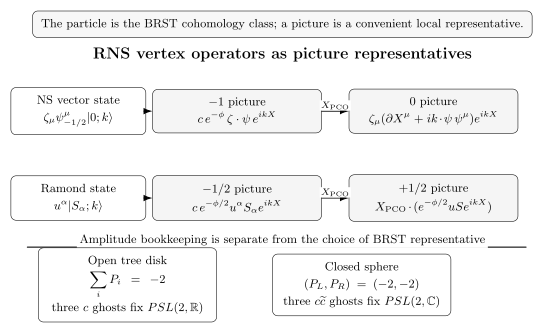
In the RNS formalism a physical state has several picture representatives. The NS and Ramond representatives are often the simplest; picture-changing produces equivalent representatives in other pictures.
Conventions for dimensions
Section titled “Conventions for dimensions”The local matter OPEs are normalized as on the previous pages,
so that the holomorphic matter stress tensor is
For a closed-string chiral factor, this convention gives
with in the displayed OPE. For open-string boundary vertices, the doubling trick gives twice the chiral contraction, and the boundary scaling dimension of the plane wave is
Since in mostly-plus spacetime signature, these formulas reproduce the open-string RNS mass formula
in the NS sector. For example, the unprojected NS ground-state vertex contains , whose boundary dimension is
Requiring boundary dimension gives , or , the NS tachyon. The GSO projection removes this state in the supersymmetric open string.
Superghost bosonization and picture number
Section titled “Superghost bosonization and picture number”The commuting superconformal ghosts are bosonized as
Here and are anticommuting fields of weights and , while is a boson with background charge. The stress tensor of the system is conventionally written
which implies
Several values should become automatic:
The picture number is the charge measured by the zero mode of the picture current. For the simple exponentials above, it is just the exponent :
Thus NS vertices are naturally written in integer pictures, such as and , while Ramond vertices are naturally written in half-integer pictures, such as and .
A crucial global fact is that the background charge produces a picture-number anomaly. On a genus- closed Riemann surface, each chiral sector must carry total picture number
On the sphere this is for the left-movers and for the right-movers. On the disk, an open-string tree amplitude also requires total picture number . This is why a tree-level open-string amplitude with NS external states is often computed with two vertices in the picture and the remaining vertices in the picture.
Integrated and unintegrated vertices
Section titled “Integrated and unintegrated vertices”A vertex operator has two closely related forms.
For an open string on the disk or upper half-plane, an unintegrated vertex has the form
where has boundary dimension . Since has dimension , the full unintegrated insertion has dimension . This is exactly what is needed for an insertion at a fixed point on the boundary.
An integrated open-string vertex is
where has boundary dimension and no ghost. Integrated vertices are used for punctures whose positions are not fixed by conformal symmetry.
For closed strings on the sphere, an unintegrated vertex has the form
where has weights . An integrated closed-string vertex is
The rule of thumb for tree amplitudes is simple:
The remaining vertices are integrated. In BRST language, the relation between the two forms follows from descent. If is BRST closed, then the corresponding integrated operator is obtained by acting with the -ghost zero mode along the modulus direction. Schematically,
so the integral of is BRST invariant up to boundary terms on moduli space.
Open-string NS vertices
Section titled “Open-string NS vertices”Before the GSO projection, the NS ground state is tachyonic. Its simplest unintegrated vertex is
The matter-superghost part has dimension
The condition that this be gives
The GSO projection keeps the opposite NS fermion parity from the tachyon, so this operator is absent in the supersymmetric open-string spectrum.
The first GSO-even NS state is the massless vector. In the picture its unintegrated vertex is
Here is a Chan—Paton generator, is the open-string coupling, and is the polarization. The dimension of is
so dimension one requires
BRST closure also imposes transversality,
The gauge redundancy is
This is not merely a spacetime guess. In the worldsheet theory, the longitudinal polarization is BRST exact. The photon gauge symmetry is therefore a statement about the BRST cohomology of open-string vertex operators.
The corresponding -picture representative is
again in the local CFT normalization. Depending on whether one writes the vertex on the boundary of the upper half-plane or in a purely holomorphic doubled convention, harmless factors of may be redistributed between and . The invariant content is the pair of terms
The first term is the bosonic coupling to the embedding coordinate; the second is required by worldsheet supersymmetry.
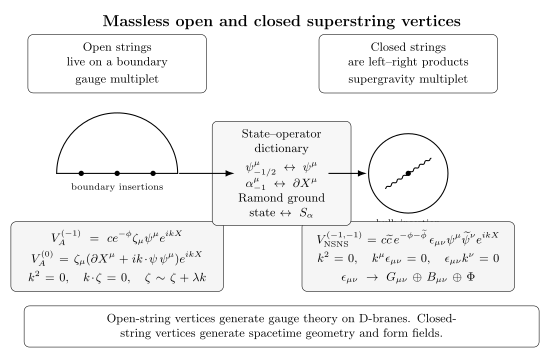
Massless vertices organize the spacetime fields: open-string vectors live on boundaries, while closed-string fields are products of left- and right-moving sectors inserted in the bulk.
Open-string Ramond vertices
Section titled “Open-string Ramond vertices”Ramond ground states are spacetime spinors. The local operator that creates a Ramond branch cut for the worldsheet fermions is the spin field . In ten dimensions its holomorphic dimension is
The natural massless Ramond vertex is in the picture:
The superghost factor has dimension , so
Therefore the plane wave must have zero dimension:
The Ramond physical-state condition becomes the massless Dirac equation. In vertex-operator language it is the condition that the supercurrent OPE have no forbidden singularity:
The GSO projection selects a definite ten-dimensional chirality,
where the sign depends on the theory and on the chosen open-string sector. Together, the GSO-projected NS vector and Ramond spinor form the ten-dimensional super Yang—Mills multiplet on a stack of D-branes.
Closed-string vertices
Section titled “Closed-string vertices”Closed-string vertices are left-right products. The simplest massless NS—NS vertex is
The left-moving factor has dimension , and the right-moving factor has dimension . Thus the plane wave must be massless:
BRST closure gives the transversality conditions
BRST exact states implement the gauge equivalences
The polarization tensor decomposes into the familiar NS—NS spacetime fields:
up to the usual refinement that the dilaton polarization must be chosen transverse modulo gauge transformations.
The mixed sectors give spacetime fermions. In schematic notation,
and similarly for NS—R. These contain the gravitino and dilatino.
The RR sector is represented by a bispinor vertex,
The bispinor is equivalent, via gamma matrices, to a sum of differential-form field strengths:
The allowed degrees are fixed by the chiral GSO projections. Equivalently, type IIA has odd RR potentials , while type IIB has even RR potentials , with the five-form field strength self-dual.
Picture-changing
Section titled “Picture-changing”Picture-changing is generated by the BRST commutator with :
The full picture-changing operator contains matter and ghost terms. Its most important term for simple on-shell vertices is
The ghost terms are essential for exact BRST invariance, but the leading matter term explains the familiar conversion from the picture to the picture.
For a BRST-closed small-Hilbert-space vertex , the picture-changed vertex is
The key OPEs are
and
Multiplying the two OPEs gives a finite limit:
This is precisely the -picture vector vertex.
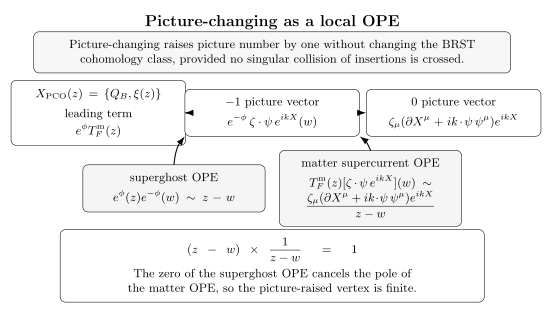
The picture-changing operator raises picture number by one. For the massless vector, the factor cancels the simple pole in the matter supercurrent OPE and leaves the -picture vertex.
Picture-changing is often described as an isomorphism of BRST cohomologies at different pictures. This statement is correct for the standard on-shell cohomology, but it comes with a practical warning: picture-changing operators are local insertions. If a PCO collides with another operator or with a boundary of moduli space, one can encounter contact terms. For elementary tree amplitudes this is usually avoided by choosing convenient fixed pictures from the start.
How BRST closure encodes the physical-state conditions
Section titled “How BRST closure encodes the physical-state conditions”The old covariant quantization conditions were
with an additional constraint in the Ramond sector. In the operator language these conditions become statements about singular terms in OPEs with and , and finally about BRST cohomology.
For the open NS vector, the matter part of the picture operator is
BRST closure of requires to have dimension and to be a superconformal primary. The dimension condition gives
The supercurrent condition gives
The remaining equivalence relation
comes from quotienting by BRST-exact operators. Thus the BRST cohomology contains precisely the transverse photon polarizations.
For the Ramond vertex, the same logic gives
and quotienting by exact states removes unphysical spinor components. In light-cone language this leaves the or of , paired by spacetime supersymmetry with the of the vector.
Useful vertex-operator dictionary
Section titled “Useful vertex-operator dictionary”The following table collects the most commonly used on-shell representatives. For open-string vertices, the displayed operators are boundary insertions. For closed-string vertices, holomorphic and antiholomorphic factors are multiplied.
The table suppresses Chan—Paton factors for open strings and the distinction between integrated and unintegrated closed-string vertices. It also suppresses cocycle factors, which are needed for fully precise mutual locality of spin fields but do not change the physical-state conditions.
Amplitude bookkeeping
Section titled “Amplitude bookkeeping”A well-defined amplitude must satisfy three separate bookkeeping rules.
First, the ghost zero modes must be soaked up. On the disk or sphere this means using three unintegrated vertices. For example, an open-string color-ordered disk amplitude can be organized as
with the three fixed positions removing the volume of .
Second, the total picture number must match the superghost anomaly. For an open-string disk amplitude with NS external states,
A standard choice is
For an amplitude with two Ramond fermions and any number of NS bosons, a common choice is
Third, the vertices must be BRST closed, and any BRST-exact insertion decouples from the amplitude unless there are boundary contributions in moduli space. This is the worldsheet origin of spacetime gauge invariance and of the Ward identities obeyed by string scattering amplitudes.
Exercises
Section titled “Exercises”Exercise 1: dimensions of superghost exponentials
Section titled “Exercise 1: dimensions of superghost exponentials”Using
compute the dimensions of , , , and .
Solution
Substitute the four values of .
For ,
For ,
For ,
For ,
The last result is useful in inverse picture-changing and in discussions of the small versus large Hilbert space.
Exercise 2: mass shell of the open NS vertices
Section titled “Exercise 2: mass shell of the open NS vertices”Use boundary dimensions to show that has , while is massless.
Solution
For an unintegrated open vertex , the operator must have boundary dimension .
For the NS ground-state vertex,
and
Setting gives
Since ,
For the vector,
so
Setting gives , hence .
Exercise 3: picture-changing the vector
Section titled “Exercise 3: picture-changing the vector”Using the leading term , show that picture-changing the picture vector gives the picture vector.
Solution
The relevant OPEs are
and
The factor from the superghost OPE cancels the simple pole from the matter supercurrent OPE. Taking gives
This is the zero-picture vector vertex, up to convention-dependent overall normalization.
Exercise 4: Ramond dimension and the Dirac equation
Section titled “Exercise 4: Ramond dimension and the Dirac equation”Show that the open Ramond vertex is massless by dimension counting. Then state the additional physical-state condition on .
Solution
In ten dimensions the spin field has dimension
The superghost factor has dimension
Therefore
For the full matter-superghost factor to have boundary dimension , the plane wave must have zero dimension:
Thus the state is massless. The Ramond zero-mode constraint gives the spacetime Dirac equation
The GSO projection further chooses one ten-dimensional chirality for .
Exercise 5: picture-number balance
Section titled “Exercise 5: picture-number balance”What picture assignments would you use for the following tree amplitudes?
- A disk amplitude with four external open-string gauge bosons.
- A disk amplitude with two open-string Ramond fermions and two open-string gauge bosons.
- A sphere amplitude with three external NS—NS closed-string states.
Solution
On the disk the total open-string picture number must be .
For four gauge bosons, a standard assignment is
For two Ramond fermions and two gauge bosons, a standard assignment is
The two Ramond vertices contribute total, so one NS vertex must be placed in the picture and the other in the picture.
On the sphere the left-moving and right-moving total picture numbers must each be . For three NS—NS states, one convenient assignment is
Equivalently, one may distribute picture-changing operators in other ways, as long as the total is .
Exercise 6: NS—NS gauge redundancies
Section titled “Exercise 6: NS—NS gauge redundancies”Starting from the massless NS—NS polarization tensor , explain how the graviton, two-form, and dilaton arise, and identify the corresponding linearized gauge redundancies.
Solution
The polarization decomposes as
The symmetric traceless part is the graviton polarization, the antisymmetric part is the Kalb—Ramond two-form polarization, and the trace is the dilaton polarization.
The BRST-exact polarizations generate
Splitting the parameters into symmetric and antisymmetric combinations gives the linearized diffeomorphism of the graviton and the two-form gauge transformation
The dilaton is the gauge-invariant scalar combination left after imposing transversality and quotienting by these redundancies.