
Circle Compactification and T-Duality
A point particle moving on a circle has quantized momentum. A closed string moving on a circle has something more: it can also wind around the circle. This single observation is the seed of T-duality.
Compactify one target-space coordinate, which we call , on a circle of radius :
For a point particle, the wavefunction must be single-valued under , so its momentum is , with . For a closed string, the map from the worldsheet circle to the target circle need not be single-valued on the universal cover. The string configuration itself is single-valued on , but the lifted coordinate may obey
The integer is the winding number. A state is therefore labelled not only by a Kaluza-Klein momentum integer , but by a pair . Roughly, the momentum contribution to the energy is proportional to , while the winding contribution is proportional to . Large and small circles are therefore not independent regimes of string theory: exchanging momentum and winding can turn one into the other.
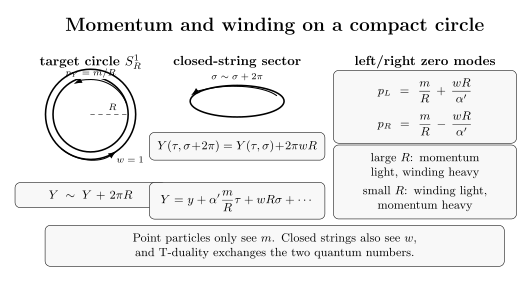
On the universal cover of the target circle, a closed string may close only up to a shift . Momentum and winding contribute to the left- and right-moving zero modes with opposite relative signs.
Throughout most of this page we use the closed bosonic string compactified from to noncompact dimensions. This is the cleanest setting for the momentum-winding lattice. In superstrings, the zero-mode lattice and the T-duality action are the same; what changes are the oscillator intercepts, spin structures, and GSO projections.
Zero modes and left-right momenta
Section titled “Zero modes and left-right momenta”Let the worldsheet coordinate be periodic as . Split the compact coordinate into left- and right-moving pieces,
A convenient zero-mode convention is
where is strictly periodic in . Shifting by gives
The winding condition therefore implies
On the other hand, the center-of-mass momentum along the circle is the average of the left and right momenta,
Solving these two equations gives the basic formula
with . Notice the two important signs: momentum enters and with the same sign, while winding enters with opposite signs. This is the microscopic reason that T-duality acts as a reflection on one chiral half of the worldsheet theory.
The oscillator expansion compatible with these conventions is
The compact direction contributes to the Virasoro zero modes as
where is the momentum in the remaining noncompact dimensions, , and include all oscillator excitations, including those of .
For the closed bosonic string, the physical-state conditions are
Thus
Adding and subtracting the two expressions gives the mass formula and level-matching condition:
and
This level-matching condition is sometimes the easiest place to see that momentum and winding are genuinely coupled. A state with nonzero cannot choose arbitrary left- and right-moving oscillator levels; the mismatch must compensate the worldsheet momentum carried by the zero modes.
Physical interpretation of the spectrum
Section titled “Physical interpretation of the spectrum”At a generic radius, the lightest states come from the smallest values of , , , and compatible with level matching. The two zero-mode contributions behave very differently as varies:
A field theorist compactifying on a very small circle sees Kaluza-Klein momenta becoming very heavy and might conclude that the circle disappears. A string theorist cannot stop there. Winding modes become light at small radius, and they reconstruct a dual large-radius geometry.
This is the first major conceptual lesson of compactification in string theory:
The statement is not a vague minimal-length slogan. It is an exact equivalence of conformal field theories for a free compact boson.
T-duality of the spectrum
Section titled “T-duality of the spectrum”Define the dual radius
and exchange the two integers
Then
while
Thus T-duality acts as
The mass formula is invariant because it depends on , not itself. The level-matching condition is also invariant because is symmetric under .
On the worldsheet fields, the same transformation is
Equivalently,
Since the original coordinate is , the duality is a reflection of the right-moving coordinate. In terms of derivatives,
This is the canonical transformation form of T-duality. It exchanges momentum density and winding density on the string.
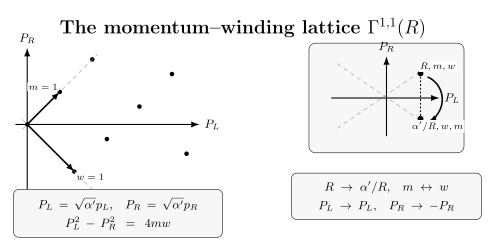
In dimensionless variables and , the compactification data form a Lorentzian lattice . T-duality is the lattice isometry , , together with .
The one-circle moduli space is therefore not the half-line . It is the half-line modulo the identification . One may choose a fundamental domain
The point
is fixed by the duality and is called the self-dual radius.
The compact-boson torus partition function
Section titled “The compact-boson torus partition function”The circle compactification is also a good laboratory for modular invariance. There are two equivalent ways to write the one-loop partition function of the compact boson.
The Hamiltonian form is a trace over momentum and winding states:
Using the explicit left- and right-moving momenta, the zero-mode part is
The phase is the torus trace of level matching. The factor is the oscillator determinant of one compact free boson.
The Lagrangian form instead sums over classical maps from the worldsheet torus into the target circle. A Euclidean torus has two cycles, and the compact coordinate may wind independently around both. If those two winding numbers are , then
The two forms are related by Poisson resummation. This relation is worth understanding. In the Hamiltonian expression, is a momentum quantum number and is a spatial winding number. In the Lagrangian expression, and are topological winding numbers around the two cycles of the Euclidean worldsheet torus. Poisson resummation transforms one of the topological sums into a momentum sum.
The Lagrangian expression makes modular invariance transparent. Under a modular transformation, the two cycles of the torus are recombined by an matrix, and the pair is correspondingly recombined. Since the sum includes all integer pairs, the partition function is invariant.
The Hamiltonian expression makes T-duality transparent. Under
one has and , so
For a single free compact boson, T-duality is therefore not merely a symmetry of the mass spectrum. It is an exact equality of the full torus partition function, and indeed of the full conformal field theory.
Generic massless fields after circle compactification
Section titled “Generic massless fields after circle compactification”At a generic radius, the massless closed-string states with and include the usual graviton, antisymmetric tensor, and dilaton in the noncompact directions:
They decompose into
There are also states with one oscillator in the noncompact direction and one in the compact direction:
Equivalently, one may form the symmetric and antisymmetric combinations associated with
From the lower-dimensional point of view, these are two gauge fields. It is often cleaner to call them the left and right gauge fields,
up to normalization conventions. Thus the generic gauge symmetry is
Finally, the state
is a scalar in the lower-dimensional theory. It is the radion, the fluctuation of the circle radius. In a one-circle compactification there is no independent field, because is antisymmetric.
T-duality acts nontrivially on these lower-dimensional fields. Since it flips but not , it exchanges the geometric and antisymmetric-tensor origins of the two gauge bosons. This is the first example of a general phenomenon: in string theory, geometry and gauge fields can mix under duality.
The self-dual radius and enhanced gauge symmetry
Section titled “The self-dual radius and enhanced gauge symmetry”At a generic radius, only the Cartan gauge bosons of are massless. At the self-dual radius , additional momentum-winding states become massless.
Set . Then
The massless conditions may be written as
Besides the generic , states, there are new possibilities:
for which
These give two additional left charged gauge bosons. Similarly,
for which
These give two additional right charged gauge bosons.
The CFT explanation is elegant. With the normalization
the chiral exponential
has holomorphic dimension
At , the dimension is . Therefore the operators
are dimension-one holomorphic currents. They generate an affine current algebra at level one. Similarly,
generate .
Thus the gauge group is enhanced:
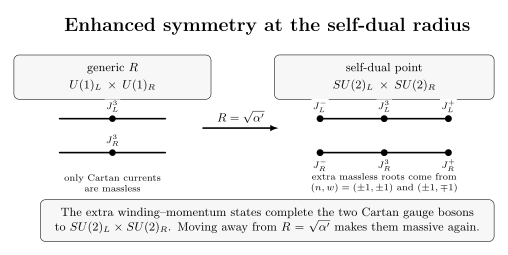
At , the charged roots of and are realized by momentum-winding states. Away from this radius, these states become massive and only the Cartan gauge bosons remain massless.
The corresponding vertex operators for the new gauge bosons are schematically
with in the noncompact spacetime directions. Together with the Cartan gauge bosons, these fill out the adjoint representations of and .
There are also additional massless scalars at the self-dual radius. They can be organized as
and transform as under . The radion is one component of this set. Moving away from the self-dual radius gives a vacuum expectation value to a scalar in this multiplet and Higgses the enhanced gauge symmetry back down to .
This is a prototype for gauge enhancement in string compactification. Gauge symmetries need not be put in by hand; they can appear when the compactification lattice develops extra vectors of the right length.
Narain-lattice viewpoint
Section titled “Narain-lattice viewpoint”The pair is not just a bookkeeping device. It belongs to an even Lorentzian lattice of signature . In dimensionless variables
one has
The Lorentzian norm is
Because and are integers, this norm is integral and even in the normalization relevant for the closed-string level-matching condition. T-duality is an automorphism of this lattice.
For one circle, the T-duality group is essentially , generated by
together with signs of and . For a compactification on a -torus, the same idea becomes the Narain lattice and the T-duality group . The special radii where extra lattice vectors have the right length are the places where nonabelian gauge symmetries appear.
This lattice viewpoint is one of the most durable ideas in string compactification. It connects worldsheet modular invariance, target-space duality, gauge enhancement, and the geometry of moduli space.
Exercises
Section titled “Exercises”Exercise 1: Derive the left- and right-moving momenta
Section titled “Exercise 1: Derive the left- and right-moving momenta”Starting from
with periodic in , derive
Solution
The winding condition gives
The oscillator part drops out because it is periodic. The zero-mode part changes by
Thus
Single-valued wavefunctions on the target circle require the center-of-mass momentum to be
Since , we also have
Adding and subtracting the two equations gives
Exercise 2: Mass formula and level matching
Section titled “Exercise 2: Mass formula and level matching”Use
and to prove
and
Solution
Since , the left-moving physical-state condition gives
so
Similarly,
Adding the two equations and using
gives the mass formula.
Subtracting the two equations gives
But
Therefore
or
Exercise 3: T-duality as a right-moving reflection
Section titled “Exercise 3: T-duality as a right-moving reflection”Show that under
the left- and right-moving momenta transform as
Then show that obeys
Solution
Using the dual radius,
Similarly,
For the field transformation, write
Since
we find
Likewise,
Exercise 4: T-duality invariance of the partition function
Section titled “Exercise 4: T-duality invariance of the partition function”Use
to show that .
Solution
For the radius , relabel the integers by
The sum over all pairs is the same as the sum over all pairs . By Exercise 3,
Therefore
The oscillator factor is independent of , so the full partition function is invariant:
Exercise 5: Extra massless states at the self-dual radius
Section titled “Exercise 5: Extra massless states at the self-dual radius”At , solve the massless conditions
for states with either , or , . Identify their left- or right-moving charges.
Solution
First take , . The two massless equations become
Thus and , so
For these states,
They are charged under the left current algebra and neutral under the right one.
Now take , . The equations become
Thus and , so
For these states,
They are charged under the right current algebra and neutral under the left one. These four states are the extra charged gauge bosons completing
Exercise 6: Dimension-one currents
Section titled “Exercise 6: Dimension-one currents”Assume the holomorphic compact boson has OPE
Show that
has conformal weight .
Solution
For a free boson with
the holomorphic exponential
has conformal weight
For
we get
Thus are dimension-one holomorphic currents. Together with , they generate the enhanced left-moving current algebra. The same argument applies to the antiholomorphic right-moving currents.