
Thermal Strings and the Hagedorn Transition
A spatial circle is a modulus of the target space. A Euclidean time circle is more delicate: it is a way of defining a thermal ensemble. This distinction is the source of almost everything interesting about finite-temperature string theory.
Let denote Euclidean time and impose
For ordinary quantum field theory, the thermal partition function is
The corresponding Euclidean path integral is performed on a circle of circumference . Bosonic spacetime fields are periodic around this circle, while fermionic spacetime fields are antiperiodic:
The minus sign is not a convention one may ignore. If one instead made spacetime fermions periodic, the trace would compute the supersymmetric index
not the thermal free energy. In a supersymmetric theory the index may be independent of and often vanishes after subtracting zero modes. The thermal partition function, by contrast, explicitly breaks spacetime supersymmetry.
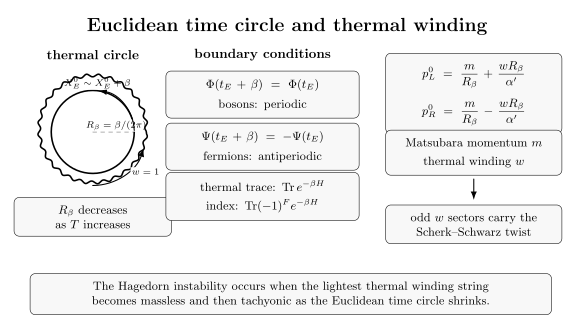
The thermal ensemble is defined by compact Euclidean time. Strings may wind around the thermal circle, and odd thermal winding sectors know about the antiperiodic boundary condition for spacetime fermions.
The new stringy ingredient is that a closed string can wind around the Euclidean time circle. A field-theory particle only has Matsubara momentum along the thermal circle. A string also has thermal winding energy proportional to . At high temperature the Euclidean time circle shrinks, so winding modes become light. Eventually one of them becomes tachyonic. This is the Hagedorn transition.
Thermal circle versus spatial circle
Section titled “Thermal circle versus spatial circle”For a compact spatial coordinate , the closed-string spectrum contains
and the spectrum is invariant under
It is tempting to make the replacement and conclude that high temperature is equivalent to low temperature. That conclusion is too fast. A thermal circle is not just a compact spatial circle. The antiperiodic boundary condition for spacetime fermions couples the spin structure to the winding number around Euclidean time. The result is a Scherk—Schwarz compactification, not the supersymmetric compactification of the previous page.
This distinction may be summarized as follows.
| circle | spacetime fermions | supersymmetry | key stringy effect |
|---|---|---|---|
| spatial | periodic unless a twist is chosen | may be preserved | exact T-duality and possible gauge enhancement |
| thermal | antiperiodic | broken | odd thermal winding modes can become tachyonic |
The bosonic zero-mode formulae remain useful, but the GSO projection and spin-structure sum are modified in winding sectors. The would-be NS—NS ground state, removed at zero temperature in type II strings, reappears in the odd thermal winding sector. This state is called the thermal scalar.
Warm-up: the Hagedorn radius in the bosonic string
Section titled “Warm-up: the Hagedorn radius in the bosonic string”Start with the closed bosonic string compactified on a circle of radius . The mass formula is
with level matching
The state with
has
It becomes massless at
For , or equivalently for , this winding mode is tachyonic. In the purely bosonic string the zero-temperature closed-string tachyon is already present, so the thermal instability is not the first problem one meets. Still, this calculation is pedagogically useful because it displays the basic mechanism: winding around Euclidean time becomes cheap at high temperature, while the negative oscillator intercept remains fixed.
Type II superstrings and the thermal scalar
Section titled “Type II superstrings and the thermal scalar”For type II strings at zero temperature, the GSO projection removes the NS—NS ground state. At finite temperature the antiperiodic boundary condition for spacetime fermions changes the spin-structure sum in sectors where the string winds around Euclidean time. In the sector of odd thermal winding, the GSO projection is effectively reversed for the relevant NS—NS ground state. This creates a physical scalar with thermal winding number .
For the type II thermal scalar with
the mass is
Therefore
For the thermal scalar is massive. At it becomes massless. For it is tachyonic, and the perturbative thermal vacuum is unstable.
This is the cleanest modern way to understand the Hagedorn transition. The exponentially growing density of string states and the thermal winding tachyon are two descriptions of the same physics. The first is a canonical-ensemble statement in the Hamiltonian picture; the second is an infrared statement in the one-loop Euclidean worldsheet path integral.
Exponential density of states
Section titled “Exponential density of states”The word Hagedorn originally refers to the exponential growth of the number of string states. For a theory with asymptotic density
the canonical partition function contains the large-energy integral
This converges for and diverges for . At the answer depends on the power and on volume effects, but the exponential scale is universal.
One can estimate directly from the worldsheet oscillator degeneracy. The Cardy formula for a chiral CFT of central charge gives
at large oscillator level .
For the closed bosonic string in light-cone gauge, each side has transverse bosons, so . Thus
At large level, , so . Hence
which gives .
For type II strings, each light-cone side has transverse bosons and transverse Majorana fermions, so
Then
and again . Therefore
which gives .
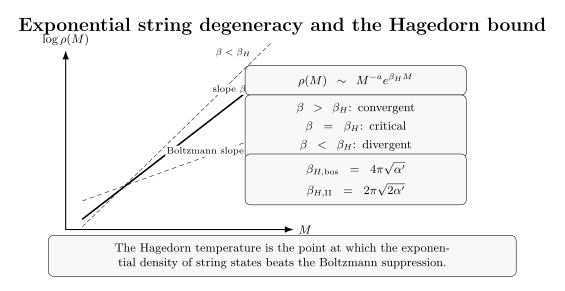
String oscillator degeneracies grow exponentially. The canonical integral is damped for , marginal at , and divergent for in the free-string approximation.
The Hagedorn scale is therefore not an accident of the thermal circle. It is forced by the asymptotic structure of the string spectrum.
One-loop free energy and the thermal scalar
Section titled “One-loop free energy and the thermal scalar”At one loop, the string free energy is a torus path integral with a compact Euclidean time direction. Schematically,
where is the fundamental domain of . The compact Euclidean time coordinate contributes a sum over maps from the worldsheet torus to the thermal circle. In the Lagrangian representation these maps are labelled by two integers, the windings around the two torus cycles:
For a purely spatial circle, the sum over is modular invariant by itself. For the thermal circle, the spin-structure sum is dressed by phases depending on and , because a spacetime fermion acquires a minus sign when transported around Euclidean time. These phases implement the thermal ensemble.
The Hagedorn singularity is easiest to see in the infrared channel of the one-loop amplitude. After a modular transformation, the dangerous contribution is the propagation of the thermal scalar in the noncompact spatial directions. Its field-theory Schwinger representation has the form
where is the number of noncompact spatial dimensions. Equivalently,
up to analytic terms and normalization conventions.
When , the infrared integral is harmless. As , it becomes nonanalytic. When , the logarithm crosses a branch cut: this is not a small correction to a stable thermal vacuum. It is a tachyonic instability of the background about which the one-loop amplitude was computed.
The thermal scalar has a simple effective description in flat space:
The complex scalar combines the and thermal winding modes. For type II strings,
Thus the Hagedorn transition is the point where the quadratic term in the thermal winding field changes sign.
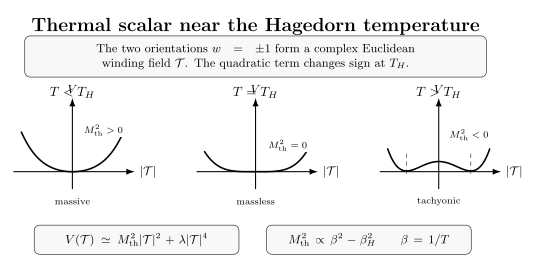
The thermal scalar is massive below the Hagedorn temperature, massless at , and tachyonic above it. The free-string expansion around the trivial thermal vacuum fails once .
Comparison with ordinary field theory
Section titled “Comparison with ordinary field theory”For an ordinary quantum field theory with finitely many massless species in spatial dimensions, dimensional analysis gives
at high temperature. The sign and coefficient depend on statistics and field content, but the power is fixed. A string theory is not a field theory with a finite number of species. It has an infinite tower of states, and the number of species at mass grows as . This exponential degeneracy overwhelms the Boltzmann suppression at .
This is why the Hagedorn temperature is sometimes described as a limiting temperature. That phrase is useful but incomplete. In an interacting theory the divergence usually indicates a phase transition or an instability, not necessarily an absolute upper bound on temperature. The thermal ensemble is trying to reorganize itself.
For open strings ending on a large number of D-branes, the natural high-temperature reorganization can be a deconfined gauge-theory plasma. For closed strings, gravity is dynamical, and high energy density can lead to black holes. In holographic examples, Hagedorn physics, black-hole thermodynamics, and deconfinement are different windows on closely related phenomena.
Why the thermal tachyon is not the ordinary closed-string tachyon
Section titled “Why the thermal tachyon is not the ordinary closed-string tachyon”It is important not to confuse three different tachyons.
First, the bosonic string has a zero-temperature closed-string tachyon even in flat space. This is a problem of the bosonic string vacuum itself.
Second, a non-BPS brane or a brane-antibrane pair may have an open-string tachyon. That tachyon lives on open strings and signals brane decay.
Third, the thermal scalar of type II string theory is a closed-string winding mode around Euclidean time. It exists because the thermal boundary condition changes the GSO projection in odd winding sectors. At zero temperature in flat ten-dimensional Minkowski space, the corresponding tachyon is absent. The instability appears only when the thermal circle is sufficiently small.
The thermal scalar is therefore a controlled diagnostic of the breakdown of the perturbative finite-temperature vacuum.
Local Hagedorn physics in curved backgrounds
Section titled “Local Hagedorn physics in curved backgrounds”In a curved static spacetime, the proper circumference of the Euclidean time circle can depend on position. If the metric contains
then the local inverse temperature is
The thermal scalar mass becomes position dependent:
The onset of the Hagedorn instability is then determined by the lowest eigenvalue of the thermal-scalar operator,
The transition occurs when crosses zero. This formulation is especially useful near black holes, where the Euclidean time circle shrinks near the horizon. It also makes clear that Hagedorn physics is not merely a counting formula; it is a spacetime instability carried by a particular winding mode.
What should one remember?
Section titled “What should one remember?”The finite-temperature string is obtained by compactifying Euclidean time with antiperiodic boundary conditions for spacetime fermions. Closed strings may wind around this thermal circle. At sufficiently high temperature, the winding mode with becomes light and then tachyonic. The same critical temperature appears from the exponential growth of the string density of states.
For type II strings in flat space,
Above , the perturbative thermal vacuum is not a stable saddle. The correct high-temperature phase depends on the theory, background, and boundary conditions, but the diagnostic is universal: the thermal scalar has crossed through zero mass.
Exercises
Section titled “Exercises”Exercise 1: Bosonic thermal winding mode
Section titled “Exercise 1: Bosonic thermal winding mode”Use the closed bosonic string mass formula
to find the critical radius and inverse temperature at which the , , winding state becomes massless.
Solution
For the specified state,
Setting gives
For a Euclidean time circle, , so
Thus
Exercise 2: Type II Hagedorn temperature from the thermal scalar
Section titled “Exercise 2: Type II Hagedorn temperature from the thermal scalar”Assume the type II thermal winding scalar has mass
Find and .
Solution
Set :
Multiplying by gives
Therefore
Exercise 3: Hagedorn growth from the Cardy formula
Section titled “Exercise 3: Hagedorn growth from the Cardy formula”For type II strings in light-cone gauge, each chiral side has central charge . Use the Cardy formula
and the large-level relation to derive .
Solution
For one chiral side with ,
For a closed string, the left and right degeneracies multiply, so
At large level,
Therefore
Thus
Exercise 4: Thermal partition function versus Witten index
Section titled “Exercise 4: Thermal partition function versus Witten index”Explain why antiperiodic spacetime fermions around Euclidean time compute , while periodic spacetime fermions compute .
Solution
In the Euclidean path integral, a trace is obtained by identifying the final and initial field configurations after Euclidean time evolution by . For bosonic variables, the trace always identifies fields periodically.
For fermionic variables, the coherent-state path integral contains a minus sign from the fermionic trace. With the standard thermal trace, this minus sign becomes the antiperiodic boundary condition
If the trace includes an insertion of , that extra sign cancels the usual fermionic trace sign, giving periodic fermions:
Thus antiperiodic fermions compute the thermal partition function, while periodic fermions compute the supersymmetric index.
Exercise 5: The infrared form of the Hagedorn singularity
Section titled “Exercise 5: The infrared form of the Hagedorn singularity”Starting from
show that the derivative with respect to is
Explain why signals an instability rather than an ordinary thermodynamic correction.
Solution
Differentiate under the integral:
Therefore
For , the denominator is positive and the integral describes the propagation of an ordinary massive mode. When , the mode becomes massless and the integral develops its characteristic infrared behavior.
For , the denominator vanishes at real momentum . Equivalently, the quadratic term in the effective action
is not positive definite. The trivial saddle is unstable. Thus the Hagedorn tachyon is not a harmless one-loop correction; it tells us that the background around which we expanded is no longer stable.
Exercise 6: Why thermal T-duality is not ordinary spatial T-duality
Section titled “Exercise 6: Why thermal T-duality is not ordinary spatial T-duality”A spatial circle compactification has a symmetry with . Why does this not immediately imply that a thermal ensemble at high temperature is equivalent to one at low temperature?
Solution
The zero-mode lattice of the compact boson still has a formal momentum-winding exchange, but a thermal circle contains additional data: spacetime fermions are antiperiodic around Euclidean time. This boundary condition is required to compute
rather than the supersymmetric index.
In the worldsheet description, the antiperiodic spacetime-fermion condition couples spin structures to thermal winding numbers. Odd winding sectors have different GSO projections from the zero-temperature theory. In particular, the type II thermal scalar appears in an odd winding sector and can become tachyonic.
Thus the thermal background is a Scherk—Schwarz compactification, not the same CFT as a supersymmetric spatial compactification. High temperature is not simply a dual description of low temperature; the thermal spin-structure phases change the spectrum and produce the Hagedorn instability.