
Coordinate Systems and the Boundary
The main idea
Section titled “The main idea”Anti-de Sitter space is one spacetime, but AdS/CFT constantly uses several coordinate systems because different coordinates make different parts of the dictionary transparent.
Global coordinates make the Hilbert-space interpretation manifest: the boundary is the cylinder , and global time evolution is generated by the CFT dilatation operator after radial quantization. Poincaré coordinates make the flat-space CFT vacuum and ordinary momentum-space correlators manifest: the boundary looks like . Fefferman—Graham coordinates make the near-boundary dictionary manifest: sources, expectation values, counterterms, and Weyl transformations are organized in a radial expansion.
The crucial point is this:
The AdS boundary is not a finite-distance wall. It is a conformal boundary. A choice of coordinates near infinity is simultaneously a choice of conformal frame and a choice of UV regulator for the boundary theory.
This page develops the coordinate systems that will be used throughout the course. Later pages will use them almost mechanically: global coordinates for spectra and states, Poincaré coordinates for correlators and black branes, Fefferman—Graham coordinates for holographic renormalization, and horizon-regular coordinates for real-time response.
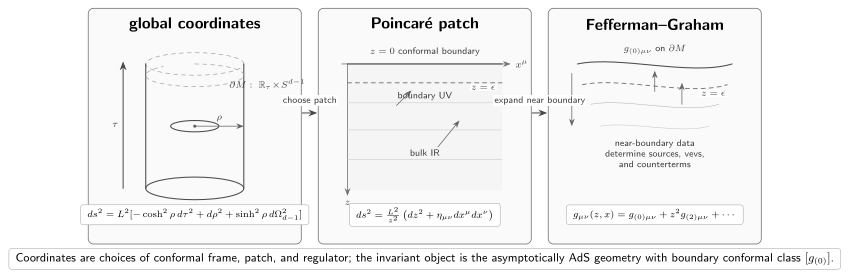
Three complementary ways to describe . Global coordinates display the cylinder ; Poincaré coordinates display a flat boundary patch with radial UV/IR relation; Fefferman—Graham coordinates organize the near-boundary data , , used in holographic renormalization.
Global coordinates: AdS as a spacetime with a cylinder at infinity
Section titled “Global coordinates: AdS as a spacetime with a cylinder at infinity”Start from the embedding of in ,
A convenient global parametrization is
where parametrizes . The induced metric is
Here and is global time. Strictly, the hyperboloid has closed timelike curves because is periodic. The physical Lorentzian AdS spacetime used in holography is the universal cover, where .
It is also useful to define
Then
This form makes the large- asymptotics especially visible. Near infinity,
Multiplying the metric by and taking gives the boundary conformal metric
Equivalently, using dimensionless time ,
and the overall factor is part of the chosen conformal frame.
Compact radial coordinate
Section titled “Compact radial coordinate”A particularly clean conformal compactification follows from
Since and , the global metric becomes
The conformal boundary is at . Removing the divergent conformal factor gives
This is why one often says that global AdS has boundary . More precisely, global AdS has a conformal boundary whose natural global conformal frame is the Lorentzian cylinder.
Poincaré coordinates: the flat boundary patch
Section titled “Poincaré coordinates: the flat boundary patch”For most practical calculations in AdS/CFT, especially local correlation functions, one uses Poincaré coordinates:
where and . The conformal boundary is at . Multiplying by gives the boundary metric
Thus Poincaré coordinates naturally describe a CFT on flat Minkowski space.
One explicit relation to the embedding coordinates is useful for orientation. With ,
These equations obey
where includes the Lorentzian boundary time direction. They also show immediately that the Poincaré patch is the region with .
The Poincaré patch does not cover all of global AdS. The surface is the Poincaré horizon of pure AdS: it is a coordinate horizon, not a curvature singularity. This distinction matters. A calculation in the Poincaré vacuum is often simpler than a global calculation, but it is not automatically a statement about every global state.
The scaling isometry and the radial direction
Section titled “The scaling isometry and the radial direction”The Poincaré metric is invariant under
On the boundary this becomes the CFT dilatation . This is the first precise hint of the radial/energy-scale relation:
The statement is not that is a gauge-invariant energy scale by itself. Radial position depends on coordinates and gauge choices. The invariant statement is that radial diffeomorphisms act near the boundary as Weyl transformations and RG transformations of the boundary data.
Cutoff surfaces
Section titled “Cutoff surfaces”A surface has induced metric
In holographic calculations one usually does not evaluate the action directly at . Instead one regulates at , computes the on-shell action, adds local counterterms on the cutoff surface, and then sends :
This is the gravitational version of UV renormalization. The divergence near is an infinite-volume divergence in the bulk, but it maps to a UV divergence in the boundary CFT.
A useful diagnostic is the proper radial distance between and at fixed :
The boundary is infinitely far away in proper distance. This is why the boundary is not a literal wall placed at finite distance.
Euclidean AdS and hyperbolic space
Section titled “Euclidean AdS and hyperbolic space”For Euclidean correlators one Wick-rotates . The Poincaré metric becomes
This is hyperbolic space in the upper-half-space model. The boundary is plus a point at infinity. Euclidean AdS is especially useful for deriving conformal two- and three-point functions because the bulk-to-boundary propagator takes a simple form,
The Lorentzian continuation is not a formality: real-time correlators require choices of contour and boundary condition. Infalling conditions at horizons, Schwinger-Keldysh contours, and prescriptions will appear later.
The boundary is a conformal class
Section titled “The boundary is a conformal class”The clean mathematical definition of the AdS boundary uses a defining function. A spacetime is asymptotically locally AdS if one can find a function such that
and the rescaled metric
extends smoothly to . The boundary metric is then
But is not unique. If is a defining function, then so is
near the boundary. This changes the boundary representative by a Weyl rescaling,
Therefore the natural boundary datum of pure AdS geometry is not one metric , but the conformal class
When the boundary CFT is coupled to a background metric, choosing a representative is choosing a conformal frame. In even boundary dimension there can be a Weyl anomaly, so the quantum generating functional is not strictly invariant under all Weyl rescalings; the anomaly is local and is encoded holographically by logarithmic terms in the near-boundary expansion.
Fefferman—Graham coordinates: the near-boundary expansion
Section titled “Fefferman—Graham coordinates: the near-boundary expansion”Fefferman—Graham coordinates put any asymptotically locally AdS metric into the near-boundary form
at least in a collar neighborhood of the boundary. The coordinate is a defining function, and has an expansion of the form
The logarithmic term is present in even boundary dimension for generic sources and boundary curvature. For pure Einstein gravity, the lower coefficients up to order are locally determined by the boundary metric and matter sources. The coefficient contains state-dependent information; in particular, it is related to the CFT stress tensor.
For a flat boundary and no anomaly terms, the relation has the schematic form
With conventional Einstein normalization, and for simple cases where local curvature/anomaly contributions vanish,
The omitted local terms are not optional decoration. They are essential on curved boundaries, in even , and when one keeps track of renormalization schemes.
What Fefferman—Graham gauge is good for
Section titled “What Fefferman—Graham gauge is good for”Fefferman—Graham coordinates are excellent for questions that live near the boundary:
| Task | Why Fefferman—Graham helps |
|---|---|
| Identify sources | , scalar leading terms, and boundary gauge fields appear directly. |
| Compute one-point functions | canonical momenta and subleading coefficients give vevs after counterterms. |
| Derive Ward identities | radial constraints become CFT conservation, trace, and anomaly equations. |
| Renormalize the action | divergences are local functionals of cutoff-surface data. |
| Track Weyl transformations | radial diffeomorphisms implement boundary Weyl transformations. |
They are not ideal for everything. Fefferman—Graham coordinates often break down at horizons or caustics of the geodesics normal to the boundary. For black holes and real-time correlators, one usually switches to coordinates that are regular at the future horizon.
Global cylinder versus Minkowski boundary
Section titled “Global cylinder versus Minkowski boundary”The global boundary cylinder and the Poincaré boundary are conformally related. In unit-radius notation, write the cylinder metric as
Minkowski polar coordinates are related to cylinder coordinates by
Then
So flat Minkowski space is a conformal patch of the cylinder. This is the boundary reason why global AdS and Poincaré AdS are both natural. A CFT can be placed on either background; the two descriptions are related by conformal transformations, with the usual caveats about operator insertions, states, anomalies, and global domains.
The bulk version is subtler. Poincaré coordinates cover only a portion of global AdS, and the Poincaré vacuum is adapted to the time translation , not to the global Hamiltonian . For local vacuum correlators this distinction is often harmless; for horizons, thermodynamics, and global questions it is not.
Horizon-regular coordinates
Section titled “Horizon-regular coordinates”A common mistake is to use coordinates that are singular exactly where the physical boundary condition is imposed. This appears most often in black-hole backgrounds.
Even in pure Poincaré AdS, one can define an ingoing null coordinate
Then
and the pure AdS metric becomes
For black branes the analogous ingoing Eddington—Finkelstein coordinate is regular at the future horizon and is the natural coordinate for imposing infalling boundary conditions. We will use this in the real-time Green-function and hydrodynamics chapters.
Which coordinates should you use?
Section titled “Which coordinates should you use?”| Coordinate system | Boundary frame | Best for | Main danger |
|---|---|---|---|
| Global AdS | spectra, states, radial quantization, thermal AdS, Hawking-Page physics | confusing the global cylinder with flat Minkowski space | |
| Poincaré AdS | local correlators, momentum space, black branes, RG intuition | forgetting it covers only a patch of global AdS | |
| Euclidean Poincaré AdS | Euclidean correlators, Witten diagrams, conformal integrals | losing Lorentzian causal prescriptions | |
| Fefferman—Graham | arbitrary | holographic renormalization, Ward identities, stress tensor | using it through horizons where it may fail |
| Eddington—Finkelstein | usually flat or thermal | real-time response, infalling conditions, numerical evolution | hiding the simple near-boundary expansion |
| AdS-Rindler | causal diamond/domain of dependence | subregion physics, entanglement wedges, modular flow | mistaking coordinate horizons for singularities |
The best practice is not to love one coordinate system too much. Use the coordinate system that makes the physical question transparent, and translate near the boundary when extracting CFT data.
Common mistakes
Section titled “Common mistakes”Mistake 1: treating the boundary as a finite-radius brane
Section titled “Mistake 1: treating the boundary as a finite-radius brane”The boundary is reached only after conformal compactification. A cutoff surface or is a regulator, not the actual CFT spacetime. The induced metric on the cutoff surface diverges; the finite boundary metric is obtained after a Weyl rescaling.
Mistake 2: confusing a coordinate patch with a state
Section titled “Mistake 2: confusing a coordinate patch with a state”Poincaré coordinates are a coordinate patch; the Poincaré vacuum is a state. The two are related in practice, but not identical ideas. Global AdS can be described in many coordinates, and the same coordinate system can support different bulk states.
Mistake 3: using the UV/IR slogan too literally
Section titled “Mistake 3: using the UV/IR slogan too literally”It is useful to remember , but the exact relation between radial position and field-theory scale is scheme- and gauge-dependent. Holographic RG is a statement about how radial evolution reorganizes boundary data, not a local observable called “the energy scale at point .”
Mistake 4: extracting vevs before renormalization
Section titled “Mistake 4: extracting vevs before renormalization”Subleading coefficients in a near-boundary expansion are not automatically renormalized expectation values. One must include the Gibbons—Hawking—York term, counterterms, possible finite scheme-dependent terms, and then vary the renormalized action.
Mistake 5: ignoring the conformal frame
Section titled “Mistake 5: ignoring the conformal frame”The CFT on and the CFT on are conformally related in many situations, but energies, vacua, thermal circles, anomalies, and operator normalizations must be transformed carefully.
Exercises
Section titled “Exercises”Exercise 1: Derive the global AdS metric
Section titled “Exercise 1: Derive the global AdS metric”Using
with , derive
Solution
The ambient metric is
For the two timelike embedding coordinates,
because the cross terms cancel. For the spatial coordinates,
Since , the induced metric is
Using gives the desired result.
Exercise 2: Compactify global AdS
Section titled “Exercise 2: Compactify global AdS”Let . Show that the global metric becomes
What is the boundary metric in this conformal frame?
Solution
From we get
Differentiating gives
so
Substituting into the global metric,
The boundary is at . Multiplying by and restricting to the boundary gives
Exercise 3: The Poincaré scaling isometry
Section titled “Exercise 3: The Poincaré scaling isometry”Show that
is invariant under
Explain the boundary interpretation.
Solution
Under the transformation,
The numerator transforms as
while the denominator transforms as
The factors of cancel, so the bulk metric is invariant. At the boundary, only remains. This is the CFT dilatation. The fact that scales together with is the geometric origin of the radial/energy-scale relation.
Exercise 4: Proper distance to the Poincaré boundary
Section titled “Exercise 4: Proper distance to the Poincaré boundary”At fixed , compute the proper radial distance between and in Poincaré AdS. What happens as ?
Solution
At fixed ,
Therefore
As , the distance diverges logarithmically. Thus the conformal boundary is infinitely far away in the physical bulk metric even though it is placed at a finite coordinate location in the compactified geometry.
Exercise 5: A near-boundary stress tensor check
Section titled “Exercise 5: A near-boundary stress tensor check”Suppose an asymptotically AdS metric in Fefferman—Graham form has flat boundary metric and expansion
with no anomaly or source-dependent local terms. What constraints should satisfy if the dual CFT stress tensor is conserved and traceless?
Solution
In this simple flat-boundary case,
Conservation of the stress tensor gives
Tracelessness gives
In the bulk these conditions arise from the radial constraint equations. In more general cases, sources, curved boundary metrics, and anomalies modify the trace Ward identity by local terms.
Further reading
Section titled “Further reading”- O. Aharony, S. S. Gubser, J. Maldacena, H. Ooguri, and Y. Oz, Large N Field Theories, String Theory and Gravity, especially the sections reviewing AdS geometry and the conformal boundary.
- E. Witten, Anti de Sitter Space and Holography, for the original boundary-value viewpoint of holographic observables.
- L. Susskind and E. Witten, The Holographic Bound in Anti-de Sitter Space, for the UV/IR interpretation of radial position.
- K. Skenderis, Lecture Notes on Holographic Renormalization, for Fefferman—Graham expansions, counterterms, Ward identities, and anomalies.