
Defects, Interfaces, and Probe Branes
The main idea
Section titled “The main idea”Wilson loops are nonlocal probes described by fundamental strings. Baryon vertices are wrapped branes with strings attached. A broader and extremely useful class of nonlocal or lower-dimensional observables is described by probe branes.
A probe brane can add a sector of degrees of freedom localized on a submanifold of the boundary theory. Depending on the setup, this sector may be interpreted as
- a conformal defect,
- an interface,
- a flavor sector,
- an impurity,
- a boundary-like sector,
- or a lower-dimensional CFT coupled to a higher-dimensional ambient CFT.
The organizing principle is symmetry. A flat -dimensional conformal defect inside a -dimensional CFT preserves
up to internal symmetries and supersymmetry. The corresponding probe brane often contains an
factor in its induced worldvolume geometry, because
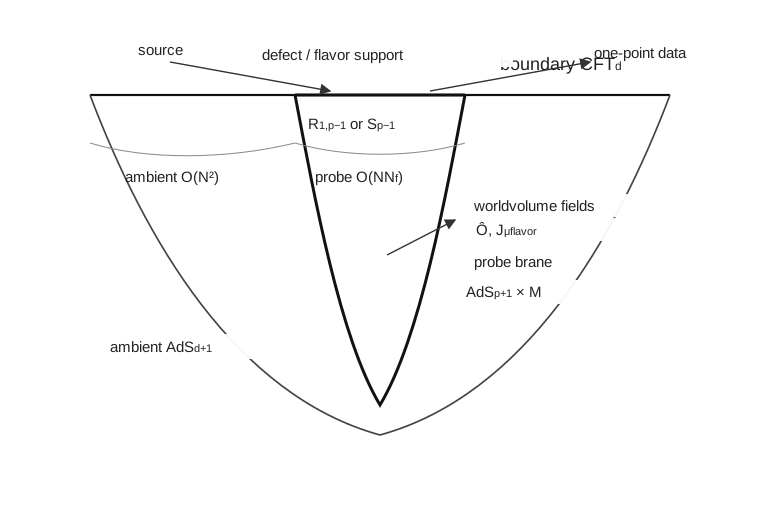
A probe brane fills an -like submanifold of the bulk and ends on a -dimensional defect or flavor sector in the boundary theory. Worldvolume fields compute defect currents, flavor currents, mesons, and displacement data.
Ambient CFT, defect CFT, and interface CFT
Section titled “Ambient CFT, defect CFT, and interface CFT”Let the ambient CFT live on -dimensional spacetime with coordinates
A flat defect sits at
The defect may carry its own local operators , while the ambient theory still has operators . Correlation functions are constrained by the subgroup of the conformal group preserving the defect. For example, a scalar primary in the presence of a flat defect can have a nonzero one-point function
This is impossible in the vacuum of an ordinary homogeneous CFT on flat space, but becomes allowed once the defect gives a preferred transverse distance.
An interface is codimension one. It separates two regions, often with different couplings or different CFTs. A boundary CFT is related but not identical: the spacetime itself has a boundary, and the boundary condition is part of the definition of the theory.
Holographically, these distinctions matter:
| Boundary structure | Typical bulk representation | Leading feature |
|---|---|---|
| Probe defect | Probe brane ending on a submanifold | Subleading localized degrees of freedom |
| Flavor sector | D-branes filling the boundary directions | Fundamental matter or flavor currents |
| Interface | Probe brane or backreacted Janus geometry | Couplings jump or vary across a wall |
| BCFT | End-of-the-world brane or capped geometry | Spacetime has a boundary |
These objects are cousins, not synonyms.
The probe approximation
Section titled “The probe approximation”A brane is a probe when its backreaction on the ambient geometry is parametrically suppressed. For color branes and flavor branes, the adjoint sector has order
degrees of freedom, while fundamental flavors contribute order
Thus
The probe limit is
The worldvolume fields on the brane remain dynamical, but the ambient spacetime geometry does not need to be recomputed at leading order. This is the holographic version of quenched flavor.
The probe approximation is not the same as ignoring the brane. It means that one solves the brane equations in a fixed background, using an action such as
where
and
Here denotes pullback to the brane worldvolume. The DBI term controls embeddings and worldvolume gauge dynamics; the Wess-Zumino term encodes couplings to Ramond-Ramond fluxes and is crucial for charges and anomalies.
Induced geometry and defect operator dimensions
Section titled “Induced geometry and defect operator dimensions”Suppose a probe brane has an induced AdS factor
A scalar worldvolume fluctuation with effective mass in the AdS factor has near-boundary behavior
with
The dimension is a defect operator dimension. Notice the , not . This is one of the most common sources of mistakes in probe-brane calculations.
Similarly, a worldvolume gauge field is dual to a flavor or defect current. The source is the leading boundary value of the gauge field on the brane worldvolume, and the expectation value is determined by the canonical radial momentum after holographic renormalization.
Example: D3/D5 defect CFT
Section titled “Example: D3/D5 defect CFT”A classic defect example uses D3-branes and a probe D5-brane. In flat space, one may arrange the branes schematically as
| Direction | 0 | 1 | 2 | 3 | 4 | 5 | 6 | 7 | 8 | 9 |
|---|---|---|---|---|---|---|---|---|---|---|
| D3 | ||||||||||
| D5 |
The intersection is dimensional. In the near-horizon geometry of the D3-branes, the D5-brane worldvolume becomes
The boundary interpretation is four-dimensional SYM coupled to a three-dimensional defect hypermultiplet. The defect preserves part of the supersymmetry and a conformal subgroup. Worldvolume fluctuations compute defect operator spectra and correlation functions.
A useful diagnostic in defect CFTs is the displacement operator , which measures the failure of the ambient stress tensor to be conserved in the transverse directions:
where are coordinates along the defect and are transverse coordinates. Holographically, the displacement operator is related to transverse brane fluctuations.
Example: D3/D7 flavor branes
Section titled “Example: D3/D7 flavor branes”The D3/D7 system is the standard top-down construction of fundamental flavor in AdS/CFT. The brane array can be represented as
| Direction | 0 | 1 | 2 | 3 | 4 | 5 | 6 | 7 | 8 | 9 |
|---|---|---|---|---|---|---|---|---|---|---|
| D3 | ||||||||||
| D7 |
The intersection is dimensional, so the flavor fields live in the full boundary spacetime rather than on a lower-dimensional defect. In the near-horizon limit, a massless D7 embedding has worldvolume
The open strings stretching between D3 and D7 branes give fields in the fundamental representation of the gauge group. In the probe limit, this adds quenched fundamental matter to the adjoint plasma. The D7 worldvolume gauge field is dual to a flavor current,
and brane embedding fluctuations are dual to quark bilinears and mesonic operators.
If the D7-brane sits a finite distance away from the D3 stack in the transverse directions, the fundamental matter has a mass. In the bulk geometry this appears as a nontrivial brane embedding. Small fluctuations around that embedding produce a discrete meson spectrum at zero temperature. At finite temperature, the brane can either remain outside the horizon or fall through it; this gives a geometric picture of meson melting.
One-point functions and bulk-defect OPE data
Section titled “One-point functions and bulk-defect OPE data”A defect breaks translations transverse to the defect. As a result, ambient scalar one-point functions need not vanish. For a scalar primary of dimension in the presence of a flat conformal defect,
where is the distance to the defect. The coefficient is defect CFT data. In holography, such one-point functions come from bulk fields sourced by the brane or from nontrivial classical profiles induced by the defect.
Another important structure is the bulk-defect OPE. As an ambient operator approaches the defect, it can be expanded in defect-local operators:
Probe brane fluctuations organize the spectrum and OPE data of the defect operators . This is one reason brane embeddings are more than visual pictures: they encode a lower-dimensional conformal bootstrap problem inside the holographic geometry.
Interfaces and Janus geometries
Section titled “Interfaces and Janus geometries”Interfaces can sometimes be described by probe branes, but an important class is described by Janus solutions. In a Janus configuration, a coupling such as the Yang-Mills coupling changes across an interface. The bulk dual is a domain-wall-like geometry with an AdS slicing. For a conformal interface in a -dimensional CFT, the bulk often admits slices of the form
inside an asymptotically AdS spacetime. The interface lives at the boundary of the AdS slice.
Probe branes and Janus geometries represent two different levels of backreaction. A probe brane describes a localized sector whose stress tensor is parametrically small compared to the ambient large- degrees of freedom. A fully backreacted Janus solution changes the ambient bulk geometry at leading large- order.
Boundary CFT and end-of-the-world branes
Section titled “Boundary CFT and end-of-the-world branes”Boundary CFTs, or BCFTs, are related but distinct. A BCFT lives on a manifold with boundary, for example a half-space. A common holographic effective description introduces an end-of-the-world brane in the bulk. Such branes do not merely add localized flavor degrees of freedom; they can end spacetime and impose gravitational boundary conditions.
It is therefore useful not to collapse all lower-dimensional structures into one word. Defect branes, flavor branes, interface geometries, and end-of-the-world branes are cousins, not synonyms.
What is computed from a probe brane?
Section titled “What is computed from a probe brane?”The following dictionary is a useful starting point.
| Probe-brane object | Boundary interpretation |
|---|---|
| Classical embedding | Defect/flavor vacuum data, masses, condensates |
| Worldvolume scalar fluctuation | Defect operator or mesonic operator |
| Worldvolume gauge field | Flavor or defect current |
| Worldvolume horizon | Dissipation in a driven flavor/defect sector |
| Brane action on shell | Defect free energy or flavor contribution to thermodynamics |
| String ending on probe brane | Finite-mass quark or impurity excitation |
| Brane ending on boundary submanifold | Defect or interface support |
The source/vev logic is the same as in the bulk field dictionary. Near the asymptotic boundary of the brane worldvolume, a fluctuation has a leading mode and a response mode. The leading mode sources a defect or flavor operator; the response mode determines its expectation value after holographic renormalization.
Finite temperature and worldvolume horizons
Section titled “Finite temperature and worldvolume horizons”Probe branes in black-hole backgrounds introduce an additional piece of physics: the induced metric on the brane may have a worldvolume horizon. This can happen even when the brane is not itself a black brane in the higher-dimensional sense.
For example, a flavor brane in an AdS black-brane background can support dissipative flavor-current response. If an external electric field is applied on the brane, the DBI action can develop an effective open-string metric horizon. The location of this worldvolume horizon controls dissipation, noise, and nonequilibrium steady-state observables in the flavor sector.
The moral is that probe branes are not only kinematic decorations. They carry their own causal structure and variational problem.
Common mistakes
Section titled “Common mistakes”Treating probe flavor as dynamical QCD flavor at large
Section titled “Treating probe flavor as dynamical QCD flavor at large NcN_cNc”Probe flavor is quenched: . It captures many mesonic and flavor-current observables, but it omits leading-order flavor backreaction on the gluonic sector.
Forgetting the brane worldvolume is itself asymptotically AdS
Section titled “Forgetting the brane worldvolume is itself asymptotically AdS”For conformal defects, the probe brane often contains an AdS factor. Operator dimensions of defect fields are computed using this lower-dimensional AdS factor, not necessarily the full ambient AdS dimension.
Confusing flavor branes with Wilson-loop strings
Section titled “Confusing flavor branes with Wilson-loop strings”A Wilson loop is usually computed by a fundamental string worldsheet. A flavor brane adds a sector of open-string degrees of freedom. Strings can end on flavor branes, but the objects are not the same.
Calling every interface a probe brane
Section titled “Calling every interface a probe brane”Some interfaces require fully backreacted geometries, such as Janus solutions. Probe branes are appropriate only when the localized sector is parametrically subleading in large- counting.
Ignoring worldvolume gauge choices and counterterms
Section titled “Ignoring worldvolume gauge choices and counterterms”Probe-brane actions have their own variational problems and divergences. Holographic renormalization is still required, especially for one-point functions and thermodynamics.
Exercises
Section titled “Exercises”Exercise 1: Probe-limit scaling
Section titled “Exercise 1: Probe-limit scaling”Suppose an adjoint sector has degrees of freedom and fundamental flavors contribute degrees of freedom. Show that flavor backreaction is suppressed when .
Solution
The relative size of flavor effects compared with the adjoint sector is
When , flavor observables can remain nontrivial, but their effect on the leading-order adjoint stress tensor and geometry is suppressed. This is the probe or quenched-flavor limit.
Exercise 2: Defect conformal symmetry
Section titled “Exercise 2: Defect conformal symmetry”A flat -dimensional defect is inserted into a -dimensional CFT. Explain why the preserved conformal group is rather than .
Solution
The full group acts as conformal transformations of the entire -dimensional spacetime. A flat defect selects a -dimensional subspace and therefore breaks transformations that move points away from the defect or mix defect and transverse directions. The transformations that preserve the defect act conformally along the defect and form . Rotations in the transverse directions may also be preserved, giving an additional symmetry for a flat defect.
Exercise 3: The AdS factor on the brane
Section titled “Exercise 3: The AdS factor on the brane”Why does a conformal defect brane usually contain an factor in its worldvolume geometry?
Solution
A -dimensional conformal defect has conformal symmetry . The isometry group of is also . Therefore a brane worldvolume containing an factor geometrizes the defect conformal symmetry. The asymptotic boundary of this AdS factor is the defect spacetime, and worldvolume fields on it are dual to defect operators.
Exercise 4: D3/D7 meson operators
Section titled “Exercise 4: D3/D7 meson operators”In a D3/D7 setup, what boundary operators are naturally dual to fluctuations of the D7 embedding and to the D7 worldvolume gauge field?
Solution
Fluctuations of the D7 embedding describe changes in the position of the flavor brane in directions transverse to it. These are dual to flavor bilinears such as mesonic scalar operators, schematically or supersymmetric partners depending on the embedding and preserved supersymmetry.
The D7 worldvolume gauge field is dual to a flavor current. Its boundary value sources a global flavor symmetry current in the field theory:
Solving the worldvolume Maxwell equation with appropriate boundary and horizon conditions gives flavor-current correlators and conductivities.
Further reading
Section titled “Further reading”- A. Karch and E. Katz, “Adding flavor to AdS/CFT,” arXiv:hep-th/0205236.
- O. DeWolfe, D. Z. Freedman, and H. Ooguri, “Holography and defect conformal field theories,” arXiv:hep-th/0111135.
- M. Kruczenski, D. Mateos, R. C. Myers, and D. J. Winters, “Meson spectroscopy in AdS/CFT with flavour,” arXiv:hep-th/0304032.
- A. Karch, A. O’Bannon, and K. Skenderis, “Holographic renormalization of probe D-branes in AdS/CFT,” arXiv:hep-th/0512125.
- D. Bak, M. Gutperle, and S. Hirano, “A dilatonic deformation of AdS and its field theory dual,” arXiv:hep-th/0304129.