
Vertex Operators, OPEs, and the Virasoro Algebra
The previous page explained how the stress tensor recognizes primary fields and generates conformal transformations. We now apply that machinery to the most important local operators in perturbative string theory: vertex operators. In flat space, a string state with spacetime momentum is represented on the worldsheet by a plane wave multiplied by oscillator factors such as , , or their superstring analogues.
This page has two goals. First, we compute the conformal weights of exponential vertex operators. Second, we derive the OPE and convert it into the Virasoro algebra. These are the local CFT facts behind the mass-shell conditions and the infinite set of Virasoro constraints.
Plane-wave vertex operators
Section titled “Plane-wave vertex operators”For the free boson normalized by
the basic spacetime-momentum operator is
The normal-ordering symbols remove the self-contractions inside a single exponential. Contractions between different operators remain, and they are precisely what determine OPEs.
Differentiating the two-point function gives
Therefore
The free-boson stress tensor is
Applying Wick’s theorem gives
The antiholomorphic OPE is identical with bars. Thus the plane-wave vertex has weights
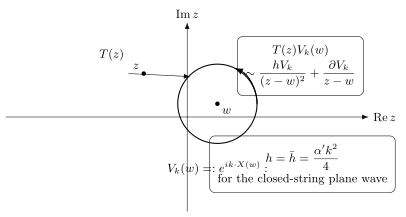
The double pole in measures the holomorphic weight . The simple pole translates the insertion.
This formula is the CFT version of the string mass-shell condition. For a closed-string integrated vertex operator on the sphere, the matter part must have weights . For the bosonic closed-string tachyon, this gives
With mostly-plus spacetime metric, , so
For a massless closed-string vertex,
the derivatives contribute , so the exponential must contribute . Hence
Products of exponential operators
Section titled “Products of exponential operators”The product of two normal-ordered exponentials is not simply the normal-ordered exponential of the sum. One must also include the cross-contraction:
The omitted terms contain descendants built from derivatives of . Expanding about gives
Thus the OPE naturally produces a primary operator with momentum together with its derivative descendants. This is the worldsheet origin of the string-theoretic statement that local vertex operators fuse into towers of intermediate string states.
General OPE structure
Section titled “General OPE structure”The operator product expansion is a local completeness relation for operators. In a holomorphic CFT, if and are primary fields of weights and , then schematically
For a full two-dimensional CFT one also includes the antiholomorphic power,
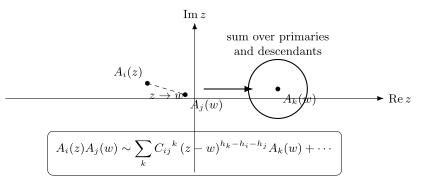
The OPE is a short-distance expansion. In string amplitudes, the same local expansion becomes factorization onto intermediate string states.
The OPE is not merely a computational trick. In a two-dimensional CFT, the spectrum of primary fields, the OPE coefficients , and the rules for descendants are essentially the data of the theory.
The stress tensor itself has a special OPE with itself:
The double and simple poles say that transforms like a field of holomorphic weight . The fourth-order pole is new. It is the central charge.
For free bosons,
and Wick contractions give
Therefore
for free scalar fields. The central charge counts degrees of freedom, but it counts them with signs and weights once ghosts or fermions are included. Later the matter contribution will be balanced by the ghost contribution , forcing the critical bosonic string to have .
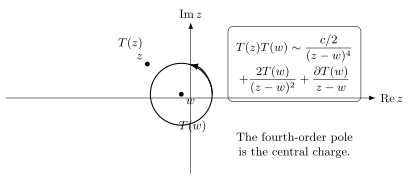
The central term in the Virasoro algebra is already visible locally as the fourth-order pole in the OPE.
One should not think of the central charge as a small correction. It controls the transformation of under conformal maps, the Casimir energy on the cylinder, the normal-ordering constants of the string, and the cancellation of the Weyl anomaly.
Virasoro generators
Section titled “Virasoro generators”The holomorphic stress tensor is expanded in Laurent modes as
Equivalently,
The antiholomorphic sector has
The mode measures holomorphic scaling dimension on the plane. Acting on a primary state created by a field of weight , it gives eigenvalue . The modes with create descendants, while with annihilate a primary state.
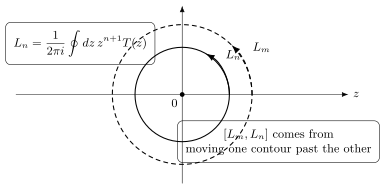
The Virasoro mode is the moment of . Commutators of modes follow from moving stress-tensor contours through each other.
Deriving the Virasoro algebra from the OPE
Section titled “Deriving the Virasoro algebra from the TTTTTT OPE”The Virasoro commutator is computed by a double contour integral:
Using the OPE, the contour extracts residues at . The useful residue formulas are
and
The result is
This is the Virasoro algebra. It is the central extension of the algebra of local holomorphic vector fields on the circle.
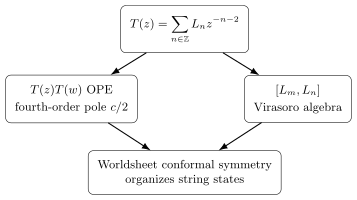
The Laurent expansion of turns the local OPE into the mode algebra of conformal transformations.
Classically, the central term is absent. Quantum mechanically, normal ordering creates it. In string theory this quantum term is not optional: Lorentz invariance, Weyl invariance, and BRST nilpotency all know about it.
Antiholomorphic copy and closed strings
Section titled “Antiholomorphic copy and closed strings”Closed strings have two commuting copies of the Virasoro algebra:
and
For a parity-invariant flat target-space theory, in the matter sector. The condition becomes level matching. The stronger physical-state constraints will reappear after ghosts and BRST are introduced.
What to remember
Section titled “What to remember”The chain of ideas is compact but powerful:
The vertex operator has weights . The stress tensor OPE
is equivalent to the Virasoro algebra. The central charge is the number that will later decide whether the string worldsheet quantum theory is consistent.
Exercises
Section titled “Exercises”Exercise 1. Weight of the plane-wave vertex
Section titled “Exercise 1. Weight of the plane-wave vertex”Using
show that has holomorphic weight .
Solution
Use
The double pole comes from contracting both factors in with the exponential:
Since , this becomes
The single contractions produce the simple pole . Therefore
so .
Exercise 2. Closed-string tachyon mass
Section titled “Exercise 2. Closed-string tachyon mass”For the bosonic closed-string tachyon vertex , require matter weights . Derive the spacetime mass squared using mostly-plus signature.
Solution
The condition gives
hence
With mostly-plus signature, , so
This is the closed bosonic string tachyon mass.
Exercise 3. Exponential OPE
Section titled “Exercise 3. Exponential OPE”Show that
Solution
Only cross-contractions contribute. They exponentiate:
Using
we obtain
The remaining normal-ordered exponential is expanded around , giving the displayed primary and its descendants.
Exercise 4. Central charge of free bosons
Section titled “Exercise 4. Central charge of DDD free bosons”Explain why independent free scalar fields have central charge .
Solution
For one free boson,
The fourth-order pole in comes from the double contraction. There are two Wick pairings, and each contributes a factor proportional to
Including the normalization , the total coefficient is
Comparing with
one free boson has . For independent bosons, the contributions add, so .
Exercise 5. The central term in the Virasoro algebra
Section titled “Exercise 5. The central term in the Virasoro algebra”Use the fourth-order pole in the OPE to derive the central contribution
in .
Solution
The central part of the OPE is
Inside the double contour expression, the inner contour gives
Multiplying by gives
The outer contour includes , so it extracts
Therefore the central term is