
13. Competing Orders, Stripes, and Spatially Modulated Phases
The previous page introduced the simplest ordered phase in holographic quantum matter: a charged condensate that is homogeneous in space. That is the cleanest example, but it is not the only kind of order that a strongly coupled finite-density system can prefer. A compressible quantum system may lower its free energy by organizing charge, spin, current, pairing, or flavor density into a pattern with a nonzero wavevector. In that case the order parameter is not just nonzero; it is spatially modulated.
This page explains how such phases appear holographically. The central idea is simple:
A spatially modulated phase usually begins as a finite-momentum instability of a homogeneous black brane.
In the boundary theory this instability is seen as a static susceptibility that diverges at a preferred wavevector . In the bulk it appears as a normalizable zero mode of the coupled fluctuation equations at
Following that zero mode below the critical temperature produces a nonlinear black-brane solution with less symmetry than the original background. Depending on the order parameter, the result may be a charge density wave, a current wave, a striped superfluid, a helical phase, a checkerboard, a crystal, or a more exotic phase with several intertwined orders.
This is one of the places where holography is genuinely useful. Strongly coupled matter may have no quasiparticles, yet it can still have sharp thermodynamic instabilities, order parameters, collective modes, and hydrodynamic constraints. The bulk description packages these ingredients into a geometric boundary-value problem.
Where this page fits
Section titled “Where this page fits”This page belongs after the discussion of superconductors and superfluids because both homogeneous and modulated orders are governed by the same broad logic:
- start with a symmetric black-brane background;
- find a linear instability of that background;
- impose source-free boundary conditions for spontaneous order;
- construct the nonlinear broken-symmetry solution;
- compare free energies in the correct ensemble;
- study response functions and collective modes in the ordered phase.
The difference is that the unstable mode now carries spatial momentum. A homogeneous order parameter has . A striped, helical, or crystalline order parameter has .
The prerequisite is the standard dictionary for sources and expectation values, black-brane thermodynamics, and real-time response. Pages 04—08 provide the finite-density and transport background, while page 12 provides the homogeneous symmetry-breaking template.
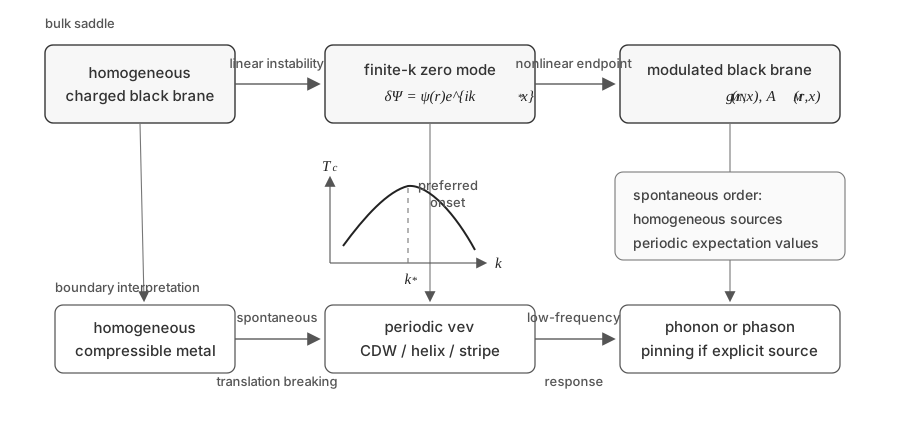
A spatially modulated phase is found by following a finite-momentum zero mode of a homogeneous charged black brane into a nonlinear bulk solution. The boundary interpretation separates the source , the order parameter , and the collective phase mode.
Translation symmetry: explicit, spontaneous, and approximate
Section titled “Translation symmetry: explicit, spontaneous, and approximate”Before discussing stripes, we need a clean vocabulary. Translation symmetry can be absent in several logically different ways.
Explicit translation breaking
Section titled “Explicit translation breaking”Translations are explicitly broken when the Hamiltonian or Lagrangian contains a spatially dependent source. For example, a scalar source
is a literal lattice deformation. The wavevector is chosen by the external source. The system may respond strongly or weakly, but the symmetry is not present in the microscopic problem. In the bulk, explicit translation breaking appears as a non-normalizable spatially dependent boundary condition.
In a holographic calculation, this is the most direct way to make the DC conductivity finite: translations are no longer exact, so momentum is not exactly conserved. Linear axion models, Q-lattices, ionic lattices, and random disorder were organized in page 07 around this explicit-breaking logic.
Spontaneous translation breaking
Section titled “Spontaneous translation breaking”Translations are spontaneously broken when the source is translation invariant, but the state is not. For an operator , a simple unidirectional modulated expectation value is
Here is arbitrary: shifting the pattern in space changes but costs no free energy in the absence of explicit pinning. The continuous translation symmetry is broken to a discrete subgroup,
In the bulk, spontaneous translation breaking is diagnosed by source-free boundary conditions and a modulated normalizable mode. The wavevector is selected dynamically.
Approximate translation breaking
Section titled “Approximate translation breaking”Real materials usually have lattices and impurities. In hydrodynamic language, translations may be nearly conserved rather than exact. A spontaneously modulated phase in a weak explicit lattice has a collective phase mode that becomes pinned. The pinned mode is no longer gapless; instead it appears at a small frequency .
This distinction is crucial. A spontaneous charge density wave in a perfectly clean continuum does not automatically have finite DC conductivity. Momentum may still be exactly conserved. A pinned charge density wave can have finite DC conductivity because the external lattice or disorder can absorb momentum.
What kind of order is being modulated?
Section titled “What kind of order is being modulated?”A spatial pattern is not a complete physical description. One must say what is modulated.
Charge density waves
Section titled “Charge density waves”A charge density wave has
The charge density itself is spatially periodic. In holography this means the near-boundary electric flux of the bulk gauge field is modulated.
Current density waves
Section titled “Current density waves”A current density wave has, for example,
Such phases may break parity or time reversal, depending on the pattern. In the bulk they often involve spatial components of the gauge field and metric.
Pair density waves and striped superfluids
Section titled “Pair density waves and striped superfluids”A pair density wave is a superconducting or superfluid order whose condensate carries nonzero momentum:
or, in a pure pair-density-wave phase, and only finite-momentum components are present. A striped superfluid may therefore break both the global symmetry and translations.
Helical phases
Section titled “Helical phases”A helical phase is spatially modulated but can remain homogeneous after combining translations with an internal rotation. In three spatial dimensions a convenient basis of Bianchi VII one-forms is
A vector order parameter proportional to or rotates as one moves along . This is physically modulated, but the bulk equations can reduce to ordinary differential equations because the ansatz preserves a generalized homogeneous structure. This technical simplification is one reason helical phases are popular in holographic model building.
Nematics, smectics, and crystals
Section titled “Nematics, smectics, and crystals”A nematic breaks rotations but not translations. A smectic breaks translations in one direction. A crystal breaks translations in several independent directions. A striped phase is the simplest smectic-like pattern:
A checkerboard or full crystal requires dependence on two or more spatial coordinates. In the bulk this usually means solving nonlinear partial differential equations rather than ordinary differential equations.
The susceptibility criterion
Section titled “The susceptibility criterion”The boundary diagnosis of a second-order transition into a modulated phase is a divergent static susceptibility at finite momentum.
Suppose a source couples to an operator as
The linear response is
A static instability occurs when the inverse susceptibility develops a zero:
Equivalently, a pole of reaches the origin of the complex frequency plane at finite :
In the bulk, this is a quasinormal mode becoming a static normalizable zero mode.
A useful Landau description near a finite-momentum transition is
In momentum space,
If , the quadratic kernel is minimized on the shell . When changes sign, the homogeneous phase is unstable not to order, but to order at finite wavevector.
This form is only an effective description. Holography gives a way to compute , , nonlinear terms, and transport data from a gravitational model rather than postulating them.
Bulk criterion: a normalizable finite- zero mode
Section titled “Bulk criterion: a normalizable finite-kkk zero mode”Consider a homogeneous charged black brane with metric, gauge field, and perhaps scalar fields depending only on the radial coordinate :
A finite-momentum fluctuation has the form
where denotes all coupled bulk fields: metric perturbations, gauge-field perturbations, scalar perturbations, and possible tensor or form fields. The equations are coupled ordinary differential equations in as long as the background is homogeneous.
The boundary conditions for a retarded correlator are:
- infalling behavior at the horizon for ;
- regularity at the horizon for the static zero mode;
- vanishing non-normalizable modes at the boundary for spontaneous order;
- normalizable falloffs that encode expectation values.
For a scalar operator of dimension , the near-boundary expansion takes the schematic form
A spontaneous modulated scalar order has
A finite- instability is therefore a source-free solution of the linearized equations at . This is an eigenvalue problem. Depending on the setup, one may solve for at fixed , for at fixed , or for both simultaneously.
Why finite-momentum instabilities occur
Section titled “Why finite-momentum instabilities occur”A homogeneous charged black brane is stable only if all fluctuation modes have quasinormal frequencies in the lower half-plane. Several mechanisms can push a finite-momentum mode upward until it reaches .
Effective mass in the IR
Section titled “Effective mass in the IR”Near an extremal or near-extremal charged horizon, the geometry often contains an -like region. A fluctuation with spatial momentum can have an effective mass
If this violates the Breitenlohner-Freedman bound,
the near-horizon region is unstable. In ordinary holographic superconductors the most unstable mode is often . In striped or helical phases, couplings may make smallest at nonzero .
Chern-Simons and parity-violating couplings
Section titled “Chern-Simons and parity-violating couplings”Five-dimensional models with Chern-Simons terms can mix gauge-field fluctuations in a momentum-dependent way. Schematically, a term such as
can create off-diagonal couplings proportional to in the fluctuation equations. Such terms can favor current-carrying or helical instabilities.
Axion-like and pseudoscalar couplings
Section titled “Axion-like and pseudoscalar couplings”A neutral pseudoscalar coupled through
can mix scalar, gauge, and metric perturbations. At finite density, this mixing may generate instabilities at nonzero momentum and produce phases with intertwined charge and current modulation.
Competing homogeneous orders
Section titled “Competing homogeneous orders”Sometimes a finite-momentum phase appears because two nearly degenerate homogeneous orders compete. The system then lowers its free energy by alternating between tendencies in space. This is the holographic analog of familiar condensed-matter mechanisms in which superconductivity, magnetism, charge order, and nematicity intertwine.
From zero mode to nonlinear branch
Section titled “From zero mode to nonlinear branch”A linear zero mode only tells us that the homogeneous phase is marginally unstable. To establish a genuine phase, one must construct the nonlinear solution.
Near a second-order transition, one can expand in a small amplitude :
If the leading mode is a cosine,
then nonlinearities generate higher harmonics:
and similarly at higher orders. Thus the full solution is not just one Fourier mode. It is a periodic black brane whose horizon, electric flux, scalar fields, and metric components acquire spatial dependence.
Farther from the critical point the perturbative expansion is not enough. One solves the full nonlinear Einstein-matter equations with periodic boundary conditions in :
The free energy must then be minimized over both the field profiles and the wavevector . The preferred stripe period is not always the same as the linear instability wavevector away from .
Ensembles and free-energy comparison
Section titled “Ensembles and free-energy comparison”One common mistake is to declare a modulated solution physical merely because it exists. Existence is not enough. The stable phase is the one with the lowest appropriate thermodynamic potential.
At fixed temperature and chemical potential, the relevant potential is the grand potential
At fixed temperature and charge density, one should use the Helmholtz free energy
In a spatially modulated phase, these should be interpreted as densities averaged over a unit cell:
A complete holographic phase diagram should specify:
- the thermodynamic ensemble;
- the boundary sources held fixed;
- the order parameters measured;
- the preferred wavevector;
- the free-energy difference from competing phases;
- the stability of the nonlinear branch.
For an authoritative calculation, all six are needed.
Goldstone modes: phasons and phonons
Section titled “Goldstone modes: phasons and phonons”If translations are spontaneously broken, there must be a gapless collective mode. For a one-dimensional stripe,
the phase is the collective coordinate. A small, slowly varying phase
is the phason. Equivalently, define a displacement field
so that
The displacement field says how far the stripe pattern has shifted.
In a clean system, the low-energy effective theory contains elastic energy. For a unidirectional stripe,
The form is anisotropic because the stripe direction and transverse directions are not equivalent. This is the smectic logic.
For a full crystal with displacement fields , the elastic free energy has the more familiar form
Holographically, these collective modes appear as low-frequency quasinormal modes of the modulated black brane.
Pinning and phase relaxation
Section titled “Pinning and phase relaxation”If an explicit lattice or disorder is present, the sliding mode is pinned. The phason is no longer exactly gapless. A simple pinned collective mode has a resonance frequency . In transport, a useful phenomenological form for the optical conductivity is
Here:
- is the incoherent conductivity;
- is the momentum susceptibility;
- is the momentum relaxation rate;
- is the phase relaxation rate;
- is the pinning frequency.
This formula is not the answer to every holographic striped phase, but it is a useful diagnostic. It shows how three phenomena are distinct:
- momentum relaxation: the environment can absorb momentum;
- pinning: the collective sliding mode has a restoring force;
- phase relaxation: defects or dislocations relax the phase of the density wave.
A clean spontaneous stripe has and, if momentum is conserved, . A pinned stripe has . A stripe with mobile dislocations may have .
Ward identities and force balance
Section titled “Ward identities and force balance”The distinction between explicit and spontaneous breaking is encoded in Ward identities. If spatially dependent sources are present, momentum is not conserved. Schematically,
The last term is the force exerted by the external source. If all scalar sources are spatially homogeneous and no external electromagnetic field is applied, then
A state may still be spatially modulated, but translations are spontaneously rather than explicitly broken. The total momentum is conserved even though the ground state is not translation invariant.
This is why clean spontaneous stripes do not automatically solve the finite-DC-conductivity problem. A modulated expectation value is not the same thing as explicit momentum relaxation.
Holographic construction: practical workflow
Section titled “Holographic construction: practical workflow”A serious holographic construction of a striped or helical phase usually follows this workflow.
Step 1: Choose the homogeneous parent phase
Section titled “Step 1: Choose the homogeneous parent phase”Start with a black brane that represents the symmetric phase. This is often a charged black brane in an Einstein-Maxwell, Einstein-Maxwell-dilaton, or supergravity-inspired model.
Step 2: Identify fluctuation channels
Section titled “Step 2: Identify fluctuation channels”Classify perturbations by momentum , frequency , and remaining symmetries. At finite density, metric and gauge perturbations generally mix. If scalar or pseudoscalar fields are present, they may also mix.
Step 3: Search for zero modes
Section titled “Step 3: Search for zero modes”Solve the linearized equations with regular horizon behavior and vanishing sources at the boundary. A nontrivial solution at gives a candidate critical point.
Step 4: Determine the preferred wavevector
Section titled “Step 4: Determine the preferred wavevector”The zero mode may exist over a range of . The true instability is the one with the highest critical temperature:
Equivalently, at fixed temperature one may look for the first mode that becomes unstable as a parameter is varied.
Step 5: Construct the nonlinear branch
Section titled “Step 5: Construct the nonlinear branch”Solve the nonlinear equations with periodic boundary conditions. For helices this can sometimes reduce to ordinary differential equations. For stripes and crystals it usually requires partial differential equations.
Step 6: Compute the thermodynamics
Section titled “Step 6: Compute the thermodynamics”Compute the renormalized on-shell action, entropy, charge, energy, and stress tensor. Compare the correct thermodynamic potential with all relevant competing phases.
Step 7: Study collective modes
Section titled “Step 7: Study collective modes”Compute low-frequency response in the ordered phase. Identify phonons, phasons, pinned modes, amplitude modes, and possible diffusive or incoherent modes.
The zero mode is only the beginning. The phase is established only when the nonlinear branch and its thermodynamics are under control.
Helical phases versus striped phases
Section titled “Helical phases versus striped phases”Helical phases deserve a separate comment because they are often technically easier than stripes.
A stripe depends explicitly on a spatial coordinate in scalar functions:
The Einstein-matter equations are partial differential equations in .
A helical phase may be written using invariant one-forms whose dependence is fixed algebraically. The coefficients depend only on :
Although the geometry is spatially modulated in ordinary coordinates, the equations can become ordinary differential equations. This makes helical phases a useful laboratory for spontaneous translation breaking, chiral order, and anisotropic transport.
However, the simplification is also a limitation. A helical ansatz describes a special kind of spatial order, not a generic lattice or stripe. One should not infer the general physics of all density waves from helical models alone.
Competing and intertwined orders
Section titled “Competing and intertwined orders”Strongly correlated systems often have several nearby instabilities. Holographically, this can happen when several bulk fields have comparable effective masses in the IR. A modulated phase may then contain multiple nonzero expectation values.
For example, a single finite- instability may generate both charge density and current density modulation:
The relative phase is physical. A cosine in charge and a sine in current can indicate circulating currents or parity-breaking structure.
Similarly, a superconducting condensate may coexist with a charge density wave:
The higher harmonic in charge may be induced even if the leading condensate harmonic is the primary order. This is why the phrase “the order parameter” must be used carefully: the visible density wave may be secondary to another primary instability.
Worked example: finite-wavevector Landau instability
Section titled “Worked example: finite-wavevector Landau instability”Consider a real scalar order parameter with quadratic free energy
where and
For , , and all modes cost positive free energy. At , the modes on the shell become marginal. For , the quadratic term becomes negative at .
Add a stabilizing quartic term for a single-mode stripe:
Minimizing gives
Besides , the ordered solution has
The free-energy difference is
Thus the striped branch is thermodynamically preferred near if . In a holographic calculation, is inferred from the zero-mode condition, while and the preferred nonlinear wavevector require going beyond the linear problem.
What holography adds beyond Landau theory
Section titled “What holography adds beyond Landau theory”Landau theory says what is possible. Holography can compute the strong-coupling dynamics of a concrete large- model.
In particular, holography can determine:
- which operator becomes unstable;
- whether the instability is at or ;
- the critical temperature ;
- the preferred wavevector ;
- whether the nonlinear transition is first or second order;
- the full spatial profile of charge, current, condensate, and stress;
- the entropy and free energy of the ordered black brane;
- the collective-mode spectrum in the broken phase;
- the optical and thermoelectric conductivities.
The price is that the answer is model dependent. Bottom-up holographic stripes are controlled gravitational models, not universal predictions about all strange metals.
Common pitfalls
Section titled “Common pitfalls”Pitfall 1: “A lattice” and “a stripe” are not the same thing
Section titled “Pitfall 1: “A lattice” and “a stripe” are not the same thing”A lattice is usually explicit: a source breaks translations. A stripe is often spontaneous: the state breaks translations. They may look similar in plots of charge density, but they have different Ward identities and different collective modes.
Pitfall 2: A modulated expectation value does not imply finite DC conductivity
Section titled “Pitfall 2: A modulated expectation value does not imply finite DC conductivity”If translations are spontaneously broken but momentum is conserved, the electric current can still overlap with conserved momentum. Clean spontaneous order alone does not remove the momentum bottleneck.
Pitfall 3: The most visible modulation may not be the primary order
Section titled “Pitfall 3: The most visible modulation may not be the primary order”Charge density is easy to plot, but the primary unstable mode may be a scalar, current, pseudoscalar, or superconducting condensate. Charge modulation may be induced secondarily.
Pitfall 4: The linear wavevector need not be the final wavevector
Section titled “Pitfall 4: The linear wavevector need not be the final wavevector”The wavevector at is the preferred infinitesimal instability. Away from , nonlinear effects can shift the thermodynamically preferred period.
Pitfall 5: Helical phases are not generic stripes
Section titled “Pitfall 5: Helical phases are not generic stripes”Helical ansätze are powerful because they reduce the equations to ODEs. But this convenience comes from symmetry. A generic striped or crystalline black brane is a PDE problem.
Pitfall 6: Source-free boundary conditions are non-negotiable for spontaneous order
Section titled “Pitfall 6: Source-free boundary conditions are non-negotiable for spontaneous order”If the non-normalizable coefficient of the modulated field is nonzero, the modulation is explicitly sourced. That is a different physical problem.
Summary
Section titled “Summary”Spatially modulated holographic phases are ordered states in which finite-density quantum matter lowers its free energy by forming structure at nonzero wavevector. The basic chain is
The most important conceptual distinctions are:
- explicit versus spontaneous translation breaking;
- homogeneous order versus finite-momentum order;
- primary order versus induced secondary modulation;
- clean sliding modes versus pinned modes;
- helical ODE constructions versus genuinely inhomogeneous PDE solutions;
- existence of a solution versus thermodynamic dominance.
A high-quality holographic analysis of a modulated phase must include the zero mode, the nonlinear branch, source/vev identification, free-energy comparison, and collective response. Without all of these, one has only part of the physics.
Exercises
Section titled “Exercises”Exercise 1: Source or vev?
Section titled “Exercise 1: Source or vev?”A bulk scalar dual to an operator of dimension has near-boundary expansion
For which values of and does this describe explicit translation breaking? For which values does it describe spontaneous translation breaking?
Solution
The coefficient of is the source. If , the boundary theory is explicitly deformed by a spatially dependent source, so translations are explicitly broken.
If but , the source is translation invariant but the expectation value is spatially modulated. This is spontaneous translation breaking.
If both and , this scalar does not break translations. If and , the response is modulated, but the breaking is explicit because the Hamiltonian already contains a spatially dependent source.
Exercise 2: Goldstone mode of a stripe
Section titled “Exercise 2: Goldstone mode of a stripe”Consider a striped order parameter
Show that a translation shifts . Explain why this implies a Goldstone mode when translations are spontaneously broken.
Solution
Under a translation,
Thus the translated configuration is equivalent to
If translations are an exact symmetry, different values of have the same free energy. A slowly varying is therefore a low-energy collective mode. This is the phason, or equivalently the displacement field of the stripe.
Exercise 3: Why spontaneous stripes do not automatically give finite DC conductivity
Section titled “Exercise 3: Why spontaneous stripes do not automatically give finite DC conductivity”Suppose a clean finite-density system spontaneously breaks translations but has no external lattice, no disorder, and no explicit spatial source. Explain why the electric DC conductivity can still contain a delta function at .
Solution
The key point is that spontaneous translation breaking does not remove momentum conservation. The state is not invariant under translations, but the Hamiltonian still is. Therefore total momentum remains an exactly conserved quantity.
At finite charge density, the electric current generally overlaps with momentum. If momentum cannot decay, an applied electric field can accelerate the conserved momentum, producing a delta function in and a corresponding pole in .
To obtain finite DC conductivity from momentum decay, translations must be explicitly broken, or another mechanism must remove the current-momentum overlap. A clean sliding density wave has a Goldstone mode, not automatic momentum relaxation.
Exercise 4: Preferred finite wavevector
Section titled “Exercise 4: Preferred finite wavevector”For the quadratic free energy
show that the first instability occurs at when changes sign.
Solution
The quadratic coefficient is
Since , the second term is nonnegative and is minimized when
Thus the minimum occurs on the shell . For , for all , so the homogeneous phase is stable. At , , so modes with become marginal. For , those modes have negative quadratic free energy, signaling an instability toward finite-momentum order.
Exercise 5: Boundary conditions for a holographic zero mode
Section titled “Exercise 5: Boundary conditions for a holographic zero mode”A coupled fluctuation takes the form
State the boundary conditions required for this fluctuation to represent a spontaneous finite-momentum instability of a homogeneous black brane.
Solution
For a spontaneous finite-momentum instability, the mode should be a source-free normalizable zero mode. The required conditions are:
- at the onset of the instability.
- for a spatially modulated phase.
- The fluctuation must be regular at the horizon. For nonzero frequency retarded correlators this becomes infalling behavior; at one imposes smoothness in regular horizon coordinates.
- All non-normalizable coefficients at the boundary must vanish, so no spatially modulated source is applied.
- At least one normalizable coefficient must be nonzero, giving a modulated expectation value.
- Gauge redundancies must be fixed or treated through gauge-invariant variables, so the zero mode is physical rather than pure gauge.
These conditions define an eigenvalue problem for and .
Further reading
Section titled “Further reading”For broader context, useful references include reviews of holographic quantum matter, treatments of holographic superconductivity and symmetry-broken phases, and the literature on striped, helical, Q-lattice, and inhomogeneous black-brane solutions. The important conceptual lesson is stable across these references: spatial modulation must be diagnosed by source-free finite-momentum order, not merely by the appearance of a spatially dependent bulk field.