
2. Quantum Critical Matter and the Holographic Dictionary
Quantum critical matter is the cleanest entry point into holographic many-body physics. It is the regime where the microscopic lattice scale has faded from the infrared description, no ordinary mass scale controls the dynamics, and temperature becomes the dominant low-energy scale. In such systems, scaling and conservation laws often determine the structure of thermodynamics and transport more strongly than microscopic quasiparticles do.
A relativistic conformal field theory is the simplest example. It has dynamical exponent , no intrinsic energy scale, and a stress tensor whose trace vanishes up to anomalies and sources. At finite temperature, it becomes a strongly coupled quantum critical fluid. Holographically, the vacuum is described by pure AdS, while the thermal state is described by a neutral planar AdS black brane.
The core idea of this page is:
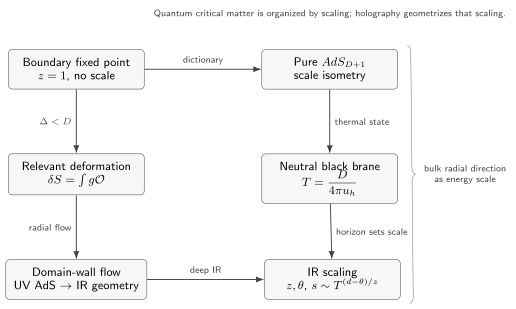
Quantum critical matter begins with a scale-invariant fixed point. The holographic vacuum is pure AdS, while finite temperature produces a neutral black brane. Relevant deformations generate radial domain-wall flows, and more general infrared phases may exhibit Lifshitz scaling or hyperscaling violation.
Quantum critical points
Section titled “Quantum critical points”A quantum critical point is a continuous phase transition at zero temperature, tuned by a nonthermal parameter . Near the critical value , the correlation length diverges as
The characteristic energy scale vanishes as
where is the dynamical critical exponent. At nonzero temperature, the thermal scale cuts off the quantum critical regime:
If the theory is relativistic, . If time and space scale differently,
In a conventional weakly coupled critical theory, one often studies criticality by perturbative RG or quasiparticle-like collective modes. Holography is useful when the critical theory is strongly coupled and has many degrees of freedom.
CFTs as fixed points
Section titled “CFTs as fixed points”For a relativistic CFT in boundary spacetime dimensions, the stress tensor has scaling dimension
and a scalar primary operator has two-point function
A deformation by takes the form
The coupling has dimension
Thus:
| Operator dimension | Deformation type | IR behavior |
|---|---|---|
| relevant | grows toward the IR | |
| marginal | requires beta-function analysis | |
| irrelevant | dies toward the IR, but may be dangerously irrelevant |
This classification becomes a geometric statement in holography: a relevant deformation is a scalar profile that changes the bulk geometry as one moves inward along the radial direction.
Pure AdS as the fixed-point geometry
Section titled “Pure AdS as the fixed-point geometry”In Poincare coordinates, pure may be written as
with boundary at . The scale transformation
is an isometry of the metric. This is the geometric origin of conformal scaling in the boundary theory.
The coordinate is often interpreted as an inverse energy scale:
This statement is useful but should not be treated too literally. The radial coordinate organizes the RG direction, but a precise Wilsonian interpretation requires care, counterterms, and sometimes multi-trace data.
Finite temperature: the neutral black brane
Section titled “Finite temperature: the neutral black brane”The thermal state of a holographic CFT on flat space is described by the planar AdS black brane,
The horizon is at . Regularity of the Euclidean solution gives
The entropy density is the horizon area density divided by :
Since , this gives the CFT scaling
This is the first thermodynamic success of the geometry: scale invariance fixes the power of , while the gravitational solution computes the strong-coupling coefficient.
The neutral current dictionary
Section titled “The neutral current dictionary”If the boundary theory has a conserved global current , the dual bulk field is a gauge field . Near the boundary, in a convenient radial gauge, one has schematically
The leading coefficient is the source. The subleading coefficient determines the expectation value:
up to normalization and counterterms.
At zero density, the conductivity of a particle-hole symmetric quantum critical fluid is finite because the current need not overlap with conserved momentum. This is why the zero-density case is pedagogically cleaner than finite density.
Scaling of conductivity
Section titled “Scaling of conductivity”Dimensional analysis gives the scaling of conductivity in a relativistic CFT. The current has dimension
while the electric field has dimension
Since , the conductivity has dimension
At finite temperature and zero density,
In spatial dimensions, the conductivity is dimensionless:
This is one reason why -dimensional quantum critical transport has played such an important role in holographic quantum matter.
Relevant deformations as domain walls
Section titled “Relevant deformations as domain walls”A scalar operator deformation is represented by a bulk scalar field . Near the boundary,
For standard quantization, is the source and is related to the expectation value. Turning on a relevant source changes the geometry. A common ansatz for homogeneous RG flows is
A fixed point has . A flow between fixed points is a domain wall: the geometry is approximately AdS in the UV and may approach another AdS region, a gapped endpoint, or a scaling IR geometry.
Beyond relativistic scaling
Section titled “Beyond relativistic scaling”Holographic quantum matter often considers more general scaling forms. A Lifshitz geometry realizes
with . A hyperscaling-violating geometry adds an overall scaling violation controlled by . The thermodynamic entropy density then scales as
The parameter acts like an effective spatial dimension for thermodynamics. When , entanglement entropy can show logarithmic area-law violation, reminiscent of Fermi-surface physics.
These geometries are powerful, but they are usually IR regimes of full domain-wall solutions, not complete spacetimes by themselves. A complete solution must specify a UV boundary theory, sources, charge density, boundary conditions, and thermodynamic ensemble.
Fixed commensurate density versus compressible matter
Section titled “Fixed commensurate density versus compressible matter”It is useful to separate two broad categories.
At fixed commensurate density, the low-energy theory may be a CFT or another quantum critical theory with no continuously tunable charge density. The cleanest holographic examples are neutral black branes.
In compressible matter, the density changes continuously with chemical potential. Holographically, this requires a bulk gauge field with radial electric flux. Charged black branes, EMD geometries, electron stars, and probe branes are examples that appear later.
This separation matters because finite density introduces a new hydrodynamic complication: current overlaps with momentum. Zero-density quantum critical transport is the right place to learn the horizon response logic before the finite-density momentum bottleneck enters.
Worked example: entropy scaling of a neutral CFT
Section titled “Worked example: entropy scaling of a neutral CFT”For the neutral black brane above,
Solving for gives
Substituting,
Thus the entropy density scales as
as required by a CFT in spatial dimensions.
Common pitfalls
Section titled “Common pitfalls”Pitfall 1: scale invariance is always conformal invariance. In many relativistic unitary theories this is expected under suitable assumptions, but nonrelativistic systems may have Lifshitz scaling without conformal symmetry.
Pitfall 2: the radial coordinate is literally the energy scale. It is an extremely useful guide, but precise RG statements require holographic renormalization and scheme choices.
Pitfall 3: every IR scaling metric is a complete dual. Usually it is not. It is an approximate near-horizon or deep-interior regime of a full solution.
Pitfall 4: zero density means uninteresting. Zero-density quantum critical transport is where the cleanest horizon-dissipation logic first appears.
Exercises
Section titled “Exercises”Exercise 1: Dimension of the source
Section titled “Exercise 1: Dimension of the source”A scalar operator has dimension in a -dimensional boundary theory. Find the engineering dimension of its source in .
Solution
The action is dimensionless. Since and , the source must have dimension
The deformation is relevant if , marginal if , and irrelevant if .
Exercise 2: Conductivity scaling
Section titled “Exercise 2: Conductivity scaling”Use dimensional analysis to show that the conductivity of a relativistic CFT in spatial dimensions scales as .
Solution
The current has dimension and the electric field has dimension . Therefore
At finite temperature, is the only scale, so
For , the conductivity is dimensionless.
Exercise 3: Entropy scaling with hyperscaling violation
Section titled “Exercise 3: Entropy scaling with hyperscaling violation”For , , and , find the entropy scaling exponent.
Solution
Use
With , , and ,
Thus
Exercise 4: Relevant deformation as geometry
Section titled “Exercise 4: Relevant deformation as geometry”Explain why a relevant deformation of a CFT is naturally represented by a radial bulk scalar profile.
Solution
A relevant coupling grows toward the IR under RG flow. In holography, radial evolution geometrizes RG evolution. Turning on the source for a relevant scalar operator changes the bulk scalar boundary condition. The scalar then evolves into the interior and backreacts on the metric, producing a domain-wall geometry. The UV region remains approximately AdS, while the IR region may approach a different fixed point, a gapped endpoint, or a scaling geometry.
Further reading
Section titled “Further reading”Useful references include Hartnoll—Lucas—Sachdev on zero-density matter and quantum critical transport, Zaanen—Liu—Sun—Schalm on holographic matter and the geometrization of RG, and standard AdS/CFT textbooks for CFT fixed points, scalar falloffs, and black-brane thermodynamics.