
Wilson Loops and Fundamental Strings
The main idea
Section titled “The main idea”Local single-trace operators are not the only observables in a gauge theory. Gauge theories also have line operators: observables supported on curves rather than points. The most important example is the Wilson loop. It measures the holonomy of the gauge connection around a contour , and in many gauge theories it is the cleanest diagnostic of confinement, screening, heavy-probe forces, and phases of gauge dynamics.
In AdS/CFT, the Wilson loop has a beautifully geometric dual:
A Wilson loop in the fundamental representation is computed, at strong coupling and large , by an open fundamental string whose worldsheet ends on the loop at the AdS boundary.
Schematically,
Here is a two-dimensional string worldsheet in the bulk, is the renormalized Nambu-Goto action, and the boundary condition means that the endpoint of the open string traces out the curve on the conformal boundary.
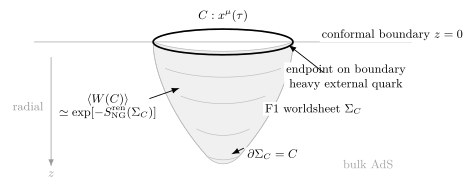
A fundamental Wilson loop is represented holographically by an open F1 worldsheet ending on the boundary contour . In the classical string limit, is dominated by the renormalized minimal area of .
This page develops the dictionary. The next page uses it to compute the heavy-quark potential from a U-shaped string worldsheet.
Wilson loops in ordinary gauge theory
Section titled “Wilson loops in ordinary gauge theory”Let be a gauge field and let be a representation of the gauge group. The Wilson loop along a closed curve is
where denotes path ordering. The trace is essential. The parallel transporter around a closed curve transforms by conjugation under a gauge transformation, and the trace removes that conjugation.
For a path parametrized by , this is
The most useful physical interpretation is that is the phase factor acquired by an infinitely heavy external probe in representation whose worldline is . This is why Wilson loops are so sensitive to confinement: they ask how expensive it is to insert heavy color sources.
For a rectangular Euclidean loop with temporal extent and spatial separation ,
the large- behavior defines the static potential between a heavy quark and antiquark:
Thus a Wilson loop is both an operator and a measuring device. It measures the free energy of external color sources.
Area law, perimeter law, and what Wilson loops diagnose
Section titled “Area law, perimeter law, and what Wilson loops diagnose”In a confining gauge theory, a large rectangular Wilson loop in the fundamental representation often obeys an area law,
where is the confining string tension. For a rectangle, this gives
In a Coulomb phase, one instead expects a potential of the form in four dimensions. In a screened phase with dynamical fundamental matter, the Wilson loop may fail to show an asymptotic area law because the external flux tube can break by pair creation.
For this course, the crucial distinction is the following:
| Boundary behavior | Physical interpretation | Typical potential |
|---|---|---|
| Area law | confinement of external fundamental probes | |
| Coulombic behavior | conformal or weakly screened interaction | |
| Perimeter/screened behavior | string breaking or deconfinement | saturates or is screened |
The vacuum of four-dimensional SYM is conformal, so it does not confine. The holographic Wilson loop in vacuum gives a strong-coupling Coulomb potential,
not a linear potential. Confining behavior appears in other geometries, for example those with an IR wall, a cigar cap, or a shrinking cycle that prevents the string from sliding indefinitely into the deep bulk.
The Maldacena-Wilson loop in SYM
Section titled “The Maldacena-Wilson loop in N=4\mathcal N=4N=4 SYM”In SYM, the Wilson operator naturally dual to a fundamental string is not merely the ordinary gauge-field holonomy. The supersymmetric line operator also couples to the six adjoint scalars , :
Here is a unit vector on ,
This scalar coupling is not ornamental. It is required by the D3-brane origin of the probe. A heavy external quark can be engineered by separating one D3-brane from a stack of D3-branes. The massive open string stretched between the separated brane and the stack becomes a heavy -boson in the fundamental of the unbroken . Its worldline coupling includes both the gauge field and the scalar fields that describe transverse brane positions.
A straight line with constant preserves half of the supercharges. A circle with constant is also half-BPS after the conformal map from the line to the circle, but its expectation value is not equal to one because the conformal transformation changes the regularization by an anomaly-like finite term.
The internal vector has a direct bulk meaning: it specifies where the string endpoint sits on the as it moves along the boundary curve. Thus the full boundary condition for a string in is not just
but also, schematically,
for the internal direction.
Why a fundamental string?
Section titled “Why a fundamental string?”The D-brane origin of the canonical correspondence explains the Wilson-loop dictionary almost without calculation.
On the gauge-theory side, a fundamental Wilson loop inserts an infinitely heavy external quark. On the string-theory side, a fundamental quark is the endpoint of a fundamental open string ending on the D3-branes. After the near-horizon limit, the D3-brane stack is replaced by , and the endpoint of the string is pushed to the AdS boundary. The string itself remains as a macroscopic object stretching into the bulk.
The dictionary is therefore:
| CFT / gauge-theory object | Bulk object |
|---|---|
| Fundamental Wilson loop | Fundamental string worldsheet ending on |
| Heavy external quark | Endpoint of an F1 string at the boundary |
| Curve | Boundary condition for AdS embedding coordinates |
| Scalar coupling in SYM | Boundary condition on position |
| Strong-coupling saddle | Classical minimal worldsheet |
| Perimeter divergence | Infinite rest mass of external quark |
The word “external” matters. In pure SYM there are no dynamical fundamental quarks. The Wilson loop is a probe operator, not the worldline of a dynamical field already present in the Lagrangian. Dynamical flavor degrees of freedom require additional flavor branes, a topic that appears later.
The string action and the strong-coupling limit
Section titled “The string action and the strong-coupling limit”At leading order in the classical string limit, the relevant action is the Nambu-Goto action
where the induced worldsheet metric is
For a Euclidean Wilson loop, the worldsheet is Euclidean and is positive. For a Lorentzian Wilson line, one must use the appropriate Lorentzian string action and real-time prescription.
In the canonical duality,
so a typical classical string action scales as
This explains a famous qualitative feature of holographic Wilson loops: at strong ‘t Hooft coupling, the exponent is proportional to , not to .
The saddle-point approximation is controlled by large :
so the string worldsheet is governed by classical geometry. Quantum fluctuations of the worldsheet give corrections of order in the exponent, while corrections to the target-space geometry give inverse powers of or depending on the observable and background. String loop effects are controlled by and are suppressed in the planar large- limit.
Thus the cleanest version of the formula is
when and .
Boundary divergence and quark-mass subtraction
Section titled “Boundary divergence and quark-mass subtraction”A string that ends at the AdS boundary has infinite area. This is not a bug; it is the bulk version of the infinite mass of an external quark.
Near the boundary of Euclidean AdS,
consider a straight Wilson line of Euclidean length . The dual string is the vertical surface
The induced metric is
so the bare action with cutoff is
The divergence is proportional to the length of the boundary contour:
This is interpreted as the infinite rest mass of the heavy quark. The renormalized string action subtracts it:
up to finite scheme choices. For the half-BPS straight line in SYM, the standard convention gives
This normalization is physically natural because the straight BPS external quark has no force acting on it in the vacuum.
Example: the circular half-BPS loop
Section titled “Example: the circular half-BPS loop”The circular Wilson loop is the simplest nontrivial closed contour. Let the boundary curve be a circle of radius in a Euclidean plane:
In Euclidean AdS, the corresponding classical worldsheet is a hemisphere,
One convenient parametrization is
with . The induced metric is that of Euclidean AdS with radius :
The bare area diverges near . After subtracting the perimeter divergence, the renormalized action is
Therefore the classical string prediction is
This result is one of the cleanest examples where the strong-coupling string saddle matches a quantity that can also be studied very precisely on the gauge-theory side. In the planar limit, the half-BPS circular Wilson loop is captured by a Gaussian matrix model, whose strong-coupling asymptotics reproduce the same exponential behavior, with computable prefactors.
The circle and the straight line are related by a conformal transformation, so why are their expectation values different? The answer is that the line has an infrared divergence while the circle has a finite scale. The regularization and conformal map do not commute innocently. The difference is a finite anomaly-like effect, and holographically it appears as the finite part of the renormalized worldsheet area.
Preview: the rectangular loop and the heavy-quark potential
Section titled “Preview: the rectangular loop and the heavy-quark potential”For the rectangular loop, the worldsheet has two nearly vertical pieces ending on the quark and antiquark worldlines and a smooth U-shaped bottom that connects them in the bulk. In pure AdS, conformal invariance fixes the potential to have the form
where the classical string calculation gives
The next page derives this result. For now, notice the structure:
- the dependence follows from conformal invariance;
- the coefficient follows from the string tension in AdS units;
- the numerical constant follows from solving the minimal surface problem;
- the perimeter divergences from the two vertical string pieces must be subtracted.
In confining holographic backgrounds, the same rectangular-loop calculation changes qualitatively. If the geometry has an effective IR bottom where the string can sit, the large- worldsheet consists of two vertical pieces plus a long horizontal segment at the bottom. Then
where is the effective string tension evaluated at the IR wall or cap. Thus the Wilson-loop prescription naturally converts geometric IR structure into confinement diagnostics.
Which bulk object for which line operator?
Section titled “Which bulk object for which line operator?”The fundamental string is only the first entry in a larger line-operator dictionary.
| Boundary line operator | Bulk description |
|---|---|
| Fundamental Wilson loop | F1 string |
| Fundamental ‘t Hooft loop | D1 string |
| Wilson-‘t Hooft loop with charges | string |
| Large-rank antisymmetric Wilson loop | D5-brane with electric flux |
| Large-rank symmetric Wilson loop | D3-brane with electric flux |
| Surface/defect generalizations | Higher-dimensional branes |
The reason is simple: different line operators carry different electric and magnetic charges under the gauge theory, and the bulk has different extended objects carrying the corresponding string charges. The full story is tied to S-duality, brane polarization, representation theory, and boundary conditions for higher-form symmetries. Those refinements belong later in the course. For this page, the key lesson is:
Minimal surfaces are not just “areas”
Section titled “Minimal surfaces are not just “areas””It is tempting to summarize the prescription as “compute the area of a surface.” That is true in the strict classical Nambu-Goto approximation, but several qualifications matter in real calculations.
First, the surface is embedded in the full ten-dimensional geometry when the internal space is relevant. For supersymmetric Wilson loops in SYM, the boundary condition encodes the scalar coupling.
Second, the action may contain more than the Nambu-Goto area. A fundamental string also has a coupling to the NS-NS two-form,
in Euclidean signature. This vanishes in the simplest examples with , but it matters in more general backgrounds.
Third, the saddle may not be unique. When several classical worldsheets end on the same contour, the leading contribution comes from the saddle with smallest renormalized action, but subdominant saddles can signal phase transitions. The Gross-Ooguri transition for correlators of Wilson loops is a classic example: connected and disconnected minimal surfaces compete.
Fourth, the boundary divergence must be removed consistently. The subtraction is analogous in spirit to holographic renormalization for fields, but now the divergent object is a string worldsheet area rather than a bulk field action.
Fifth, the ordinary Wilson loop and the supersymmetric Maldacena-Wilson loop have different ultraviolet properties. The scalar coupling can cancel divergences and preserve supersymmetry for special contours. Without it, cusps, intersections, and sharp corners generate additional divergences controlled by cusp anomalous dimensions.
Wilson loops as line defects
Section titled “Wilson loops as line defects”A modern viewpoint treats a Wilson line not merely as an observable but as a defect CFT supported on the line. A straight Wilson line in a CFT preserves a subgroup of the conformal group. For a line in Euclidean dimensions, the preserved spacetime symmetry is
where is the conformal group along the line and rotates the transverse directions. In SYM, a half-BPS Wilson line also preserves part of the R-symmetry and supersymmetry.
From the bulk point of view, the straight string worldsheet is an subspace inside . Fluctuations of the string worldsheet are dual to defect operators living on the Wilson line. This line-defect perspective is extremely useful for precision tests: one can study displacement operators, Bremsstrahlung functions, cusp anomalous dimensions, and defect OPE data.
The first lesson, however, is already visible at the classical level. A line defect in the CFT carves out a two-dimensional worldsheet in the bulk.
Validity of the classical Wilson-loop prescription
Section titled “Validity of the classical Wilson-loop prescription”For the formula
to be quantitatively reliable, several assumptions are normally being made:
| Assumption | Bulk meaning | Boundary meaning |
|---|---|---|
| suppress string loops and backreaction | planar limit | |
| suppress worldsheet corrections | strong ‘t Hooft coupling | |
| probe approximation | ignore backreaction of the F1 string | one external quark, not matter |
| smooth contour | no cusp/intersection divergences beyond perimeter term | controlled line defect |
| fixed representation | fundamental representation, not large-rank representation | F1 rather than D-brane saddle |
| specified internal coupling | boundary condition on | scalar coupling fixed |
This table is worth taking seriously. Many incorrect uses of holographic Wilson loops come from silently applying the fundamental-string formula outside its regime.
Common mistakes
Section titled “Common mistakes”Mistake 1: Treating the Wilson loop as a local operator. A Wilson loop is supported on a curve. It creates a line defect or heavy external probe. Its bulk dual is an extended worldsheet, not a pointlike field.
Mistake 2: Forgetting the scalar coupling in SYM. The string dual of the standard supersymmetric Wilson loop is the Maldacena-Wilson loop with scalar coupling. The ordinary gauge-field Wilson loop is a different operator.
Mistake 3: Interpreting the string endpoint as a dynamical quark. In SYM without flavor branes, the fundamental Wilson loop is an external probe. Dynamical fundamental matter requires extra ingredients.
Mistake 4: Ignoring the perimeter divergence. A string ending at the AdS boundary has infinite area. The divergence is the infinite mass of the external quark and must be subtracted.
Mistake 5: Assuming Wilson loops always show confinement. Vacuum SYM is conformal. Its heavy-quark potential is Coulombic, not linear.
Mistake 6: Confusing representation with string type. A fundamental Wilson loop is an F1 string. Magnetic and dyonic line operators involve D1 or strings; large-rank Wilson loops are often described by D-branes.
Exercises
Section titled “Exercises”Exercise 1: Gauge invariance of a closed Wilson loop
Section titled “Exercise 1: Gauge invariance of a closed Wilson loop”Let
be the holonomy around a closed curve based at . Under a gauge transformation , show that
Conclude that is gauge invariant.
Solution
For an open path from to , the parallel transporter transforms as
A closed loop has , so
Taking the trace removes the conjugation:
Thus the traced Wilson loop is gauge invariant.
Exercise 2: Extracting the static potential
Section titled “Exercise 2: Extracting the static potential”Suppose a rectangular Euclidean Wilson loop has large- behavior
Show that
Solution
Taking the logarithm gives
Divide by :
Taking removes the subleading term and gives
Exercise 3: Why the exponent scales as
Section titled “Exercise 3: Why the exponent scales as λ\sqrt\lambdaλ”Using
and
show that a classical string worldsheet action in has the form
up to a conventional factor of , where is a dimensionless area functional.
Solution
If , then the induced metric is
For a two-dimensional worldsheet,
Therefore
Defining
we obtain
Exercise 4: Perimeter divergence of a straight string
Section titled “Exercise 4: Perimeter divergence of a straight string”Consider the vertical string dual to a straight Wilson line of Euclidean length in Poincaré AdS,
Use the embedding , , to show that
with cutoff .
Solution
The induced metric is
Hence
The Nambu-Goto action is
The integral gives
The divergent term is proportional to the length of the boundary line and is interpreted as the infinite external-quark mass.
Exercise 5: The hemisphere ending on a circle
Section titled “Exercise 5: The hemisphere ending on a circle”Show that the surface
ends on a circle of radius at the AdS boundary . Explain why conformal invariance implies that the finite part of the circular Wilson loop cannot depend on .
Solution
At the boundary , the equation becomes
which is a circle of radius . The only scale in the boundary contour is . In a conformal theory, a dimensionless normalized expectation value of a smooth circular loop cannot depend on the absolute value of after the local perimeter divergence is subtracted. Therefore the finite part of the renormalized action is a pure number times , independent of .
Indeed, the explicit classical string computation gives
so
with no dependence on the radius.
Further reading
Section titled “Further reading”- J. M. Maldacena, “Wilson loops in large field theories”. The original fundamental-string prescription for Wilson loops in AdS/CFT.
- S.-J. Rey and J.-T. Yee, “Macroscopic strings as heavy quarks: large- gauge theory and anti-de Sitter supergravity”. The complementary heavy-quark/macroscopic-string construction.
- N. Drukker, D. J. Gross, and H. Ooguri, “Wilson loops and minimal surfaces”. A detailed study of minimal surfaces, BPS loops, divergences, and loop-equation aspects.
- J. Erickson, G. Semenoff, and K. Zarembo, “Wilson loops in supersymmetric Yang-Mills theory”. Perturbative and matrix-model evidence for the circular Wilson loop result.
- V. Pestun, “Localization of gauge theory on a four-sphere and supersymmetric Wilson loops”. The localization derivation of the Gaussian matrix model for supersymmetric circular Wilson loops.