
Hard-Wall and Soft-Wall Models
The main idea
Section titled “The main idea”Pure AdS is too conformal to describe ordinary low-energy QCD. It has no intrinsic mass scale, no discrete tower of massive hadrons, and no confining flux tube in the Wilson-loop sense. A bottom-up AdS/QCD model therefore begins with a pragmatic question:
What is the minimal five-dimensional structure that preserves the ultraviolet logic of the AdS/CFT dictionary but modifies the infrared enough to model confinement and hadron physics?
The two classic answers are the hard wall and the soft wall.
The hard-wall model keeps the AdS metric
and simply cuts off the radial direction at
The cutoff acts like an infrared box. Bulk normal modes become discrete, with masses roughly set by zeros of Bessel functions. For many hadron towers, this gives
The soft-wall model removes the abrupt wall and instead introduces a smooth infrared profile, often written as a dilaton factor in the five-dimensional action,
This changes the radial Sturm-Liouville problem into something close to a harmonic oscillator. For vector mesons in the simplest model one finds
which gives the linear radial Regge behavior
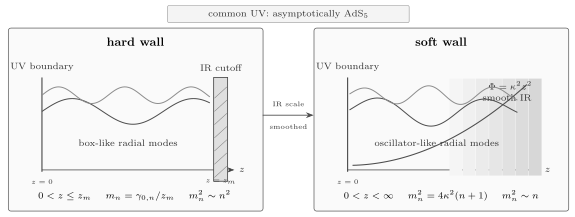
The hard wall introduces confinement by ending the AdS radial interval at . The soft wall replaces the sharp cutoff by a smooth infrared profile, commonly , producing oscillator-like radial spectra and .
These models are extremely useful, but their status must be stated honestly. They are not known to be exact duals of large- QCD. They are phenomenological five-dimensional effective models inspired by AdS/CFT. Their strength is that they package large- counting, current correlators, chiral symmetry, confinement scales, and hadron spectra into a calculable geometric framework. Their weakness is that the infrared geometry and field content are chosen by modeling judgment, not derived from a complete string construction of QCD.
A good way to use them is this:
A bad way to use them is to say: “this is QCD because it is five-dimensional.” Tiny sentence, enormous crime scene.
What problem are these models solving?
Section titled “What problem are these models solving?”A four-dimensional confining gauge theory has a mass gap and a discrete spectrum of color-singlet hadrons. In the large- limit, stable mesons and glueballs have parametrically narrow widths. For example, normalized single-trace meson operators have two-point functions with poles
in Euclidean signature. At large , the widths scale as
so the spectral density becomes a sum over narrow resonances.
Pure Poincaré AdS does not naturally produce such a spectrum. A free scalar in Euclidean AdS with momentum satisfies a radial equation whose normalizable solutions behave continuously in . This is appropriate for a CFT, whose two-point functions have branch cuts rather than isolated hadron poles. To model QCD-like physics, we need to modify the infrared.
The minimal requirements are:
| QCD feature | Holographic modeling ingredient |
|---|---|
| approximate UV scaling | asymptotically AdS metric near |
| confinement scale | IR wall, cap, or smooth dilaton/warp-factor scale |
| discrete hadrons | normalizable radial eigenmodes |
| large- narrow resonances | classical five-dimensional fields |
| flavor symmetry | five-dimensional gauge fields for |
| chiral symmetry breaking | bifundamental scalar or brane embedding data |
| current correlators | on-shell action differentiated with respect to UV sources |
The hard wall and soft wall are the two simplest laboratories for this list.
The bottom-up dictionary
Section titled “The bottom-up dictionary”In a top-down string construction, the bulk fields, compact space, interactions, and boundary conditions are fixed by the higher-dimensional theory. In bottom-up AdS/QCD, one instead chooses a small set of five-dimensional fields dual to important QCD operators.
For light-flavor mesons one often introduces five-dimensional gauge fields
dual to the chiral currents
It is convenient to define vector and axial combinations
One also introduces a bifundamental scalar
transforming as
under . Since has engineering dimension , the AdS mass-dimension relation in gives
Near the boundary,
where is the quark-mass source and is proportional to the chiral condensate. The factor is conventional.
The simplest hard-wall meson action is schematically
with the fields living on the interval .
The five-dimensional gauge coupling is not arbitrary if one wants the ultraviolet current-current correlator to match perturbative QCD at large Euclidean momentum. The standard matching gives
in common normalization. This is a good example of the bottom-up philosophy: the UV part of the model is fixed by operator matching, while the IR wall and some boundary conditions are phenomenological.
The hard-wall vector spectrum
Section titled “The hard-wall vector spectrum”Let us see the main mechanism explicitly. Consider a five-dimensional Maxwell field in AdS on the hard-wall interval. The quadratic action is
Choose radial gauge
and transverse four-dimensional modes
Write
The radial equation becomes
The solution regular near the UV boundary is
A common IR condition for vector mesons is Neumann,
Using
we get
Therefore
where is the th zero of . For large ,
so
This is the central success and central limitation of the hard wall. It naturally gives a discrete spectrum and a mass gap. But highly excited QCD mesons are better organized by approximately linear Regge behavior,
not by .
Hard-wall correlators and poles
Section titled “Hard-wall correlators and poles”The same equation also computes the vector-current two-point function. Instead of a normalizable mode, solve the bulk-to-boundary problem
The on-shell Maxwell action reduces to a boundary term,
After imposing the IR condition and renormalizing the UV divergence, the current correlator is obtained by differentiating with respect to . The normalizable modes appear as poles in the two-point function. This is the same GKPW logic as before, but with an IR boundary condition that discretizes the spectrum.
In this sense the hard wall is a five-dimensional version of a large- resonance model. The UV source creates a current insertion; the current couples to a tower of normalizable bulk modes; those modes are interpreted as mesons.
Chiral symmetry breaking in the hard wall
Section titled “Chiral symmetry breaking in the hard wall”The hard-wall model can also describe the basic chiral symmetry pattern
The bifundamental scalar has a background profile
with
in the simplest hard-wall setup. The nonzero gives a -dependent mass to the axial gauge field through , splitting vector and axial-vector mesons. Pions arise from the coupled system involving the phase of and the longitudinal part of .
A famous success of the original hard-wall construction is that it naturally reproduces the Gell-Mann-Oakes-Renner relation,
up to conventions for the normalization of .
There is an important conceptual caveat. In the simplest hard-wall model, and are treated as independent input parameters because the scalar equation in fixed AdS permits both coefficients. In real QCD, the condensate is dynamically determined once the quark masses and gauge dynamics are specified. More refined holographic models try to improve this by adding scalar potentials, backreaction, tachyon dynamics, or top-down brane embeddings.
Why soft walls were introduced
Section titled “Why soft walls were introduced”The hard wall is brutally effective: it creates a mass gap by ending space. But an abrupt radial cutoff has two aesthetic and physical drawbacks.
First, the large excitation spectrum is box-like:
Second, the wall is not generated dynamically by a smooth solution of bulk equations. It is imposed by hand.
The soft-wall idea is to replace the sharp cutoff by a smooth infrared profile that suppresses wavefunctions at large . The simplest implementation keeps the AdS metric but modifies the action by
For a vector field,
The mode equation becomes
This is again a Sturm-Liouville problem, but now on the half-line . The infrared boundary condition is normalizability with respect to the weight , not an imposed condition at .
The soft-wall spectrum as a harmonic oscillator
Section titled “The soft-wall spectrum as a harmonic oscillator”The vector equation can be put in Schrödinger form. Write
Now set
Then
where
For
we find
Thus
This is a radial harmonic-oscillator potential. The normalizable spectrum is
The eigenfunctions may be written as
with the appropriate exponential factor appearing in the Schrödinger wavefunction .
The result is the main reason the soft wall became popular: it gives linear radial trajectories without a hard IR brane.
Regge behavior and spin
Section titled “Regge behavior and spin”A basic empirical feature of hadron spectroscopy is approximate Regge behavior,
where is the radial excitation number and is the spin. In a semiclassical string picture, this is natural because the mass squared of a rotating string grows linearly with angular momentum.
A hard-wall model is not well adapted to this behavior at high excitation number. A soft wall with quadratic dilaton is better: the radial equation becomes oscillator-like, producing linear trajectories. In its simplest version, one often quotes
where the intercept depends on the field, spin, and model details.
This formula should not be oversold. The soft wall is a phenomenological way to encode the desired large-excitation behavior. In a complete confining string dual, the Regge physics would come from a full string background and its worldsheet dynamics. The soft wall captures one important spectral feature with a very economical five-dimensional model.
Hard wall versus soft wall
Section titled “Hard wall versus soft wall”The two models are best viewed as complementary approximations.
| Feature | Hard wall | Soft wall |
|---|---|---|
| IR scale | sharp cutoff | smooth profile |
| radial domain | finite interval | half-line |
| normal modes | box-like Bessel modes | oscillator-like modes |
| large- vector spectrum | ||
| simplest calculation | boundary-value problem with IR condition | Sturm-Liouville problem with normalizability |
| confinement intuition | space ends in the IR | wavefunctions are suppressed in the IR |
| main virtue | simple, concrete, good for low-lying modes | linear Regge trajectories |
| main drawback | abrupt nondynamical wall | dilaton/background often imposed by hand |
The hard wall is often easier for teaching because boundary conditions are visible. The soft wall is often more realistic for high radial excitations because it produces linear trajectories. Neither should be mistaken for a controlled top-down dual of QCD.
What does “confinement” mean in these models?
Section titled “What does “confinement” mean in these models?”The word confinement has several related but distinct meanings:
- A mass gap.
- A discrete color-singlet spectrum.
- An area law for large Wilson loops.
- Vanishing expectation value of the Polyakov loop in a confining phase.
- Absence of colored asymptotic states.
- Linear Regge trajectories.
Hard-wall and soft-wall models can capture some of these features but not all automatically.
The hard wall produces a mass gap and discrete normal modes. It can also produce an area-law-like Wilson-loop behavior if the string worldsheet is forced to sit near the IR wall at large separation. But the wall itself is imposed, so the model does not dynamically explain confinement.
The soft wall produces a mass gap and linear radial spectra for suitable fields. But a dilaton factor in a probe-field action does not automatically guarantee Wilson-loop confinement. For Wilson loops, the relevant object is the string-frame geometry seen by a fundamental string. A background that confines meson wavefunctions in a five-dimensional action may or may not produce an area law for a fundamental string.
This distinction matters. Spectral confinement and Wilson-loop confinement are related in genuine confining gauge theories, but a bottom-up model can realize one more cleanly than the other.
The Wilson-loop criterion in geometric language
Section titled “The Wilson-loop criterion in geometric language”For a static quark-antiquark pair, the holographic Wilson-loop prescription uses the Nambu-Goto action of a fundamental string. In a general string-frame metric of the form
the string tension felt at radial position is controlled by
A sufficient intuitive condition for confinement is that has a positive minimum in the infrared, so a large string worldsheet prefers to lie at that radial position. Then
In a hard-wall model, the minimum is effectively at the wall. In a smooth top-down confining geometry, it may occur where a circle caps off or where the string-frame warp factor has a minimum. In a soft-wall meson model with only a dilaton in the field action, one must ask separately what the string-frame geometry is. This is a recurring theme: different observables probe different parts of the would-be dual.
How to compute in hard-wall or soft-wall models
Section titled “How to compute in hard-wall or soft-wall models”A typical bottom-up computation follows a standard pattern.
1. Choose the operator
Section titled “1. Choose the operator”For a QCD operator of dimension and spin , choose a five-dimensional field with the corresponding UV behavior. For a scalar in AdS,
For a conserved current, use a five-dimensional gauge field. For the stress tensor or glueball sectors, one may use metric or scalar-gravity fluctuations, depending on the model.
2. Choose the background
Section titled “2. Choose the background”The simplest backgrounds are:
and
More sophisticated models replace this by an Einstein-dilaton background,
where and are solved from equations of motion or fitted to thermodynamics and spectra.
3. Solve the radial eigenvalue problem
Section titled “3. Solve the radial eigenvalue problem”A general mode equation has Sturm-Liouville form
with normalization
The masses are eigenvalues. The wavefunctions determine decay constants and cubic couplings through overlap integrals.
4. Compute correlators from the on-shell action
Section titled “4. Compute correlators from the on-shell action”For two-point functions, solve the non-normalizable problem with source normalization at the boundary. The renormalized on-shell action gives
The poles of this correlator occur at the normal-mode eigenvalues.
5. Interpret the answer with model discipline
Section titled “5. Interpret the answer with model discipline”Ask three questions before believing the result:
- Was the UV normalization matched to QCD or chosen freely?
- Is the IR scale fixed from one observable and then used to predict another?
- Is the observable sensitive to the imposed wall/dilaton in a way that could change in a different model?
This discipline separates useful phenomenology from decorative holography.
A useful example: vector meson dominance
Section titled “A useful example: vector meson dominance”Because the five-dimensional gauge field is dual to the flavor current, the current correlator naturally decomposes into normal modes:
This resembles vector meson dominance: external current sources couple to a tower of vector resonances. In hard-wall and soft-wall models, the residues are determined by the UV behavior of the normalizable wavefunctions. Schematically,
This is a nice example of what bottom-up holography does well. It turns a qualitative large- statement — current correlators are sums over narrow resonances — into a calculable radial eigenvalue problem.
Relation to top-down confinement
Section titled “Relation to top-down confinement”Hard-wall and soft-wall models are not the only way to obtain confinement holographically. In more geometric models, the infrared can arise from a smooth cap, wrapped branes, fluxes, or a running dilaton. Examples include Witten’s D4-brane model, Klebanov-Strassler-type cascading geometries, and other top-down or semi-top-down constructions.
A smooth confining geometry often has one of the following features:
The bottom-up hard wall mimics the existence of an IR endpoint. The soft wall mimics a smooth confining potential in the radial wave equation. They are useful because they are analytically simple, not because they replace the problem of deriving QCD from string theory.
Common mistakes
Section titled “Common mistakes”Mistake 1: calling the hard wall “the dual of QCD”
Section titled “Mistake 1: calling the hard wall “the dual of QCD””The hard wall is a model inspired by holography. It is not a derived string dual of QCD. It has too few fields, no asymptotic freedom, and an imposed IR cutoff.
Mistake 2: confusing a mass gap with full confinement
Section titled “Mistake 2: confusing a mass gap with full confinement”A discrete spectrum is not the same as proving Wilson-loop area law, chiral symmetry breaking, center symmetry, and absence of colored states. Holographic models can capture different confinement diagnostics with different degrees of reliability.
Mistake 3: using the wrong spectrum at high excitation
Section titled “Mistake 3: using the wrong spectrum at high excitation”Hard-wall spectra behave like a box at large radial number. If one wants linear radial Regge behavior, the soft wall or a more dynamical confining background is more natural.
Mistake 4: ignoring boundary conditions
Section titled “Mistake 4: ignoring boundary conditions”IR boundary conditions are part of the model. Changing Dirichlet to Neumann conditions can change the spectrum and couplings. These choices should be justified by symmetry, variational principles, or phenomenological calibration.
Mistake 5: treating and too naively
Section titled “Mistake 5: treating mqm_qmq and σ\sigmaσ too naively”In simple hard-wall models, the quark mass and condensate coefficients are often independent inputs. That is not the same as a dynamical derivation of chiral symmetry breaking.
Mistake 6: thinking the dilaton factor always affects strings the same way it affects probe fields
Section titled “Mistake 6: thinking the dilaton factor always affects strings the same way it affects probe fields”The soft-wall factor in a five-dimensional meson action modifies probe-field wave equations. A Wilson loop probes the string-frame metric and fundamental string action. These are related only in a fully specified string background.
Exercises
Section titled “Exercises”Exercise 1: Hard-wall vector modes
Section titled “Exercise 1: Hard-wall vector modes”Consider a transverse five-dimensional gauge field in AdS on the interval . Starting from
show that the regular solution is . Then impose the Neumann condition and derive the quantization condition.
Solution
Multiply the equation by :
Let and define . Then
which is Bessel’s equation of order one. The solution regular at is
so
The Neumann condition gives
Therefore
where is the th zero of .
Exercise 2: The soft-wall Schrödinger potential
Section titled “Exercise 2: The soft-wall Schrödinger potential”For the soft-wall vector equation
set . Show that
Solution
Start by expanding the equation:
With ,
and
Substitution gives
Therefore
For ,
Thus
Exercise 3: Source and condensate for the chiral scalar
Section titled “Exercise 3: Source and condensate for the chiral scalar”The bifundamental scalar is dual to with in a four-dimensional boundary theory. Use the scalar mass-dimension relation to find , and write the near-boundary expansion of .
Solution
For a scalar in AdS/CFT,
With ,
The two independent near-boundary powers are
Therefore the standard hard-wall ansatz is
where is the quark-mass source and is proportional to the condensate .
Exercise 4: Why the hard wall misses linear radial Regge behavior
Section titled “Exercise 4: Why the hard wall misses linear radial Regge behavior”Using the large- asymptotic behavior of Bessel zeros,
show that the hard-wall vector spectrum has . Compare this with the soft-wall vector spectrum.
Solution
The hard-wall vector masses are
For large ,
so
The soft-wall vector spectrum is instead
so
This is why the soft wall is better suited to modeling linear radial Regge trajectories.
Exercise 5: Which confinement diagnostic is being tested?
Section titled “Exercise 5: Which confinement diagnostic is being tested?”Classify each statement as testing a mass gap, Wilson-loop confinement, chiral symmetry breaking, or large- resonance behavior.
- The two-point function has isolated poles at .
- The scalar has a nonzero coefficient when .
- A large rectangular Wilson loop gives .
- Meson widths vanish as .
Solution
- Isolated poles indicate a discrete spectrum and therefore a mass gap when the lowest pole is at nonzero mass.
- A nonzero condensate coefficient in the chiral limit indicates spontaneous chiral symmetry breaking, assuming the coefficient is dynamically determined rather than merely inserted.
- A linear heavy-quark potential tests Wilson-loop confinement.
- Vanishing widths are the large- resonance property. In holography this corresponds to tree-level classical bulk fields and suppressed bulk interactions.
Further reading
Section titled “Further reading”- J. Erlich, E. Katz, D. T. Son, and M. A. Stephanov, QCD and a Holographic Model of Hadrons. The classic hard-wall AdS/QCD model for low-energy meson physics.
- A. Karch, E. Katz, D. T. Son, and M. A. Stephanov, Linear Confinement and AdS/QCD. The original soft-wall model emphasizing linear Regge behavior.
- J. Polchinski and M. J. Strassler, Hard Scattering and Gauge/String Duality. An influential use of an IR cutoff in gauge/string duality for confining physics.
- J. Erdmenger, N. Evans, I. Kirsch, and E. Threlfall, Mesons in Gauge/Gravity Duals. A useful broader review of mesons in holographic models.
- U. Gursoy, E. Kiritsis, F. Nitti, and collaborators on improved holographic QCD. These models go beyond fixed AdS backgrounds by using dynamical Einstein-dilaton geometries fitted to QCD-like thermodynamics and spectra.