
Lie Algebras for CFT
Lie algebras appear in CFT in three different ways, and it is useful not to mix them up.
First, there is the spacetime symmetry algebra. In a -dimensional Euclidean CFT this is ; in Lorentzian signature it is . Its representations classify local operators by scaling dimension and spin.
Second, there are internal global symmetries. These include ordinary flavor symmetries, -symmetries in supersymmetric theories, and discrete symmetries when present. Their Lie algebras label multiplets of local operators. In AdS/CFT, these global symmetries become gauge symmetries in the bulk.
Third, in two-dimensional CFT there are current algebras. A conserved holomorphic current does not merely generate a finite-dimensional Lie algebra ; its modes generate the affine algebra . This is the algebraic engine behind WZW models, Sugawara stress tensors, KZ equations, rational CFT, and many worldsheet descriptions of strings.
This appendix is a working reference. It is not a full course on Lie theory. Its goal is to make the representation labels, normalizations, and formulas used in CFT and AdS/CFT immediately readable.
Basic conventions
Section titled “Basic conventions”A finite-dimensional Lie algebra is a vector space with a bilinear antisymmetric bracket
obeying the Jacobi identity
Choose a basis of . In a physics convention for compact Lie algebras, the bracket is often written
where are the structure constants. Some mathematics references use anti-Hermitian generators and omit the factor of . The physics convention is natural when are Hermitian matrices acting on a Hilbert space.
A representation is a map
such that
In CFT, a local operator transforming in representation has infinitesimal transformation
up to the sign convention chosen for charges. The important invariant fact is that operators organize into multiplets of .
Three recurring examples
Section titled “Three recurring examples”The following table is the mental map for this course.
| Algebra | Where it appears | What it labels |
|---|---|---|
| or | Conformal symmetry | , spin, conformal multiplets |
| Spin chains, 2D current algebra, angular momentum | spin , Dynkin label | |
| SYM | -symmetry labels | |
| 2D WZW and current algebra | affine highest weights, level | |
| superconformal symmetry | supermultiplets, BPS shortening |
The same representation-theoretic words occur in all rows: weights, highest weights, Casimirs, tensor products, singlets, and selection rules. The details differ, but the logic is remarkably stable.
Cartan subalgebra, roots, and weights
Section titled “Cartan subalgebra, roots, and weights”Let be a complex semisimple Lie algebra of rank . A Cartan subalgebra is a maximal commuting subalgebra. Choose a basis , , for .
In the Cartan-Weyl basis, the algebra is decomposed into
where is the root system. A root is a linear functional on , characterized by
For every root , there is a root vector . Roots describe the charges of the algebra generators under the Cartan subalgebra.
A representation decomposes into weight spaces. A vector has weight if
The generators shift weights:
This is the simplest way to picture finite-dimensional representations: a representation is a finite set of weights, and the roots tell you how the algebra moves between them.
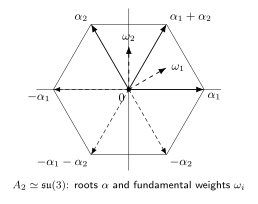
The root system. The roots , , and generate the positive-root directions. The fundamental weights are dual to the simple coroots through . The overall scale of the drawing is conventional.
A choice of positive roots defines simple roots
Every positive root is a nonnegative integer combination of simple roots:
The coroot associated with is
The fundamental weights are defined by
A highest weight is usually written in Dynkin-label form as
For compact groups, finite-dimensional irreducible representations are classified by dominant integral highest weights:
This is why Dynkin labels are so useful. They are the nonnegative integers that specify the representation.
Highest-weight representations
Section titled “Highest-weight representations”A highest-weight representation is generated from a highest-weight vector obeying
The rest of the representation is obtained by applying lowering operators .
This logic appears repeatedly in CFT:
- For finite internal symmetries, highest weights label ordinary global-symmetry multiplets.
- For conformal symmetry, a primary state is annihilated by , and descendants are obtained using .
- For Virasoro symmetry, a highest-weight state is annihilated by , and descendants are obtained using .
- For affine current algebra, an affine primary is annihilated by positive current modes and transforms in a finite-dimensional representation of under .
The same diagram keeps reappearing: a highest state sits at the top, lowering operators generate a module, and null states or shortening conditions can remove part of the module.
Weyl vector, dimensions, and Casimirs
Section titled “Weyl vector, dimensions, and Casimirs”The Weyl vector is
The Weyl dimension formula gives the dimension of the finite-dimensional irreducible representation :
The quadratic Casimir in the representation of highest weight is
when long roots have length squared and generators are normalized in the standard physics convention. The Casimir is defined by
The Dynkin index is defined by
The relation between and is
For with fundamental generators normalized by
one has
These constants appear in beta functions, current two-point functions, anomalies, and large- counting.
representations and Young diagrams
Section titled “SU(N)SU(N)SU(N) representations and Young diagrams”For , irreducible representations may be labeled either by Dynkin labels
or by Young diagrams. The connection is simple. If the Young diagram has row lengths
then the Dynkin labels are
Conversely,
Useful examples are:
| Group | Representation | Dynkin label | Dimension |
|---|---|---|---|
| spin | |||
| fundamental | |||
| antifundamental | |||
| adjoint | |||
| fundamental | |||
| antifundamental | |||
| vector of | |||
| adjoint | |||
For SYM, the most important sequence is
These are the half-BPS chiral-primary representations. Their protected scaling dimensions are
In the dictionary, they match scalar Kaluza-Klein harmonics on with angular momentum .
Selection rules and invariant tensors
Section titled “Selection rules and invariant tensors”A correlation function must be invariant under all global symmetries. If operators transform in representations of a compact global symmetry group , then the correlator can be nonzero only if
contains the singlet representation.
This is the representation-theoretic origin of many CFT selection rules. For example, a three-point coefficient
can be nonzero only if
contains a -invariant tensor. If the singlet appears more than once, there are multiple independent tensor structures in internal-symmetry space.
For adjoint currents, the two most common invariant tensors are
For with , there is also a symmetric invariant
In CFT language, these invariant tensors multiply spacetime tensor structures. Symmetry fixes the tensor structures; dynamics fixes their coefficients.
The conformal algebra as a Lie algebra
Section titled “The conformal algebra as a Lie algebra”The conformal algebra in dimensions is generated by
In the convention used in this course,
and
in Euclidean signature. This algebra is isomorphic to
In Lorentzian signature it is
A primary state is a highest-weight state for the conformal algebra:
Descendants are obtained by acting with :
Thus CFT representation theory is also highest-weight representation theory, but with respect to the noncompact conformal algebra. This is why unitarity bounds are subtler than for compact Lie groups: noncompact generators do not act like ordinary compact rotations.
The subalgebra
Section titled “The SL(2)SL(2)SL(2) subalgebra”Many CFT calculations reduce to an problem. In two dimensions, the global holomorphic conformal algebra is generated by
with
For a primary state,
and descendants are produced by . In higher-dimensional lightcone bootstrap, an analogous collinear controls towers of large-spin operators. This is why representation theory keeps returning in apparently different CFT problems.
Affine Lie algebras and current algebras
Section titled “Affine Lie algebras and current algebras”In two-dimensional CFT, a holomorphic conserved current has the OPE
Here is the level and is the invariant metric on . Expanding
one obtains the affine algebra
The zero modes generate the original finite-dimensional algebra . The nonzero modes are the new two-dimensional ingredient.
For a WZW model based on a simple Lie algebra at level , the Sugawara stress tensor gives
where is the dual Coxeter number. The central charge is
An affine primary labeled by a finite-dimensional highest weight has conformal weight
For integrable highest-weight representations at level , the finite highest weight must obey
where is the highest root. For , this becomes
for Dynkin labels .
For , the allowed representations are
Their conformal weights are
and the central charge is
Cosets
Section titled “Cosets”A coset CFT is built from a pair of current algebras and with . The symbolic notation is
The stress tensor is the difference
so the central charge is
Cosets are useful because they produce new CFTs from current-algebra data. Minimal models, parafermions, and many rational CFTs can be described this way. In string theory, cosets also provide exact worldsheet descriptions of curved target-space backgrounds.
The -symmetry of SYM is
The six real scalars transform as the vector of , which is the representation
The four Weyl fermions transform as
and their conjugates transform as
The -symmetry currents transform in the adjoint
The stress-tensor multiplet has a scalar superconformal primary in
The half-BPS single-trace chiral primaries are schematically
and transform in
These are the cleanest example of representation theory becoming a holographic spectrum: is the isometry algebra of , and labels spherical harmonics on .
Lie algebra data frequently used in CFT
Section titled “Lie algebra data frequently used in CFT”| Rank | Common use | |||
|---|---|---|---|---|
| gauge theory, WZW models, spin chains | ||||
| rotations, -symmetry, vector models | ||||
| supersymmetry, flavor symmetry conventions | ||||
| exceptional symmetry, SCFTs | ||||
| exceptional symmetry, SCFTs | ||||
| exceptional symmetry, heterotic strings |
For , this table uses the convention in which the fundamental representation has dimension . Some physics papers instead write for the same group. Always check the convention.
AdS/CFT checkpoints
Section titled “AdS/CFT checkpoints”Lie algebras become physical data in holography in several ways.
A global symmetry current in the CFT,
is dual to a bulk gauge field,
The Lie algebra controls the non-Abelian bulk gauge interactions through .
The stress tensor is the current for conformal symmetry. It is dual to the bulk metric:
The conformal algebra is the isometry algebra of in Lorentzian signature. This is the first exact match in the AdS/CFT dictionary.
For SYM,
is the isometry algebra of . Thus -symmetry representation theory becomes harmonic analysis on the internal sphere.
In two-dimensional worldsheet CFT, affine Lie algebras determine exact string backgrounds. The level often controls the curvature radius in string units. Large is a semiclassical limit; small is intrinsically stringy.
Common pitfalls
Section titled “Common pitfalls”Do not confuse a group with its algebra. The algebra captures infinitesimal transformations. The global form of the group matters for charge quantization, line operators, global anomalies, and allowed representations.
Do not confuse tensor products with fusion products. For ordinary finite-dimensional Lie algebras, tensor products decompose as usual. In rational 2D CFT and WZW models, fusion rules are level-truncated versions of tensor-product rules.
Do not confuse spin with -symmetry. Spacetime spin is part of the Lorentz or rotation representation. -symmetry is an internal symmetry that acts nontrivially on supercharges.
Do not assume every representation is unitary. Compact internal symmetries have finite-dimensional unitary representations. Noncompact conformal algebras require separate unitarity bounds, and infinite-dimensional Virasoro or affine modules have their own positivity conditions.
Do not ignore normalization. A factor of in the definition of roots or generators changes formulas for , , and . Fix the convention before comparing formulas across references.
Exercises
Section titled “Exercises”Exercise 1: Casimir from the highest weight
Section titled “Exercise 1: SU(2)SU(2)SU(2) Casimir from the highest weight”For , the simple root has length squared , and the fundamental weight is . A spin- representation has highest weight
Use
with to show that
Solution
Since and , we have
The highest weight is , and . Therefore
Thus
Exercise 2: allowed primaries of
Section titled “Exercise 2: allowed primaries of SU(2)kSU(2)_kSU(2)k”Show that the integrability condition for gives
Then compute the conformal weights for .
Solution
For , a highest weight is labeled by the Dynkin label
The highest root is the simple root, so the integrability condition is
Therefore
For , the allowed spins are and . The conformal weights are
Thus
Exercise 3: the half-BPS mass formula
Section titled “Exercise 3: the N=4\mathcal N=4N=4 half-BPS mass formula”A half-BPS scalar primary in SYM has
Use the scalar AdS/CFT mass-dimension relation in ,
to find the bulk mass for , , and .
Solution
Substitute :
For ,
For ,
For ,
The scalar saturates the Breitenlohner-Freedman bound .
Exercise 4: singlet selection rule
Section titled “Exercise 4: singlet selection rule”Suppose three scalar primaries transform in representations , , and of a compact internal symmetry group . Explain why a nonzero three-point function requires
to contain the singlet.
Solution
A three-point function with internal indices has the schematic form
where is an invariant tensor in
Equivalently, the tensor product must contain the trivial representation. If no singlet exists, there is no invariant tensor to contract the internal indices, so the correlator must vanish.
Further reading
Section titled “Further reading”For finite-dimensional simple Lie algebras, highest weights, characters, tensor products, affine Lie algebras, WZW models, fusion rules, modular invariants, and cosets, the most directly relevant reference is Di Francesco—Mathieu—Sénéchal, Chapters 13—18.
For the conformal algebra and representation theory used in the modern bootstrap, read this appendix together with the earlier pages on primaries, radial quantization, unitarity bounds, Casimirs, and conformal blocks.
For SYM and AdS/CFT, the indispensable finite-dimensional algebra is
and the indispensable superalgebra is