
Ghosts, Superghosts, and BRST Quantization
The RNS matter theory has beautiful local symmetries: worldsheet diffeomorphisms, Weyl transformations, and local worldsheet supersymmetry. After going to superconformal gauge, these symmetries are no longer visible as ordinary gauge redundancies of the metric and gravitino. They reappear in a subtler form: as ghost fields and BRST symmetry.
This page explains that structure. The main points are simple, but they are worth getting exactly right.
First, gauge fixing conformal symmetry introduces anticommuting reparametrization ghosts with weights and central charge . Second, gauge fixing local worldsheet supersymmetry introduces commuting superconformal ghosts with weights and central charge . Third, the total central charge of the matter plus ghost system vanishes only in ten spacetime dimensions:
Thus BRST nilpotency gives . Finally, the physical spectrum is not obtained by imposing the old constraints by hand, but by taking a cohomology:
This is the clean modern form of the Virasoro and super-Virasoro constraints. It is also the language in which vertex operators and scattering amplitudes are most naturally written.
Gauge fixing and ghost fields
Section titled “Gauge fixing and ghost fields”Start with the locally supersymmetric worldsheet theory. Before gauge fixing, the bosonic fields couple to the worldsheet metric , and the worldsheet fermions couple to the gravitino . Superconformal gauge sets, schematically,
This gauge choice is not free. The Faddeev—Popov determinant for diffeomorphisms and Weyl transformations is represented by the ghost system. The corresponding determinant for local worldsheet supersymmetry is represented by the ghost system.
For the holomorphic sector the ghost action is
The antiholomorphic sector has independent fields for closed strings. For open strings one usually uses the doubling trick, so the holomorphic fields on the doubled plane carry the full information.
The statistics are important:
This reversal of statistics is not a typo. Gauge fixing a bosonic gauge symmetry produces fermionic ghosts, while gauge fixing a fermionic gauge symmetry produces bosonic ghosts.
The system
Section titled “The bcbcbc system”The reparametrization ghost fields obey the OPE
Since has weight and has weight , their mode expansions on the plane are
The OPE gives
A useful way to remember the stress tensor is to begin with a general anticommuting first-order system whose field has weight and whose field has weight . Its stress tensor is
Equivalently,
up to harmless normal-ordering conventions. For the string reparametrization ghosts , so
With this stress tensor,
and
as required.
The central charge of an anticommuting first-order system is
For this gives
This is the same number that cancels the central charge of the bosonic string matter CFT. In the superstring it cancels only part of the matter anomaly; the remaining part is supplied by the superghosts.
The ghost-number current is conventionally written
It assigns
Unintegrated vertex operators carry a factor of and hence ghost number one in each chiral sector. Integrated vertex operators have no ghost and are obtained by integrating a dimension-one matter operator over the worldsheet.
The superghost system
Section titled “The βγ\beta\gammaβγ superghost system”The superconformal ghosts satisfy a first-order OPE
where the relative sign is a convention tied to radial ordering. The important point is that and are commuting fields. Their conformal weights are
Therefore
The allowed values of depend on the spin structure:
The modes obey
For a commuting first-order system with of weight and of weight , the stress tensor has the same formal expression as above,
but the central charge has the opposite sign:
For the superconformal ghosts , hence
The ghost contribution in the RNS superstring is therefore
The matter contribution from bosons and real Majorana fermions is
Vanishing of the total conformal anomaly gives
This is the ghost-sector derivation of the critical dimension of the RNS superstring.
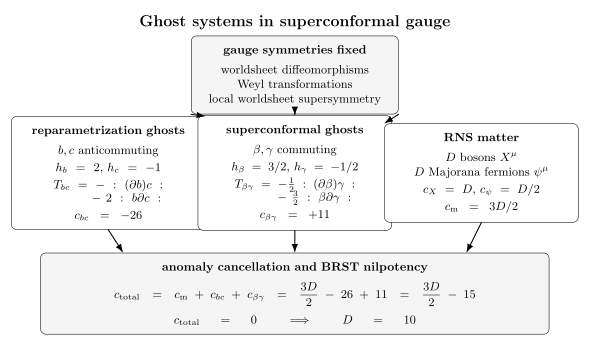
Superconformal gauge introduces two first-order ghost systems. The ghosts come from diffeomorphism/Weyl gauge fixing and contribute ; the commuting ghosts come from local supersymmetry gauge fixing and contribute . Together they cancel the matter central charge only for .
Bosonizing the reparametrization ghosts
Section titled “Bosonizing the reparametrization ghosts”The system can be bosonized. For many computations this is less essential than superghost bosonization, but it gives a useful intuition for ghost number and background charge.
Introduce a chiral scalar with background charge. In a common convention,
and
The improvement term is crucial. A free scalar without this term would have central charge , not . The background charge shifts both the central charge and the dimensions of exponential operators. This is the same mechanism that will appear more prominently in the superghost scalar below.
One moral is worth keeping: ghost number is a charge measured by a current, but that current has an anomaly on curved worldsheets. Consequently correlation functions are nonzero only when enough ghost insertions are present to soak up the ghost zero modes. On the sphere, for example, three ghosts are needed in the holomorphic sector. This is the origin of the familiar three unintegrated vertex operators in tree-level open-string amplitudes.
Bosonizing the superghosts
Section titled “Bosonizing the superghosts”The system is not just a nuisance. It is responsible for the picture number that appears in every RNS vertex operator. The standard bosonization is
Here and are anticommuting fields with weights
and OPE
The scalar satisfies
but it is not an ordinary free scalar. Its stress tensor includes a background-charge term,
The stress tensor is
Their central charges are
as required for the system.
The background charge changes the dimension of . The key formula is
Some special cases are used constantly:
These numbers explain the standard RNS vertex operators. The massless NS vertex contains , whose dimension is before the ghost is included. The Ramond vertex contains , whose dimension is in ten dimensions.
There is a small but important Hilbert-space subtlety. The bosonized variables include the zero mode of , which was not present in the original system. The enlarged space is called the large Hilbert space. The physical RNS theory lives in the small Hilbert space, defined by excluding explicit dependence on the zero mode, equivalently by requiring
Picture-changing is most transparent in the large Hilbert space, but physical vertex operators are usually represented in the small Hilbert space.
Picture number
Section titled “Picture number”In the bosonized description, an operator containing is said to be in picture . Thus
The picture-changing operator is the BRST commutator
Its leading matter term is
Since
has conformal dimension zero. Acting with raises picture number by one:
provided the limit is nonsingular or is defined by the usual normal-ordered prescription. There is also an inverse picture-changing operator, often denoted , whose simplest representative is
which lowers the picture by one in the appropriate cohomology.
Picture is not a new physical quantum number. Different pictures represent the same BRST cohomology class, as long as picture-changing is used away from singular collisions and away from special zero-momentum subtleties. It is a bookkeeping device forced on us by the superghost zero modes.
On a genus- closed worldsheet, the total left-moving picture number in a nonzero amplitude is
and similarly for the right-moving sector. On the sphere, this says
For example, a tree-level closed-string amplitude is often computed with two NS vertices in the picture and the rest in the picture. For an open-string disk amplitude, the holomorphic bookkeeping similarly requires total picture .
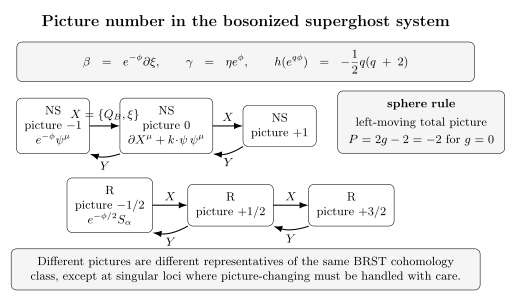
Picture number is the -charge carried by the superghost exponential. The picture-changing operator raises picture by one, while an inverse picture-changing operator lowers it. The commonly used canonical pictures are for NS states and for Ramond states.
The BRST charge
Section titled “The BRST charge”Gauge fixing does not destroy gauge invariance. It repackages it as a global fermionic symmetry generated by the BRST charge . The charge is nilpotent,
precisely when the quantum anomaly cancels. For the RNS string this requires and the correct normal-ordering constants.
A compact way to write the holomorphic BRST current is
Then
Here and are the matter stress tensor and matter supercurrent,
up to the convention-dependent factor of . The ghost supercurrent can be written as
again up to harmless sign conventions for the OPE. Expanding the formula for gives the familiar nonlinear terms such as and .
For many purposes, the schematic structure is more important than the precise convention-dependent signs:
The ghost enforces the Virasoro constraints, and the ghost enforces the super-Virasoro constraints. The ghost self-interactions encode the fact that the constraint algebra is nonabelian: Virasoro generators do not commute among themselves, and supercurrents close onto the stress tensor.
BRST cohomology as the physical state space
Section titled “BRST cohomology as the physical state space”The physical state condition is
Two BRST-closed states that differ by a BRST-exact state are physically equivalent:
Therefore the physical Hilbert space is the cohomology
This single formula simultaneously implements several older-looking conditions:
The cohomology formulation is especially efficient for vertex operators. A local vertex operator is physical when
where the bracket is graded. It is trivial if
For an open string, an unintegrated physical vertex operator has the form
with total conformal weight zero and ghost number one. Its integrated version is obtained, morally, by removing and integrating a dimension-one operator:
The relation between unintegrated and integrated vertices is controlled by the ghost:
This is why -ghost insertions appear when one integrates over moduli of higher-genus worldsheets.
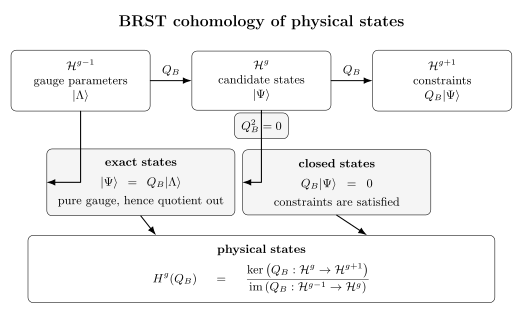
The BRST charge maps states of one ghost number to the next and satisfies . Physical states are closed states modulo exact states: .
How the old constraints reappear
Section titled “How the old constraints reappear”It is useful to see why BRST cohomology is not an extra assumption but the gauge-fixed version of the original constraints. In the bosonic string, the BRST charge contains a term
If a state is BRST closed, the coefficients of independent ghost modes force the matter state to obey the Virasoro constraints, up to the gauge equivalences generated by BRST-exact states.
In the RNS string there is also
Thus the same closure condition enforces the super-Virasoro constraints. The dots are not optional; they are exactly what makes the BRST charge nilpotent when the constraint algebra has central extensions and nonlinear brackets.
For example, in the NS sector the matter state becomes physical only when
and the gauge shift
is represented by adding a BRST-exact state. In the Ramond sector, BRST closure imposes the spacetime Dirac equation on the spinor polarization. These facts will become concrete on the next page when we write vertex operators explicitly.
Summary
Section titled “Summary”The gauge-fixed RNS string is a matter CFT plus ghosts:
The system is anticommuting with weights
The system is commuting with weights
Together the ghosts contribute . Since the matter system contributes , anomaly cancellation and BRST nilpotency imply
The superghosts are bosonized as
with
The exponent is the picture number. Standard NS vertices live naturally in the picture, Ramond vertices in the picture, and the picture-changing operator
raises the picture by one.
Finally, the physical state space is BRST cohomology:
This is the precise quantum replacement for imposing the Virasoro and super-Virasoro constraints and then quotienting by null states. It is the foundation for the vertex-operator formalism used in superstring scattering amplitudes.
Exercises
Section titled “Exercises”Exercise 1: central charges and the critical dimension
Section titled “Exercise 1: central charges and the critical dimension”For an anticommuting first-order system with weights and , the central charge is
For a commuting first-order system with the same weights, it is
Compute for , compute for , and derive the critical dimension of the RNS string.
Solution
For the reparametrization ghosts, , so
For the superconformal ghosts, , so
Thus
The RNS matter sector has bosons and real Majorana fermions, hence
Criticality requires
so
Exercise 2: mode expansions from conformal weights
Section titled “Exercise 2: mode expansions from conformal weights”A holomorphic primary field of weight has the plane expansion
Use this rule to derive the mode expansions of . Explain why the modes are half-integer in the NS sector and integer in the R sector.
Solution
For and ,
Therefore
For the superghosts,
so
The labels follow the spin structure of the worldsheet supersymmetry ghosts. In the NS sector the fields are antiperiodic around the spatial circle, giving
In the R sector they are periodic, giving
Exercise 3: weights of superghost exponentials
Section titled “Exercise 3: weights of superghost exponentials”The bosonized superghost scalar obeys
Compute the weights of , , , and . Use the result to check that has dimension one in ten dimensions.
Solution
For ,
For ,
For ,
For ,
The ten-dimensional spin field has
Thus
This is why can appear as the matter-superghost part of a Ramond vertex operator or as the integrand of a spacetime supercharge.
Exercise 4: why picture changing has dimension zero
Section titled “Exercise 4: why picture changing has dimension zero”The leading matter term in the picture-changing operator is
Show that this term has conformal dimension zero. Why is this the right dimension for an operator that changes the representative of a vertex operator without changing its physical state?
Solution
The matter supercurrent has dimension
The superghost exponential has
Therefore
The omitted ghost terms are required for BRST invariance and also have dimension zero. A picture-changing operator should map a dimension-zero unintegrated vertex to another dimension-zero unintegrated vertex, or a dimension-one integrated vertex to another dimension-one integrated vertex. Thus it must itself have dimension zero.
Exercise 5: BRST cohomology
Section titled “Exercise 5: BRST cohomology”Assume . Show that if is BRST closed, then is also BRST closed. Explain why this makes the quotient natural.
Solution
If is BRST closed, then
Now shift it by a BRST-exact state:
Acting with gives
Therefore the shifted state is also BRST closed. BRST-exact shifts are gauge redundancies of the gauge-fixed theory, so physical states are not individual closed states but equivalence classes of closed states modulo exact states:
Exercise 6: total picture number on the sphere
Section titled “Exercise 6: total picture number on the sphere”On a genus- worldsheet, the left-moving total picture number must be . What is the required left-moving picture number on the sphere? Give two common choices for distributing the picture number in tree-level amplitudes.
Solution
The sphere has genus
Therefore
For open-string tree amplitudes, a common choice is to take two NS vertices in the picture and all remaining NS vertices in the picture. The total picture is then
For closed-string tree amplitudes, one often takes two NS-NS vertices in the picture and all remaining NS-NS vertices in the picture. Then the left-moving and right-moving picture numbers are both .