
Advanced AdS/CFT
Aim of the course
Section titled “Aim of the course”This is the advanced version of the AdS/CFT curriculum. It assumes substantially more background than AdS/CFT Foundations, the companion course designed for readers with lower prerequisites.
Advanced AdS/CFT is a graduate and research-level route through the AdS/CFT correspondence. It is written for readers who already know the basics of quantum field theory, general relativity, conformal field theory, and string theory, and who want a coherent modern path from the original duality to the tools used in current research.
The guiding equality is
This is not merely a resemblance between gauge theory and gravity. It is a statement about two complete quantum descriptions. In the semiclassical limit, it becomes the practical prescription
so that CFT correlators are obtained by differentiating a renormalized on-shell bulk action.
The repeated discipline of the course is to specify the observable, dictionary entry, boundary and interior conditions, approximation, renormalization scheme, and regime of validity. Classical gravity is a powerful limit of AdS/CFT, not the whole correspondence.
Course map
Section titled “Course map”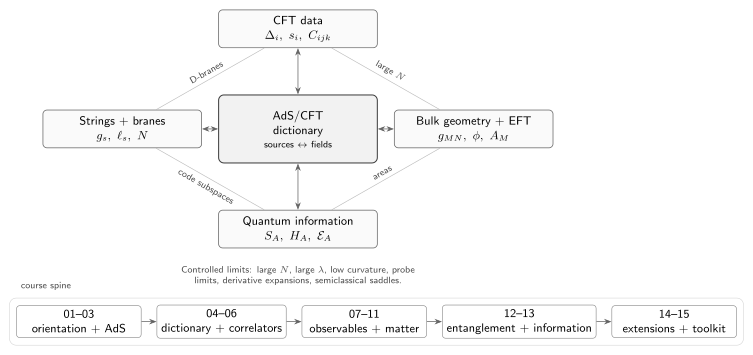
AdS/CFT is learned by translating between four languages: CFT data, bulk geometry and effective field theory, string/D-brane constructions, and quantum information. The practical dictionary is controlled by parameters such as , , , and .
The course contains 73 lecture-note pages plus this landing page. The early modules build the conceptual spine: holography, large , AdS geometry, the source/operator dictionary, and the canonical D3-brane example. The middle modules develop calculational tools: correlators, Witten diagrams, renormalization, Wilson loops, black holes, real-time response, transport, RG flows, finite density, and quantum matter. The later modules cover entanglement, reconstruction, black-hole information, examples beyond AdS/CFT, and a research toolkit.
Prerequisites
Section titled “Prerequisites”| Subject | Useful prior knowledge | What the course reinforces |
|---|---|---|
| QFT | Path integrals, symmetries, Ward identities, perturbation theory | Sources, generating functionals, Kubo formulas, large- factorization |
| CFT | Primaries, OPEs, scaling dimensions, stress tensor, radial quantization | CFT data, thermal CFTs, modular Hamiltonians, entanglement |
| GR | Metrics, curvature, horizons, black-hole thermodynamics | AdS boundaries, black branes, Brown-York tensors, Einstein equations |
| String theory | Worldsheets, D-branes, open/closed strings, compactification basics | D3/M2/M5 examples, flux quantization, brane probes, stringy corrections |
| Quantum information | Entropy, relative entropy, purification, basic codes | RT/HRT, QES, JLMS, entanglement wedges, error correction |
The main dictionary, before details
Section titled “The main dictionary, before details”| Boundary object | Bulk object | Leading dictionary |
|---|---|---|
| CFT state $ | \Psi\rangle$ | Quantum-gravity state with specified asymptotics |
| Scalar primary | Bulk scalar | |
| Conserved current | Bulk gauge field | sources |
| Stress tensor | Bulk metric | sources |
| Single-trace operator | Single-particle bulk excitation | Large- factorization |
| Multi-trace operator | Multi-particle state or changed boundary condition | Double-trace deformations give mixed boundary conditions |
| Thermal state | AdS black hole or black brane | Entropy from horizon area |
| Retarded correlator | Lorentzian perturbation problem | Infalling condition at future horizon |
| Wilson loop | String worldsheet ending on | |
| Defect/flavor sector | Probe brane | Worldvolume fields compute defect/flavor observables |
| Entanglement entropy | Extremal surface or QES | |
| RG scale | Radial direction | Boundary is UV; deeper bulk is IR, with caveats |
A useful hierarchy is
Each arrow throws away corrections. Large suppresses bulk loops. Large ‘t Hooft coupling suppresses stringy corrections. A sparse low-dimension spectrum is needed for an Einstein-like local bulk effective theory.
Complete table of contents
Section titled “Complete table of contents”1. Orientation
Section titled “1. Orientation”2. Black holes, large , and strings
Section titled “2. Black holes, large NNN, and strings”- Black-Hole Entropy and the Holographic Principle
- Large- Gauge Theory
- Strings from Flux Tubes
- D-Branes as Gauge Theory and Gravity
3. Anti-de Sitter geometry
Section titled “3. Anti-de Sitter geometry”- AdS as a Spacetime
- Coordinate Systems and the Boundary
- Causal Structure and the Cylinder
- Geodesics, Redshift, and RG Scale
4. CFT data and the dictionary
Section titled “4. CFT data and the dictionary”- CFT Data, Large , and Single-Trace Operators
- Sources, Operators, and Generating Functionals
- Fields in AdS and the Mass-Dimension Relation
- Gauge Fields, Currents, and the Graviton
- The GKPW Prescription
5. The canonical example
Section titled “5. The canonical example”- D3-Branes and Two Low-Energy Limits
- Super-Yang-Mills
- Type IIB on AdS
- Parameters and Regimes of Validity
- First Tests of the Correspondence
6. Correlators, Witten diagrams, and renormalization
Section titled “6. Correlators, Witten diagrams, and renormalization”- Scalar Two-Point Functions
- Holographic Renormalization
- Three-Point Functions and Cubic Couplings
- Witten Diagrams and Large- Perturbation Theory
- Real-Time Correlators and Infalling Boundary Conditions
7. Wilson loops, branes, and nonlocal observables
Section titled “7. Wilson loops, branes, and nonlocal observables”- Wilson Loops and Fundamental Strings
- Heavy-Quark Potential
- Baryon Vertices and Wrapped Branes
- Defects, Interfaces, and Probe Branes
8. Finite temperature and black holes
Section titled “8. Finite temperature and black holes”- Thermal Field Theory and Euclidean Time
- AdS-Schwarzschild and Black Branes
- Hawking-Page and Confinement
- Thermodynamics of Plasma
- Retarded Green Functions and Quasinormal Modes
9. Transport, hydrodynamics, and plasma physics
Section titled “9. Transport, hydrodynamics, and plasma physics”- Linear Response and Kubo Formulas
- Holographic Conductivity
- Shear Viscosity and
- Fluid/Gravity Correspondence
- Heavy-Ion Lessons and Limitations
10. RG flows, confinement, and QCD-like duals
Section titled “10. RG flows, confinement, and QCD-like duals”- Relevant Deformations and Domain Walls
- Holographic -Theorems
- Hard-Wall and Soft-Wall Models
- Confinement, Wilson Loops, and Mass Gaps
- Flavor Branes, Chiral Symmetry, and Mesons
11. Finite density and holographic quantum matter
Section titled “11. Finite density and holographic quantum matter”- Charged Black Holes and Chemical Potential
- AdS Throats and Local Criticality
- Holographic Fermions and Fermi Surfaces
- Holographic Superconductors
- Momentum Relaxation and Strange-Metal Transport
12. Entanglement, geometry, and bulk reconstruction
Section titled “12. Entanglement, geometry, and bulk reconstruction”- Entanglement Entropy in QFT
- Ryu-Takayanagi and HRT
- Quantum Corrections, JLMS, and Replica Methods
- Entanglement Wedge and Subregion Duality
- Entanglement First Law and Einstein Equations
- Quantum Error Correction and Bulk Locality
13. Black-hole information and quantum gravity
Section titled “13. Black-hole information and quantum gravity”- Eternal Black Holes and the Thermofield Double
- Chaos, Shockwaves, and the Butterfly Effect
- Information Loss in AdS/CFT
- Page Curve, Islands, and Modern Lessons
14. Beyond the canonical duality
Section titled “14. Beyond the canonical duality”- AdS/CFT and Brown-Henneaux
- M2-Branes, ABJM, and AdS/CFT
- M5-Branes and Six-Dimensional CFTs
- Higher Spin, Vector Models, and Sparse Spectra
- Nonconformal Branes and Generalized Holography
- Flat Space, de Sitter, and Open Problems
15. Computation and research toolkit
Section titled “15. Computation and research toolkit”- How to Compute a Holographic Observable
- Dictionary Tables
- Common Normalizations and Conventions
- Numerical Holography and the DeTurck Method
- Reading Guide to the Literature
- Capstone Problems
Suggested paths through the course
Section titled “Suggested paths through the course”For a first serious pass, read
This path gives the conceptual and calculational spine: large , AdS geometry, the GKPW prescription, the canonical example, correlators, black holes, entanglement, and the research toolkit.
For black holes and gravity, read
For quantum matter and transport, read
For string theory and branes, read
For entanglement and quantum information, read
Conventions used throughout
Section titled “Conventions used throughout”Unless stated otherwise, the course uses the following notation.
| Symbol | Meaning |
|---|---|
| Boundary spacetime dimension | |
| Bulk spacetime dimension | |
| AdS radius | |
| Bulk Newton constant in dimensions | |
| Poincaré radial coordinate, boundary at | |
| Alternative radial coordinate, often boundary at | |
| Boundary indices | |
| Bulk indices | |
| Scaling dimension of a CFT primary | |
| ’t Hooft coupling | |
| Stress-tensor two-point coefficient, often the invariant measure of large |
The standard Poincaré AdS metric is
The boundary is at . A cutoff surface regulates UV divergences in the CFT. Holographic renormalization removes divergent dependence on by adding local counterterms on that cutoff surface.
What counts as understanding AdS/CFT?
Section titled “What counts as understanding AdS/CFT?”Understanding AdS/CFT means being able to perform controlled translations. Given a boundary quantity such as
you should be able to identify the bulk problem, solve or approximate it, renormalize the result, and state which assumptions made the calculation possible.
A good holographic calculation usually has this anatomy:
- Identify the CFT observable and ensemble.
- Identify the dual bulk field, geometry, brane, string, or extremal surface.
- Specify boundary conditions at the AdS boundary.
- Specify interior or horizon conditions when needed.
- Solve the classical, quantum, or numerical bulk problem.
- Add counterterms or subtract universal divergences.
- Extract the response, entropy, free energy, or correlator.
- Check Ward identities, thermodynamics, scaling, and limits.
- State the regime of validity.
The final step is where many wrong holographic claims are born. Never skip it.
Common misconceptions to avoid
Section titled “Common misconceptions to avoid”“Classical gravity is AdS/CFT.”
Section titled ““Classical gravity is AdS/CFT.””Classical Einstein gravity is a limit of AdS/CFT. The full duality is a statement about a quantum theory of gravity or string/M-theory and a nongravitational quantum theory.
“The radial direction is literally the RG scale.”
Section titled ““The radial direction is literally the RG scale.””The radial/scale relation is powerful, especially near the boundary, but too local a statement is gauge-dependent. Wilsonian holographic RG, Fefferman-Graham expansions, causal wedges, and entanglement wedges each refine the slogan differently.
“Every bottom-up model is an exact dual.”
Section titled ““Every bottom-up model is an exact dual.””Bottom-up models can isolate universal mechanisms, but they are not automatically UV-complete string duals. Their value depends on whether the question being asked is universal, effective, or model-dependent.
“Euclidean and Lorentzian calculations differ only by .”
Section titled ““Euclidean and Lorentzian calculations differ only by t=−iτt=-i\taut=−iτ.””Real-time response requires causal prescriptions. In a black-hole background, retarded correlators are selected by infalling boundary conditions at the future horizon.
“Large guarantees Einstein gravity.”
Section titled ““Large NNN guarantees Einstein gravity.””Large gives factorization and suppresses loops, but an Einstein-like local bulk also requires a sparse low-dimension spectrum and a large gap to higher-spin or stringy states.
Exercises
Section titled “Exercises”Exercise 1: Exact statement or approximation?
Section titled “Exercise 1: Exact statement or approximation?”Classify each statement as an exact duality statement, a large- statement, a large-coupling gravity statement, a phenomenological model statement, or false as written.
- The CFT partition function with sources equals the bulk quantum-gravity partition function with corresponding boundary conditions.
- Connected correlators of suitably normalized single-trace operators are suppressed at large .
- Every holographic theory has .
- A scalar primary of dimension maps semiclassically to a scalar field with .
- A five-dimensional Einstein-Maxwell-scalar model is automatically a UV-complete string dual.
Solution
- Exact duality statement, when both sides are fully defined.
- Large- statement.
- False as written. The value is a leading result for broad classes of two-derivative Einstein-gravity duals, and can be modified by higher-derivative terms, finite-coupling corrections, anisotropy, or other effects.
- Large-coupling or semiclassical bulk statement.
- False as written. Such a model may be a useful bottom-up effective theory, but it is not automatically UV-complete.
Exercise 2: Which corrections are suppressed?
Section titled “Exercise 2: Which corrections are suppressed?”In the AdS/CFT example,
Explain what becomes small when and what becomes small when .
Solution
The ratio controls the size of the classical gravitational action in AdS units. Large suppresses bulk quantum loops and gives large- factorization in the CFT.
The ratio controls the separation between the AdS curvature radius and the string length. Large suppresses corrections and makes massive string states heavy compared with the AdS scale.
Thus large suppresses quantum-gravity loop corrections, while large suppresses stringy higher-derivative corrections.
Further reading
Section titled “Further reading”- Juan Maldacena, “The Large Limit of Superconformal Field Theories and Supergravity,” arXiv:hep-th/9711200.
- S. S. Gubser, Igor R. Klebanov, and Alexander M. Polyakov, “Gauge Theory Correlators from Non-Critical String Theory,” arXiv:hep-th/9802109.
- Edward Witten, “Anti de Sitter Space and Holography,” arXiv:hep-th/9802150.
- Ofer Aharony, Steven S. Gubser, Juan Maldacena, Hirosi Ooguri, and Yaron Oz, “Large Field Theories, String Theory and Gravity,” arXiv:hep-th/9905111.
- Kostas Skenderis, “Lecture Notes on Holographic Renormalization,” arXiv:hep-th/0209067.
- Sean A. Hartnoll, Andrew Lucas, and Subir Sachdev, “Holographic Quantum Matter,” arXiv:1612.07324.
- Mukund Rangamani and Tadashi Takayanagi, Holographic Entanglement Entropy, arXiv:1609.01287.
Continue with What Is AdS/CFT?.