
Lorentzian Correlators
Euclidean CFT is beautifully rigid. Conformal symmetry fixes two- and three-point functions, packages four-point functions into functions of cross-ratios, and makes the OPE a sharply convergent expansion in radial quantization. But AdS/CFT is ultimately a statement about a real-time quantum theory as well. Boundary sources can be turned on at real Lorentzian time. Bulk signals propagate causally. Black holes absorb perturbations. Thermal states have retarded response and quasinormal modes. Entanglement wedges, shock waves, Regge limits, and chaos are all Lorentzian questions.
The goal of this page is to explain how Lorentzian CFT correlators are obtained from Euclidean correlators, why the prescription is not a harmless decoration, and how the different real-time correlators encode causality and spectral information.
The key message is:
This page is not yet about conformal blocks or the Lorentzian inversion formula. Those come later. Here we build the basic real-time dictionary.
Conventions
Section titled “Conventions”We work in Lorentzian spacetime dimensions with mostly-plus metric
so that
The corresponding Euclidean coordinate is
Analytic continuation is implemented by complexifying Euclidean time:
Equivalently, the complex Lorentzian time variable is
The small real parameters attached to operator insertions are not physical time delays. They encode operator ordering.
For a Wightman correlator ordered as
one takes
and then sends all to zero after the continuation. The real times may have any order. The vertical ordering in complex time is what remembers the operator ordering.
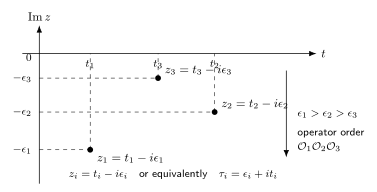
Analytic continuation to Lorentzian time. For the Wightman ordering , one evaluates the Euclidean correlator at , equivalently , with . The real-time order of the numbers is independent of this operator ordering.
Euclidean correlators as analytic functions
Section titled “Euclidean correlators as analytic functions”A Euclidean correlator is initially defined for real Euclidean insertion points:
For separated points, it can often be regarded as the boundary value of an analytic function of complexified coordinates. Lorentzian correlators arise by approaching real Lorentzian points from different directions in this complex domain.
The cleanest rule is the following. The Lorentzian Wightman correlator with the displayed operator order is
Different choices of the ordering of the give different Lorentzian boundary values. This matters because Euclidean CFT correlators have singularities when points become null-separated after continuation. Around these singularities, the analytic function has branch cuts or poles. Lorentzian physics is the physics of those sheets.
This is why the phrase “the Lorentzian correlator” is incomplete. One should specify the ordering:
All are related, but they are not the same object.
The scalar two-point function
Section titled “The scalar two-point function”Let be a scalar primary of dimension . In Euclidean signature,
Continue using . The ordered Wightman function
is
The oppositely ordered Wightman function
is
These two expressions differ only in the sign of , but that sign determines the side of the branch cut. When , the separation is spacelike and the denominator stays away from the negative real axis. Then
When , the separation is timelike. The denominator crosses the branch cut of the complex power. The two Wightman functions can then differ.
For non-integer and separated timelike points, one obtains the schematic discontinuity
For integer or half-integer dimensions, this formula should be understood by analytic continuation in . The discontinuity may collapse partly or entirely to distributions supported on the light cone. This is familiar for free fields: the commutator is often supported sharply on .
Time-ordered correlators
Section titled “Time-ordered correlators”The time-ordered two-point function is
In terms of Wightman functions,
For higher-point functions, time ordering is a sum over Wightman orderings weighted by step functions. For example,
This formula suppresses contact terms at coincident times. In field theory, equal-time contact terms are often essential for Ward identities, anomalies, and conserved charges. In holography they are controlled by boundary counterterms in holographic renormalization.
The main point is that time ordering is not the same as Wightman ordering. Wightman order is an ordering of operators in the product. Time ordering rearranges operators according to real Lorentzian time.
Commutators and microcausality
Section titled “Commutators and microcausality”The commutator two-point function is
For a local bosonic operator in a unitary relativistic QFT,
This is microcausality. The Euclidean correlator knows this fact in a somewhat hidden way: spacelike-separated Lorentzian points can be reached without crossing the light-cone branch cut, so the two Wightman orderings agree.
The light cone is the singular surface
In a CFT, light-cone singularities are especially strong because there is no mass scale to smooth them. This is why Lorentzian CFT is more delicate than Euclidean CFT. The Euclidean OPE is naturally organized by radial distance; the Lorentzian theory is also sensitive to causal separation and null limits.
Retarded and advanced correlators
Section titled “Retarded and advanced correlators”The retarded correlator measures causal linear response. With our convention,
The advanced correlator is
Thus
For a local relativistic theory, the commutator also vanishes outside the light cone, so the retarded correlator has support only in the future light cone:
This is the field-theory version of causal propagation. In AdS/CFT, it is the boundary imprint of causal propagation in the bulk.
The retarded correlator is the object that appears in linear response. If the Hamiltonian is perturbed by a source
then the first-order response is
up to the convention-dependent sign associated with the definition of the source coupling. The important structural point is fixed: the response at only depends on sources in the causal past of .
Momentum space and spectral density
Section titled “Momentum space and spectral density”Define the Fourier transform by
Because has support only for , the function is analytic for
assuming the usual polynomial boundedness appropriate to a local QFT. This analyticity is one of the most useful real-time constraints.
The spectral density is the Fourier transform of the commutator:
With the retarded convention above,
Therefore
for the nonlocal part of the correlator. Contact terms are real polynomials in momenta and do not contribute to spectral weight, although they do affect local Ward identities.
For a Hermitian bosonic operator,
In a unitary vacuum theory, positive energy implies that the Wightman spectral weight has support at positive frequency. For scalar primaries in a CFT, the nonlocal momentum-space two-point function has the schematic form
up to normalization and contact terms. Its branch cut lies where
namely inside the Lorentzian light cone in momentum space. This is the momentum-space version of causal spectral support.
Lorentzian cross-ratios and sheets
Section titled “Lorentzian cross-ratios and sheets”For four scalar operators, Euclidean conformal symmetry organizes the correlator using cross-ratios. In one often writes
In Euclidean signature, is the complex conjugate of . In Lorentzian signature, and should be treated as independent variables after analytic continuation. The same Euclidean function can have many Lorentzian boundary values depending on how the continuation winds around branch points at
and similarly for .
This is not just a technical nuisance. Different sheets correspond to different physical orderings. For example:
- ordinary time-ordered correlators live on one set of sheets;
- commutators are discontinuities across branch cuts;
- out-of-time-ordered correlators live on sheets reached by nontrivial analytic continuation;
- Regge and chaos limits are Lorentzian sheet limits, not ordinary Euclidean limits.
This is why modern CFT, especially the bootstrap relevant for AdS/CFT, treats Lorentzian analyticity as part of the physical structure of the theory.
Lorentzian OPE: what changes?
Section titled “Lorentzian OPE: what changes?”The Euclidean OPE is a convergent expansion under radial ordering. Schematically,
In Lorentzian signature, this statement requires more care. The singularity structure depends on whether is spacelike, timelike, or null.
For spacelike separation, one can often continue from Euclidean signature without crossing singularities. The OPE behaves much like the Euclidean OPE.
For timelike separation, the operator ordering matters. The same formal OPE may land on different analytic sheets.
For null separation,
operators become singular in a particularly strong way. The appropriate expansion is the lightcone OPE, organized not simply by dimension , but by twist
Low-twist operators dominate lightcone limits. This fact is one of the main engines behind the lightcone bootstrap, the large-spin expansion, and many CFT derivations of bulk locality constraints in AdS/CFT.
Thermal and Schwinger-Keldysh correlators
Section titled “Thermal and Schwinger-Keldysh correlators”In a thermal state,
real-time correlators obey the KMS condition. For two bosonic operators,
This is the thermal version of Euclidean periodicity in imaginary time.
The most systematic way to organize real-time thermal correlators is the Schwinger-Keldysh contour. Instead of a single time-ordered path integral, one uses a contour with forward and backward Lorentzian segments, and sometimes Euclidean caps. Different placements of operators on the contour produce Wightman, retarded, advanced, time-ordered, anti-time-ordered, and out-of-time-ordered correlators.
This language is indispensable for real-time holography. Black hole horizons naturally impose retarded boundary conditions, while more general Schwinger-Keldysh contours require a corresponding contour prescription in the bulk.
Contact terms and scheme dependence
Section titled “Contact terms and scheme dependence”Many CFT correlators are only uniquely defined at separated points. When points collide, one may add local contact terms consistent with symmetries. In position space these are derivatives of delta functions. In momentum space they are polynomials in and .
For example, a two-point function may have the form
where is a polynomial. The nonlocal part determines spectral cuts and long-distance physics. The polynomial part is a choice of local counterterms.
In AdS/CFT, this distinction is not optional. Holographic correlators are computed by varying an on-shell bulk action. That action diverges near the AdS boundary and must be renormalized by adding local boundary counterterms. These counterterms precisely produce contact-term ambiguities in CFT correlators.
AdS/CFT checkpoint
Section titled “AdS/CFT checkpoint”Lorentzian correlators are where the CFT starts sounding like bulk spacetime.
The Euclidean dictionary says roughly
The Lorentzian dictionary asks a sharper question: which bulk solution computes which CFT correlator?
For the retarded correlator at finite temperature, the answer is especially important:
The physics is transparent. A retarded response is causal: the system absorbs disturbances after the source is applied. A black hole horizon also absorbs. Infalling boundary conditions implement this causal absorption in the bulk.
Several central holographic ideas are already visible from the CFT side:
- Poles of are normal modes in global AdS or quasinormal modes in black hole backgrounds.
- Branch cuts in indicate continua of states or large- limits of dense spectra.
- Spectral density measures how strongly the CFT absorbs energy at given .
- The vanishing of commutators at spacelike separation is the boundary version of causal propagation.
- Lorentzian four-point functions diagnose bulk scattering, shock waves, chaos, and constraints from causality.
This is why a holographer cannot stop at Euclidean correlators. Euclidean CFT data is the compact encoding of the theory; Lorentzian correlators reveal its causal dynamics.
Common pitfalls
Section titled “Common pitfalls”The first common pitfall is to write
without an prescription. For non-integer , this expression is not a distribution until a branch prescription is specified.
The second common pitfall is to confuse Wightman ordering with time ordering. The correlator
has the operator order shown, even if . A time-ordered correlator would rearrange the operators.
The third common pitfall is to ignore contact terms. Contact terms do not matter at separated points, but they matter for Ward identities, anomalies, charge commutators, and holographic renormalization.
The fourth common pitfall is to assume that a Euclidean cross-ratio limit has the same meaning in Lorentzian signature. In Lorentzian CFT, the sheet matters. Going around a branch point changes the physical correlator.
Summary
Section titled “Summary”Euclidean CFT correlators are the starting point, but Lorentzian CFT requires analytic continuation with a specified prescription. Wightman functions are boundary values with a chosen operator ordering. Time-ordered correlators are step-function combinations of Wightman functions. Commutators are discontinuities across Lorentzian branch cuts. Retarded correlators encode causal response and have analytic structure in the upper half of the complex frequency plane.
For AdS/CFT, these ideas are not decorative. They are the boundary formulation of bulk causality, horizon absorption, quasinormal modes, real-time response, and eventually bulk scattering.
Exercises
Section titled “Exercises”Exercise 1. Derive the Wightman prescription
Section titled “Exercise 1. Derive the Wightman iϵi\epsiloniϵ prescription”Start from the Euclidean scalar two-point function
Use with to derive
Solution
Substitute
Then
But
Therefore
Taking gives
The sign of came from the fact that the first operator has the larger Euclidean regulator.
Exercise 2. Show that the scalar commutator vanishes at spacelike separation
Section titled “Exercise 2. Show that the scalar commutator vanishes at spacelike separation”Using
show that when .
Solution
For spacelike separation,
The real part of the denominator is positive. Taking ,
Both prescriptions approach the same positive real number. No branch cut is crossed. Therefore
and hence
This is the two-point manifestation of microcausality.
Exercise 3. Retarded analyticity
Section titled “Exercise 3. Retarded analyticity”Let
with for . Explain why is analytic for , assuming suitable boundedness at large .
Solution
Because vanishes for , the time integral is
Write
Then
For , the factor damps the large- integral. Under the standard assumptions that the real-time distribution is sufficiently well behaved after smearing, the integral defines an analytic function of in the upper half-plane.
The physical content is simple: causality in time implies analyticity in frequency.
Exercise 4. Choose the regulators for a Wightman ordering
Section titled “Exercise 4. Choose the regulators for a Wightman ordering”What ordering computes the Lorentzian Wightman correlator
Solution
The ordering follows the operator ordering, not the real-time ordering. Therefore one should take
Then continue the Euclidean correlator by
The real values of may be in any order. The Wightman product remains
Exercise 5. Retarded response from Wightman functions
Section titled “Exercise 5. Retarded response from Wightman functions”Show that the retarded correlator can be written as
Why does this vanish for ?
Solution
By definition,
The commutator expectation value is
Thus
and so
It vanishes for because there. This is the defining causal property of retarded response.
Further reading
Section titled “Further reading”For the QFT foundations, review analytic continuation, Wightman functions, spectral representations, and the Källén-Lehmann representation in a standard quantum field theory text. For CFT applications, study Lorentzian four-point functions, lightcone OPE limits, reflection positivity, and the Lorentzian inversion formula. For AdS/CFT, the essential next step is the real-time prescription for holographic retarded correlators and the relation between retarded poles and quasinormal modes.