
The Stress-Tensor Trace
The previous page described renormalization group flow as a motion in theory space. This page explains the same idea locally, through the stress tensor.
The stress tensor is the operator coupled to the spacetime metric. Its trace measures the failure of a theory to be invariant under local changes of scale. At a fixed point, beta functions vanish. If the stress tensor can be improved appropriately, the flat-space trace vanishes:
That equation is one of the central meanings of conformal invariance.
The main lesson is:
More precisely, in a renormalized QFT one should expect a trace identity of the schematic form
Here are beta functions, is a possible virial or improvement term, and is a Weyl anomaly on curved backgrounds. At separated points in flat space, a genuine CFT has a representative of the stress tensor for which
This is why the stress tensor is not just another operator. It is the operator that tells us whether the theory is sitting at a conformal fixed point.
Conventions
Section titled “Conventions”There are two common RG conventions. The previous page used an IR-oriented Wilsonian scale factor , where increasing means coarse graining toward longer distances. In this page, when writing beta functions in trace identities, we use the high-energy convention
Thus moving to the IR corresponds to decreasing . If denotes the beta function with respect to , then
The sign of a trace formula can look different from book to book because of this convention, and also because of Euclidean versus Lorentzian choices. The invariant statement is not the sign convention; it is that the trace is controlled by how couplings respond to changes of scale.
Throughout this page, we work mostly in flat Euclidean space unless explicitly stated otherwise.
Stress tensor from translations
Section titled “Stress tensor from translations”In a classical field theory with fields , the stress tensor first appears as the Noether current for translations. If the action is invariant under
then there is a conserved current satisfying
on the equations of motion. The conserved charges are the momenta
In a relativistic theory, one can usually choose a symmetric stress tensor,
by adding improvement terms that do not change the conserved momentum. Once is symmetric, it is the natural object that couples to the metric and generates spacetime transformations.
This is important: the stress tensor is not unique as a local operator. We can shift it by certain identically conserved local terms without changing the global charges. The trace, however, is sensitive to these improvements, and this sensitivity is exactly what matters when deciding whether scale invariance enhances to conformal invariance.
Stress tensor from metric variation
Section titled “Stress tensor from metric variation”The cleanest definition of is obtained by putting the theory on a background metric .
Let
be the Euclidean generating functional, where are background sources for local operators . We use the convention
Equivalently,
This definition is more than aesthetic. It immediately tells us what the trace means.
A local Weyl transformation is
Using the metric variation formula,
if the sources are held fixed. Therefore:
This is the local version of the statement that the dilatation generator measures scaling.
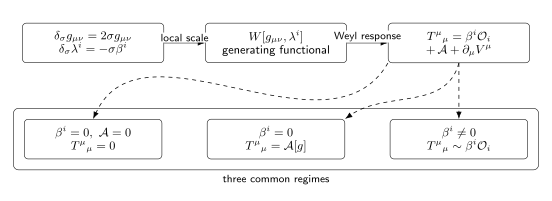
The trace is the local response of the generating functional to a Weyl transformation. In flat space, a properly improved fixed point has . Away from a fixed point, beta functions appear. On curved space, a CFT can have a Weyl anomaly .
Scale transformations and the trace
Section titled “Scale transformations and the trace”In flat space, a global scale transformation is
If the symmetric stress tensor is conserved, then the naive dilatation current is
Its divergence is
Thus, if
then is conserved and the theory is scale invariant.
The converse is subtler. A theory can be scale invariant even if the trace is not zero, provided the trace is a total derivative:
Then the improved dilatation current
is conserved:
The vector is called a virial current. The crucial question is whether can be removed by improving the stress tensor. If it can, then the scale-invariant theory is actually conformally invariant.
Improvement terms
Section titled “Improvement terms”The stress tensor is not unique. In flat space, if is a local scalar operator, then
is identically conserved:
Its trace is
Therefore, if the original stress tensor obeys
then
has
This is the simplest and most common improvement mechanism.
Example: the free massless scalar
Section titled “Example: the free massless scalar”Consider the free massless scalar in dimensions,
The canonical symmetric stress tensor is
On the equation of motion , its trace is
Using
on shell, this becomes
Thus the trace is an improvement term. The improved stress tensor is
It is conserved, symmetric, and traceless on shell:
This example is a perfect warning: if one uses the wrong stress tensor, the free massless scalar looks merely scale invariant. With the correct improved stress tensor, it is conformal for . In , the elementary scalar field itself has special infrared subtleties, but its derivative theory and vertex-operator CFTs are central examples of two-dimensional CFT.
Why conformal invariance needs more than scale invariance
Section titled “Why conformal invariance needs more than scale invariance”If is symmetric and conserved, the current for special conformal transformations is
Its divergence is
when is conserved and symmetric. Therefore, if
then the special conformal currents are conserved.
This is the structural reason conformal invariance is stronger than scale invariance. Scale invariance asks for a conserved dilatation current. Conformal invariance asks for conserved special conformal currents as well. A traceless stress tensor gives both.
For the unitary, local, Poincare-invariant theories that dominate this course, RG fixed points are expected to be CFTs under suitable assumptions. But the assumptions matter. The stress tensor is where the assumptions live.
Quantum trace identity
Section titled “Quantum trace identity”Now consider a renormalized theory described by dimensionless couplings and sources for operators . The local RG equation has the schematic form
Here is a local anomaly functional. Using the definitions of and , this becomes
Equivalently, at the operator level and away from coincident operator insertions,
with the understanding that improvement terms, virial currents, operator mixing, and contact terms may have to be included in a careful treatment.
This equation is the local form of the Callan-Symanzik equation. It says:
At a fixed point,
In flat space, where curvature-dependent anomalies vanish, a properly improved CFT has
Relevant deformations and the trace
Section titled “Relevant deformations and the trace”Let be a scalar primary of dimension in a CFT. Deform the theory by
where is dimensionless. Near the fixed point, the beta function begins as
Thus, to leading order,
in the convention used here.
If , the deformation is relevant. In the high-energy convention, is negative at small positive , reflecting that grows as one runs toward the IR. In the IR Wilsonian convention of the previous page, the eigenvalue is
Same physics, opposite flow parameter.
This is the first bridge between the operator dimension and the trace. The operator dimension tells us how a coupling runs. The coupling’s running tells us the trace.
Marginal couplings and conformal manifolds
Section titled “Marginal couplings and conformal manifolds”If , then the deformation is classically marginal:
At linear order,
But quantum corrections can give
There are three qualitatively different possibilities:
| Type | Trace consequence | Physical meaning |
|---|---|---|
| Marginally relevant | drives the theory away from the fixed point | The coupling grows toward the IR. |
| Marginally irrelevant | drives the theory back to the fixed point | The coupling dies logarithmically. |
| Exactly marginal | to all orders | There is a continuous family of CFTs. |
Exactly marginal couplings are crucial in supersymmetric AdS/CFT examples. In four-dimensional super Yang-Mills, the complexified gauge coupling is exactly marginal, and the theory remains conformal along a conformal manifold. The trace remains zero in flat space even though the value of the coupling changes.
Anomalies: why CFTs can have a trace on curved space
Section titled “Anomalies: why CFTs can have a trace on curved space”A flat-space CFT has
at separated points after improvement. But this does not mean the trace vanishes on every background. In even spacetime dimensions, the generating functional can have a Weyl anomaly.
In two dimensions, the standard form is
up to sign conventions for and . The number is the central charge.
In four dimensions, the trace anomaly has the schematic form
Here is the Weyl tensor and is the Euler density. The coefficient of is scheme-dependent because it can be shifted by local counterterms. The coefficients and are intrinsic CFT data.
This is not a contradiction. The anomaly is a statement about coupling the theory to a background geometry. In flat space, the curvature terms vanish.
Contact terms and separated points
Section titled “Contact terms and separated points”Trace identities should be read carefully. As operator equations, they are most robust inside correlation functions at separated points. If , then a CFT has
in flat space. But when collides with one of the , there are contact terms. These contact terms encode the transformation laws of the operators under scale and conformal transformations.
For example, the integrated scale Ward identity for scalar primaries says
at a fixed point. Locally, the terms come from contact terms in the trace Ward identity.
So one should not say, too casually, that the trace operator is zero in every possible sense. The precise statement is:
with contact terms enforcing Ward identities.
Examples
Section titled “Examples”Massive deformation of a free scalar
Section titled “Massive deformation of a free scalar”Start with the conformally improved massless scalar and add
At the Gaussian fixed point,
Thus the mass-squared coupling has RG exponent
The mass term is relevant. Correspondingly, the trace becomes proportional to the mass deformation:
with a sign depending on Euclidean/Lorentzian and beta-function conventions. The important point is that introduces a length scale,
so the theory is no longer scale invariant.
Gauge theory in four dimensions
Section titled “Gauge theory in four dimensions”For a four-dimensional gauge theory written schematically as
quantum running of produces a trace proportional to the beta function:
If and all other beta functions vanish, the flat-space trace vanishes after improvement. This is the stress-tensor way to say that the theory is conformal.
This will matter later for super Yang-Mills, where the gauge beta function vanishes and the theory is the canonical four-dimensional CFT in AdS/CFT.
Two-dimensional CFT
Section titled “Two-dimensional CFT”In two dimensions, the flat-space trace condition becomes
Conservation of the stress tensor then implies
Thus the stress tensor splits into a holomorphic and antiholomorphic part:
This is the beginning of the Virasoro story. The entire infinite-dimensional structure of two-dimensional CFT grows out of the same local equation:
Holographic checkpoint
Section titled “Holographic checkpoint”The stress-tensor trace is one of the most important CFT quantities in AdS/CFT.
First, the stress tensor is dual to the bulk metric:
Second, the CFT trace Ward identity is encoded by the radial constraints of gravity. In Fefferman-Graham language, the near-boundary radial direction plays the role of scale. Radial evolution of the bulk fields corresponds to RG evolution of boundary sources.
Third, the Weyl anomaly of the CFT is reproduced by logarithmic divergences in the regulated bulk on-shell action. In even boundary dimensions, holographic renormalization gives precisely the structure
Fourth, relevant deformations of the CFT correspond to turning on non-normalizable modes of bulk fields. If
then is the source for an operator of dimension . The deformation contributes to the trace because carries scale dimension .
Thus the trace equation is the boundary shadow of bulk radial dynamics:
Common pitfalls
Section titled “Common pitfalls”Pitfall 1: confusing conserved with traceless
Section titled “Pitfall 1: confusing conserved with traceless”Translation invariance gives
Conformal invariance requires, after improvement,
These are different statements.
Pitfall 2: using the canonical stress tensor too literally
Section titled “Pitfall 2: using the canonical stress tensor too literally”The canonical stress tensor is often not the conformal stress tensor. Improvement terms are not cosmetic; they can change the trace and reveal conformal invariance.
Pitfall 3: thinking anomalies mean the theory is not a CFT
Section titled “Pitfall 3: thinking anomalies mean the theory is not a CFT”A CFT can have a Weyl anomaly on curved space. In even dimensions, this anomaly is part of the CFT data. Flat-space conformal invariance is not spoiled by curvature terms that vanish on flat backgrounds.
Pitfall 4: ignoring contact terms
Section titled “Pitfall 4: ignoring contact terms”The equation in a CFT is a separated-point statement. Contact terms are needed to reproduce the scaling of operators inside correlation functions.
Summary
Section titled “Summary”The stress-tensor trace is the local diagnostic of scale dependence. Classically, a traceless stress tensor implies conserved dilatation and special conformal currents. If the trace is a removable improvement term, scale invariance enhances to conformal invariance.
Quantum mechanically, the trace identity is controlled by beta functions and anomalies:
At a flat-space CFT fixed point, after choosing the correct improved stress tensor,
This equation is one of the cleanest ways to recognize a conformal field theory, and it is one of the main boundary equations that holography geometrizes.
Exercises
Section titled “Exercises”Exercise 1 — Weyl variation and the trace
Section titled “Exercise 1 — Weyl variation and the trace”Assume
For a Weyl variation
show that
Solution
Substitute the Weyl variation into the metric variation formula:
Thus
Since
we obtain
Exercise 2 — Improvement of a scalar stress tensor
Section titled “Exercise 2 — Improvement of a scalar stress tensor”For the free massless scalar,
Using the equation of motion , show that
Then verify that
is traceless on shell.
Solution
The trace of the canonical tensor is
Using ,
Therefore
The improvement term has trace
Adding this to the canonical trace gives
on shell.
Exercise 3 — Trace of a relevant deformation
Section titled “Exercise 3 — Trace of a relevant deformation”Let a CFT be deformed by
where has scaling dimension and is dimensionless. Show that the leading beta function is
Explain why is relevant even though is negative for positive in this convention.
Solution
The dimensionful source is
Holding the physical source fixed while changing gives
Therefore
at leading order.
If , then for positive in the high-energy convention . This means decreases as increases toward the UV, or equivalently grows as decreases toward the IR.
In the IR Wilsonian convention with , the exponent is
so the deformation is relevant.
Exercise 4 — Integrated two-dimensional anomaly
Section titled “Exercise 4 — Integrated two-dimensional anomaly”For a two-dimensional CFT on a compact Euclidean surface without boundary, suppose
Use the Gauss-Bonnet theorem
to compute
Solution
Substitute the anomaly into the integral:
Using Gauss-Bonnet,
Therefore
This shows that the central charge controls the global Weyl response of the two-dimensional CFT.
Exercise 5 — Special conformal current
Section titled “Exercise 5 — Special conformal current”Let be symmetric, conserved, and traceless in flat space. Define
Show that
Solution
Differentiate:
The second term vanishes by conservation:
For the first term,
Contracting with symmetric gives
The first and third terms cancel because is symmetric. The remaining term is
which vanishes because the stress tensor is traceless. Hence