
BPS Multiplets and Protected Data
Supersymmetry becomes truly powerful when it is combined with unitarity. The reason is simple: in radial quantization, the adjoint of a Poincare supercharge is a conformal supercharge,
so norms of supersymmetric descendants are controlled by anticommutators of the form
But is not an arbitrary operator. It is a bosonic generator built from the dilatation generator , Lorentz generators, and -symmetry generators. Therefore positivity of norms implies inequalities relating the scaling dimension to spin and -charges. When such an inequality is saturated, one or more descendants have zero norm and must be removed from the Hilbert space. The representation becomes shorter. This is the basic origin of BPS multiplets.
The slogan for this page is
For AdS/CFT, BPS multiplets are not decorative. They are the safest observables in the duality. They are the operators whose dimensions and quantum numbers can often be matched across weakly coupled gauge theory, strongly coupled CFT, and weakly curved supergravity.
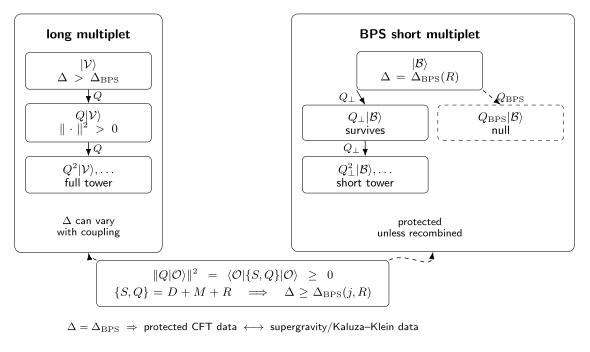
A long superconformal multiplet has no null -descendants and its dimension can vary continuously. A BPS multiplet saturates a positivity bound: some -descendants become null and are quotiented out. If the short multiplet cannot recombine with another short multiplet into a long one, its protected data are robust under continuous changes of coupling.
Superconformal primaries
Section titled “Superconformal primaries”A conformal multiplet starts from a conformal primary satisfying
and its descendants are obtained by acting with translations .
A superconformal multiplet starts from a superconformal primary satisfying
where is a commutator or anticommutator depending on whether is bosonic or fermionic. The full multiplet is generated by acting with the Poincare supercharges , , and then with translations .
The commutators with dilatations have the schematic form
Thus acting with raises the scaling dimension by , while acting with raises it by :
A superconformal multiplet can therefore be viewed as a finite tower of ordinary conformal primary operators, together with their conformal descendants. The supercharges move between the ordinary conformal primaries inside the same supermultiplet.
This distinction is important. In ordinary CFT language, a conserved current and the stress tensor are conformal primaries. In a supersymmetric CFT, they often sit inside a larger supermultiplet. For example, in four-dimensional SYM, the stress tensor, supercurrents, and -symmetry currents all belong to the same short multiplet.
Long multiplets
Section titled “Long multiplets”A long multiplet is the generic representation. Starting from a superconformal primary , none of the allowed -descendants is null, so the representation contains the maximal number of independent components compatible with the algebra.
The scaling dimension of a long multiplet is not fixed by symmetry. It can move continuously as one changes exactly marginal couplings. In a gauge theory, a long operator can acquire an anomalous dimension. In AdS/CFT, this is the boundary sign of a bulk excitation whose mass in AdS units depends on the string coupling or the curvature scale.
A useful schematic picture is
The multiplet is long because every step that is allowed by quantum numbers produces a nonzero state. In radial quantization,
for all independent supercharges that are allowed to act on the primary.
This is the generic situation. Protection is the exception.
Shortening and the BPS bound
Section titled “Shortening and the BPS bound”The essential algebraic fact is that the anticommutator contains together with Lorentz and -symmetry generators:
The precise coefficients depend on dimension, amount of supersymmetry, and conventions. The logic does not. Acting on a superconformal primary with definite spin and -charges, this anticommutator becomes a number or a finite matrix. Positivity of descendant norms implies
where denotes Lorentz spins and denotes -symmetry quantum numbers. The function is the relevant unitarity bound.
A short multiplet appears when the bound is saturated:
Then one or more descendants have zero norm:
In a unitary theory, null states are quotiented out, so
inside the physical Hilbert space. Equivalently, the corresponding local operator is annihilated by some supercharges:
This is a BPS condition. If the theory has independent Poincare supercharges and the primary is annihilated by of them, physicists often call it a -BPS primary. For example, in four-dimensional super Yang-Mills theory there are Poincare supercharges. A half-BPS local primary is annihilated by of them.
The word “BPS” originally comes from solitons saturating mass-charge bounds. In SCFT representation theory, the same idea appears with the energy on the cylinder, namely the scaling dimension , replacing the mass.
What is protected?
Section titled “What is protected?”Shortening fixes the dimension in terms of charges. Since charges are quantized or symmetry-protected, the dimension cannot vary continuously as long as the representation remains short. This is the first and most important protected datum:
Other data can also be protected, but with more qualifications. A careful hierarchy is useful:
| Data | Typical behavior |
|---|---|
| -symmetry representation | Protected by symmetry. |
| BPS dimension | Protected by shortening. |
| Selection rules | Protected by symmetry and shortening. |
| Some two- and three-point coefficients | Often protected in special sectors, especially highly supersymmetric ones. |
| Generic four-point functions | Usually not protected. |
| Long-multiplet dimensions and OPE coefficients | Generally coupling-dependent. |
The dangerous phrase is “BPS means everything is protected.” It does not. BPS means the representation is short and certain data are protected. Correlation functions involving BPS operators can still contain unprotected long multiplets in their OPE. Four-point functions of half-BPS operators in SYM are a famous example: the external operators are protected, but the correlator contains nontrivial dynamical information.
Recombination
Section titled “Recombination”There is one subtlety that every AdS/CFT student should learn early: a short multiplet can sometimes stop being protected by recombining with another short multiplet into a long multiplet.
The schematic phenomenon is
At the unitarity threshold, a long multiplet decomposes into shorter multiplets. Conversely, two compatible short multiplets can combine into one long multiplet when the coupling is varied away from the threshold. In that case the individual short multiplets need not remain protected as separate objects.
A short multiplet is robustly protected when no compatible partner exists with the required quantum numbers. This is why protected quantities are often formulated in terms of an index or a cohomology: such quantities automatically ignore pairs that can recombine.
Cohomological viewpoint
Section titled “Cohomological viewpoint”Choose a nilpotent supercharge or a supercharge whose square is a compact bosonic symmetry. The protected sector is often described by -cohomology:
An operator represents a cohomology class if
with the identification
The key point is that -exact operators decouple from protected quantities. If a pair of states can recombine into a long multiplet, their contributions usually cancel in an index or disappear from cohomology.
The superconformal index is the standard Hilbert-space version of this idea. Schematically,
Only states satisfying
contribute. States with positive pair up bosonically and fermionically and cancel because of . This is why the index is independent of continuous coupling constants, even though the full spectrum is not.
The index is powerful, but it is not the whole BPS spectrum. It is a protected signed count, not a complete list of all BPS states.
The four-dimensional chiral example
Section titled “The four-dimensional N=1\mathcal N=1N=1 chiral example”The simplest widely used example is a four-dimensional SCFT. Its bosonic symmetry is
A scalar chiral primary satisfies
and obeys the protected dimension-charge relation
Here the normalization is such that a free chiral multiplet scalar has and . Anti-chiral primaries obey the analogous relation with the opposite sign of :
The product of two chiral operators is chiral:
if both and are annihilated by . Therefore chiral operators form a ring, the chiral ring, after quotienting by appropriate -exact or equation-of-motion relations:
The dimension relation is additive because the -charge is additive:
This is one of the cleanest examples of how a symmetry algebra turns a dynamical question into a representation-theoretic answer.
Half-BPS operators in SYM
Section titled “Half-BPS operators in N=4\mathcal N=4N=4 SYM”The canonical AdS/CFT example is four-dimensional super Yang-Mills theory. Its superconformal algebra is
with bosonic part
The six real scalar fields , , transform in the vector representation of . In Dynkin-label notation, this is
The basic single-trace half-BPS scalar primaries are symmetric traceless products of the six scalars:
or, using an auxiliary null polarization vector with ,
For gauge group , the single-trace operators begin at . They transform in the representation
and have protected scaling dimension
The case is especially important:
This is the superconformal primary of the stress-tensor multiplet. Acting with the supercharges produces the currents, the supercurrents, and the stress tensor. Since the stress tensor and conserved currents have protected dimensions, the whole multiplet is short.
The half-BPS tower
is the CFT side of the Kaluza-Klein tower of type IIB supergravity on . For a scalar operator in a four-dimensional CFT, the AdS mass-dimension relation is
Therefore the half-BPS scalar primary with corresponds to a bulk scalar with
precisely the kind of discrete spectrum one expects from spherical harmonics on .
This is one of the first nontrivial checks of the AdS/CFT dictionary: weak-coupling gauge-theory operators and strong-coupling supergravity modes can be matched because supersymmetry protects the dimensions and quantum numbers.
Protected versus unprotected in SYM
Section titled “Protected versus unprotected in N=4\mathcal N=4N=4 SYM”It is useful to contrast two famous classes of operators.
The half-BPS operators above have dimensions fixed by -symmetry:
By contrast, the Konishi operator is a singlet scalar operator schematically of the form
with the appropriate gauge-theory definition and mixing understood. It is not BPS. It belongs to a long multiplet, so its dimension is not protected:
where is the ‘t Hooft coupling. At weak coupling one can compute perturbatively. At strong coupling the corresponding dual object is stringy rather than a light supergravity mode. This contrast is a perfect illustration of why BPS data are the cleanest bridge to AdS/CFT.
The schematic division of CFT data is
The protected sector anchors the dictionary. The long sector contains the hard dynamical information.
BPS OPEs and selection rules
Section titled “BPS OPEs and selection rules”Suppose and are BPS primaries. Their OPE has the ordinary CFT form
but supersymmetry restricts which can appear. At minimum, the -symmetry representation of must appear in the tensor product
Shortening imposes additional constraints. In protected cohomological sectors, the product closes on BPS operators modulo -exact terms:
However, the full physical OPE of two BPS operators is usually larger than the protected ring. It can contain long multiplets. For example, four-point functions of half-BPS operators in SYM are among the central observables in modern holographic bootstrap studies precisely because they contain both protected and unprotected exchanged operators.
A safe rule is:
They imply strong constraints, not triviality.
BPS states in radial quantization
Section titled “BPS states in radial quantization”Under the state-operator map, a local operator corresponds to a state on :
The dilatation generator becomes the Hamiltonian on the cylinder:
A BPS bound is therefore an energy-charge bound on the cylinder:
A BPS state saturates the bound:
This is exactly the form needed for holography. Global AdS also has a Hamiltonian, and supersymmetric bulk states saturate energy-charge bounds derived from the AdS superalgebra. The state-operator map makes the comparison direct:
This is the representation-theoretic foundation behind many matches between chiral primaries, Kaluza-Klein modes, giant gravitons, supersymmetric black holes, and supersymmetric indices.
AdS/CFT checkpoint
Section titled “AdS/CFT checkpoint”BPS multiplets prepare several essential pieces of the holographic dictionary.
First, a protected dimension gives a protected bulk mass in AdS units. For scalar operators,
Second, -symmetry representations become angular momentum or harmonic data on the compact internal space. In ,
is the isometry group of . Thus quantum numbers are literally spherical-harmonic quantum numbers in the bulk.
Third, short multiplets are the natural home of supergravity fields. Long multiplets are typically dual to stringy or quantum bulk excitations. The statement is not that every short multiplet is “classical supergravity”; multi-trace BPS operators can describe multiparticle states or branes. The statement is that protected short multiplets are the part of the CFT spectrum that can be matched reliably across coupling.
Finally, BPS indices give protected counts of supersymmetric states. This is the CFT technology behind microscopic entropy counts for supersymmetric AdS black holes.
Common misconceptions
Section titled “Common misconceptions”BPS does not mean free. A BPS operator can live in a strongly interacting theory. Its protected dimension follows from representation theory, not from weak coupling.
BPS does not mean all correlators are fixed. Some protected correlators are fixed or nonrenormalized, but generic correlators involving BPS operators can still contain nontrivial dynamics.
BPS does not mean immune to recombination. A short multiplet can disappear from the protected spectrum if it pairs with another short multiplet to form a long multiplet. Indices and cohomology are designed to capture what survives this pairing.
The index is not the full spectrum. It is a protected signed count. It can miss BPS states that cancel in boson-fermion pairs.
Summary
Section titled “Summary”A BPS multiplet is a shortened superconformal representation. The shortening follows from positivity:
Since contains , Lorentz generators, and -symmetry generators, unitarity gives a bound
When the bound is saturated, some supercharges annihilate the primary, null descendants are removed, and the multiplet becomes short. This fixes in terms of charges. In AdS/CFT, that protection is what allows exact matching between CFT operators and bulk supersymmetric states.
The key examples are chiral primaries in four-dimensional SCFTs,
and half-BPS primaries in SYM,
These are the first protected landmarks in the CFT landscape from which the AdS/CFT dictionary becomes sharply visible.
Exercises
Section titled “Exercises”Exercise 1: A toy BPS bound from positivity
Section titled “Exercise 1: A toy BPS bound from positivity”Suppose a superconformal primary is an eigenstate of a charge and satisfies the schematic one-dimensional relation
Assume . Show that unitarity implies . What happens when ?
Solution
The norm of the -descendant is
Because is a superconformal primary, the term annihilates it on the right, so this becomes
Unitarity requires the norm to be nonnegative. If has positive norm, then
so
When , the descendant has zero norm. In a unitary theory it is null and is removed, so the physical representation obeys
This is the simplest algebraic model of BPS shortening.
Exercise 2: Additivity in a chiral ring
Section titled “Exercise 2: Additivity in a chiral ring”In a four-dimensional SCFT, let and be scalar chiral primaries with -charges and . Show that the product has protected dimension in chiral-ring cohomology.
Solution
Chiral primaries satisfy
The product is also annihilated by because acts as a graded derivation:
The -charge is additive:
Therefore the chiral shortening condition gives
This statement is naturally understood in the chiral ring, where -exact terms are quotiented out.
Exercise 3: The half-BPS tower in SYM
Section titled “Exercise 3: The half-BPS tower in N=4\mathcal N=4N=4 SYM”The six real scalars of SYM have classical dimension and transform as of . Explain why the symmetric traceless single-trace operator
has representation and protected dimension .
Solution
The product of scalars contains a completely symmetric traceless tensor. Under , this representation is denoted
Classically, each scalar has dimension , so the product has classical dimension . The nontrivial statement is that this remains true quantum mechanically. The operator is the superconformal primary of a half-BPS multiplet. Its dimension is fixed by the BPS shortening condition in terms of its representation:
Since the -symmetry representation cannot vary continuously with the coupling, the dimension is protected.
Exercise 4: Why an index is coupling-independent
Section titled “Exercise 4: Why an index is coupling-independent”Consider the schematic index
Explain why only states with contribute.
Solution
Let
This operator is positive in a unitary theory. If a state has positive eigenvalue , then it is paired with another state of opposite fermion number by the action of or . The two states have the same and therefore contribute
to the trace.
Only unpaired states with
can survive. These are precisely the states annihilated by both and , modulo exact pairings. Hence the index is a protected count of BPS cohomology classes rather than the full spectrum.
Exercise 5: BPS does not imply a trivial OPE
Section titled “Exercise 5: BPS does not imply a trivial OPE”Let be a protected BPS operator. Explain why the four-point function
can still contain unprotected dynamical information.
Solution
The external operators are protected: their dimensions and symmetry representations are fixed. However, the OPE
can contain both short and long multiplets, subject to symmetry selection rules. The exchanged long multiplets have dimensions and OPE coefficients that generally depend on coupling. Therefore the conformal block expansion of the four-point function can contain unprotected data even though the external operators are BPS.
This is exactly why BPS four-point functions are so valuable in AdS/CFT. They are constrained enough to be tractable, but rich enough to encode nontrivial bulk dynamics.