
AdS as a Spacetime
Why the geometry comes next
Section titled “Why the geometry comes next”The previous module ended with D-branes. A stack of D3-branes has two low-energy descriptions: an open-string description as a four-dimensional gauge theory and a closed-string description as a ten-dimensional gravitational background. The near-horizon part of the D3-brane geometry is
Before we can use this statement as a duality, we need to understand what anti-de Sitter space actually is. The word “AdS” is often used so casually that it hides the most important structure:
The timelike boundary is what allows one to prescribe boundary data for bulk fields. The constant negative curvature is what gives AdS a large isometry group. That isometry group is the same finite-dimensional group that acts as the global conformal group of a -dimensional Lorentzian CFT:
up to global and covering-group subtleties. This symmetry match is not the whole of AdS/CFT, but it is the geometric reason AdS is the natural spacetime for a gravitational dual of a conformal field theory.
This page treats AdS as a spacetime in its own right. Later pages will introduce coordinate systems, causal structure, geodesics, and the radial/RG relation. Here the goal is to make the basic object precise.
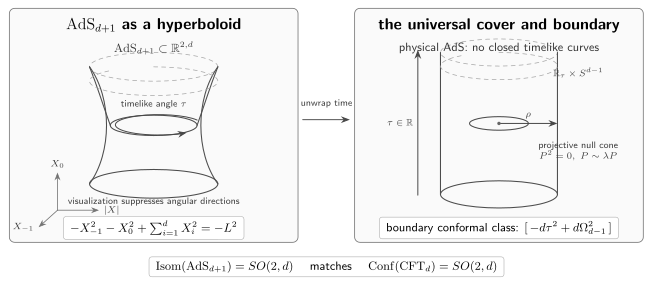
A schematic low-dimensional slice of . The hyperboloid sits in the auxiliary flat space . The angle in the plane is timelike and is unwrapped to obtain the physical universal cover. The conformal boundary of global AdS has representative metric .
The embedding definition
Section titled “The embedding definition”Let be a flat ambient vector space with coordinates
and metric
The signature is : two negative directions and positive directions. Anti-de Sitter space of radius is the hyperboloid
Equivalently,
The physical metric on is the metric induced from .
A small warning is useful right away. The ambient space has two time directions, but AdS itself has only one local time direction. The second ambient time direction is an auxiliary device that makes the symmetry group manifest. Locally, the induced metric on the hyperboloid has Lorentzian signature .
The embedding definition is useful because it makes three facts almost immediate:
- AdS has constant negative curvature.
- Its isometry group is the group preserving the ambient quadratic form.
- The conformal boundary can be described using the projective null cone of .
We now unpack these one at a time.
Global coordinates
Section titled “Global coordinates”Introduce coordinates by
and
Here are coordinates on a unit , while
These coordinates automatically satisfy the hyperboloid equation:
The induced metric is
This is the global AdS metric. It covers the entire hyperboloid, except for the usual coordinate degeneracy of angular coordinates on .
The coordinate is the angle in the plane. On the literal hyperboloid, therefore,
But a curve at fixed and fixed angular position on has
So the periodic identification of produces closed timelike curves. That is not the spacetime used in ordinary AdS/CFT. We pass to the universal cover by unwrapping the time coordinate:
In most physics discussions, means this universal covering spacetime. When global issues matter, it is better to write , but the tilde is usually suppressed.
The static global form
Section titled “The static global form”It is often useful to trade for a radial coordinate with dimensions of length,
and to use the dimensionful time
Then
The metric becomes
This form makes several things transparent. It is static. It is spherically symmetric. It has no horizon. The function
is the member of the global AdS-Schwarzschild family. A black hole in global AdS modifies this function schematically to
which will become important in the finite-temperature module.
The proper radial distance from to is infinite:
So the boundary is not at a finite proper distance. Nevertheless, as we will see below, it is at finite conformal distance and at finite global light-travel time.
The conformal compactification
Section titled “The conformal compactification”A compact radial coordinate makes the boundary visible. Define by
Then
Substituting into the global metric gives
The factor diverges at . Removing this divergent Weyl factor gives the conformally related metric
This metric is finite on the cylinder
The conformal boundary is the timelike hypersurface
with representative metric
Thus the conformal boundary of global AdS is
with metric defined only up to Weyl rescaling.
This last phrase is crucial. The boundary metric in AdS/CFT is not a uniquely chosen metric; it is a conformal class. A CFT can be placed on any representative of that conformal class, with Weyl anomalies in even boundary dimensions treated carefully.
Light reaches the boundary in finite global time
Section titled “Light reaches the boundary in finite global time”The compactified metric is the easiest way to see the causal structure. For radial null motion, set and :
Therefore
A light ray emitted from the center reaches the boundary in
In dimensionful time,
This is why people say that AdS acts like a gravitational box. The phrase is helpful but imperfect. AdS is not Minkowski space with a wall at finite radius. The boundary is at infinite proper distance, and the curvature is nonzero everywhere. The box-like behavior comes from the conformal structure: null rays reach the timelike boundary in finite global time, so the gravitational problem requires boundary conditions there.
In AdS/CFT those boundary conditions are not merely technical choices. They become CFT sources, background fields, or choices of state.
The radius and the curvature
Section titled “The radius LLL and the curvature”AdS is a maximally symmetric spacetime with negative curvature. In dimensions, a maximally symmetric space has Riemann tensor of the form
where is the sectional curvature. With the curvature convention used in this course, for AdS
Thus
and contraction gives
Here are intrinsic AdS indices, not to be confused with the boundary spacetime dimension .
The radius is therefore the curvature length scale. Large means weak curvature; small means strong curvature. In holography this distinction is critical. Classical Einstein gravity is reliable only when all curvature radii are large compared with the string length or whatever microscopic quantum-gravity length scale is relevant.
AdS solves the vacuum Einstein equation with negative cosmological constant:
Substituting the AdS Ricci tensor gives
Equivalently, many holography papers write the bulk action as
whose equation of motion is
when no matter fields are present. The dots denote boundary terms, counterterms, matter actions, and higher-derivative corrections depending on the problem.
Why the symmetry group is
Section titled “Why the symmetry group is SO(2,d)SO(2,d)SO(2,d)”The ambient quadratic form
is preserved by . Therefore maps the hyperboloid
to itself. The connected orientation- and time-orientation-preserving component is usually denoted , and physicists often abbreviate the relevant group as .
The corresponding Killing vectors are the restrictions of ambient Lorentz generators to the hyperboloid:
They satisfy the algebra. The number of independent generators is
This is also the maximum possible number of Killing vectors in a -dimensional spacetime. Hence AdS is maximally symmetric.
The global time translation of AdS is generated by rotations in the plane:
In global AdS/CFT this generator is identified with the Hamiltonian of the CFT quantized on the cylinder .
Matching the conformal group
Section titled “Matching the conformal group”The conformal group of Lorentzian flat space is generated by
where are translations, are Lorentz transformations, is the dilatation, and are special conformal transformations. The number of generators is
the same as .
This equality is more than numerology. The conformal algebra in Lorentzian dimensions, for , is precisely
This is the basic reason AdS is compatible with a boundary CFT. The bulk isometry group acts on the boundary as the conformal group.
A useful dictionary is:
| Bulk AdS generator | Boundary CFT meaning |
|---|---|
| Rotation in the plane | Hamiltonian on |
| Subgroup preserving a Poincaré patch | Poincaré transformations and dilatations on |
| Full | Full finite-dimensional conformal group |
| Quotients of AdS by discrete isometries | CFT states or backgrounds with corresponding identifications |
For the canonical example,
The compact factor adds another symmetry:
which matches the R-symmetry of super-Yang—Mills theory. That part of the dictionary belongs to the canonical-example module, but it is good to see already how geometric symmetries become global symmetries of the CFT.
The projective null cone
Section titled “The projective null cone”The conformal boundary can also be described directly in the ambient space. The hyperboloid equation is
Points near infinity have large . If we forget the overall scale of , the boundary is obtained from null rays of the ambient space:
This is the projective null cone.
Why null? If is very large while remains fixed, the rescaled vector approaches a vector with
Why projective? Because the overall magnitude of is the radial direction. Boundary points remember the direction of approach, not the divergent radial scale.
This construction makes conformal symmetry transparent. The group acts linearly on and preserves . Since boundary points are rays , the induced action on a chosen section of the cone is conformal rather than strictly metric-preserving.
This embedding-space viewpoint is extremely useful in modern CFT and AdS calculations. It is the geometric origin of the fact that conformal transformations look nonlinear in but linear in a higher-dimensional auxiliary space.
Global AdS and radial quantization
Section titled “Global AdS and radial quantization”Global AdS naturally corresponds to the CFT on the cylinder
This is the Lorentzian version of radial quantization. A CFT on flat Euclidean can be Weyl-mapped to a cylinder by writing
Equivalently, with ,
After a Weyl rescaling, Euclidean scale transformations become translations along . In Lorentzian signature, the CFT Hamiltonian on is related to the dilatation operator of the flat-space CFT.
This is why energies in global AdS are related to scaling dimensions. Roughly,
A more precise version appears when we study fields in AdS. For a scalar field of mass ,
That relation will be derived in the CFT dictionary module. For now, the important point is conceptual: global AdS time translations are not arbitrary; they are the bulk version of a natural CFT time evolution.
Exact AdS versus asymptotically AdS
Section titled “Exact AdS versus asymptotically AdS”The metric above is exact AdS. Most holographic geometries used in research are not exactly AdS everywhere. They are asymptotically AdS: near the conformal boundary they approach AdS closely enough to define CFT sources and expectation values, while in the interior they can contain black holes, horizons, scalar hair, domain walls, solitons, branes, or time-dependent matter.
This distinction is central. The CFT background and sources are read from the boundary behavior. The CFT state, temperature, density, RG flow, or nonequilibrium dynamics are encoded in the interior.
A rough but useful slogan is:
The next pages will make this precise by studying coordinate systems and boundary expansions.
AdS versus Minkowski and de Sitter
Section titled “AdS versus Minkowski and de Sitter”It is useful to compare the three maximally symmetric Lorentzian spacetimes.
| Spacetime | Curvature | Symmetry group | Boundary behavior | Holographic status |
|---|---|---|---|---|
| Minkowski | ISO | null, spatial, and timelike infinities | flat-space holography is subtle | |
| de Sitter | spacelike future and past boundaries | cosmological holography is less settled | ||
| AdS | timelike conformal boundary | standard AdS/CFT setting |
The negative curvature of AdS is not the only important ingredient. The timelike boundary is equally essential. It lets the bulk theory be formulated with boundary conditions at spatial infinity, while the boundary itself is a Lorentzian spacetime on which a quantum field theory can live.
In this sense, AdS/CFT is not simply “gravity in a negatively curved space.” It is a duality between a gravitational theory with asymptotically AdS boundary conditions and a nongravitational theory living on the associated conformal boundary.
Useful examples by dimension
Section titled “Useful examples by dimension”A few dimensions occur so frequently that it is worth recording their symmetry groups.
| Bulk spacetime | Boundary theory | AdS isometry group | Comments |
|---|---|---|---|
| CFT or conformal quantum mechanics | Important in near-extremal black holes and nearly-AdS gravity. | ||
| CFT | Locally ; asymptotic symmetry enhances to Virasoro. | ||
| CFT | Appears in M2-brane and ABJM dualities. | ||
| CFT | The canonical SYM / type IIB example. | ||
| CFT | Appears in M5-brane and theory dualities. |
For , the finite-dimensional conformal group is only the beginning. Two-dimensional CFTs have infinite-dimensional local conformal symmetry, and the asymptotic symmetry group of AdS gravity reflects this through the Brown-Henneaux Virasoro algebra. That story belongs to the later module on AdS/CFT.
Common mistakes
Section titled “Common mistakes”Mistake 1: Thinking the second ambient time is physical
Section titled “Mistake 1: Thinking the second ambient time is physical”The embedding space has two timelike directions, but it is not the physical spacetime. AdS is the hyperboloid with the induced metric, and that induced metric has one time direction. The extra time direction is an elegant way to make manifest.
Mistake 2: Forgetting the universal cover
Section titled “Mistake 2: Forgetting the universal cover”The literal hyperboloid has a periodic timelike coordinate . The physical spacetime used in AdS/CFT is normally the universal cover, where is unwrapped. When a paper says “global AdS,” it almost always means this universal cover.
Mistake 3: Treating the boundary metric as unique
Section titled “Mistake 3: Treating the boundary metric as unique”The boundary metric is a representative of a conformal class. Different choices related by Weyl rescaling describe the same conformal boundary structure, although Weyl anomalies and sources can make the transformation law nontrivial.
Mistake 4: Confusing Euclidean AdS and Lorentzian AdS
Section titled “Mistake 4: Confusing Euclidean AdS and Lorentzian AdS”Euclidean AdS is hyperbolic space with isometry group . Lorentzian AdS has isometry group . Many formulas are related by analytic continuation, but causal statements and boundary conditions are not interchangeable.
Mistake 5: Saying “AdS is dual to a CFT” without specifying the rest of the bulk theory
Section titled “Mistake 5: Saying “AdS is dual to a CFT” without specifying the rest of the bulk theory”Pure AdS geometry by itself is not a full duality. A complete holographic model includes the bulk fields, interactions, boundary conditions, string or M-theory compactification data when applicable, and the rules for computing observables. The geometry supplies the stage and the symmetry structure; the full duality is a statement about quantum dynamics.
Exercises
Section titled “Exercises”Exercise 1: Derive the global AdS metric
Section titled “Exercise 1: Derive the global AdS metric”Use
with , to derive
Solution
First compute the contribution from the two ambient time coordinates:
The cross terms cancel because of the sine and cosine combination. For the spatial coordinates,
Using
we get
Adding the two pieces gives
Since ,
Exercise 2: Closed timelike curves and the universal cover
Section titled “Exercise 2: Closed timelike curves and the universal cover”On the literal hyperboloid, is an angular coordinate with period . Show that this produces closed timelike curves. Then explain how the universal cover removes them.
Solution
Fix and fix a point on . The global metric reduces to
This is timelike for any nonzero . But on the literal hyperboloid,
Therefore the curve
is closed and timelike. The universal cover replaces the periodic coordinate by
so the same timelike curve is no longer closed. This is the spacetime normally used in AdS/CFT.
Exercise 3: The cosmological constant
Section titled “Exercise 3: The cosmological constant”Assume
in dimensions. Show that AdS solves the vacuum Einstein equation
with
Solution
First contract the Ricci tensor:
Substitute into the Einstein equation:
The coefficient must vanish, so
Exercise 4: Counting conformal generators
Section titled “Exercise 4: Counting conformal generators”Show that the number of generators of the Lorentzian conformal group in dimensions equals the number of generators of .
Solution
The conformal group has:
Thus the total number is
The group acts on a vector space of dimension . The number of antisymmetric generators is therefore
The counts agree, and more strongly the Lie algebras are isomorphic:
Exercise 5: The boundary conformal class
Section titled “Exercise 5: The boundary conformal class”Starting from the global metric, show that the boundary metric is conformal to
Solution
At large ,
The metric becomes
The divergent factor in the directions parallel to the boundary is . Multiply the metric by
Then the radial term vanishes at the boundary:
while the tangential part approaches
Thus the conformal boundary has representative metric
with the understanding that only its conformal class is canonically defined.
Exercise 6: A radial light ray
Section titled “Exercise 6: A radial light ray”Using the compactified metric
compute the time required for a radial light ray to travel from the center of global AdS to the boundary.
Solution
For radial null motion, and . Therefore
so
A light ray moving outward from the center to the boundary travels from
Therefore
Restoring gives
Further reading
Section titled “Further reading”- G. W. Gibbons, Anti-de-Sitter spacetime and its uses. A careful pedagogical account of global AdS, including the distinction between the hyperboloid and its universal cover.
- Edward Witten, Anti De Sitter Space And Holography. A foundational paper emphasizing AdS boundary conditions, conformal symmetry, and the relation between bulk quantities and CFT observables.
- Ofer Aharony, Steven Gubser, Juan Maldacena, Hirosi Ooguri, and Yaron Oz, Large N Field Theories, String Theory and Gravity. The classic review; see especially the early sections on AdS geometry and the basic correspondence.
- Martin Ammon and Johanna Erdmenger, Gauge/Gravity Duality. Useful for connecting the geometry of AdS to practical holographic computations.
- Sean Carroll, Spacetime and Geometry, and Robert Wald, General Relativity. Standard references for Lorentzian geometry, curvature conventions, and Einstein equations.