
Light-Cone Quantization and the Critical Dimension
The covariant quantization of the previous note is elegant because it keeps Lorentz invariance visible. Its price is that the Fock space initially contains unphysical timelike and longitudinal excitations. The physical-state conditions remove them, but the mechanism is indirect.
Light-cone quantization does the opposite. It solves the constraints before quantization, leaving only the genuinely propagating string coordinates. The Hilbert space is then manifestly positive-norm. The price is that Lorentz invariance becomes non-manifest and must be checked quantum mechanically. That check is where the famous values
first appear in their most concrete form.
Here is the target-space dimension and is the open-string normal-ordering constant, also called the intercept.
The remaining gauge freedom in conformal gauge
Section titled “The remaining gauge freedom in conformal gauge”In conformal gauge the Polyakov action becomes a free two-dimensional field theory, but the equations are accompanied by constraints:
Here
Conformal gauge has not fixed all gauge freedom. There are still residual reparametrizations
which preserve the conformal form of the worldsheet metric. Light-cone gauge uses this residual freedom to choose one target-space coordinate, , to be proportional to the worldsheet time.
For the open string, whose Neumann mode expansion is
the light-cone gauge choice is
Equivalently,
and
This gauge is valid in a sector with . Intuitively, the string is being described by snapshots at fixed target-space light-cone time .
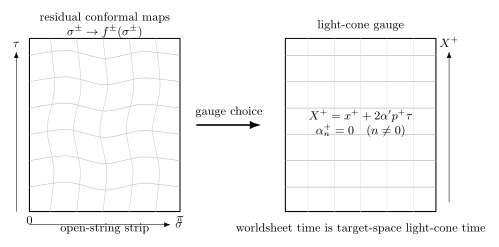
After conformal gauge, residual transformations remain. Light-cone gauge uses them to set for an open string, removing all nonzero oscillators.
This is very different from merely choosing a Lorentz frame. It is a gauge condition on the worldsheet fields. Once is fixed, the Virasoro constraints determine in terms of the transverse coordinates .
Solving the constraints for
Section titled “Solving the constraints for X−X^-X−”For the open string the Virasoro generators are
Split the dot product into light-cone and transverse pieces:
Because for , the constraint for becomes
Thus
where
The constraint gives the light-cone Hamiltonian. Including the normal-ordering constant,
Using
we get
Therefore
The invariant mass is
so the open-string mass formula is
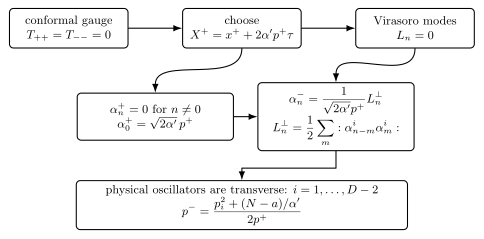
The gauge condition removes the nonzero oscillators. The Virasoro constraints then express every in terms of transverse bilinears and determine from the mass-shell condition.
There is now no independent oscillator , and there is no independent oscillator . The only creation operators are
They obey
This Hilbert space is manifestly positive-norm. The string has transverse oscillators, just like a massless particle has physical polarizations.
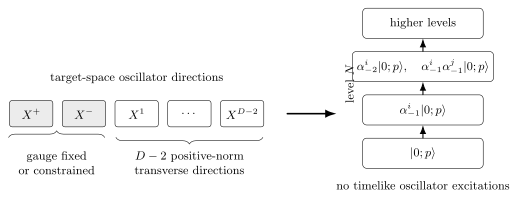
Light-cone quantization removes by a gauge choice and determines by the constraints. The physical Fock space is built only from transverse oscillators .
The intercept from zero-point energy
Section titled “The intercept from zero-point energy”The number operator is
Because there are transverse bosons, normal ordering the light-cone Hamiltonian produces a zero-point energy. Formally each oscillator contributes , so
Using zeta-function regularization,
we find
The mass formula is written as
so the intercept is
At this stage this is a statement about the light-cone zero-point energy. It does not yet say what must be. To find that, we must ask whether the quantized theory still represents the full Lorentz group.
The Lorentz-algebra test
Section titled “The Lorentz-algebra test”Light-cone gauge makes the transverse rotation group manifest, but the full Lorentz group is hidden. Classically the Lorentz generators are
After light-cone gauge fixing, the dangerous generators are
They contain and therefore become nonlinear functions of the transverse oscillators. Schematically,
with replaced by . Operator ordering now matters.
The full Lorentz algebra requires
A direct computation gives an anomalous term proportional to
The two independent coefficients vanish only if
Therefore
This is one of the cleanest derivations of the critical dimension of the bosonic string.
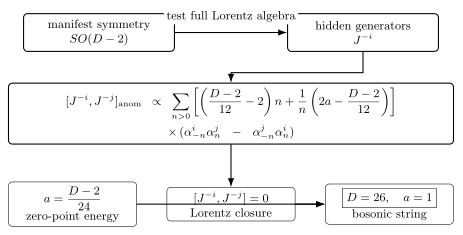
Light-cone quantization has a positive-norm Hilbert space, but Lorentz invariance is not automatic. Closure of the hidden generators fixes and .
Open-string spectrum in light-cone gauge
Section titled “Open-string spectrum in light-cone gauge”Set now
The open-string mass formula becomes
The first few levels are especially instructive.
The vacuum state is
with
This is the open-string tachyon. Its presence is a sign that the bosonic string vacuum is unstable. The superstring will remove this tachyon by the GSO projection.
The first excited states are
They have
There are polarizations, exactly the number of physical polarizations of a massless vector in dimensions. Thus this level is interpreted as a massless gauge boson.
At the next level the independent light-cone states are
and
The count is
This number is not random. A massive spin-two particle in dimensions transforms as a symmetric traceless tensor of the massive little group , whose dimension is
Thus the light-cone states, although written in terms of transverse oscillators, recombine into a full representation. This is a concrete low-level check of Lorentz invariance.
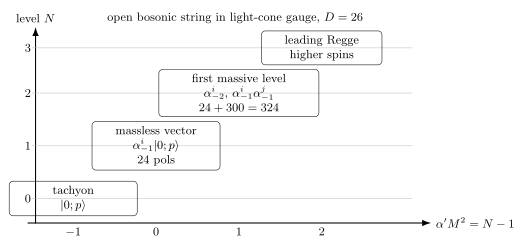
For the open bosonic string, . The level states have degeneracy , matching the symmetric traceless representation of the massive little group .
The leading Regge trajectory is obtained by repeatedly applying the same transverse oscillator,
It contains states of spin growing linearly with , so
This is the quantum continuation of the classical Regge relation derived from the rotating string.
Closed strings in light-cone gauge
Section titled “Closed strings in light-cone gauge”The closed string has two independent transverse oscillator algebras,
corresponding to right- and left-moving modes. The zero-mode convention is
In light-cone gauge we set
Thus
The two Virasoro constraints solve both longitudinal oscillator families:
The two constraints are
Since
we get
and
At the critical value ,
The condition
is called level matching. It is the operator version of invariance under translations around the closed-string spatial circle.
The first closed-string levels
Section titled “The first closed-string levels”At
we find the closed-string tachyon,
At
the states are
They are massless and have
physical polarizations. Decompose this tensor under the massless little group :
The dimensions are
and
These are the physical polarizations of the spacetime fields
namely the graviton, the antisymmetric two-form, and the dilaton.
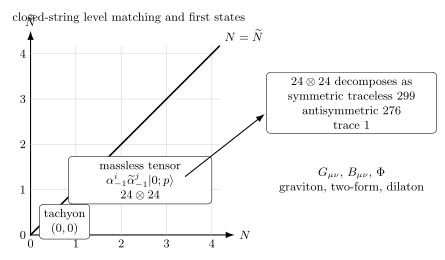
Closed strings have independent left- and right-moving oscillator levels. Level matching forces . The first massless states form , decomposing into the graviton, two-form, and dilaton.
Summary
Section titled “Summary”Light-cone quantization gives the most economical description of the free string:
For the bosonic string, the transverse zero-point energy gives
Requiring the hidden Lorentz generators to close gives
The open-string spectrum is
and the closed-string spectrum is
The next question is not just what the first few levels are, but how many states appear at very high level. That question leads to the string partition function and the Hagedorn temperature.
Exercises
Section titled “Exercises”Exercise 1. Light-cone scalar product
Section titled “Exercise 1. Light-cone scalar product”Using
show that
Solution
Invert the definitions:
and similarly for . The contribution from the and directions is
Expanding gives
Adding the transverse directions gives
Exercise 2. Derive from
Section titled “Exercise 2. Derive αn−\alpha_n^-αn− from Ln=0L_n=0Ln=0”For the open string in light-cone gauge, use
to derive
Solution
Start with
In light-cone components,
For , the first light-cone term contributes only when , namely , and the second contributes only when . Thus the two light-cone terms together give
The constraint becomes
Since
we obtain
Exercise 3. The intercept
Section titled “Exercise 3. The intercept”Using zeta-function regularization, compute the open-string intercept for transverse bosons.
Solution
The zero-point energy is
With
we find
The light-cone mass formula is written as
so the intercept is the negative of the zero-point energy:
For this gives
Exercise 4. Count the first massive open-string level
Section titled “Exercise 4. Count the first massive open-string level”At level , count the light-cone states
for . Show that the answer equals the dimension of a symmetric traceless tensor of .
Solution
The states contribute
states. The states are symmetric in because the oscillators commute, so they contribute
states. Therefore
A symmetric rank-two tensor of has dimension
Removing its trace gives
Thus the level- light-cone states form precisely the massive spin-two representation.
Exercise 5. Decompose the massless closed-string state
Section titled “Exercise 5. Decompose the massless closed-string state”Show that
decomposes into states.
Solution
The tensor product of two vectors decomposes into symmetric traceless, antisymmetric, and trace parts:
The symmetric tensors have dimension
Removing the trace gives
The antisymmetric tensors have dimension
The trace gives one scalar. Hence
These are the graviton, two-form, and dilaton polarizations.
Exercise 6. Why the critical dimension follows from Lorentz closure
Section titled “Exercise 6. Why the critical dimension follows from Lorentz closure”Use the anomalous coefficient
to show that Lorentz closure requires and .
Solution
The expression must vanish for every positive integer . Since it contains an term and a term, each coefficient must vanish separately:
and
The first equation gives
Substituting this into the second equation gives