Skip to content

String Interactions and the Free Boson CFT

We have quantized the free bosonic string and uncovered several unmistakably stringy features: Regge trajectories, massless spin-two states, and Hagedorn growth. But a theory is not only a spectrum. We also need interactions.

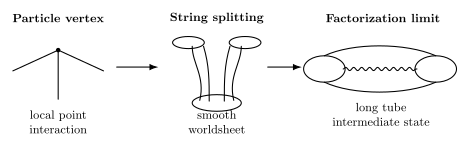
For point particles, interactions are usually described by local vertices in a spacetime Feynman diagram. A cubic scalar interaction, for instance, is drawn as three worldlines meeting at a point. Strings behave differently. A closed string splits into two closed strings by sweeping out a smooth pair-of-pants worldsheet; two closed strings join by the same surface viewed with the opposite time orientation. The interaction is not placed at a point on the worldsheet. It is encoded in the topology and geometry of the worldsheet itself.

String interactions are smooth worldsheets, including a pair of pants and a long tube degeneration.

A string Feynman diagram is a two-dimensional surface. A long thin tube represents propagation of an intermediate string state and gives the pole structure familiar from field theory.

Schematically, perturbative string amplitudes have the form

A=topologiesgsχ[DXDh]Diff×WeyleSE[X,h]iVi.\mathcal A = \sum_{\text{topologies}} g_s^{-\chi} \int \frac{[DX\,Dh]}{\text{Diff}\times\text{Weyl}} \,e^{-S_E[X,h]} \, \prod_i \mathcal V_i .

Here χ\chi is the Euler characteristic of the worldsheet, gsg_s is the string coupling, and the operators Vi\mathcal V_i describe the external string states. This formula is not yet a complete prescription: later we must gauge-fix the metric, introduce ghosts, integrate over moduli, and impose BRST invariance. But the conceptual point is already visible:

particle perturbation theory: graphs,string perturbation theory: surfaces.\text{particle perturbation theory: graphs}, \qquad \text{string perturbation theory: surfaces}.

In this page we prepare the CFT tools needed to make this precise.

Euclidean worldsheets and the complex plane

Section titled “Euclidean worldsheets and the complex plane”

In Lorentzian conformal gauge the free string action is

S=14παdτdσηαβαXμβXμ.S = -\frac{1}{4\pi\alpha'} \int d\tau\,d\sigma\, \eta^{\alpha\beta} \partial_\alpha X^\mu \partial_\beta X_\mu .

For path integrals and operator products, it is usually better to rotate to Euclidean time,

τ=iτE,\tau=-i\tau_E,

so that

SE=14παdτEdσ[(τEX)2+(σX)2].S_E = \frac{1}{4\pi\alpha'} \int d\tau_E\,d\sigma\, \left[ (\partial_{\tau_E}X)^2+(\partial_\sigma X)^2 \right].

Introduce the complex cylinder coordinate

w=τE+iσ,wˉ=τEiσ.w=\tau_E+i\sigma, \qquad \bar w=\tau_E-i\sigma .

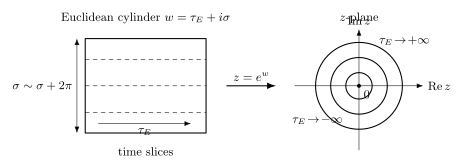
For a closed string, σσ+2π\sigma\sim\sigma+2\pi, so the free Euclidean worldsheet is a cylinder. The exponential map

z=ew=eτE+iσz=e^w=e^{\tau_E+i\sigma}

sends the cylinder to the punctured complex plane. Constant Euclidean time slices become circles,

τE=constantz=eτE.\tau_E=\text{constant} \quad \Longleftrightarrow \quad |z|=e^{\tau_E}.

Thus Euclidean time evolution on the cylinder becomes radial evolution on the plane.

The Euclidean cylinder maps to the punctured complex plane by z equals e to the w.

The map z=ewz=e^w turns time ordering on the Euclidean cylinder into radial ordering on the plane. The remote past and future of the cylinder become z=0z=0 and z=z=\infty.

This is the beginning of radial quantization. It will become essential when we identify local operators with string states.

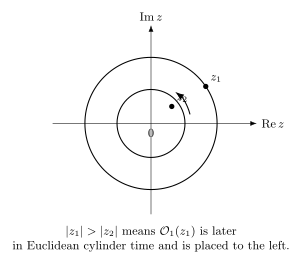
On the Euclidean plane the analogue of time ordering is radial ordering. For two local operators,

R ⁣[O1(z1,zˉ1)O2(z2,zˉ2)]={O1(z1,zˉ1)O2(z2,zˉ2),z1>z2,O2(z2,zˉ2)O1(z1,zˉ1),z2>z1.R\!\left[ \mathcal O_1(z_1,\bar z_1) \mathcal O_2(z_2,\bar z_2) \right] = \begin{cases} \mathcal O_1(z_1,\bar z_1)\mathcal O_2(z_2,\bar z_2), & |z_1|>|z_2|, \\ \mathcal O_2(z_2,\bar z_2)\mathcal O_1(z_1,\bar z_1), & |z_2|>|z_1|. \end{cases}

The outer operator is later in Euclidean cylinder time. This simple dictionary is the reason contour integrals in the zz-plane reproduce commutators and symmetry transformations.

Radial ordering places operators at larger absolute value to the left.

Radial ordering is time ordering after the cylinder-plane map. An operator at larger z|z| is later in Euclidean time.

For correlation functions we write

R{O1(z1,zˉ1)On(zn,zˉn)}.\left\langle R\{\mathcal O_1(z_1,\bar z_1)\cdots \mathcal O_n(z_n,\bar z_n)\} \right\rangle .

In most CFT notation the RR is suppressed, but it is conceptually always present.

In complex coordinates,

z=σ1+iσ2,zˉ=σ1iσ2,=z,ˉ=zˉ,z=\sigma^1+i\sigma^2, \qquad \bar z=\sigma^1-i\sigma^2, \qquad \partial=\partial_z, \qquad \bar\partial=\partial_{\bar z},

the Euclidean free-boson action is

SE=12παd2zXμˉXμ.S_E = \frac{1}{2\pi\alpha'} \int d^2z\, \partial X^\mu \bar\partial X_\mu .

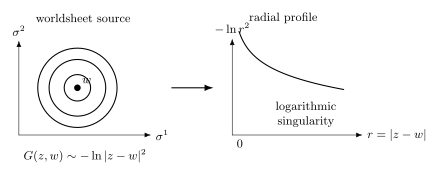
The path integral is Gaussian. The two-point function is therefore the Green function of the two-dimensional Laplacian. With the convention

ˉlnzw2=πδ(2)(zw),\partial\bar\partial \ln |z-w|^2 = \pi\,\delta^{(2)}(z-w),

one obtains

Xμ(z,zˉ)Xν(w,wˉ)=α2ημνlnzw2.\boxed{ \left\langle X^\mu(z,\bar z)X^\nu(w,\bar w) \right\rangle = -\frac{\alpha'}{2}\eta^{\mu\nu}\ln |z-w|^2 . }

This logarithm is the fundamental local singularity from which the free-boson CFT is built.

The free boson Green function has a logarithmic singularity at the source point.

In two dimensions the scalar Green function is logarithmic. Derivatives of the logarithm produce the poles that appear in operator product expansions.

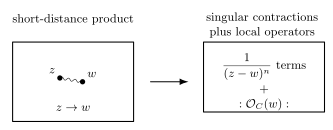
The operator product expansion is the statement that as two insertions approach each other, their product can be replaced inside correlators by a sum of local operators at one point:

OA(z,zˉ)OB(w,wˉ)CCAB    C(zw,zˉwˉ)OC(w,wˉ).\mathcal O_A(z,\bar z)\mathcal O_B(w,\bar w) \sim \sum_C C_{AB}^{\;\;C}(z-w,\bar z-\bar w)\, \mathcal O_C(w,\bar w).

The symbol \sim means equality of singular terms as zwz\to w inside correlation functions. Terms regular at z=wz=w are usually omitted.

For the free boson, differentiating the logarithmic Green function gives

Xμ(z)Xν(w,wˉ)α2ημνzw,\partial X^\mu(z)\,X^\nu(w,\bar w) \sim -\frac{\alpha'}{2} \frac{\eta^{\mu\nu}}{z-w},

and

Xμ(z)Xν(w)α2ημν(zw)2.\partial X^\mu(z)\,\partial X^\nu(w) \sim -\frac{\alpha'}{2} \frac{\eta^{\mu\nu}}{(z-w)^2}.

Similarly,

ˉXμ(zˉ)ˉXν(wˉ)α2ημν(zˉwˉ)2,\bar\partial X^\mu(\bar z)\,\bar\partial X^\nu(\bar w) \sim -\frac{\alpha'}{2} \frac{\eta^{\mu\nu}}{(\bar z-\bar w)^2},

while holomorphic and antiholomorphic derivatives have no local singularity with each other:

Xμ(z)ˉXν(wˉ)0.\partial X^\mu(z)\,\bar\partial X^\nu(\bar w) \sim 0.

These four OPEs are the workhorses of perturbative string theory.

The field XμX^\mu has a singular self-contraction, so composite operators must be normal ordered. A useful definition is

:Xμ(z,zˉ)Xν(w,wˉ):=Xμ(z,zˉ)Xν(w,wˉ)+α2ημνlnzw2.:X^\mu(z,\bar z)X^\nu(w,\bar w): = X^\mu(z,\bar z)X^\nu(w,\bar w) + \frac{\alpha'}{2}\eta^{\mu\nu}\ln |z-w|^2 .

For local composites, one first subtracts the singular part and then takes the coincident limit. For example,

:XμXμ:(w)=limzw[Xμ(z)Xμ(w)+α2D(zw)2].:\partial X^\mu\partial X_\mu:(w) = \lim_{z\to w} \left[ \partial X^\mu(z)\partial X_\mu(w) + \frac{\alpha'}{2}\frac{D}{(z-w)^2} \right].

Normal ordering separates singular short-distance physics from finite operator data.

The OPE separates singular contractions from a normal-ordered finite operator.

As zwz\to w, the product of fields splits into singular contractions plus a normal-ordered local operator. Wick contractions are the practical way to compute free-boson OPEs.

String vertex operators are built from exponentials of XμX^\mu. The basic normal-ordered exponential is

:eikX(z,zˉ):.:e^{ik\cdot X(z,\bar z)}: .

Using Wick’s theorem,

:eik1X(z,zˉ)::eik2X(w,wˉ):zwαk1k2:ei(k1+k2)X(w,wˉ):.:e^{ik_1\cdot X(z,\bar z)}: :e^{ik_2\cdot X(w,\bar w)}: \sim |z-w|^{\alpha' k_1\cdot k_2} :e^{i(k_1+k_2)\cdot X(w,\bar w)}: .

Differentiated fields act on exponentials by a simple pole:

Xμ(z):eikX(w,wˉ):iα2kμzw:eikX(w,wˉ):.\partial X^\mu(z) :e^{ik\cdot X(w,\bar w)}: \sim -i\frac{\alpha'}{2}\frac{k^\mu}{z-w} :e^{ik\cdot X(w,\bar w)}: .

These formulas already contain the seed of string scattering amplitudes: products of many plane-wave vertices generate powers of zizjαkikj|z_i-z_j|^{\alpha' k_i\cdot k_j}. Later, after adding the correct ghost factors and integrating over punctures, these powers become Veneziano and Virasoro-Shapiro amplitudes.

The most important takeaways are:

Xμ(z,zˉ)Xν(w,wˉ)=α2ημνlnzw2,\left\langle X^\mu(z,\bar z)X^\nu(w,\bar w)\right\rangle = -\frac{\alpha'}{2}\eta^{\mu\nu}\ln |z-w|^2, Xμ(z)Xν(w)α2ημν(zw)2,\partial X^\mu(z)\partial X^\nu(w) \sim -\frac{\alpha'}{2} \frac{\eta^{\mu\nu}}{(z-w)^2},

and

:eik1X(z,zˉ)::eik2X(w,wˉ):zwαk1k2:ei(k1+k2)X(w,wˉ):.:e^{ik_1\cdot X(z,\bar z)}: :e^{ik_2\cdot X(w,\bar w)}: \sim |z-w|^{\alpha' k_1\cdot k_2} :e^{i(k_1+k_2)\cdot X(w,\bar w)}: .

The next page introduces the stress tensor T(z)T(z), which turns these local OPEs into the full machinery of conformal symmetry.

Exercise 1. Cylinder time and radial ordering

Section titled “Exercise 1. Cylinder time and radial ordering”

Let z=eτE+iσz=e^{\tau_E+i\sigma}. Show that τE\tau_E ordering on the cylinder is equivalent to radial ordering on the plane.

Solution

Taking the absolute value gives

z=eτE+iσ=eτE.|z|=|e^{\tau_E+i\sigma}|=e^{\tau_E}.

Thus

τE,1>τE,2eτE,1>eτE,2z1>z2.\tau_{E,1}>\tau_{E,2} \quad \Longleftrightarrow \quad e^{\tau_{E,1}}>e^{\tau_{E,2}} \quad \Longleftrightarrow \quad |z_1|>|z_2|.

Later Euclidean time corresponds to larger radius on the plane.

Starting from

Xμ(z,zˉ)Xν(w,wˉ)=α2ημνlnzw2,\langle X^\mu(z,\bar z)X^\nu(w,\bar w)\rangle = -\frac{\alpha'}{2}\eta^{\mu\nu}\ln |z-w|^2,

derive

Xμ(z)Xν(w)α2ημν(zw)2.\partial X^\mu(z)\partial X^\nu(w) \sim -\frac{\alpha'}{2} \frac{\eta^{\mu\nu}}{(z-w)^2}.
Solution

The holomorphic part of the logarithm is ln(zw)\ln(z-w). Therefore

zln(zw)=1zw.\partial_z \ln(z-w)=\frac{1}{z-w}.

Differentiating with respect to ww gives

w1zw=1(zw)2.\partial_w\frac{1}{z-w} = \frac{1}{(z-w)^2}.

Hence

zw[α2ημνln(zw)]=α2ημν(zw)2.\partial_z\partial_w \left[ -\frac{\alpha'}{2}\eta^{\mu\nu}\ln(z-w) \right] = -\frac{\alpha'}{2} \frac{\eta^{\mu\nu}}{(z-w)^2}.

This is the singular OPE.

Use Wick’s theorem to show that

:eik1X(z,zˉ)::eik2X(w,wˉ):zwαk1k2:ei(k1+k2)X(w,wˉ):.:e^{ik_1\cdot X(z,\bar z)}: :e^{ik_2\cdot X(w,\bar w)}: \sim |z-w|^{\alpha' k_1\cdot k_2} :e^{i(k_1+k_2)\cdot X(w,\bar w)}: .
Solution

For two normal-ordered exponentials, Wick’s theorem gives the cross-contraction factor

exp[ik1X(z,zˉ)ik2X(w,wˉ)].\exp\left[ \left\langle i k_1\cdot X(z,\bar z)\, i k_2\cdot X(w,\bar w) \right\rangle \right].

The contraction is

ik1X(z,zˉ)ik2X(w,wˉ)=k1k2(α2lnzw2).\left\langle i k_1\cdot X(z,\bar z)\, i k_2\cdot X(w,\bar w) \right\rangle = -k_1\cdot k_2 \left( -\frac{\alpha'}{2}\ln |z-w|^2 \right).

Thus the factor is

exp[α2k1k2lnzw2]=zwαk1k2.\exp\left[ \frac{\alpha'}{2}k_1\cdot k_2\ln |z-w|^2 \right] = |z-w|^{\alpha' k_1\cdot k_2}.

The regular part of the product can then be expanded around ww, giving the displayed OPE.

Show that

Xμ(z):eikX(w,wˉ):iα2kμzw:eikX(w,wˉ):.\partial X^\mu(z) :e^{ik\cdot X(w,\bar w)}: \sim -i\frac{\alpha'}{2}\frac{k^\mu}{z-w} :e^{ik\cdot X(w,\bar w)}: .
Solution

Contract Xμ(z)\partial X^\mu(z) with the exponent:

Xμ(z)ikνXν(w,wˉ)ikν(α2ημνzw).\partial X^\mu(z)\, i k_\nu X^\nu(w,\bar w) \sim i k_\nu \left( -\frac{\alpha'}{2} \frac{\eta^{\mu\nu}}{z-w} \right).

This equals

iα2kμzw.-i\frac{\alpha'}{2}\frac{k^\mu}{z-w}.

Multiplying by the uncontracted normal-ordered exponential gives

Xμ(z):eikX(w,wˉ):iα2kμzw:eikX(w,wˉ):.\partial X^\mu(z) :e^{ik\cdot X(w,\bar w)}: \sim -i\frac{\alpha'}{2}\frac{k^\mu}{z-w} :e^{ik\cdot X(w,\bar w)}: .