
Thermodynamics of the N=4 Plasma
The simplest strongly coupled plasma
Section titled “The simplest strongly coupled plasma”The planar AdS black brane is dual to the thermal state of super Yang-Mills theory on flat space . This page computes its equilibrium thermodynamics.
The result is famous enough to memorize, but it is much more useful to understand where every factor comes from. In the classical supergravity regime,
the strongly coupled plasma has
Here is the entropy density, is the pressure, and is the energy density. The free-energy density is
The entire computation is a clean example of the thermal AdS/CFT dictionary.
| Boundary quantity | Bulk quantity |
|---|---|
| temperature | smoothness period of Euclidean time, or surface gravity |
| entropy density | horizon area density divided by |
| free-energy density | renormalized Euclidean on-shell action density |
| stress tensor | normalizable metric coefficient in Fefferman-Graham form |
| degrees of freedom | classical bulk action scale |
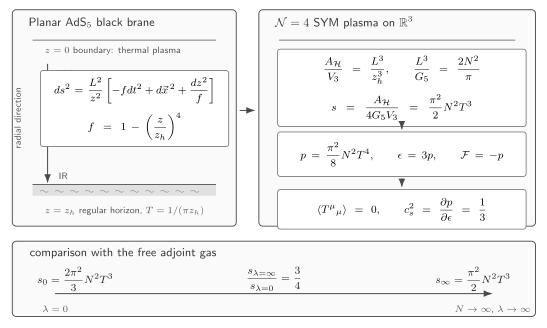
The planar AdS black brane turns horizon data into the equation of state of the strongly coupled SYM plasma. The horizon location fixes , the horizon area gives , the Euclidean on-shell action gives , and conformality gives .
The word “plasma” can mislead. At weak coupling one imagines a gas of gluons, scalars, and fermions. At strong coupling and large , the theory is better described by a smooth black brane. The thermodynamic variables remain perfectly sharp, but they are not describing long-lived quasiparticles.
The black-brane geometry
Section titled “The black-brane geometry”Use Poincaré coordinates for the five-dimensional AdS black brane:
The conformal boundary is at , and the horizon is at . In Lorentzian signature, is a regular future event horizon after changing to ingoing Eddington-Finkelstein coordinates. In Euclidean signature, regularity at fixes the periodicity of Euclidean time and hence the temperature.
Near , write with . Since
the Euclidean part of the metric becomes a smooth plane only if has period
Thus
Equivalently, with , the horizon is at , and
The two radial conventions are both common. The coordinate is convenient near the boundary; the coordinate makes the horizon radius look more like an ordinary black-hole radius.
Entropy density from horizon area
Section titled “Entropy density from horizon area”At fixed Lorentzian time and at the horizon, the induced spatial metric in the three boundary directions is
Therefore the horizon area per unit boundary volume is
The Bekenstein-Hawking entropy density is
For type IIB string theory on ,
Using gives
This is the sharpest version of the slogan “black-hole area counts field-theory entropy.” The black-brane horizon is extended along the three boundary spatial directions, so its area is proportional to . The entropy is extensive in the boundary volume but controlled by an area in the bulk.
The scaling comes from . In the CFT, the same scaling is the number of adjoint color degrees of freedom. This is not a coincidence; in holographic CFTs, the stress-tensor central charge is proportional to .
Pressure, energy density, and free energy
Section titled “Pressure, energy density, and free energy”Since the boundary theory on flat space is conformal, the thermal stress tensor must be traceless:
Thus
The thermodynamic identity
then integrates to
The integration constant is zero for the homogeneous plasma on . Hence
and
Equivalently, the holographic stress tensor gives the mixed-index expectation value
With lower indices in the rest frame, this is .
Several thermodynamic quantities follow immediately:
The value is fixed by conformal invariance in four spacetime dimensions. What holography computes is the overall normalization of the equation of state at strong coupling.
The Euclidean-action viewpoint
Section titled “The Euclidean-action viewpoint”The same free energy can be found directly from the renormalized Euclidean gravitational action. Schematically,
so
The five-dimensional Euclidean action is
The counterterm action removes UV divergences as the cutoff surface is taken to the boundary. For the planar black brane, the finite renormalized answer is
The entropy follows from
This agreement between the horizon-area calculation and the Euclidean-action calculation is a valuable normalization check. It tells us that the temperature, ensemble, counterterms, and Newton constant have been matched consistently.
Why the answer is
Section titled “Why the answer is O(N2)O(N^2)O(N2)”In the boundary theory, all elementary fields are in the adjoint representation, so a thermal gas of weakly coupled fields has degrees of freedom. In the bulk, the same scaling comes from
At large , the planar black brane is the dominant homogeneous thermal saddle on . There is no finite-temperature Hawking-Page transition in the planar case, because the black-brane free-energy density scales as for every nonzero .
This differs from the theory on , where the radius of the sphere supplies an additional scale and thermal AdS can dominate at low temperature. In the planar case, conformal invariance leaves no dimensionless ratio except those involving sources or chemical potentials.
The free-field comparison and the factor
Section titled “The free-field comparison and the factor 3/43/43/4”At zero coupling, SYM is a gas of adjoint massless fields. Per adjoint color generator, the physical degrees of freedom are
The bosonic degeneracy is , and the fermionic degeneracy is . Therefore the free pressure is
At large ,
The strong-coupling entropy is
Thus
This is famous, but it is not an exact theorem about all holographic plasmas. It compares two different limits of the same large- theory:
The striking fact is not merely that is close to . The striking fact is that a classical gravitational area predicts a definite normalization for a strongly coupled, non-BPS thermal quantity.
Finite-coupling and finite- corrections
Section titled “Finite-coupling and finite-NNN corrections”The supergravity answer is the first term in a controlled expansion. For the canonical duality,
Finite corrections come from higher-derivative stringy terms, especially the type IIB interaction. The leading correction to the entropy density has the form
Equivalently,
The positive correction means that as the coupling is decreased from infinity, the entropy begins to move upward toward the free-field value.
Finite corrections are quantum-gravity corrections in the bulk. They arise from string loops and are suppressed by powers of at fixed large . Schematic expansions of thermodynamic quantities therefore look like
The full type IIB higher-derivative expansion is subtler than this schematic line, but the conceptual lesson is stable: large suppresses string-scale corrections, while large suppresses quantum-gravity loops.
Universal versus model-dependent information
Section titled “Universal versus model-dependent information”Some features of the equation of state are universal for any four-dimensional CFT in a homogeneous thermal state:
These statements follow from conformal invariance and thermodynamics, not from the detailed bulk solution.
Other statements are special to strongly coupled large- SYM in the classical gravity regime:
Those coefficients know about the precise normalization of , hence about the compactification and the number of D3-branes.
Still other quantities become universal only after imposing stronger assumptions on the gravitational dual. The famous shear-viscosity result
is not merely a consequence of conformal invariance. It depends on two-derivative Einstein gravity and will be derived later from real-time response.
Plasma, not QCD
Section titled “Plasma, not QCD”The phrase “ plasma” is precise but easy to misuse. The theory is supersymmetric at zero temperature, conformal, has adjoint scalars and fermions, and has no running coupling. The thermal state breaks supersymmetry because the fermions are antiperiodic around the thermal circle, but the microscopic theory is still not QCD.
The comparison to the quark-gluon plasma is therefore structural rather than literal. Holography gives a controlled example of a strongly coupled non-Abelian plasma with entropy of order , rapid thermal relaxation governed by black-brane quasinormal modes, no weakly coupled quasiparticle expansion at large , and hydrodynamics emerging from long-wavelength gravitational perturbations.
The equilibrium equation of state is only the beginning. The real power of the black-brane geometry appears when one perturbs it: sound modes, shear diffusion, conductivity, spectral functions, and nonequilibrium relaxation all become classical wave problems in the same background.
Common mistakes
Section titled “Common mistakes”A common mistake is to say that is a universal prediction of holography. It is not. It is the ratio between the infinite-coupling and free limits of the canonical large- theory.
Another mistake is to identify the black-brane entropy with a microscopic derivation of every thermal microstate. The horizon-area computation gives the thermal entropy in the gravitational saddle. AdS/CFT supplies a nonperturbative unitary definition through the CFT, but the classical area calculation itself is a coarse thermodynamic computation.
A third mistake is to forget the ensemble. The planar black brane computes the canonical ensemble at fixed and zero chemical potentials. Charged or rotating black holes compute different ensembles with R-charge chemical potentials or angular velocities.
Finally, do not confuse the planar black brane with the global AdS black hole. On , the planar black brane dominates for all . On , thermal AdS and global AdS-Schwarzschild compete, producing the Hawking-Page transition discussed in the previous page.
Exercises
Section titled “Exercises”Exercise 1: Entropy from area
Section titled “Exercise 1: Entropy from area”Starting from
show that
Use and .
Solution
At the horizon, the induced spatial metric along the three boundary directions is
Therefore
The Bekenstein-Hawking entropy density is
Using and gives
Exercise 2: Equation of state
Section titled “Exercise 2: Equation of state”Assume conformal invariance in four dimensions and the entropy density
Derive , , , and .
Solution
Use
Then
The free-energy density is
Conformal invariance gives
so
Finally,
Exercise 3: The free-field entropy and the factor
Section titled “Exercise 3: The free-field entropy and the factor 3/43/43/4”Count the free-field degrees of freedom of SYM and show that
at leading order in large . Then show that .
Solution
Per adjoint color generator, the bosons are two gauge-boson polarizations plus six real scalars:
The fermions are four Weyl fermions, each with two helicity states:
The free pressure is
Thus
Differentiating with respect to gives
The strong-coupling result is
Therefore
Exercise 4: Stress tensor normalization
Section titled “Exercise 4: Stress tensor normalization”The holographic stress tensor of the planar black brane can be written as
Use the pressure found above to determine and check the trace Ward identity.
Solution
For mixed indices in the rest frame,
Comparing with
gives
The trace is
as required for a CFT on flat space.
Exercise 5: Leading finite-coupling correction
Section titled “Exercise 5: Leading finite-coupling correction”Assume
Compute the leading strong-coupling expansion of .
Solution
Since
we have
Thus
Further reading
Section titled “Further reading”- S. S. Gubser, I. R. Klebanov, and A. W. Peet, Entropy and Temperature of Black 3-Branes.
- E. Witten, Anti-de Sitter Space, Thermal Phase Transition, And Confinement In Gauge Theories.
- S. S. Gubser, I. R. Klebanov, and A. A. Tseytlin, Coupling Constant Dependence in the Thermodynamics of N=4 Supersymmetric Yang-Mills Theory.
- O. Aharony, S. S. Gubser, J. Maldacena, H. Ooguri, and Y. Oz, Large N Field Theories, String Theory and Gravity.