
Baryon Vertices and Wrapped Branes
The main idea
Section titled “The main idea”A single heavy external quark in the fundamental representation is represented holographically by a fundamental string ending on the AdS boundary. A baryon is different. In an gauge theory, a color-singlet baryonic source is not made from one fundamental index; it is made by antisymmetrizing fundamental indices:
The bulk dual must therefore contain an object on which fundamental strings can end. In the canonical duality, that object is a D5-brane wrapped on the entire and localized as a particle in . This wrapped D5-brane is called the baryon vertex.
The most important point is not its shape but its charge. The background carries units of Ramond-Ramond five-form flux through :
Because of a Wess-Zumino coupling on the D5-brane worldvolume, this flux induces units of electric charge for the D5 worldvolume gauge field. A fundamental string endpoint carries one unit of the opposite charge. A wrapped D5-brane in therefore requires string endpoints. This is the bulk version of the statement that fundamentals can be contracted with to form an singlet.
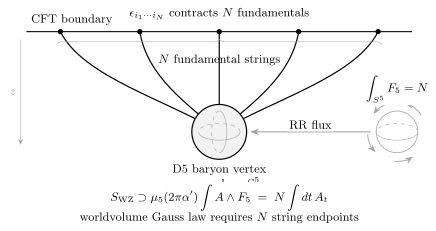
The baryon vertex in . The D5-brane wraps the internal and is pointlike in . The five-form flux induces units of worldvolume electric charge, so Gauss law requires fundamental strings to end on the wrapped brane.
This page explains the baryon vertex in three increasingly general languages: the color-singlet structure in the boundary theory, the wrapped-brane Gauss law in the bulk, and the broader role of wrapped branes as heavy nonlocal or determinant-like observables in holography.
The boundary baryon as an antisymmetric color singlet
Section titled “The boundary baryon as an antisymmetric color singlet”For a theory with dynamical fundamental fields , an ordinary baryonic operator has the schematic form
with spin, flavor, and derivative structure suppressed. Under with ,
so the operator is gauge invariant. The number is not a dynamical accident. It is the rank of the gauge group and the number of fundamental indices needed to make a singlet.
In the canonical theory, however, the elementary dynamical fields are in the adjoint representation. There are no dynamical quarks in the fundamental representation unless one adds flavor branes or external probes. Therefore the simplest baryonic object in the original example is better thought of as a baryonic Wilson-line configuration: heavy external fundamental sources, with their color indices contracted by an epsilon tensor.
A useful schematic expression is
where is a fundamental Wilson line along the curve . In SYM, the supersymmetric line operator usually uses the Maldacena-Wilson connection
where specifies a direction on . The color structure is the point: fundamental lines can join into a singlet, just as strings can join on the D5 baryon vertex.
There is a small but important subtlety. If all curves are literally identical and the gauge group is exactly , then the determinant of a single fundamental Wilson line is trivial. The physically interesting baryonic Wilson configurations have separated external quark worldlines, or a junction structure at initial and final times, so that the epsilon tensor supplies a nontrivial color-singlet boundary condition.
The wrapped D5-brane baryon vertex
Section titled “The wrapped D5-brane baryon vertex”The canonical background is
with units of self-dual five-form flux. The baryon vertex is a D5-brane with worldvolume
It wraps the whole internal sphere and sits at some radial position and spatial location in . From the viewpoint, it is a heavy charged particle. The fundamental strings stretching from the boundary to the D5-brane represent the heavy external quarks.
The D5-brane action is of Dirac-Born-Infeld plus Wess-Zumino form,
For the baryon vertex, the decisive term is the coupling between the worldvolume gauge field and the background five-form flux:
up to an orientation-dependent sign. Flux quantization gives
so the wrapped D5 action contains the effective coupling
This is a tadpole for the worldvolume electric field. Since the D5-brane wraps a compact , Gauss law does not allow an uncancelled net electric charge. A fundamental string endpoint on a D-brane is electrically charged under the brane’s worldvolume gauge field. Therefore fundamental strings must end on the D5-brane to cancel the charge induced by the background flux.
This is the cleanest derivation of the baryon vertex. The bulk statement
is the holographic image of the boundary statement
Why the number of strings is exactly
Section titled “Why the number of strings is exactly NNN”The integer appears three times, in three different languages:
| Language | Meaning of |
|---|---|
| Gauge theory | rank of and number of indices in |
| String background | number of D3-branes and five-form flux units through |
| D5 worldvolume | induced electric charge that must be cancelled by string endpoints |
The equality of these three meanings is one of the satisfying early checks of the duality. The wrapped D5-brane does not merely look like a baryon vertex; its worldvolume Gauss law enforces the same combinatorics as the boundary color tensor.
One sometimes hears the phrase “a baryon is made of strings.” That is close but slightly too loose. The more precise statement is:
A baryonic Wilson configuration in holography is represented by fundamental strings whose endpoints on a wrapped D5-brane cancel the electric tadpole induced by units of RR five-form flux.
This phrasing keeps both sides honest. The boundary baryon is a gauge-invariant color contraction. The bulk baryon vertex is a wrapped brane with a quantized worldvolume charge constraint.
Energetics and large- scaling
Section titled “Energetics and large-NNN scaling”The wrapped D5-brane is heavy. This is exactly what one expects: a baryon in a large- gauge theory has mass of order in the usual large- counting.
To see the scaling, use Poincaré coordinates for ,
A static D5-brane wrapped on at radial position has a redshifted DBI energy of order
Using
one obtains, in these conventions,
before including the detailed electric flux and string profile. The exact coefficient is less universal than the lesson:
The strings also contribute an energy of order . The complete baryonic Wilson configuration is found by minimizing the total action of the wrapped D5-brane plus the attached strings, with force balance at the vertex. For quarks separated by a characteristic boundary distance in a conformal theory, dimensional analysis implies
with a numerical coefficient depending on the geometry of the quark positions and on the precise saddle. The factor is robust; it is the bulk reflection of large- baryon physics.
This differs from the quark-antiquark potential computed from one U-shaped string,
A mesonic source is order one in the number of fundamental strings. A baryonic source is order .
The force-balance picture
Section titled “The force-balance picture”A useful classical picture is this:
- string endpoints are fixed on the boundary at the positions of external quarks.
- The strings descend into AdS and meet at a D5-brane wrapped on .
- The D5-brane can move in the AdS radial direction.
- The stable saddle, when it exists, satisfies force balance between the string tensions and the effective weight of the wrapped D5-brane.
The force balance is not merely Newtonian mechanics drawn in curved space. It follows from varying the combined action
subject to the worldvolume Gauss-law constraint. At the string endpoints on the D5-brane, the boundary variation of the Nambu-Goto action must be balanced by the variation of the D5 action and its electric flux.
For many purposes one does not need the full solution. The qualitative lessons are already powerful:
- baryons are heavy objects with energy of order ;
- the baryon vertex is forced by flux quantization;
- baryonic observables are sensitive to wrapped branes, not only to supergravity fields;
- in finite-temperature or confining geometries, the position of the vertex and the fate of the attached strings diagnose screening, confinement, and baryon stability.
Baryon vertices versus baryonic operators
Section titled “Baryon vertices versus baryonic operators”There are two related but distinct uses of the word “baryon” in holography.
External baryonic Wilson configurations
Section titled “External baryonic Wilson configurations”The D5 baryon vertex in represents external fundamental charges. This is the object discussed above. It is best viewed as a baryonic Wilson-line configuration, especially in pure SYM where there are no dynamical fundamental quarks.
Determinant-like baryonic operators
Section titled “Determinant-like baryonic operators”In more general AdS/CFT examples, especially quiver gauge theories dual to , the internal space can have nontrivial cycles. D3-branes wrapped on three-cycles can represent determinant-like baryonic operators. Their dimensions scale like because the wrapped D3-brane mass is proportional to .
For unit-radius internal metrics, the standard estimate is
The precise operator depends on the quiver theory and on the homology class of . The important lesson is that wrapped branes are the natural bulk duals of heavy operators whose dimensions scale as .
In itself, , so there are no topologically stable D3-branes wrapped on nontrivial three-cycles. Determinant and subdeterminant operators built from adjoint scalars in SYM are instead related to giant gravitons and other D3-brane configurations. They are important, but they are not the same object as the D5 baryon vertex.
Wrapped branes as a general dictionary entry
Section titled “Wrapped branes as a general dictionary entry”The pages so far have mostly discussed two kinds of bulk objects:
- supergravity fields, dual to single-trace local operators;
- fundamental strings, dual to Wilson-line observables.
Wrapped branes add a third major class. They are extended objects in ten or eleven dimensions which may become particles, strings, domain walls, or defects in the noncompact AdS spacetime after wrapping internal cycles.
| Bulk object | Boundary interpretation | Typical scaling |
|---|---|---|
| fundamental string ending on the boundary | Wilson line in the fundamental representation | exponent |
| D5 on with strings | baryonic Wilson vertex for external quarks | energy |
| D3 on | determinant-like baryonic operator | dimension |
| wrapped brane extending along an AdS subspace | defect, interface, or extended operator | depends on brane and embedding |
| brane with worldvolume electric flux | Wilson loops in higher representations or bound-state probes | often at fixed |
This table is deliberately schematic. The detailed dictionary depends on the internal geometry, fluxes, supersymmetry, and boundary conditions. But the organizing principle is stable: internal cycles and background fluxes turn branes into charged objects in AdS, and those charges become global, topological, or representation-theoretic data in the CFT.
Center charge and -ality
Section titled “Center charge and NNN-ality”The baryon vertex is also a geometric avatar of -ality. A single fundamental Wilson line transforms nontrivially under the center of , while a product of fundamentals is center-neutral:
The D5 vertex implements the same rule dynamically. A single F-string cannot simply end in empty AdS; it must end on the boundary, on a suitable brane, on a horizon, or on another object carrying the right charge. A wrapped D5 in can absorb exactly units of fundamental-string endpoint charge because the background five-form flux induces exactly units of worldvolume electric charge.
This does not mean that every configuration with fewer than strings is impossible in every background. Horizons can absorb strings, flavor branes can carry endpoint charges, and D-branes with worldvolume flux can describe higher-representation Wilson loops. The narrower statement is that the standalone baryon vertex in the vacuum background is the object that makes external fundamental charges into a singlet.
Baryons in confining and finite-temperature geometries
Section titled “Baryons in confining and finite-temperature geometries”In a conformal theory, no intrinsic mass scale exists, so the baryonic potential for external quarks separated by must scale like . In confining holographic backgrounds, the story changes. Strings can lie along an IR wall or cap, producing linear potentials. A baryon vertex may sit near the IR region, with strings stretching to boundary quarks. The resulting baryon energy can contain a term proportional to the total length of confining strings, closer to the qualitative picture of a baryon in a confining gauge theory.
At finite temperature, black-brane horizons introduce screening. Strings can fall into the horizon, and sufficiently large baryonic configurations may cease to exist as connected saddles. The vertex may be pulled toward the horizon, and the preferred configuration can transition from a connected baryon to screened quark-like pieces. This is the baryonic analogue of the connected-to-disconnected transition for the quark-antiquark Wilson loop.
These applications are useful, but one should keep the hierarchy of claims clear:
- the existence of the D5 vertex and the requirement of strings is a topological/flux statement;
- the detailed baryon potential is a dynamical saddle calculation;
- phenomenological baryons in QCD-like bottom-up models are model-dependent.
Common mistakes
Section titled “Common mistakes”Mistake 1: Treating the baryon vertex as a dynamical quark
Section titled “Mistake 1: Treating the baryon vertex as a dynamical quark”The wrapped D5-brane is not one of the quarks. It is the junction that contracts fundamental color indices. The quarks are represented by the string endpoints on the boundary.
Mistake 2: Forgetting the Wess-Zumino term
Section titled “Mistake 2: Forgetting the Wess-Zumino term”The DBI volume term tells you that a wrapped D5-brane is heavy. It does not explain why strings must end on it. The quantized number of string endpoints comes from the Wess-Zumino coupling to .
Mistake 3: Calling every wrapped brane a baryon vertex
Section titled “Mistake 3: Calling every wrapped brane a baryon vertex”A D5 on with attached F-strings is a baryon vertex. A D3 wrapped on a nontrivial three-cycle may be dual to a determinant-like baryonic operator. A D-brane with electric flux may describe a higher-representation Wilson loop. These are related members of the wrapped-brane dictionary, but they are not interchangeable.
Mistake 4: Importing too much QCD intuition into SYM
Section titled “Mistake 4: Importing too much QCD intuition into N=4\mathcal N=4N=4 SYM”The canonical baryon vertex lives in a conformal, supersymmetric, adjoint-matter theory with external fundamental probes. It captures large- color-singlet structure beautifully, but it is not automatically a realistic proton.
Mistake 5: Ignoring gauge group subtleties
Section titled “Mistake 5: Ignoring gauge group subtleties”The epsilon tensor is an invariant tensor of . In a theory, a product of fundamentals is not neutral under the overall unless additional ingredients are included or the decoupled center-of-mass is treated appropriately. In the AdS/CFT limit, the interacting theory is usually discussed as or data with subtleties in line operators and one-form symmetries.
Exercises
Section titled “Exercises”Exercise 1: The epsilon tensor and gauge invariance
Section titled “Exercise 1: The epsilon tensor and gauge invariance”Let transform in the fundamental representation of . Show that
is gauge invariant.
Solution
Under ,
The determinant identity gives
For , , hence
This is the boundary reason that a baryon contains exactly fundamentals.
Exercise 2: The D5 worldvolume charge
Section titled “Exercise 2: The D5 worldvolume charge”Use
and the Wess-Zumino term
to show that the wrapped D5-brane carries units of electric charge under its worldvolume gauge field.
Solution
Integrating the Wess-Zumino coupling over the internal gives
Substituting the normalizations,
Thus
The D5 worldvolume has an induced electric charge . Since a fundamental string endpoint carries one unit of worldvolume electric charge, Gauss law requires string endpoints with the opposite orientation.
Exercise 3: Scaling of the wrapped D5 energy
Section titled “Exercise 3: Scaling of the wrapped D5 energy”In the Poincaré metric
estimate the DBI energy of a D5-brane wrapped on at . Use
Solution
The wrapped D5-brane is pointlike in AdS and wraps the internal . The redshift from the time direction contributes a factor , while the internal volume contributes . Thus
Therefore
Now
Since ,
Hence
The exact coefficient can be modified by worldvolume electric flux and by the full force-balanced embedding, but the scaling
is the key result.
Exercise 4: Dimension of a wrapped D3-brane baryonic operator
Section titled “Exercise 4: Dimension of a wrapped D3-brane baryonic operator”Consider type IIB string theory on , where is an Einstein space with unit-radius volume . A D3-brane wraps a three-cycle and is pointlike in . Assuming
show that its conformal dimension is
Solution
A particle of mass in global AdS has leading large-mass dimension
For a D3-brane wrapped on ,
where the cycle volume is measured in the unit-radius metric on . Thus
Substituting the given expressions,
Simplifying,
The dimension scales as , as expected for determinant-like baryonic operators.
Exercise 5: Why fewer than strings are not a standalone baryon
Section titled “Exercise 5: Why fewer than NNN strings are not a standalone baryon”Explain why a wrapped D5-brane in vacuum cannot be the endpoint of only fundamental strings if no other charged object is present.
Solution
The Wess-Zumino coupling induces units of worldvolume electric charge on the D5-brane. A fundamental string endpoint supplies one unit of the opposite charge. If only strings end on the D5-brane, the net worldvolume charge is proportional to , which violates Gauss law on the compact wrapped unless some other object supplies the missing charge.
On the boundary side, isolated fundamental indices cannot be contracted with to form a pure baryon. More elaborate configurations can exist if additional ingredients are included, such as horizons, flavor branes, anti-strings, or branes carrying worldvolume flux. But the standalone baryon vertex in the vacuum canonical background requires strings.
Further reading
Section titled “Further reading”- Edward Witten, “Baryons And Branes In Anti de Sitter Space”.
- David Gross and Hirosi Ooguri, “Aspects of Large Gauge Theory Dynamics as Seen by String Theory”.
- A. Brandhuber, N. Itzhaki, J. Sonnenschein, and S. Yankielowicz, “Baryons from Supergravity”.
- Curtis Callan, Alberto Guijosa, and Konstantin Savvidy, “Baryons and String Creation from the Fivebrane Worldvolume Action”.
- Ofer Aharony, Steven Gubser, Juan Maldacena, Hirosi Ooguri, and Yaron Oz, “Large Field Theories, String Theory and Gravity”.
Takeaway
Section titled “Takeaway”The baryon vertex is one of the sharpest places where the gauge-theory color algebra becomes literal geometry. The invariant tensor becomes a wrapped D5-brane; the fundamental color indices become fundamental strings; and the statement that the configuration is a singlet becomes a worldvolume Gauss law enforced by units of five-form flux.