
Type IIB on AdS5 x S5
The main idea
Section titled “The main idea”The field-theory side of the canonical duality is four-dimensional super-Yang-Mills. The bulk side is not merely “gravity in five dimensions.” The exact statement is that the CFT is dual to type IIB string theory on
with units of Ramond-Ramond five-form flux through the .
The useful hierarchy of bulk descriptions is
Each arrow is an approximation or a consistent truncation, not a change of the duality. The full bulk theory contains massive string excitations, Kaluza-Klein modes on , D-branes, black holes, and quantum effects. Classical five-dimensional Einstein gravity is a powerful subsector, but it is not the whole bulk theory.
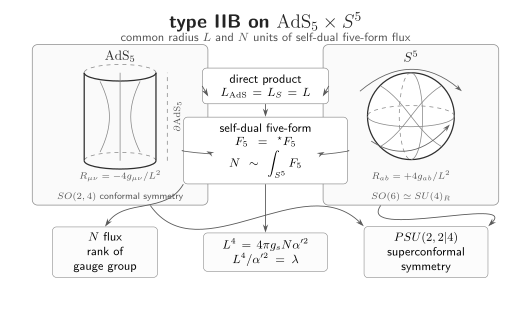
The canonical bulk background is a product of a noncompact factor and a compact factor with the same radius . The self-dual five-form flux threads the and fixes in the conventions of this course. The two isometry groups and match the conformal and R-symmetry groups of SYM.
The most important formulas are
so that
This is the first place where the strong/weak character of AdS/CFT becomes concrete. When , the AdS radius is large compared with the string length, and the bulk string theory can be approximated by supergravity for observables that do not excite string-scale modes. When , bulk quantum loops are suppressed. The next page will systematize these statements into a regime-of-validity map.
The ten-dimensional background
Section titled “The ten-dimensional background”In Poincare coordinates for , the metric is
Here is the unit-radius round metric on . The same radius multiplies both factors. This equality is not a convention; it is forced by the type IIB equations of motion with self-dual five-form flux.
A coordinate-independent way to write the background is
The curvature of the two factors is
where Greek indices are along and Latin indices are along .
The dilaton and axion are constant:
The NS-NS two-form and RR two-form vanish in the undeformed background:
The essential field is the RR five-form field strength,
With unit-radius volume forms, it can be written as
The factor is tied to the fact that both factors are five-dimensional and have curvature magnitude . The self-duality condition says that the flux has equal electric and magnetic components: it threads the compact and also has legs along .
Type IIB fields: what is turned on?
Section titled “Type IIB fields: what is turned on?”The bosonic massless fields of type IIB string theory include the metric, the dilaton, the RR axion, two two-form potentials, and the RR four-form potential. For this background, only a small subset is nonzero.
| Field | Meaning | Value in |
|---|---|---|
| ten-dimensional metric | product metric on | |
| dilaton | constant, | |
| RR axion | constant, identified with | |
| NS-NS two-form | zero | |
| RR two-form | zero | |
| RR four-form potential | nonzero through | |
| self-dual RR five-form field strength | supports the geometry and carries units of flux |
The relevant complex scalar is the axio-dilaton
The canonical dictionary identifies it with the complexified Yang-Mills coupling,
Thus, in the convention ,
The type IIB duality acts naturally on . In the boundary theory this is the Montonen-Olive duality of SYM. We will not need the full modular structure on this page, but it is a useful reminder that the canonical duality is much more rigid than its two-derivative gravity limit.
Why the five-form supports the product geometry
Section titled “Why the five-form supports the product geometry”For the fields turned on above, the type IIB equations reduce schematically to
with constant and . One should treat this as an equation-of-motion statement. Because is self-dual, type IIB supergravity is usually written using a pseudo-action and the condition is imposed after variation. Imposing self-duality too early in a naive action is a classic way to lose factors of two.
The five-form flux is a Freund-Rubin type ingredient. Its stress tensor gives opposite-sign curvature to the Lorentzian and compact factors:
A useful mental model is
The compact sphere is therefore not a passive internal decoration. It is part of the solution that allows the noncompact spacetime to be anti-de Sitter.
Flux quantization and the origin of
Section titled “Flux quantization and the origin of NNN”D3-branes couple electrically to the RR four-form potential . The corresponding five-form flux is quantized. In the standard D3-brane normalization,
where
Since
we have
Therefore
and hence
Using the course convention
this becomes
The interpretation is immediate:
Large ‘t Hooft coupling makes the string length small compared with the AdS radius.
The near-horizon D3-brane metric
Section titled “The near-horizon D3-brane metric”The same geometry appears directly from the extremal D3-brane solution. In string frame,
where
In the near-horizon region ,
The metric becomes
Now define
Then
This is the Poincare patch of times a round . The low-energy open-string description gives SYM. The low-energy near-horizon closed-string description gives type IIB string theory on . Maldacena’s conjecture identifies these two interacting descriptions after the common decoupled flat-space sector is removed.
Symmetry matching
Section titled “Symmetry matching”The bosonic isometry group of the background is
The first factor is the conformal group of four-dimensional Minkowski space:
The second factor is the isometry group of the five-sphere:
which is the R-symmetry group of SYM.
The supersymmetry also matches. The D3-brane worldvolume theory has Poincare supercharges. At the conformal point it also has conformal supercharges. The total number of fermionic generators is therefore , matching the maximal supersymmetry of type IIB string theory on .
Together these generators form
which is the superconformal symmetry group of SYM. This is one of the strongest elementary checks of the canonical duality.
What does the mean in the CFT?
Section titled “What does the S5S^5S5 mean in the CFT?”The CFT does not live on . It lives on the conformal boundary of , for example in the Poincare patch or in global coordinates.
The is an internal compact space. Its angular momenta are R-charges. A particle moving on transforms under , and the dual CFT operator transforms under the corresponding representation.
A rough dictionary is:
| Bulk structure | CFT meaning |
|---|---|
| position | spacetime and energy-scale data |
| angular momentum | representation and R-charge |
| five-form flux quantum | rank of the gauge group |
| radius in string units | ’t Hooft coupling |
| ten-dimensional graviton multiplet | protected single-trace operators |
| massive string oscillator states | generic unprotected single-trace operators |
This is why the should not be discarded. Even when a calculation can be done in a five-dimensional truncation, the ten-dimensional origin determines which fields exist, which symmetries they carry, and which CFT operators they source.
Kaluza-Klein modes and protected operators
Section titled “Kaluza-Klein modes and protected operators”Fields on can be expanded in spherical harmonics on . For a scalar field,
where denotes AdS coordinates and denotes sphere coordinates. Scalar spherical harmonics obey
From the five-dimensional point of view, angular momentum on appears as mass in AdS. Thus one ten-dimensional field becomes an infinite tower of five-dimensional fields.
This tower is not a small correction. Since the radius of equals the radius of ,
The KK modes are order-one in AdS units. What becomes heavy at large are the genuine massive string oscillator modes:
This distinction is crucial. KK modes are supergravity modes. String oscillator modes are not.
Many KK modes are dual to protected short multiplets of SYM. A central family is the chiral primary tower
The parentheses denote the symmetric traceless projection under . The dimensions of these operators are protected, so they can be matched between weakly coupled SYM and strongly coupled supergravity.
A few universal entries are:
| Bulk mode | Boundary operator | Protected dimension |
|---|---|---|
| five-dimensional graviton | stress tensor | |
| gauge fields from isometries | R-currents | |
| dilaton zero mode | ||
| axion zero mode | ||
| selected metric and fluctuations | chiral primary multiplets |
The word “selected” matters. Some scalar modes arise from mixtures of the metric and the four-form potential. One should not identify every spherical harmonic of every ten-dimensional field with a simple operator without diagonalizing the coupled linearized equations.
The five-dimensional viewpoint
Section titled “The five-dimensional viewpoint”Many calculations use a five-dimensional action such as
The equation of motion is
so pure is a solution. This five-dimensional description is the simplest way to compute stress-tensor correlators, black-brane thermodynamics, hydrodynamic transport, and holographic entanglement in the classical limit.
But there are two different ideas here.
First, a Kaluza-Klein reduction on rewrites ten-dimensional supergravity as five-dimensional gravity coupled to infinitely many fields.
Second, a consistent truncation keeps only a finite subset of fields such that every solution of the lower-dimensional theory uplifts to a solution of the ten-dimensional equations. Type IIB on admits a maximally supersymmetric consistent truncation to five-dimensional gauged supergravity with gauge group , and many smaller truncations are used in practical holography.
A consistent truncation is powerful, but it is not justified by the KK modes being parametrically heavy. They are not. It is justified by symmetry and the special structure of the equations.
The Newton constant and
Section titled “The Newton constant and N2N^2N2”The ten-dimensional Newton constant is
Reducing on a round of radius gives
Therefore
Using
we find
This is the gravitational origin of the scaling of the boundary matrix theory. For Einstein gravity in , the holographic central charges are
at leading large . The exact result is
The classical geometry captures the leading term and misses the correction, as expected.
Regime of validity, preview
Section titled “Regime of validity, preview”The background contains three useful length scales:
The ratio between the AdS radius and the string length is controlled by :
The ratio between the AdS scale and the five-dimensional Newton constant is controlled by :
Thus the cleanest classical type IIB supergravity regime is
with weak string coupling in the chosen IIB frame when
The conceptual hierarchy is:
| CFT limit | Bulk meaning |
|---|---|
| suppresses bulk quantum loops | |
| suppresses finite string-length corrections | |
| fixed protected sector | often captured by supergravity KK modes |
| generic unprotected high-spin operators | require massive string states at finite |
The next page will turn this preview into a detailed map of the plane.
Common mistakes
Section titled “Common mistakes”Mistake 1: saying the dual is pure gravity on
Section titled “Mistake 1: saying the dual is pure gravity on AdS5\mathrm{AdS}_5AdS5”Pure Einstein gravity is a useful subsector. The full bulk theory is type IIB string theory on .
Mistake 2: treating the as negligible
Section titled “Mistake 2: treating the S5S^5S5 as negligible”The has the same radius as . There is no large hierarchy that makes all KK modes heavy compared with the AdS scale. Ignoring the sphere is justified only for suitable neutral observables or within a consistent truncation.
Mistake 3: confusing KK modes with string modes
Section titled “Mistake 3: confusing KK modes with string modes”KK masses scale like and remain order one in AdS units. Massive string modes scale like and have dimensions of order at large .
Mistake 4: forgetting flux quantization
Section titled “Mistake 4: forgetting flux quantization”The integer is not merely a continuous parameter of a classical solution. It is the quantized five-form flux through , and it is also the rank of the gauge group.
Mistake 5: identifying bulk fields with elementary SYM fields
Section titled “Mistake 5: identifying bulk fields with elementary SYM fields”The elementary fields , , and are not gauge-invariant local observables. Bulk fields are dual to gauge-invariant operators, typically single-trace operators such as , , , and protected scalar composites.
Summary
Section titled “Summary”The canonical bulk background is specified by
and constant axio-dilaton
Flux quantization gives
and dimensional reduction gives
The bosonic symmetry match is
and the full superisometry is
The geometrizes R-symmetry and produces KK towers dual to protected operator multiplets. Classical five-dimensional gravity is a controlled approximation to the full type IIB dual, not the full duality itself.
Exercises
Section titled “Exercises”Exercise 1: Recover the Poincare-patch AdS metric
Section titled “Exercise 1: Recover the Poincare-patch AdS metric”Starting from the near-horizon D3-brane metric
use to show that the first two terms become the Poincare-patch metric on .
Solution
From
we have
Then
and
Therefore
The first bracket is the Poincare patch of .
Exercise 2: Derive the radius-flux relation
Section titled “Exercise 2: Derive the radius-flux relation”Assume
and use
Show that
Solution
First compute
Therefore
Solving for gives
Using then gives .
Exercise 3: Why a pure five-dimensional truncation is subtle
Section titled “Exercise 3: Why a pure five-dimensional truncation is subtle”Explain why the statement
means that Kaluza-Klein modes on are not parametrically heavier than the AdS scale. Why can five-dimensional effective actions nevertheless be useful?
Solution
The AdS curvature scale is also . If
then KK modes are light in AdS units. There is no hierarchy of the form
Thus one cannot justify throwing away all KK modes by a simple low-energy expansion below the internal scale.
Five-dimensional effective actions are still useful for two reasons. First, some calculations only source fields in a closed sector of the equations, such as the metric and a few matter fields. Second, special consistent truncations exist: every solution of the lower-dimensional truncated theory uplifts to a solution of the ten-dimensional theory. In such cases the truncation is justified by consistency and symmetry, not by a large KK mass gap.
Exercise 4: A minimal scalar harmonic on
Section titled “Exercise 4: A minimal scalar harmonic on S5S^5S5”Consider a ten-dimensional massless scalar obeying
on . Expand
where
Find the effective five-dimensional mass and the corresponding standard-quantization dimension in .
Solution
The ten-dimensional Laplacian separates as
Substitution gives
Thus
For a scalar in , the mass-dimension relation is
So
whose solutions are
The standard positive-dimension choice is
For , this gives , as expected for the dilaton zero mode dual to an exactly marginal operator. This exercise also shows why one must be careful: the chiral primaries with do not arise from a minimally coupled scalar in this simple way; they come from specific mixed metric and five-form fluctuations.
Exercise 5: Central charge scaling from dimensional reduction
Section titled “Exercise 5: Central charge scaling from dimensional reduction”Use
to show that
Then show that the holographic result
gives at leading order.
Solution
First,
Since
we get
Therefore
The exact result is , so the missing is an correction beyond classical supergravity.
Further reading
Section titled “Further reading”- J. Maldacena, The Large N Limit of Superconformal Field Theories and Supergravity. The original D-brane decoupling and near-horizon argument.
- O. Aharony, S. Gubser, J. Maldacena, H. Ooguri, and Y. Oz, Large N Field Theories, String Theory and Gravity. The classic review of the correspondence and its parameter dictionary.
- E. D’Hoker and D. Freedman, Supersymmetric Gauge Theories and the AdS/CFT Correspondence. Detailed lecture notes on the canonical example and its supergravity side.
- H. Kim, L. Romans, and P. van Nieuwenhuizen, Mass Spectrum of Chiral Ten-Dimensional N=2 Supergravity on . The classic computation of the type IIB supergravity Kaluza-Klein spectrum on .