
Eternal Black Holes and the Thermofield Double
The main idea
Section titled “The main idea”The eternal AdS black hole is the cleanest laboratory for separating three ideas that are often blurred together:
- a thermal density matrix in one quantum system,
- a pure entangled state in two quantum systems,
- a two-sided black-hole geometry with an Einstein—Rosen bridge.
The essential statement is
where
Here and are two independent copies of the same CFT Hilbert space, , and
More carefully, the left state is often the CPT conjugate of the right state, so one writes . For most computations in this page the distinction only affects how one defines left operators.
This page begins the black-hole information module because the thermofield double is the simplest exact example where a black-hole exterior looks thermal while the complete boundary state is pure. It is not yet the evaporating black-hole problem. It is the equilibrium, two-sided, AdS version of the problem: a place where horizons, entropy, entanglement, and behind-the-horizon geometry can all be discussed with sharp boundary variables.
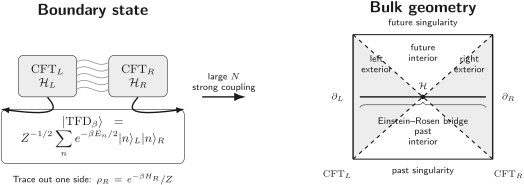
The thermofield double is a pure entangled state of two non-interacting CFTs. At large and high enough temperature for the black-hole saddle to dominate, it is dual to the two-sided eternal AdS black hole. The entropy of either CFT equals the area of the bifurcation surface at leading order, .
The thermofield double as a purification
Section titled “The thermofield double as a purification”Start with one CFT in a thermal state
This is a mixed state on a single Hilbert space . Any mixed state can be purified by embedding it into a larger Hilbert space. The thermofield double is the canonical purification obtained by using a second identical copy:
The TFD state is
It is normalized because
Tracing out the left CFT gives
Thus every right-sided observable has the ordinary thermal expectation value:
This is the first crucial lesson. A thermal density matrix can arise either because the system is fundamentally in a mixed state, or because it is a subsystem of a larger pure state. In AdS/CFT the latter option is explicit: the right exterior of the eternal black hole is dual to the right CFT alone, while the full two-sided geometry is dual to a pure state in .
The entanglement entropy of one side is
Equivalently,
For a holographic large- CFT in the deconfined phase, this entropy is order and is reproduced by the black-hole area.
The Euclidean path integral preparation
Section titled “The Euclidean path integral preparation”The TFD state has a simple path-integral construction. The thermal partition function of one CFT is the Euclidean path integral on a circle of circumference :
Cut this circle into two equal intervals of Euclidean length . The path integral on the half-circle prepares a state in two copies of the Hilbert space. In the energy basis it gives precisely
up to the left-right conjugation convention.
This Euclidean construction is also the cleanest way to see the bulk geometry. In the high-temperature saddle of global AdS, or for planar black branes at any nonzero temperature, the Euclidean bulk is a smooth black-hole cigar: the Euclidean time circle smoothly caps off in the interior. Cutting the Euclidean cigar across a time-reflection-symmetric slice and analytically continuing gives the two-sided Lorentzian black hole.
So the TFD is not an arbitrary entangled state. It is prepared by Euclidean evolution for a time . This strongly constrains its entanglement structure, and that special structure is what allows a simple semiclassical wormhole interpretation.
The two-sided AdS black hole
Section titled “The two-sided AdS black hole”A convenient representative of the eternal AdS-Schwarzschild family is
with
For the planar black brane one replaces by and uses the planar form of . The horizon is at
The exterior metric above only covers one asymptotic region. Its maximal analytic extension has two AdS boundaries, two exterior regions, a future interior, a past interior, and a bifurcation surface where the future and past horizons meet. Each asymptotic boundary has its own CFT:
The two CFTs are not coupled. The Hamiltonian is simply
The wormhole is therefore not a channel through which the two field theories exchange signals. It is a geometric representation of entanglement in a particular state of two decoupled systems.
At , the time-symmetric spatial slice connects the two exteriors through an Einstein—Rosen bridge. The bifurcation surface has area , and the Bekenstein-Hawking entropy is
From the boundary viewpoint this is the thermal entropy of one CFT, which is also the entanglement entropy between the two CFTs:
The term is the bulk quantum correction discussed in the previous module: the leading area term is corrected by bulk entanglement and counterterm contributions.
The horizon as an RT surface
Section titled “The horizon as an RT surface”The RT/HRT formula gives a particularly sharp interpretation of the area law. Take the boundary region to be the entire right boundary at the time-symmetric slice. The complementary boundary region is the entire left boundary. The extremal surface homologous to the right boundary is the bifurcation surface .
Thus, at leading order,
This is one of the most beautiful checks of the TFD dictionary:
There is a useful conceptual distinction here. The total state is pure, so
But either side alone is mixed, so
The mutual information between the two complete CFTs is therefore
This large mutual information is the boundary signature of the connected two-sided geometry.
Time evolution and the sign trap
Section titled “Time evolution and the sign trap”The TFD state has a simple but important symmetry. Since the same energy eigenvalue appears on both sides,
Therefore the state is invariant under
This is the boundary version of the boost Killing symmetry of the eternal black hole. In the Penrose diagram this Killing vector is future-directed on the right exterior and past-directed on the left exterior. That is the source of a common sign confusion: the geometric time coordinate in the left exterior is naturally oriented oppositely to the physical future time of the left CFT.
Now evolve both CFTs forward with their ordinary Hamiltonians:
In the energy basis,
This state is not equal to the original TFD. However, the reduced density matrix on either side is unchanged:
So one-sided observables remain thermal and time-translation invariant, while two-sided observables change. In the bulk this corresponds to the fact that the exterior regions remain stationary, but the Einstein—Rosen bridge grows with the two-sided time. This is a first glimpse of a major modern theme: black-hole interiors can encode time-dependent information that is invisible in strictly one-sided thermal observables.
One-sided and two-sided correlators
Section titled “One-sided and two-sided correlators”For a right-sided operator, the TFD gives ordinary thermal correlators:
The right exterior of the black hole is enough to compute such correlators. This is the Lorentzian continuation of the finite-temperature dictionary studied in the previous modules.
Two-sided correlators are more interesting. Schematically,
measures correlations between the two boundaries. With the standard left-right conjugation convention, this correlator is equivalent to a thermal correlator with an imaginary time shift by :
up to operator-ordering and conjugation conventions. The shift by is the algebraic trace of the Euclidean half-circle that prepares the TFD.
In the bulk, heavy-operator two-sided correlators can be approximated by spacelike geodesics passing through the Einstein—Rosen bridge. More generally, two-sided correlators are sensitive to the wormhole geometry in a way that one-sided thermal correlators are not.
This is why the eternal black hole is a useful information-theoretic laboratory. The one-sided observer sees thermal physics; the doubled system contains the purification; and two-sided observables know about the entanglement that purifies the thermal state.
Non-traversability
Section titled “Non-traversability”The two-sided eternal AdS black hole contains a wormhole, but it is not traversable. A causal signal sent from the right boundary into the black hole cannot emerge at the left boundary. It hits the future singularity.
The boundary explanation is simple. The two CFTs are decoupled:
Therefore a right-sided perturbation cannot causally affect a left-sided observable. For in a causal ordering where no explicit left-right interaction has been turned on,
Entanglement creates correlations, not communication. This distinction is absolutely central. A Bell pair has correlations, but it does not transmit a signal. The eternal black hole is the gravitational version of the same principle, except that in the large- and strong-coupling regime the correlations are geometrized as an Einstein—Rosen bridge.
There are controlled deformations that can make related wormholes traversable. The most famous construction couples the two boundaries by a brief double-trace interaction of the schematic form
which can generate negative averaged null energy in the bulk and open a causal window through the wormhole. That is a deformation of the system. It is not a property of the undeformed TFD state.
Low temperature, high temperature, and saddle dominance
Section titled “Low temperature, high temperature, and saddle dominance”The TFD state exists for every in any quantum system. The statement
is a statement about the dominant semiclassical bulk saddle in a suitable regime.
For a CFT on at large , low-temperature thermal physics may be dominated by thermal AdS rather than by an AdS-Schwarzschild black hole. At high temperature the large black hole dominates, and the two-sided black-hole saddle is the natural bulk dual of the TFD. This is the Lorentzian counterpart of the Hawking—Page discussion in the finite-temperature module.
For a planar black brane, there is no finite-temperature Hawking—Page transition in the same sense; the black brane describes the deconfined thermal plasma for any nonzero temperature in the infinite-volume limit.
The moral is simple: the TFD is exact, but the semiclassical geometry it is approximated by depends on the phase and on the large- saddle.
Eternal black hole versus black-hole microstate
Section titled “Eternal black hole versus black-hole microstate”The TFD is not a typical pure state of one CFT. It is a pure state of two CFTs:
A one-sided black-hole microstate, by contrast, is a state
with energy of order that of a black hole. Such a state may reproduce thermal one-point functions and simple two-point functions for a long time, but it is not literally the TFD and it does not have a second asymptotic boundary.
This distinction matters for the information problem. The eternal black hole shows how a black-hole exterior can look thermal while the complete quantum state remains pure. But it does not by itself solve the problem of an evaporating black hole formed from collapse. For evaporation, one must understand time-dependent geometry, Hawking radiation, Page curves, islands, and the fine-grained entropy of radiation. Those topics appear later in this module.
Dictionary
Section titled “Dictionary”| Boundary statement | Bulk statement |
|---|---|
| Two decoupled CFTs, | Two asymptotic AdS boundaries |
| $ | \mathrm{TFD}_\beta\rangle$ |
| $\rho_R=\mathrm{Tr}_L | \mathrm{TFD}\rangle\langle\mathrm{TFD} |
| Horizon area at leading order | |
| symmetry | Boost Killing symmetry of the eternal geometry |
| Evolution by | Growth of the Einstein—Rosen bridge |
| One-sided correlators | Exterior black-hole perturbation theory |
| Two-sided correlators | Probes of the bridge and behind-horizon geometry |
| No left-right coupling | Non-traversable wormhole |
| Double-trace left-right coupling | Possible traversable deformation in special setups |
Common mistakes
Section titled “Common mistakes”Mistake 1: thinking the TFD is just a thermal state
Section titled “Mistake 1: thinking the TFD is just a thermal state”The right CFT is thermal after tracing out the left CFT, but the doubled state is pure:
Confusing the purified state with the reduced state is the most common conceptual error.
Mistake 2: treating the two CFTs as interacting
Section titled “Mistake 2: treating the two CFTs as interacting”The two CFTs in the undeformed TFD setup are decoupled. The connected bulk geometry is not produced by an interaction term in the boundary Hamiltonian. It is produced by entanglement in the state.
Mistake 3: calling the wormhole traversable
Section titled “Mistake 3: calling the wormhole traversable”The eternal black-hole wormhole is non-traversable. Entanglement gives correlations, not signals. Traversability requires additional physics, such as a carefully chosen coupling between the two boundaries.
Mistake 4: ignoring the left-time sign convention
Section titled “Mistake 4: ignoring the left-time sign convention”The TFD is invariant under , not under . Geometrically, the eternal black-hole Killing time is future-directed on one boundary and past-directed on the other.
Mistake 5: identifying every entangled state with a smooth wormhole
Section titled “Mistake 5: identifying every entangled state with a smooth wormhole”The TFD has a very special entanglement pattern: energy eigenstates are paired with Boltzmann weights. Generic entangled states of two CFTs do not automatically have a smooth semiclassical Einstein—Rosen bridge.
Mistake 6: confusing the eternal black hole with an evaporating black hole
Section titled “Mistake 6: confusing the eternal black hole with an evaporating black hole”The eternal AdS black hole is an equilibrium object. It is not the same as a black hole formed from collapse and then evaporating into an external bath. It is an essential warm-up, not the whole information paradox.
Exercises
Section titled “Exercises”Exercise 1: Tracing out one side
Section titled “Exercise 1: Tracing out one side”Starting from
show explicitly that
Then show that
Solution
The projector is
Tracing over the left Hilbert space gives
Using ,
The entropy is
Since
we get
Exercise 2: Which Hamiltonian leaves the TFD invariant?
Section titled “Exercise 2: Which Hamiltonian leaves the TFD invariant?”Show that
but that does not annihilate the TFD unless the state has support only at zero energy.
Solution
Acting on a basis term gives
and
Therefore
term by term in the TFD sum, so
On the other hand,
Thus
which is generally nonzero. Evolution by changes the phases of the TFD components while leaving the one-sided density matrices thermal.
Exercise 3: Euclidean half-circle preparation
Section titled “Exercise 3: Euclidean half-circle preparation”Use the matrix element of Euclidean time evolution to show that a Euclidean path integral over an interval of length prepares the TFD state.
Solution
The Euclidean evolution operator is
Insert complete sets of energy eigenstates at the two ends of the interval:
Interpreting the two ends of the interval as the two Hilbert-space factors gives a state proportional to
Normalizing by gives
Depending on the orientation of the Euclidean path integral, the left factor may be represented by the conjugate state .
Exercise 4: The horizon as the RT surface
Section titled “Exercise 4: The horizon as the RT surface”Consider the time-symmetric slice of the two-sided eternal black hole. Let be the entire right boundary. Explain why the RT surface computing is the bifurcation surface of the horizon.
Solution
The RT surface must be codimension two, extremal on the time-symmetric slice, and homologous to the boundary region . Since is the entire right boundary, the bulk region homologous to is the entire right exterior plus the part of the bridge ending at the bifurcation surface. The surface that separates the right exterior from the left exterior is precisely the bifurcation surface .
On the time-symmetric slice it is minimal by symmetry and by the standard black-hole area theorem intuition for the stationary horizon cross-section. Therefore
at leading order. This equals the thermal entropy of the right CFT and the entanglement entropy between the two CFTs.
Exercise 5: One-sided observables remain thermal under two-sided time evolution
Section titled “Exercise 5: One-sided observables remain thermal under two-sided time evolution”Let
Show that the reduced density matrix is independent of .
Solution
The evolved state is
Then
Tracing over the left side sets , so the phase cancels:
Thus all right-sided one-point functions and density-matrix observables remain thermal, even though two-sided correlators can depend on .
Further reading
Section titled “Further reading”- J. Maldacena, Eternal Black Holes in AdS.
- T. Hartman and J. Maldacena, Time Evolution of Entanglement Entropy from Black Hole Interiors.
- M. Van Raamsdonk, Building up Spacetime with Quantum Entanglement.
- D. Harlow, Jerusalem Lectures on Black Holes and Quantum Information.
- P. Gao, D. L. Jafferis, and A. C. Wall, Traversable Wormholes via a Double Trace Deformation.
- J. Maldacena and L. Susskind, Cool Horizons for Entangled Black Holes.