
AdS3/CFT2 and Brown-Henneaux
The main idea
Section titled “The main idea”AdS/CFT is the most symmetry-rich corner of holography. In dimensions , the isometry group of AdS matches the finite-dimensional conformal group of the -dimensional boundary theory. In AdS, the boundary is two-dimensional, and local conformal transformations form an infinite-dimensional algebra. The remarkable Brown-Henneaux result is that this infinite symmetry is not merely a boundary-theory wish: it is already visible in classical three-dimensional gravity with negative cosmological constant.
For Einstein gravity on asymptotically AdS spacetimes,
the asymptotic symmetry algebra is
with equal classical central charges
This formula is one of the sharpest bridges between geometry and CFT data in all of AdS/CFT. The large-central-charge limit of the CFT is the classical-gravity limit of the bulk:
The page has two goals. First, it explains why AdS gravity has an infinite-dimensional boundary symmetry even though pure three-dimensional Einstein gravity has no propagating gravitons. Second, it explains how the BTZ black-hole entropy follows from the Cardy formula using the Brown-Henneaux central charge.
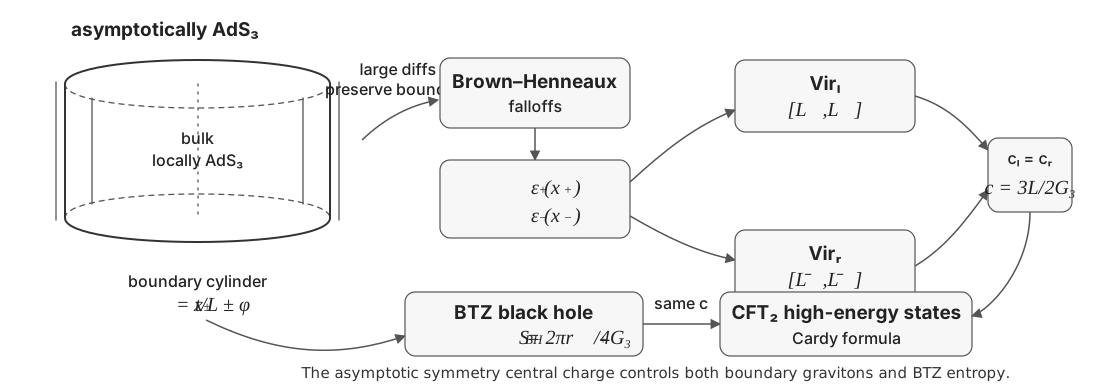
Brown-Henneaux asymptotic symmetry. Global AdS has finite isometry group , but the allowed asymptotic diffeomorphisms preserving AdS boundary conditions enlarge this to two Virasoro algebras. The central charge is the basic CFT measure of the number of degrees of freedom.
The slogan is therefore:
That one sentence prevents many misunderstandings. Pure Einstein gravity in three dimensions has no local graviton waves, but it still has black holes, boundary gravitons, nontrivial topology, Virasoro charges, and a highly constrained dual CFT interpretation.
Why three dimensions are special
Section titled “Why three dimensions are special”In three bulk dimensions the Weyl tensor vanishes identically. The Riemann tensor is completely determined by the Ricci tensor:
The vacuum Einstein equation with negative cosmological constant is
Substituting into the identity gives
Thus every smooth vacuum solution is locally AdS. There are no local curvature degrees of freedom in pure three-dimensional Einstein gravity. The usual graviton polarization count in spacetime dimensions is
so gives zero propagating graviton polarizations.
This does not mean the theory is empty. The physical content shifts from local waves to global and boundary data:
| Bulk feature | Why it matters in AdS/CFT |
|---|---|
| Boundary gravitons | Large diffeomorphisms are physical because they act nontrivially at infinity. |
| BTZ black holes | Black holes are global quotients of AdS, not local curvature lumps. |
| Virasoro charges | The boundary stress tensor organizes states into left/right conformal families. |
| Topology and saddles | Different Euclidean fillings contribute to the gravitational path integral. |
| Chern-Simons structure | Pure AdS gravity can be rewritten as an Chern-Simons theory. |
A useful analogy is electromagnetism in two spatial dimensions with boundaries. If there are no local waves in a sector, there can still be boundary charges, holonomies, and edge modes. In AdS gravity, this boundary structure is not an optional decoration. It is the mechanism by which the theory knows about a two-dimensional CFT.
Global AdS and the boundary cylinder
Section titled “Global AdS3_33 and the boundary cylinder”Global AdS can be written as
At large ,
After the usual conformal rescaling, the boundary metric is the cylinder
It is convenient to introduce dimensionless light-cone coordinates
The global isometry group is
This is precisely the global conformal group of a two-dimensional CFT on the cylinder. The Brown-Henneaux result says that once one allows diffeomorphisms that preserve the asymptotic AdS falloffs, the finite-dimensional group above is enhanced to the full local conformal group:
The three generators form the global , and similarly form . All other Virasoro generators are asymptotic symmetries rather than exact Killing vectors of global AdS.
Brown-Henneaux boundary conditions
Section titled “Brown-Henneaux boundary conditions”An asymptotically AdS metric should approach global AdS at large , but it need not equal global AdS exactly. Brown and Henneaux imposed falloff conditions of the schematic form
These boundary conditions are strong enough to define finite conserved charges and weak enough to include physically important geometries such as BTZ black holes and boundary gravitons.
The crucial question is: which diffeomorphisms preserve these falloffs? Near the boundary, the answer is controlled by two arbitrary functions,
Thus the asymptotic transformations act chirally:
Expanding in Fourier modes,
one obtains generators and . Classically their Poisson brackets have a central extension. Quantum mechanically this becomes the Virasoro algebra
The central term is written with because this basis makes the global subalgebra have no central extension. In another common basis one sees ; the difference is a shift of by the vacuum Casimir energy.
The central charge is
This number is not fitted from a black-hole entropy calculation. It is determined by the algebra of canonical boundary charges. That is why the later Cardy/BTZ agreement is so powerful: the same that appears in the asymptotic symmetry algebra controls the high-energy density of states.
Boundary gravitons
Section titled “Boundary gravitons”A small diffeomorphism that vanishes sufficiently fast at the boundary is a gauge redundancy. A large diffeomorphism that changes the boundary charges is not pure gauge. Acting with such a transformation on global AdS gives a physically distinct state called a boundary graviton.
In CFT language, the vacuum has descendants
The modes are global conformal transformations, and the mode measures energy/spin. The descendants are the CFT image of boundary gravitons.
This is a useful place to distinguish three ideas that are easily conflated:
| Statement | Correct meaning |
|---|---|
| “No local gravitons in AdS” | No propagating bulk spin-2 wave packets in pure Einstein gravity. |
| “There are boundary gravitons” | Large diffeomorphisms create physical Virasoro descendants. |
| “The theory is a CFT” | The Hilbert space and observables organize under two Virasoro algebras with Brown-Henneaux central charge. |
A theory can have no local bulk gravitons and still have an infinite-dimensional Hilbert-space structure at the boundary. AdS is the canonical example.
The stress tensor viewpoint
Section titled “The stress tensor viewpoint”The Brown-Henneaux result can also be understood through the holographic stress tensor. In Fefferman-Graham gauge,
an asymptotically AdS metric has the expansion
In three bulk dimensions the expansion terminates locally for pure Einstein gravity. The coefficient is the boundary metric source, and determines the expectation value of the CFT stress tensor. Up to convention-dependent signs associated with Lorentzian versus Euclidean signature,
The trace anomaly of a two-dimensional CFT is
again up to sign conventions for the curvature. Holographic renormalization gives the same anomaly with
This stress-tensor derivation is conceptually useful because it connects the central charge to a familiar CFT observable: the normalization of the stress-tensor two-point function and the Weyl anomaly. In AdS/CFT, the Brown-Henneaux central charge is simultaneously
Stress tensor transformations and the Schwarzian
Section titled “Stress tensor transformations and the Schwarzian”A two-dimensional CFT stress tensor does not transform as an ordinary tensor under a conformal map. On the complex plane, if , then
where
is the Schwarzian derivative. The Schwarzian term is the local signature of the central charge.
The same structure appears geometrically in AdS. A large diffeomorphism preserving Brown-Henneaux boundary conditions changes the subleading metric data, hence the boundary stress tensor, by a transformation law containing a Schwarzian. In this sense, boundary gravitons are the geometric realization of Virasoro descendants.
The vacuum energy on the cylinder is another elementary example. Mapping the plane to the cylinder produces
for a CFT on a circle of radius , where both left and right movers contribute. On the gravity side, global AdS has
Using gives
so the cylinder Casimir energy matches the mass of global AdS.
BTZ black holes
Section titled “BTZ black holes”The BTZ black hole is the basic thermal object in AdS/CFT. In coordinates adapted to stationarity and rotation,
with
Equivalently, in terms of outer and inner horizon radii and ,
The Hawking temperature and angular velocity are
The entropy is the horizon “area” divided by . In three bulk dimensions the horizon area is a circumference:
The geometry is locally AdS. The black hole arises from a global quotient, not from a local curvature singularity in the same way as a higher-dimensional Schwarzschild black hole. Nevertheless it has a genuine horizon, temperature, entropy, and causal structure. This is one reason BTZ black holes are such clean laboratories for quantum gravity.
BTZ as a CFT thermal state
Section titled “BTZ as a CFT2_22 thermal state”A rotating BTZ black hole corresponds to a CFT state with independent left- and right-moving temperatures
up to the convention for which chirality is called left or right. These combine into the Hawking temperature through
The CFT Hamiltonian and angular momentum on a circle of radius are
Thus the shifted conformal weights are related to the bulk mass and spin by
Global AdS has and , so
The massless BTZ geometry has , so
This is the familiar distinction between the vacuum on the plane and the zero-energy threshold above the cylinder vacuum.
Cardy’s formula and BTZ entropy
Section titled “Cardy’s formula and BTZ entropy”For a unitary modular-invariant two-dimensional CFT, the asymptotic density of states at large left/right weights is controlled by Cardy’s formula:
For pure Einstein gravity, . Using
and the BTZ relations
Cardy’s formula gives
Therefore
This is one of the cleanest microscopic entropy computations in holography. The calculation uses only asymptotic symmetry and modular invariance, not the detailed stringy microstates of a particular compactification. In string-theoretic AdS backgrounds, such as the D1-D5 system, the same logic is supplemented by an explicit CFT with central charge proportional to the brane charges.
What exactly is being counted?
Section titled “What exactly is being counted?”The Cardy formula counts the asymptotic growth of CFT states at high conformal weights. The BTZ black hole is a coarse-grained bulk description of many such states. The geometry is not usually one exact microstate. It is a thermodynamic saddle representing an ensemble, or a coarse-grained description of heavy states.
This distinction matters. The equality
does not mean that classical geometry has identified every individual microstate. It means that the number of states implied by the dual CFT, constrained by symmetry and modular invariance, has the same leading entropy as the black-hole horizon.
A useful hierarchy is:
| Object | CFT description | Bulk description |
|---|---|---|
| Vacuum | on the plane | Global AdS |
| Boundary graviton | Virasoro descendant of vacuum or another primary | Large diffeomorphism of an AdS geometry |
| Light primary | Low-dimension primary state | Particle or conical defect, depending on dimensions |
| Heavy primary | Backreacted geometry; often BTZ-like above threshold | |
| Thermal ensemble | Torus partition function | Euclidean BTZ or thermal AdS saddle |
| BTZ black hole | High-energy density of states | Locally AdS quotient with horizon |
The phrase “heavy state” often means scale like in the large- limit. Such states can create classical backreaction. The precise bulk interpretation depends on the spectrum and on whether the state is below or above the black-hole threshold.
Pure gravity, string theory, and the dual CFT
Section titled “Pure gravity, string theory, and the dual CFT”It is tempting to say: “pure AdS Einstein gravity is dual to a CFT with .” This is a useful semiclassical slogan, but it hides a deep problem. A complete quantum theory must have a consistent Hilbert space, a modular-invariant torus partition function, positive degeneracies, and sensible correlation functions. The Brown-Henneaux analysis tells us the asymptotic symmetry algebra and central charge. It does not by itself construct the full dual CFT.
This is why there are several levels of AdS/CFT:
| Level | What is known |
|---|---|
| Classical Einstein-AdS | Brown-Henneaux Virasoro symmetry, BTZ black holes, boundary gravitons. |
| Semiclassical pure gravity | Powerful but subtle; the full nonperturbative CFT dual is not automatically guaranteed. |
| Chern-Simons formulation | Rewrites gravity as Chern-Simons theory with level . |
| Stringy AdS backgrounds | Often have explicit candidate CFT duals, such as the D1-D5 system. |
| Higher-spin AdS | Enlarged asymptotic symmetry algebras such as -algebras. |
In the Chern-Simons formulation,
with gauge group and level
The Brown-Henneaux central charge is then
This reformulation is extremely useful for boundary charges, higher-spin generalizations, and Euclidean saddles. But it is not a magic replacement for the full quantum theory: boundary conditions, allowed holonomies, modular invariance, and the spectrum all matter.
The D1-D5 example: a stringy AdS/CFT
Section titled “The D1-D5 example: a stringy AdS3_33/CFT2_22”The most important top-down AdS/CFT example comes from the D1-D5 system. Type IIB string theory on backgrounds of the form
is dual to a two-dimensional CFT with supersymmetry. In a common regime, the central charge is
where and are D1- and D5-brane charges. The Brown-Henneaux formula agrees with this after reducing the ten-dimensional geometry to three dimensions:
The D1-D5 system is not merely a toy model. It is the arena in which many ideas about black-hole microstates, elliptic genera, symmetric-product orbifolds, AdS strings, and precision holography have been developed. But the point of the present page is broader: the Virasoro structure of AdS gravity is universal, while each string compactification supplies a particular microscopic CFT.
Thermal AdS, Euclidean BTZ, and modular transformations
Section titled “Thermal AdS, Euclidean BTZ, and modular transformations”A two-dimensional CFT at finite temperature lives on a Euclidean torus. The two cycles of the torus can be exchanged by a modular transformation. In the bulk, this exchange corresponds to changing which boundary cycle becomes contractible in the Euclidean filling.
Two important saddles are:
| Boundary torus filling | Contractible cycle | CFT interpretation |
|---|---|---|
| Thermal AdS | Spatial circle | Low-temperature vacuum-dominated phase |
| Euclidean BTZ | Thermal circle | High-temperature black-hole phase |
This is the three-dimensional version of the Hawking-Page story, but now it is tightly linked to modular invariance of the CFT torus partition function. At high temperature, modular invariance maps the partition function to a low-temperature vacuum-dominated channel, and Cardy’s formula follows from the vacuum contribution.
Schematic CFT logic:
At small , the transformed channel is dominated by the vacuum energy
so the free energy scales as
This reproduces the entropy of a nonrotating BTZ black hole. The same logic with angular potential gives the left/right Cardy formula.
Relation to earlier modules
Section titled “Relation to earlier modules”AdS/CFT sharpens many themes from earlier parts of the course:
| Earlier concept | AdS/CFT refinement |
|---|---|
| Central charge | Becomes the Virasoro central charge . |
| Black-hole entropy | BTZ entropy follows from Cardy’s universal density of states. |
| Boundary stress tensor | Its transformation law contains the Schwarzian derivative. |
| Large | Replaced by large , often or . |
| Witten diagrams | Strongly constrained by Virasoro symmetry and conformal blocks. |
| Entanglement entropy | RT geodesics reproduce the universal CFT interval formula. |
| Thermal physics | Euclidean BTZ and thermal AdS are different torus fillings. |
| Bulk locality | Particularly subtle because pure gravity has no local gravitons, while stringy AdS has rich light spectra. |
In higher-dimensional AdS/CFT, the conformal group is finite-dimensional and only constrains correlators up to functions of cross-ratios. In CFT, Virasoro symmetry gives much stronger constraints. This is why AdS/CFT is simultaneously simpler and more subtle than AdS/CFT.
Common mistakes
Section titled “Common mistakes”Mistake 1: “No local gravitons” means “no dynamics”
Section titled “Mistake 1: “No local gravitons” means “no dynamics””Pure three-dimensional Einstein gravity has no propagating graviton polarizations, but it still has boundary gravitons, BTZ black holes, nontrivial topology, modular sums, and boundary stress-tensor dynamics. The absence of local gravitons makes the theory special, not empty.
Mistake 2: Brown-Henneaux proves every AdS gravity theory is pure Einstein gravity
Section titled “Mistake 2: Brown-Henneaux proves every AdS3_33 gravity theory is pure Einstein gravity”Brown-Henneaux gives the asymptotic symmetry algebra for a specified set of boundary conditions in Einstein-AdS gravity. Stringy AdS compactifications usually contain many additional fields, branes, long strings, supersymmetry sectors, and internal excitations. They share the Brown-Henneaux gravitational central charge but have more microscopic structure.
Mistake 3: Cardy’s formula is a low-energy formula
Section titled “Mistake 3: Cardy’s formula is a low-energy formula”Cardy’s formula controls the asymptotic high-energy density of states under assumptions such as unitarity and modular invariance. Applying it to low-lying states requires extra assumptions and is generally not justified.
Mistake 4: The BTZ black hole is a local curvature singularity
Section titled “Mistake 4: The BTZ black hole is a local curvature singularity”The BTZ geometry is locally AdS outside the quotient singularity structure. Its black-hole nature comes from global identifications and causal structure. Curvature invariants are constant away from singular quotient regions.
Mistake 5: The central charge is a convention-dependent normalization
Section titled “Mistake 5: The central charge is a convention-dependent normalization”Operator normalizations can vary, but the Virasoro central charge is physical. Once and are fixed in the gravitational action, Brown-Henneaux fixes .
Mistake 6: Pure AdS gravity automatically has a known CFT dual
Section titled “Mistake 6: Pure AdS3_33 gravity automatically has a known CFT dual”The asymptotic symmetry analysis is not the same as constructing a complete, unitary, modular-invariant CFT with the correct spectrum. Pure AdS quantum gravity remains subtle. Stringy AdS examples are better controlled because the microscopic CFT can often be identified.
Exercises
Section titled “Exercises”Exercise 1: No local gravitons in three dimensions
Section titled “Exercise 1: No local gravitons in three dimensions”Use the formula for the number of on-shell graviton polarizations in spacetime dimensions,
to explain why pure Einstein gravity in AdS has no local graviton wave packets. Why does this not contradict the existence of boundary gravitons?
Solution
For ,
Thus there are no propagating local spin-2 degrees of freedom in pure three-dimensional Einstein gravity. Equivalently, the Weyl tensor vanishes identically in three dimensions, and the vacuum Einstein equation fixes the local curvature to be that of AdS.
This does not eliminate boundary gravitons. Boundary gravitons are not local wave packets in the bulk. They are produced by large diffeomorphisms that preserve the asymptotic AdS boundary conditions but act nontrivially on the boundary charges. In CFT language they are Virasoro descendants.
Exercise 2: The Brown-Henneaux central charge and global AdS energy
Section titled “Exercise 2: The Brown-Henneaux central charge and global AdS energy”Show that the CFT vacuum energy on a circle of radius ,
agrees with the mass of global AdS,
using .
Solution
Substitute the Brown-Henneaux central charge into the cylinder vacuum energy:
This equals the mass of global AdS. The match reflects the fact that global AdS is dual to the CFT vacuum on the cylinder, including its Casimir energy.
Exercise 3: Cardy reproduces BTZ entropy
Section titled “Exercise 3: Cardy reproduces BTZ entropy”For a rotating BTZ black hole,
Use
and
to derive .
Solution
First compute
and
Therefore
Using ,
and similarly
Thus
This is exactly the Bekenstein-Hawking entropy of the BTZ black hole.
Exercise 4: Left and right temperatures
Section titled “Exercise 4: Left and right temperatures”Given
show that
where
Solution
Compute
The expression in parentheses is
Therefore
Exercise 5: The global conformal subalgebra
Section titled “Exercise 5: The global conformal subalgebra”The Virasoro algebra is
Show that the modes form an subalgebra with no central term.
Solution
For ,
Therefore the central term vanishes for all brackets among . The remaining commutator is
For example,
These are the commutation relations of up to conventional choices of signs and basis. The barred modes form the second factor.
Exercise 6: Chern-Simons level and central charge
Section titled “Exercise 6: Chern-Simons level and central charge”In the Chern-Simons formulation of pure AdS gravity, the level is
Show that the Brown-Henneaux central charge can be written as .
Solution
Substitute the level into :
This is exactly the Brown-Henneaux central charge. The relation is one reason the Chern-Simons formulation is so efficient for studying AdS boundary symmetries.
Further reading
Section titled “Further reading”- J. D. Brown and M. Henneaux, Central Charges in the Canonical Realization of Asymptotic Symmetries: An Example from Three-Dimensional Gravity.
- M. Bañados, C. Teitelboim, and J. Zanelli, The Black Hole in Three Dimensional Space Time.
- M. Bañados, M. Henneaux, C. Teitelboim, and J. Zanelli, Geometry of the 2+1 Black Hole.
- A. Strominger, Black Hole Entropy from Near-Horizon Microstates.
- J. L. Cardy, Operator Content of Two-Dimensional Conformally Invariant Theories.
- S. Carlip, Conformal Field Theory, (2+1)-Dimensional Gravity, and the BTZ Black Hole.
- A. Maloney and E. Witten, Quantum Gravity Partition Functions in Three Dimensions.
- M. R. Gaberdiel and R. Gopakumar, An AdS Dual for Minimal Model CFTs.
- J. M. Maldacena and H. Ooguri, Strings in AdS and the WZW Model. Part 1.
- O. Lunin and S. D. Mathur, Correlation Functions for Orbifolds.