
Black Hole Information
Black holes are where quantum mechanics, gravity, thermodynamics, and information theory refuse to remain separate subjects. The modern black hole information problem is not simply the slogan that “black holes destroy information.” It is a precise tension among three ways of computing the same physical quantity: the fine-grained entropy of Hawking radiation.
In semiclassical gravity, Hawking radiation appears locally thermal, and its entropy grows as the black hole evaporates. In a unitary theory with a finite number of black hole microstates, the radiation entropy must instead follow a Page curve: it rises at early times, turns over near the Page time, and decreases as the remaining black hole becomes smaller. In holography, this tension is resolved in controlled settings by quantum extremal surfaces, entanglement wedge reconstruction, and island saddles in the gravitational entropy calculation. The goal of these notes is to make that statement precise, useful, and honest about its assumptions.
These pages are written for readers who already know the basics of AdS/CFT and want to enter the research literature on black hole information. The emphasis is not on slogans, but on the chain of ideas that turns the paradox into calculable statements:
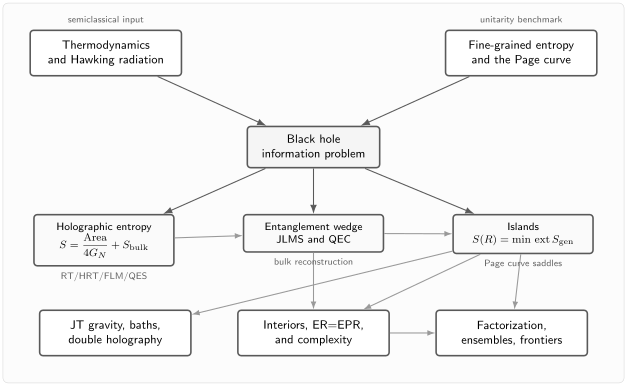
Conceptual map of the course. The information problem is sharpened by the conflict between semiclassical Hawking radiation and the unitary Page curve. Holographic entropy, entanglement wedge reconstruction, and quantum error correction provide the language in which islands and replica wormholes become natural rather than miraculous.
The central question
Section titled “The central question”Let denote the Hawking radiation collected far from an evaporating black hole. The sharp question is:
What is the fine-grained von Neumann entropy of the radiation, and how is it computed in quantum gravity?
The entropy here is
This is not the coarse-grained thermodynamic entropy of a gas of photons. It is the fine-grained entropy of a subsystem. If the complete state of the black hole plus radiation is pure, then
where denotes the remaining black hole degrees of freedom. Therefore a finite, unitary black hole cannot radiate forever in the naive Hawking way. At early times, is the smaller subsystem and its entropy can grow. At late times, the remaining black hole is the smaller subsystem, so the radiation entropy must decrease.
The paradox is that semiclassical effective field theory near a smooth horizon seems to produce almost independent thermal Hawking pairs. Tracing over the interior partners gives an entropy that keeps increasing. The modern resolution is subtle: the missing effect is not a large local violation of effective field theory at the horizon. Rather, the fine-grained gravitational entropy calculation has additional saddles, and the entanglement wedge of the radiation changes after the Page time.
Five organizing formulas
Section titled “Five organizing formulas”These notes revolve around five formulas. They are not independent tricks; they are different faces of the same semiclassical expansion of quantum gravity.
1. Bekenstein–Hawking entropy
Section titled “1. Bekenstein–Hawking entropy”A stationary black hole has entropy
or, in units ,
The area law is the first clue that quantum gravity is holographic. Ordinary local quantum field theory assigns degrees of freedom extensively in volume. Black holes instead suggest that the maximum entropy in a gravitating region scales like the area of its boundary.
2. Hawking temperature
Section titled “2. Hawking temperature”A black hole with surface gravity radiates at
For a four-dimensional Schwarzschild black hole,
The negative heat capacity already tells us that black holes are not ordinary boxes of gas. As the mass decreases, the temperature increases. Evaporation is therefore dynamically unstable in asymptotically flat space, while large AdS black holes can be thermodynamically stable if the boundary is reflecting.
3. The Page-curve expectation
Section titled “3. The Page-curve expectation”For a unitary evaporation process, a useful schematic estimate is
This is not an exact formula. It is the Page-theorem intuition: for a typical pure state in a bipartite Hilbert space, the smaller subsystem is almost maximally mixed. At early times the radiation Hilbert space is effectively smaller, so grows. At late times the remaining black hole Hilbert space is smaller, so is bounded by the entropy of the remaining black hole.
4. Quantum-corrected holographic entropy
Section titled “4. Quantum-corrected holographic entropy”For a boundary region in AdS/CFT, the classical Ryu–Takayanagi and Hubeny–Rangamani–Takayanagi prescriptions are corrected by bulk quantum entropy. The quantum extremal surface prescription says
Here is a codimension-two surface homologous to , and is the bulk region between and . The expression in brackets is the generalized entropy,
The counterterm contribution is usually left implicit: the area term and the bulk entropy are separately cutoff-dependent, but their renormalized sum is physical.
5. The island formula
Section titled “5. The island formula”For an evaporating black hole coupled to a nongravitating bath, the fine-grained entropy of a radiation region is computed by
The region is called an island. The formula says that, in the entropy calculation, the radiation region may be supplemented by certain gravitating regions behind or near the horizon. The island is not a place into which the radiation locally travels. It is part of the entanglement wedge of the radiation: a region reconstructable from the fine-grained radiation degrees of freedom.
What is actually being resolved?
Section titled “What is actually being resolved?”It is useful to separate three claims that are often blended together.
First, the Page curve can be derived in controlled semiclassical models. In JT gravity coupled to a bath, in double-holographic models, and in related setups, the island saddle dominates after the Page time and gives the unitary entropy curve.
Second, the fine-grained entropy calculation is not the same as the local Hawking calculation. Hawking’s calculation is a calculation in a fixed semiclassical background, using local effective field theory and tracing over interior partners. The island calculation is a gravitational path-integral or holographic entropy calculation. It is sensitive to nonperturbative features of quantum gravity that are invisible in any fixed-order local expansion around the no-island geometry.
Third, many conceptual questions remain open. The island formula explains how the entropy can be small, and entanglement wedge reconstruction explains how interior information can be encoded in radiation. But this does not automatically give a simple microscopic story of how an infalling observer experiences the Page transition, how factorization works in every non-ensemble theory, or how to formulate the same story in realistic asymptotically flat quantum gravity.
The most reliable attitude is therefore:
That is not a weakness of the subject. It is why these notes need to include entropy, reconstruction, operator algebras, wormholes, complexity, and open problems in one coherent narrative.
How the course is organized
Section titled “How the course is organized”I. Foundations
Section titled “I. Foundations”The first module makes the paradox sharp.
- Black Hole Entropy and the Holographic Principle introduces the four laws, the generalized second law, the Bekenstein–Hawking entropy, and the area-scaling intuition behind holography.
- Hawking Radiation and Information Loss explains why semiclassical collapse seems to produce a mixed final state.
- Page Curve and Fine-Grained Entropy develops Page’s theorem and the unitary entropy curve.
- Fast Scrambling and Hayden–Preskill Recovery explains why old black holes behave like information mirrors.
- Complementarity, AMPS, and Firewalls formulates the monogamy tension between unitarity, no drama, and effective field theory.
A reader who wants the shortest route to islands should read the first three pages carefully, skim fast scrambling, and then continue to quantum extremal surfaces.
II. Holographic entropy
Section titled “II. Holographic entropy”The second module develops the geometric entropy technology.
- The Ryu–Takayanagi Formula starts with static minimal surfaces.
- HRT and Covariant Holographic Entropy explains extremal surfaces in time-dependent geometries.
- FLM, Generalized Entropy, and Bulk Entanglement adds the leading quantum correction.
- Quantum Extremal Surfaces introduces extremization of generalized entropy.
- Rényi Entropy, Replicas, and Cosmic Branes prepares the replica derivation of islands.
- Bit Threads and Entropy Inequalities gives an alternative geometric language for entropy inequalities.
The key conceptual transition in this module is from area to generalized entropy. Once is included, the entropy surface is no longer determined purely by classical geometry.
III. Entanglement wedge and reconstruction
Section titled “III. Entanglement wedge and reconstruction”The third module explains why entropy formulas are also statements about which bulk regions are encoded in which boundary degrees of freedom.
- Causal Wedge and HKLL Reconstruction reviews local bulk reconstruction from boundary data.
- Entanglement Wedge, JLMS, and Relative Entropy explains the equality between boundary and bulk relative entropy.
- Entanglement Wedge Reconstruction states the reconstruction theorem and its physical meaning.
- Holography as Quantum Error Correction introduces code subspaces, logical operators, and redundant encoding.
- HaPPY Code and Tensor-Network Models gives a solvable toy model of holographic QEC.
- Operator-Algebra Quantum Error Correction treats the area operator, centers, and quantum-corrected RT.
- Modular Flow and Bulk Locality discusses modular reconstruction and the Petz-map viewpoint.
The slogan “the island is encoded in the radiation” means precisely that the island lies in the entanglement wedge of the radiation region. Without entanglement wedge reconstruction, the island formula would be an entropy trick. With reconstruction, it becomes a statement about where the interior information is represented.
IV. Islands and replica wormholes
Section titled “IV. Islands and replica wormholes”The fourth module is the heart of the modern Page-curve story.
- Evaporating Black Holes and Baths explains the models in which evaporation is sharply defined.
- The Island Formula derives and interprets the generalized entropy prescription for radiation.
- JT Gravity and the Schwarzian introduces the most useful two-dimensional laboratory.
- The Page Curve in JT Gravity performs an explicit island calculation.
- Replica Wormholes explains how new replica saddles reproduce the island rule.
- Double Holography shows how islands arise from ordinary RT surfaces in one higher-dimensional description.
- Islands in Higher Dimensions surveys progress and obstacles beyond two dimensions.
- What Is the Island? collects the conceptual lessons and common misunderstandings.
The technical theme is saddle competition. Before the Page time, the no-island saddle dominates and reproduces Hawking’s growing entropy. After the Page time, an island saddle dominates and the generalized entropy is controlled by the decreasing black hole area.
V. Interiors, ER=EPR, and complexity
Section titled “V. Interiors, ER=EPR, and complexity”The fifth module studies what the information story implies about the black hole interior.
- Thermofield Double and Two-Sided Black Holes reviews the eternal AdS black hole and the thermofield double state.
- ER=EPR and Traversable Wormholes discusses the relation between entanglement, wormholes, and teleportation.
- Black Hole Interior and State Dependence examines mirror operators, code-subspace dependence, and the interior after the Page time.
- Holographic Complexity: Volume and Action explains why wormhole growth seems to require a quantity beyond entanglement entropy.
- Python’s Lunch and Decoding Complexity relates nonminimal quantum extremal surfaces to the computational cost of decoding.
A recurring lesson is that information-theoretic recoverability is not the same as efficient recoverability. The Hawking radiation may contain the information in principle, while decoding it may be exponentially complex.
VI. Puzzles and research frontiers
Section titled “VI. Puzzles and research frontiers”The final module is designed to be useful for research orientation.
- Factorization Puzzles and Euclidean Wormholes explains why connected gravitational saddles can conflict with boundary factorization.
- Ensemble Averaging, Baby Universes, and JT Gravity discusses matrix ensembles, baby-universe Hilbert spaces, and alpha parameters.
- Holography of Information and Asymptotic Observables studies the gravitational Gauss law and boundary encoding.
- Flat Space, de Sitter, and Realistic Evaporation asks what survives beyond AdS and bath models.
- Open Problems in Black Hole Information collects unresolved questions and possible research directions.
This module is where one should be most careful. Euclidean wormholes, ensemble averages, and factorization puzzles are not decorative side issues. They are central to understanding what the gravitational path integral is computing.
A conceptual dictionary
Section titled “A conceptual dictionary”The following distinctions will be used repeatedly.
Thermodynamic entropy is a coarse-grained entropy associated with macroscopic variables such as mass, charge, angular momentum, and temperature. The Bekenstein–Hawking entropy is thermodynamic in this sense, but it also counts microscopic states in holographic examples.
Fine-grained entropy is the von Neumann entropy of a density matrix. The Page curve is a statement about fine-grained entropy, not about the entropy carried by a coarse-grained thermal flux.
Generalized entropy is the sum of an area term and a bulk matter entropy term:
It is the natural entropy functional in semiclassical gravity.
A quantum extremal surface is a surface that extremizes . When several such surfaces exist, the entropy prescription chooses the one with minimal generalized entropy.
An entanglement wedge is the bulk region associated with a boundary or radiation region by the relevant extremal surface. Operators in the entanglement wedge can be reconstructed from the corresponding boundary or radiation degrees of freedom within an appropriate code subspace.
An island is a gravitating region included in the entanglement wedge of an external radiation region. It appears in the entropy calculation because gravity changes how subregions and density matrices are represented.
A replica wormhole is a connected saddle in the gravitational replica path integral. It is not a traversable wormhole used for sending signals. Its role is to compute moments such as .
Factorization means that decoupled boundary theories should have factorized observables, for example . Connected bulk saddles can appear to violate this expectation, which is why factorization is a serious constraint on the interpretation of gravitational path integrals.
Common pitfalls
Section titled “Common pitfalls”The following mistakes are common enough that they are worth flagging at the beginning.
Pitfall 1: “The Hawking radiation is not thermal after the Page time.”
Locally, small portions of the radiation can still look thermal. The Page curve concerns the fine-grained entropy of the entire collected radiation system. The correction is global and nonperturbative from the viewpoint of the no-island semiclassical expansion.
Pitfall 2: “The island is a physical object that flies into the radiation.”
The island is a region included in the entropy wedge of . It is a statement about the gravitational entropy calculation and reconstruction, not a new local transport mechanism.
Pitfall 3: “Replica wormholes are ordinary wormholes connecting distant observers.”
Replica wormholes connect replicas in an auxiliary path integral used to compute entropy. They are not Lorentzian traversable wormholes unless additional analytic continuation and physical ingredients are specified.
Pitfall 4: “The Page curve alone solves every black hole information problem.”
The Page curve is a necessary benchmark for unitarity, but it is not the whole story. One also wants the microscopic encoding map, the algebra of interior observables, a factorizing interpretation when appropriate, and a realistic account of evaporation beyond idealized models.
Pitfall 5: “Quantum error correction means the bulk is only an analogy.”
In holography, QEC is not merely a metaphor. It is a structural statement about how bulk effective field theory is encoded in boundary degrees of freedom. The analogy becomes a theorem in appropriate formulations of entanglement wedge reconstruction.
Recommended reading paths
Section titled “Recommended reading paths”A reader interested mainly in the Page curve can follow:
A reader interested in bulk reconstruction can follow:
A reader interested in interiors can follow:
A reader looking for research problems should eventually read all modules, but the most direct route is:
Notation and conventions
Section titled “Notation and conventions”Unless otherwise stated, these notes use units
The gravitational coupling is . Boundary regions are usually denoted by . Hawking radiation regions are denoted by . Islands are denoted by . Entanglement wedges are denoted by or . The von Neumann entropy of a density matrix is written as
The Rényi entropy is
Relative entropy is
Entropies are written in natural logarithm units unless otherwise specified. Factors of should be inserted when converting to bits.
Exercises
Section titled “Exercises”Exercise 1. Coarse-grained and fine-grained entropy
Section titled “Exercise 1. Coarse-grained and fine-grained entropy”Explain why the Bekenstein–Hawking entropy and the radiation entropy in the Page curve are not the same kind of entropy, even though they are compared in the estimate
Solution
The Bekenstein–Hawking entropy is a thermodynamic entropy associated with a black hole macrostate, such as fixed mass, charge, and angular momentum. In holographic theories it also counts the logarithm of the number of compatible microscopic states. By contrast, is the fine-grained von Neumann entropy of the radiation density matrix.
They can be compared because, in a unitary evaporation process, the full black hole-plus-radiation state may be pure. Then the fine-grained entropy of the radiation equals that of the remaining black hole subsystem. The maximum possible fine-grained entropy of the remaining black hole is controlled by the number of available black hole microstates, whose logarithm is approximately . Thus acts as a bound on , even though the two entropies enter the discussion from different perspectives.
Exercise 2. The Page-curve estimate from Hilbert-space dimensions
Section titled “Exercise 2. The Page-curve estimate from Hilbert-space dimensions”Suppose a pure state lies in a bipartite Hilbert space with dimensions and . Use Page’s typical-state intuition to estimate .
Solution
For a typical pure state in , the smaller subsystem is nearly maximally mixed. Therefore
At early evaporation times, , so grows as more radiation degrees of freedom are emitted. At late times, , so decreases as the remaining black hole loses entropy. The crossover occurs when , which is the Page time in this simplified model.
Exercise 3. No-island versus island saddles
Section titled “Exercise 3. No-island versus island saddles”Consider a toy model in which the no-island entropy is
while the island entropy is
with . The entropy is given by the smaller of the two candidate generalized entropies. Find the transition time and sketch the resulting curve.
Solution
The transition occurs when
so
Thus
For , the no-island saddle dominates and the entropy grows linearly as . For , the island saddle dominates and the entropy decreases as . This is the simplest caricature of a Page curve. In an actual black hole calculation, the functions are not exactly linear and the island saddle is found by extremizing the generalized entropy, but the logic of saddle competition is the same.
Exercise 4. Why relative entropy matters for reconstruction
Section titled “Exercise 4. Why relative entropy matters for reconstruction”The JLMS relation is schematically
Explain why this is stronger than simply matching entanglement entropies.
Solution
Entanglement entropy is one number assigned to one state and one region. Relative entropy compares two states and measures distinguishability. If boundary relative entropy in region equals bulk relative entropy in the entanglement wedge , then all distinguishability of code-subspace states inside is visible from the boundary region .
This is exactly the kind of statement needed for reconstruction. If two bulk states differ by an operator in , and this difference changes bulk relative entropy, the boundary region must be able to detect it. Under suitable assumptions this leads to the existence of boundary operators on that represent bulk operators in .
Further reading
Section titled “Further reading”The following papers and reviews are useful anchors for the whole group of pages. Later pages give more specialized references.
- J. D. Bekenstein, “Black Holes and Entropy,” Physical Review D 7 (1973).
- J. M. Bardeen, B. Carter, and S. W. Hawking, “The Four Laws of Black Hole Mechanics,” Communications in Mathematical Physics 31 (1973).
- S. W. Hawking, “Particle Creation by Black Holes,” Communications in Mathematical Physics 43 (1975).
- S. W. Hawking, “Breakdown of Predictability in Gravitational Collapse,” Physical Review D 14 (1976).
- D. N. Page, “Information in Black Hole Radiation,” arXiv:hep-th/9306083.
- S. Ryu and T. Takayanagi, “Holographic Derivation of Entanglement Entropy from AdS/CFT,” arXiv:hep-th/0603001.
- V. E. Hubeny, M. Rangamani, and T. Takayanagi, “A Covariant Holographic Entanglement Entropy Proposal,” arXiv:0705.0016.
- T. Faulkner, A. Lewkowycz, and J. Maldacena, “Quantum Corrections to Holographic Entanglement Entropy,” arXiv:1307.2892.
- N. Engelhardt and A. C. Wall, “Quantum Extremal Surfaces,” arXiv:1408.3203.
- A. Almheiri, X. Dong, and D. Harlow, “Bulk Locality and Quantum Error Correction in AdS/CFT,” arXiv:1411.7041.
- D. L. Jafferis, A. Lewkowycz, J. Maldacena, and S. J. Suh, “Relative Entropy Equals Bulk Relative Entropy,” arXiv:1512.06431.
- X. Dong, D. Harlow, and A. C. Wall, “Reconstruction of Bulk Operators within the Entanglement Wedge in Gauge-Gravity Duality,” arXiv:1601.05416.
- D. Harlow, “The Ryu–Takayanagi Formula from Quantum Error Correction,” arXiv:1607.03901.
- G. Penington, “Entanglement Wedge Reconstruction and the Information Paradox,” arXiv:1905.08255.
- A. Almheiri, N. Engelhardt, D. Marolf, and H. Maxfield, “The Entropy of Bulk Quantum Fields and the Entanglement Wedge of an Evaporating Black Hole,” arXiv:1905.08762.
- A. Almheiri, R. Mahajan, J. Maldacena, and Y. Zhao, “The Page Curve of Hawking Radiation from Semiclassical Geometry,” arXiv:1908.10996.
- G. Penington, S. H. Shenker, D. Stanford, and Z. Yang, “Replica Wormholes and the Black Hole Interior,” arXiv:1911.11977.
- A. Almheiri, T. Hartman, J. Maldacena, E. Shaghoulian, and A. Tajdini, “Replica Wormholes and the Entropy of Hawking Radiation,” arXiv:1911.12333.
- A. Almheiri, T. Hartman, J. Maldacena, E. Shaghoulian, and A. Tajdini, “The Entropy of Hawking Radiation,” arXiv:2006.06872.
What comes next
Section titled “What comes next”The next page begins at the historical and conceptual starting point: black hole thermodynamics. The key lesson will be that the area law is not merely a property of classical horizons. It is the first sign that quantum gravity counts degrees of freedom in a radically nonlocal, holographic way.