
Stress Tensor and Conserved Currents
The previous page organized local operators into conformal families. This page focuses on the two most important universal classes of local operators in a CFT:
The stress tensor is the conserved current for spacetime symmetries. A flavor current is the conserved current for a continuous global symmetry. They are not merely examples of local operators. They are the operators that make symmetry local inside correlation functions.
For AdS/CFT, these operators are unavoidable:
If one wants to understand why gravity and gauge fields appear in the bulk, one must first understand why and are universal CFT operators.
The point of this page
Section titled “The point of this page”A conserved current is a local operator whose divergence vanishes away from contact terms:
inside a correlator with operator insertions at . The words “away from contact terms” are not a nuisance. They are the main point. The contact terms say how other operators transform under the symmetry.
For a global symmetry, the schematic Ward identity is
Here is the symmetry generator acting on . The overall sign is conventional; it depends on whether one defines or . The invariant lesson is that the divergence of vanishes at separated points and becomes a delta function when the current hits a charged operator.
For translations, the analogous Ward identity is generated by the stress tensor. For scalar insertions,
For spinning operators there are additional contact terms implementing rotations of spin indices. For scale and special conformal transformations there are contact terms involving scaling dimensions and spin representations. Thus the stress tensor is the operator that inserts infinitesimal spacetime transformations into correlators.
This is the operational meaning of a symmetry in QFT:
Two complementary definitions
Section titled “Two complementary definitions”There are two standard ways to define and .
The first is the Noether definition. If a classical action is invariant under a continuous transformation, there is a conserved current. Translation invariance gives . Internal global symmetry gives .
The second is the source definition. Couple the QFT to nondynamical background fields:
Here is the background metric, is a background gauge field for a global symmetry, and are scalar sources for local operators . Define the Euclidean generating functional
Our convention for one-point functions is
Equivalently,
This definition is the one that fits AdS/CFT most naturally. Boundary sources are boundary values of bulk fields, and CFT one-point functions are responses of the on-shell bulk action.
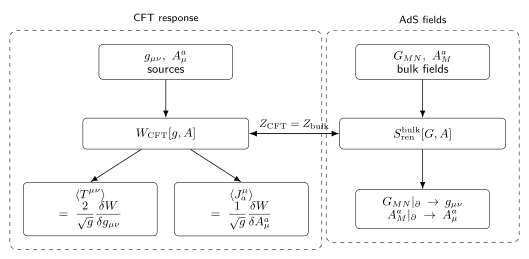
The stress tensor and global current are defined as responses to the background sources and . In a CFT, they are conserved operators with protected dimensions and . In AdS/CFT, their sources become boundary values of the bulk metric and bulk gauge field .
Background gauge invariance and current conservation
Section titled “Background gauge invariance and current conservation”Suppose the CFT has a continuous global symmetry group , with Lie algebra generators . The word “global” means that the symmetry parameter is constant in the original QFT. But once we introduce a background gauge field , we may write the generating functional in a way that is invariant under local background gauge transformations:
where
If the symmetry has no anomaly, background gauge invariance gives
Integrating by parts gives
in the absence of charged insertions. In flat space and with , this becomes
at separated points.
With charged operator insertions, the Ward identity acquires contact terms. These contact terms are precisely what make the generator of the symmetry.
Charges and radial surfaces
Section titled “Charges and radial surfaces”Given a conserved current, the associated charge is an integral over a codimension-one surface :
If and no charged operator is crossed while deforming , then is independent of the surface. This is the local-to-global mechanism behind conserved charges.
In Lorentzian quantization with a constant-time slice,
In radial quantization, is usually a sphere surrounding the origin:
A small sphere surrounding an operator insertion measures its charge. If
transforms in a representation of , then
up to the same sign convention used in the Ward identity. This is the cleanest way to think about the current-operator OPE: the singularity of is fixed by the charge of .
More explicitly, if is the area of the unit -sphere, a conventional leading singularity is
The normalization is chosen so that the flux through a small sphere gives one unit of the symmetry generator:
This is the higher-dimensional cousin of the familiar two-dimensional OPE
for a holomorphic current, up to convention-dependent signs.
Stress tensor as the current of spacetime symmetry
Section titled “Stress tensor as the current of spacetime symmetry”The stress tensor is the conserved current for translations:
The corresponding momentum charges are
If the theory is rotationally invariant, one can choose the stress tensor to be symmetric,
possibly after adding an improvement term. The angular-momentum currents are then
For scalar fields the spin terms are absent. For spinning fields they implement rotations of the operator indices.
In a CFT, after choosing a properly improved stress tensor, one also has
at separated points in flat space. Then the dilatation current is
and the special conformal currents are
Their conservation follows from conservation, symmetry, and tracelessness of .
Thus the entire conformal algebra can be generated by integrals of the stress tensor:
This is why the stress tensor is the central universal operator of any CFT.
Ward identity for conformal transformations
Section titled “Ward identity for conformal transformations”Let be an infinitesimal spacetime transformation. The stress-tensor insertion
acts on a product of local operators
For a conformal Killing vector,
the induced transformation of a scalar primary is
Therefore conformal invariance gives the integrated Ward identity
for scalar primaries. For spinning primaries, one adds the spin-rotation term
where are spin generators in the representation of .
This formula is the practical bridge between local stress-tensor conservation and the familiar constraints on CFT correlators.
Protected dimensions of currents
Section titled “Protected dimensions of currents”In a unitary CFT, conservation fixes the scaling dimensions of conserved currents:
The stress tensor is a spin-two operator. A global current is a spin-one operator. Conservation equations are shortening conditions:
They remove descendant states from the conformal multiplet. From the representation-theory viewpoint, and sit exactly at unitarity bounds. We will derive these bounds later, but it is useful to state the result now:
A small but important caveat: in , the stress tensor is usually treated as a spin-two primary operator. In , the holomorphic stress tensor transforms with a Schwarzian derivative when the central charge is nonzero, so it is quasi-primary under the global conformal group but not a primary under the full Virasoro symmetry. This exception is not a defect; it is the beginning of the central-charge story.
Two-point functions and normalizations
Section titled “Two-point functions and normalizations”Conformal symmetry almost completely fixes the two-point functions of conserved currents. For a global symmetry current in flat Euclidean space,
where
The coefficient is physical once the normalization of the symmetry generators is fixed. It is sometimes called a flavor central charge.
The stress-tensor two-point function has the form
with
The coefficient is among the most important pieces of CFT data. In two-dimensional CFT, the central charge plays an analogous role. In higher dimensions, controls the normalization of stress-tensor fluctuations.
In a holographic CFT with a weakly coupled Einstein gravity dual,
up to a known dimension-dependent normalization convention. Thus large is the CFT signal of small bulk Newton constant and semiclassical gravity.
Similarly,
for a bulk gauge field with coupling , again up to convention-dependent numerical factors.
What is fixed and what is dynamical?
Section titled “What is fixed and what is dynamical?”Ward identities fix the singular terms that encode charges. They do not fix all current correlators.
For example, symmetry fixes the leading singularity in
because a small sphere around must reproduce the representation matrix . But the full three-point function
contains dynamical coefficients. These are CFT data, constrained by Ward identities but not eliminated by them.
Similarly, the leading contact terms in stress-tensor Ward identities are fixed by the dimensions and spin representations of operators. But coefficients such as
are genuine CFT data. Some of them are partially fixed by Ward identities once operator normalizations are chosen. Others encode dynamical information about the theory.
A useful slogan is:
Diffeomorphism Ward identity with sources
Section titled “Diffeomorphism Ward identity with sources”The source definition makes it easy to write Ward identities on nontrivial backgrounds. If the theory has a metric, a background flavor gauge field, and scalar sources, diffeomorphism invariance implies a relation of the schematic form
When the background sources are turned off and there is no anomaly, this reduces to
This equation has a simple meaning. If a background electric field acts on a charged system, energy-momentum is not conserved by the matter sector alone; the background field can inject energy and momentum. If scalar sources vary in space, translation invariance is explicitly broken and the stress tensor has a corresponding nonzero divergence.
In AdS/CFT, this same identity appears as a boundary constraint following from bulk diffeomorphism invariance.
Current multiplets and supersymmetry
Section titled “Current multiplets and supersymmetry”In non-supersymmetric CFTs, and may sit in unrelated conformal families. In supersymmetric CFTs, they often belong to larger supermultiplets.
For example, in four-dimensional super Yang-Mills, the stress tensor, supercurrents, and currents all belong to the same protected stress-tensor multiplet. This is one reason the theory is so rigid and so useful in AdS/CFT. The bulk dual does not contain just a graviton in isolation; it contains a whole supergravity multiplet.
We will return to this much later. For now, remember the moral:
Anomalies
Section titled “Anomalies”A global current may fail to be conserved in the presence of background fields. This is an anomaly. Schematically,
For an ordinary global symmetry, such an anomaly is not an inconsistency. It is an ‘t Hooft anomaly: a protected piece of CFT data that must be matched along RG flows.
A gauge symmetry of a dynamical theory cannot have an uncanceled anomaly. But a global symmetry can. When we say a CFT has a global symmetry , we often mean its Ward identities hold in flat space with no background fields, while background gauge transformations of may have a controlled anomalous variation.
In AdS/CFT, boundary anomalies are often encoded by bulk Chern-Simons terms or related topological couplings. This is a beautiful example of how a contact-term-level CFT statement becomes a geometric term in the bulk effective action.
Holographic checkpoint
Section titled “Holographic checkpoint”The source definition of and is already the AdS/CFT dictionary in embryonic form.
For the stress tensor,
is matched to variation of the renormalized bulk on-shell action with respect to the boundary metric. The bulk field dual to is the graviton.
For a global current,
is matched to variation of the bulk on-shell action with respect to the boundary value of a bulk gauge field.
The bulk constraints are the gravitational and gauge-theory versions of the CFT Ward identities:
This is one of the deepest lessons of holography: conservation laws on the boundary are not optional features of the duality. They are the boundary form of gauge redundancies in the bulk.
Common pitfalls
Section titled “Common pitfalls”Pitfall 1: thinking a background gauge field makes the symmetry dynamical
Section titled “Pitfall 1: thinking a background gauge field makes the symmetry dynamical”The source used to define is nondynamical. It is a book-keeping device for current correlators. In AdS/CFT, the corresponding bulk field is dynamical, but its boundary value is fixed as a source.
Pitfall 2: forgetting contact terms
Section titled “Pitfall 2: forgetting contact terms”The conservation equation
is a separated-point statement. In a correlator with charged operators, the divergence has delta-function contact terms. Those terms are exactly how the current knows the charges of the operators.
Pitfall 3: confusing flavor currents with gauge fields in the CFT
Section titled “Pitfall 3: confusing flavor currents with gauge fields in the CFT”A CFT global current is gauge-invariant and physical. It is not the same thing as a gauge field inside a Lagrangian description. In holography, global symmetry on the boundary becomes gauge symmetry in the bulk.
Pitfall 4: treating and as conventions only
Section titled “Pitfall 4: treating CTC_TCT and CJC_JCJ as conventions only”The numerical values of and depend on normalization conventions. But once conventions are fixed, they are physical CFT data. Their scaling with is especially important in holographic theories.
Summary
Section titled “Summary”The stress tensor and global currents are the universal conserved operators of a CFT:
at separated points, with contact terms implementing transformations of operator insertions.
They are most cleanly defined by varying the generating functional with respect to background sources:
In a unitary CFT,
Their two-point functions are fixed by conformal symmetry up to constants and . In AdS/CFT,
So the CFT stress tensor and global currents are the boundary origins of bulk gravity and bulk gauge fields.
Exercises
Section titled “Exercises”Exercise 1 — Surface independence of a charge
Section titled “Exercise 1 — Surface independence of a charge”Let be a conserved current in Euclidean space away from operator insertions:
Let and be two closed codimension-one surfaces enclosing the same set of charged insertions. Show that
Solution
Let be the region between and . Since no operator insertion lies in , the current is conserved everywhere in :
By Gauss’s theorem,
The boundary is with one orientation and with the opposite orientation. Therefore
Hence the charge is independent of continuous deformations of the surface, as long as no charged operator crosses the surface.
Exercise 2 — Current conservation of the conformal two-point function
Section titled “Exercise 2 — Current conservation of the conformal two-point function”Define
Show that, for ,
This verifies separated-point conservation of the current two-point function.
Solution
Write
The derivative of the first term is
For the second term,
Multiplying by gives
Adding the two contributions,
Thus
for .
Exercise 3 — Trace of the stress-tensor two-point tensor structure
Section titled “Exercise 3 — Trace of the stress-tensor two-point tensor structure”Using
show that
Solution
First note that is an orthogonal matrix:
Then
The trace of the subtraction term is
Therefore the two pieces cancel:
This is the tensor-structure version of stress-tensor tracelessness.
Exercise 4 — Background gauge invariance implies current conservation
Section titled “Exercise 4 — Background gauge invariance implies current conservation”Assume the source variation
Under a background gauge transformation,
Show that gauge invariance of implies
when there is no anomaly.
Solution
Gauge invariance means
Integrating by parts covariantly gives
up to a boundary term. If is arbitrary and the boundary term vanishes, then
If the symmetry is anomalous, the right-hand side is replaced by the anomaly functional.
Exercise 5 — Why large means weak bulk gravity
Section titled “Exercise 5 — Why large CTC_TCT means weak bulk gravity”In a holographic CFT with an Einstein gravity dual, suppose
Explain why a semiclassical bulk gravity limit requires .
Solution
The strength of quantum gravity effects in the bulk is controlled by the dimensionless ratio
If this ratio is small, the bulk Planck scale is much smaller than the AdS curvature radius, and the gravitational path integral is dominated by classical saddle points.
Using
small bulk Newton coupling is equivalent to
Thus large is the boundary signal of weakly coupled semiclassical gravity. In large- gauge theories, usually scales like the number of degrees of freedom, often for adjoint matrix theories.