
QFT Data and Observables
The point of this page
Section titled “The point of this page”Before conformal symmetry enters, we need a clean answer to a basic question:
A first answer from ordinary QFT is: a Lagrangian. That answer is useful, but not invariant enough. Different Lagrangians can flow to the same infrared theory; gauge-fixed Lagrangians contain unphysical fields; and many CFTs, especially in strongly coupled regimes, are best understood without a weakly coupled Lagrangian at all.
A better answer is:
For a CFT, this answer sharpens dramatically. The full theory can be organized by the spectrum of local operators and their operator product expansion data. In a holographic CFT, this same data reorganizes into bulk fields, masses, couplings, and eventually geometry.
This page sets up the language that every later page will use:
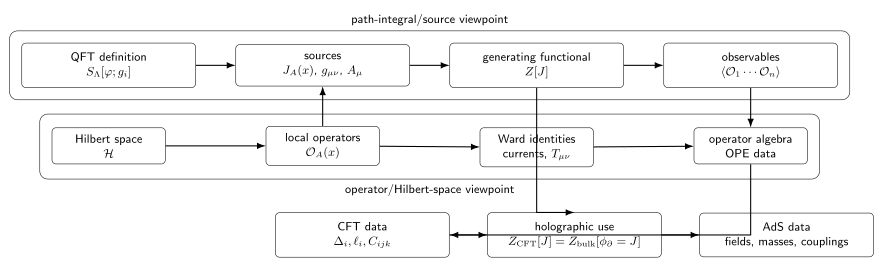
Three equivalent ways to organize QFT data. The path-integral viewpoint emphasizes sources and . The operator viewpoint emphasizes the Hilbert space, local operators, and Ward identities. In AdS/CFT, the same generating functional is reinterpreted as a bulk path integral with boundary values , while CFT data such as , , and becomes bulk spectral and interaction data.
The local QFT machine
Section titled “The local QFT machine”A local quantum field theory is a machine that assigns correlation functions to local observables. In a Euclidean path-integral presentation, the schematic definition is
where denotes the microscopic fields used in a particular description. These fields may or may not be gauge-invariant observables. In Yang—Mills theory, for example, is useful in the Lagrangian, but a gauge-invariant observable must be built from traces, Wilson loops, field strengths, or other gauge-invariant combinations.
A local operator is an object that can be inserted at a spacetime point. Typical examples are
The word “local” matters. It means that the operator probes a point, or more precisely a small neighborhood after renormalization. In an interacting QFT, composite operators such as require renormalization. One should not imagine multiplying distributions at the same point naively. A properly defined local operator is a renormalized insertion.
The basic observables are correlation functions,
At separated points, these are the cleanest data of the theory. At coincident points, one meets contact terms, operator mixing, and scheme dependence. This distinction becomes important in CFT and essential in holographic renormalization.
AdS/CFT checkpoint. In quantum gravity, local bulk fields are not gauge-invariant observables in a fundamental sense, because diffeomorphisms move points. Boundary CFT correlation functions are therefore not a decorative way to compute bulk physics; they are the precise gauge-invariant observables of the holographic theory.
Two complementary definitions of the same theory
Section titled “Two complementary definitions of the same theory”There are two standard languages for QFT.
The first is the Hilbert-space language. A Lorentzian QFT has a Hilbert space , a Hamiltonian , symmetry generators, and operator-valued distributions acting on states. Time-ordered correlation functions are vacuum expectation values,
The second is the Euclidean path-integral language. After Wick rotation, many QFT observables can be packaged as Schwinger functions,
The two languages are not rivals. Under appropriate assumptions, Euclidean correlators satisfying reflection positivity reconstruct the Lorentzian Hilbert space and Wightman functions. For CFT, the Euclidean language is often cleaner for symmetry and OPE arguments, while the Lorentzian language is essential for causality, chaos, black holes, and real-time holography.
In this course we will move between these languages constantly. The dictionary is:
The next page will discuss Euclidean and Lorentzian signatures more carefully. For now, the important point is that the QFT data can be accessed through either sources in a path integral or operators acting on states.
Sources: how to ask questions of a QFT
Section titled “Sources: how to ask questions of a QFT”A source is a classical background field coupled to an operator. Given local operators , define
Equivalently, in a Euclidean path integral,
The sign convention is not sacred; what matters is consistency. With the convention above,
At zero source,
It is often better to use the connected generating functional
Then
This is the first reason is central in AdS/CFT. The most compact form of the holographic dictionary is precisely an equality of generating functionals:
The source on the CFT side is the boundary value, or more precisely the leading asymptotic coefficient, of a bulk field .
Important sources and what they couple to
Section titled “Important sources and what they couple to”The most important sources are not optional decorations. They define universal operators.
| Source | Coupled operator | Meaning |
|---|---|---|
| Scalar source | Scalar operator | Deforms or probes the theory by |
| Background metric | Stress tensor | Measures response to geometry |
| Background gauge field | Conserved current | Measures response to global symmetry sources |
| Fermionic source | Fermionic operator | Needed for supersymmetric multiplets and spinor operators |
The stress tensor is defined as the response to the metric. In Euclidean signature, a common convention is
Some authors use the opposite sign depending on whether they vary or and depending on the convention for . The important invariant statement is:
Similarly, a conserved current is sourced by a background gauge field:
in one common Euclidean convention. The current expectation value is obtained by differentiating with respect to .
AdS/CFT checkpoint. The universal CFT sources become universal bulk fields:
This is not a mnemonic. It follows from the rule that sources are boundary values of bulk fields.
Couplings are constant sources
Section titled “Couplings are constant sources”A coupling is often a source frozen to a particular value. If a QFT action contains
then the constant is the source for .
This point is small but powerful. The space of QFTs near a fixed point is coordinatized by sources for local operators:
The renormalization group describes how these couplings change with scale,
At a CFT fixed point, for the couplings that define the fixed point. Perturbing the CFT by asks whether the deformation grows, shrinks, or remains marginal in the infrared.
If has scaling dimension , then dimensional analysis gives
Thus:
This classification will reappear in the radial direction of AdS. Relevant deformations correspond to boundary conditions that strongly affect the infrared geometry; irrelevant deformations are subtle because they are nonrenormalizable from the boundary viewpoint and often correspond to changing UV boundary data.
Local operators are not always elementary fields
Section titled “Local operators are not always elementary fields”In a free scalar theory, it is tempting to identify the basic local operator with the elementary field . But this is a special situation. In an interacting theory, and especially in a gauge theory, the local operator basis is much larger and more physical than the elementary Lagrangian fields.
For example, in four-dimensional Yang—Mills theory, gauge-invariant local operators include
with appropriate subtractions and mixing. In SYM, single-trace scalar operators such as
are central because they map to Kaluza—Klein modes on in the canonical duality.
The lesson is:
This is especially true for CFT, where local operators organize into representations of the conformal group.
Correlators as response functions
Section titled “Correlators as response functions”The source formalism makes correlation functions look like response coefficients. Expanding around gives
Thus the one-point function is the first response to a source, the connected two-point function is the linear response of one operator to another source, and higher connected correlators are nonlinear response coefficients.
This viewpoint is very useful in holography. Near the AdS boundary, a scalar field behaves schematically as
The coefficient is the source. The coefficient is related, after renormalization, to the response .
So the elementary holographic pair is not “field and field.” It is
The bulk field is the device that computes the response.
Symmetries and Ward identities
Section titled “Symmetries and Ward identities”Symmetries constrain correlation functions. In a local QFT, a continuous global symmetry gives a conserved current,
up to contact terms and possible anomalies. The associated charge is
and it acts on local operators by commutators in Lorentzian signature:
with conventions depending on whether is chosen Hermitian or anti-Hermitian.
Inside correlation functions, current conservation becomes a Ward identity. Schematically,
The delta functions are not a nuisance. They say that the current is conserved except where it meets charged operator insertions.
The stress tensor gives analogous Ward identities for spacetime symmetries. Translation invariance gives
for scalar operators, again up to convention-dependent signs and contact terms.
In a CFT, the trace Ward identity becomes central. In flat space and away from anomalies, conformal invariance implies
More generally, along an RG flow one expects the schematic relation
This formula is a bridge between RG and conformal symmetry. It is also the field-theoretic ancestor of holographic RG equations.
AdS/CFT checkpoint. Ward identities become bulk constraints. Current conservation is tied to bulk gauge invariance. Stress-tensor conservation is tied to bulk diffeomorphism invariance. The CFT does not merely have the same symmetries as the bulk; it encodes the constraints that make the bulk theory gauge-invariant.
Operator products and short-distance data
Section titled “Operator products and short-distance data”Correlation functions become singular when points approach each other. The operator product expansion organizes this singularity. In a general local QFT, one writes schematically
In a CFT, scale invariance makes the structure much sharper. For scalar primary operators,
The numbers are OPE coefficients. They are not optional data; they are the multiplication table of local operators.
For CFT, the operator spectrum and OPE coefficients determine all correlation functions, at least in the standard bootstrap viewpoint. That is why the natural CFT data are
Here is the scaling dimension, is spin, denotes global-symmetry representation data, and are three-point/OPE coefficients.
This is the point where CFT becomes much more rigid than generic QFT. A generic QFT has scale-dependent couplings and correlation functions with running. A CFT packages its local dynamics into scale-invariant operator algebra data.
Connected, disconnected, and large- correlators
Section titled “Connected, disconnected, and large-NNN correlators”The distinction between connected and disconnected correlators is crucial for holography. Suppose a theory has a large- expansion such that the connected correlators of suitably normalized single-trace operators scale as
Then, for two single-trace operators,
while a four-point function has a disconnected part of order and a connected part of order :
This is large- factorization. It is the CFT reason why the bulk theory becomes weakly coupled. Disconnected correlators describe free multi-particle propagation; connected correlators describe interactions.
The small parameter of bulk perturbation theory is therefore not mysterious. It is the inverse measure of the number of CFT degrees of freedom.
What counts as “the same QFT”?
Section titled “What counts as “the same QFT”?”A QFT can be described in many redundant ways. Field redefinitions, gauge fixing, dualities, and different UV completions may lead to the same IR observables. Therefore, when we say “the QFT,” we usually mean an equivalence class of descriptions that produce the same physical correlation functions.
Several layers of data should be distinguished:
This hierarchy prevents a common confusion: a Lagrangian is not the same as the theory. It is a useful presentation of the theory. The observables are correlation functions of gauge-invariant operators, line operators, defect operators, and other invariant probes.
In AdS/CFT, this distinction becomes existential. The same bulk theory may be invisible from a naive list of elementary boundary fields; it is visible in the organization of boundary operator data.
Contact terms and scheme dependence
Section titled “Contact terms and scheme dependence”A mature use of correlation functions requires knowing what is universal. At separated points, CFT two- and three-point functions are highly constrained and their coefficients are physical once operator normalizations are fixed. At coincident points, correlation functions can have contact terms such as
These can often be shifted by adding local counterterms to the generating functional. For example, a source counterterm
changes the two-point function of by a contact term. It does not change separated-point physics.
This is why one must be careful when saying that contains all observables. It does, but some pieces are scheme-dependent. Holographic renormalization is precisely the bulk procedure that separates finite physical data from local counterterm ambiguities.
Euclidean data, Lorentzian physics
Section titled “Euclidean data, Lorentzian physics”Euclidean correlators are often the most efficient way to define a QFT nonperturbatively. But Lorentzian physics requires operator ordering. A Euclidean two-point function analytically continued to Lorentzian signature can produce different real-time correlators depending on the continuation prescription:
The retarded correlator governs causal response. Thermal Wightman functions govern emission and absorption. Out-of-time-order correlators diagnose chaos. These distinctions are not visible if one only stares at a Euclidean expression without specifying analytic continuation.
For AdS/CFT this is a major issue. Euclidean bulk saddle points compute Euclidean partition functions and thermal free energies. Lorentzian bulk boundary conditions compute retarded correlators, quasinormal modes, causal propagation, and black-hole response.
The next page will make this Euclidean/Lorentzian distinction explicit.
The minimal data needed for AdS/CFT
Section titled “The minimal data needed for AdS/CFT”For the purpose of learning holography, the following QFT data should become second nature.
First, know the operator spectrum:
Second, know how operators are sourced:
Third, know how to extract correlators:
Fourth, know the universal operators:
Fifth, know the operator algebra:
Sixth, know which limits produce semiclassical bulk physics:
These are the ingredients that make the holographic dictionary meaningful rather than ceremonial.
Common pitfalls
Section titled “Common pitfalls”Pitfall 1: confusing microscopic fields with observables
Section titled “Pitfall 1: confusing microscopic fields with observables”The field in a path integral is often not a gauge-invariant observable. The physical objects are operators and their correlation functions. In gauge theory, this distinction is non-negotiable.
Pitfall 2: treating as only a formal object
Section titled “Pitfall 2: treating Z[J]Z[J]Z[J] as only a formal object”is formal if left unrenormalized, but after renormalization it is the most compact way to define the response of the theory to all local probes. In holography, is the object equated to the bulk path integral.
Pitfall 3: ignoring contact terms
Section titled “Pitfall 3: ignoring contact terms”Ward identities often include contact terms. These are not errors. They encode how currents and stress tensors act on operator insertions.
Pitfall 4: forgetting operator mixing
Section titled “Pitfall 4: forgetting operator mixing”Operators with the same quantum numbers can mix under renormalization. At a CFT, one usually chooses a basis of scaling operators that diagonalizes the dilatation operator. Away from a fixed point, this basis runs with scale.
Pitfall 5: assuming every CFT has a simple gravity dual
Section titled “Pitfall 5: assuming every CFT has a simple gravity dual”Every holographic gravity dual defines a CFT, but not every CFT has a weakly curved Einstein-like dual. Large and a sparse spectrum are additional dynamical conditions.
Summary
Section titled “Summary”The fundamental language of QFT is not “fields in a Lagrangian,” but rather
Sources package observables into a generating functional,
and differentiating or gives full or connected correlators. The stress tensor and conserved currents are universal because they are sourced by background geometry and background gauge fields. Ward identities express the action of symmetries on correlation functions.
For CFT, the same QFT data condenses into operator dimensions, spins, symmetry representations, and OPE coefficients:
For AdS/CFT, this data becomes the bulk spectrum, interactions, and gauge constraints. So the road to holography begins by taking QFT observables seriously.
Exercises
Section titled “Exercises”Exercise 1: full versus connected correlators
Section titled “Exercise 1: full versus connected correlators”Let
Assume . Show that
Solution
First,
Differentiate once more:
At and ,
and
Therefore
This is the connected two-point function.
Exercise 2: dimension of a source
Section titled “Exercise 2: dimension of a source”In a -dimensional CFT, a scalar operator has scaling dimension . Its source appears through
Find the scaling dimension of .
Solution
The action is dimensionless. In mass units, the measure has dimension
while
Therefore
So
Equivalently, if , the source has positive mass dimension and the deformation is relevant. If , it is marginal. If , it is irrelevant.
Exercise 3: Ward identity from current conservation
Section titled “Exercise 3: Ward identity from current conservation”Let be the conserved current for a symmetry. Suppose local operators have charges , so that
Show that the current Ward identity has the schematic form
up to sign conventions.
Solution
Consider integrating the divergence over a small ball surrounding and no other insertion:
The surface integral computes the charge acting on the operator at . Therefore, inside a correlator,
with a sign depending on whether one defines or and on Euclidean continuation conventions.
A distribution whose integral over a small ball around gives times the correlator is
Summing over all insertions gives the Ward identity.
Exercise 4: stress tensor as metric response
Section titled “Exercise 4: stress tensor as metric response”Let be the Euclidean connected generating functional. Suppose
Show that an infinitesimal Weyl transformation gives
Solution
Insert the Weyl variation into the definition:
The factors and multiply to , so
Since
we obtain
Thus Weyl invariance of implies , up to anomalies and contact terms.
Exercise 5: why large- factorization suggests weak bulk coupling
Section titled “Exercise 5: why large-NNN factorization suggests weak bulk coupling”Assume single-trace operators are normalized so that
Explain why this resembles a weakly coupled bulk theory.
Solution
In an ordinary weakly coupled field theory, normalize a field so that its two-point function is order one. If the cubic interaction has coupling , then a connected three-point function is order , and a connected tree-level four-point interaction or exchange contribution is order .
The large- CFT pattern is
This matches a bulk perturbation theory with effective coupling
Disconnected CFT correlators represent free propagation of multiple bulk particles. Connected correlators represent interactions. Thus large- factorization is the boundary reason that the bulk theory can become semiclassical and weakly interacting.