
Lightcone Bootstrap and Large Spin
The previous page introduced crossing symmetry as associativity of the OPE. This page studies one of its sharpest consequences: the lightcone bootstrap.
The basic statement is simple:
For a scalar primary , the large-spin operators have dimensions
so their twists approach
These operators are called double-twist operators and are denoted
For AdS/CFT, this is a major turning point. In a large- holographic CFT, double-trace operators are the boundary description of two-particle states in global AdS. Their anomalous dimensions are binding energies. The large-spin expansion is therefore a CFT way to compute long-distance forces in AdS.
The discussion below is mainly for unitary CFTs in using global conformal symmetry. In , Virasoro symmetry reorganizes the story, although the global lightcone logic remains useful.
Four-point crossing revisited
Section titled “Four-point crossing revisited”Let be a real scalar primary of scaling dimension . Write its four-point function as
where
Here and are conformal cross-ratio variables. In Euclidean signature they are complex conjugates. In Lorentzian signature they can be varied independently after analytic continuation.
The OPE gives the conformal block expansion
where the identity contribution has been written separately. For identical real scalars in a unitary CFT, positivity of two-point functions gives .
Exchanging gives the crossing equation
or equivalently
In terms of ,
The lightcone bootstrap extracts consequences of this equation in singular Lorentzian limits.
Twist is the lightcone quantum number
Section titled “Twist is the lightcone quantum number”For a primary operator of dimension and spin , define its twist by
Twist controls the lightcone OPE. At small , a scalar conformal block behaves schematically as
where the collinear block is
The exact normalization of is conventional. The invariant statement is that the leading power of is . Thus smaller twist means less suppression in the lightcone limit.
The identity operator has
so it dominates over all positive-twist operators.
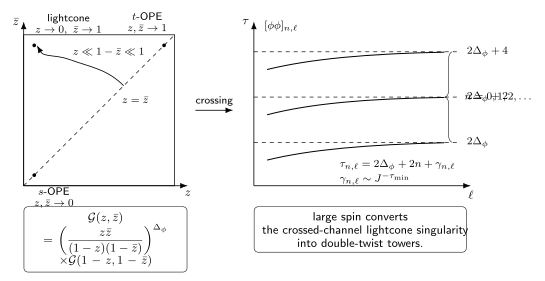
The lightcone bootstrap compares limits such as and of the crossing equation. The crossed-channel identity produces a singularity that is reproduced in the direct channel by infinitely many large-spin operators. Their twists approach , with anomalous corrections that vanish as .
The crossed-channel identity forces large spin
Section titled “The crossed-channel identity forces large spin”Use crossing in the form
In the crossed channel, the identity operator contributes
Therefore crossing implies a direct-channel contribution
In the lightcone regime and , this behaves as
This has two consequences.
First, the direct-channel OPE must contain operators whose twists approach
Indeed, a direct-channel block contributes as , so matching requires .
Second, the factor
is a power-law singularity. A finite number of fixed-spin conformal blocks cannot reproduce it. For fixed , the collinear block has at most a logarithmic singularity as . The power-law singularity arises from summing infinitely many blocks with unbounded spin.
So the crossed-channel identity forces an infinite large-spin tower in the direct channel.
Double-twist operators
Section titled “Double-twist operators”The required operators are called double-twist operators. In weakly coupled or generalized-free language they look like
Their generalized-free dimensions are
and their generalized-free twists are
In a generic interacting CFT, is notation for an asymptotic family of primary operators. The operators need not literally be normal-ordered products. The theorem-level statement is
This is one of the deepest universal facts about CFTs in : even a strongly coupled CFT has a generalized-free-like high-spin tail in the OPE of two scalar operators.
Generalized free field as the zeroth-order answer
Section titled “Generalized free field as the zeroth-order answer”A generalized free scalar has Wick-like correlators but does not need to come from a local free-field Lagrangian. Its four-point function is
The three terms are the three pairings of four identical operators. This expression is crossing-symmetric and its OPE contains double-twist operators with exact dimensions
Large- holographic CFTs start from this structure because single-trace correlators factorize at leading order. But the existence of double-twist families is not a large- assumption. Large only makes the generalized-free approximation accurate over a much wider range of the spectrum.
Minimal twist controls the leading correction
Section titled “Minimal twist controls the leading correction”The identity gives the leading double-twist towers. The next correction comes from the lowest-twist non-identity operator exchanged in the crossed channel.
Let be the lowest-twist non-identity operator relevant to the channel, with
At fixed and large spin,
where is the conformal spin of the double-twist operator. A useful definition is
More carefully,
in the common identical-scalar setup for positive-norm even-spin exchange, with determined by the OPE coefficient and by kinematics. The coefficient depends on conventions. The universal part is the power .
The OPE coefficients also receive large-spin corrections:
with possible logarithms when anomalous dimensions are inserted into powers like .
This is large-spin perturbation theory. It is perturbation theory in , not necessarily in a Lagrangian coupling.
Stress-tensor exchange and gravity
Section titled “Stress-tensor exchange and gravity”Every local CFT has a stress tensor. In a unitary CFT in ,
If stress-tensor exchange is the leading non-identity correction, then
up to normalization conventions for and .
In AdS/CFT, this is the CFT signature of graviton exchange. The negative sign is the boundary avatar of gravitational attraction: the two-particle energy is lowered by a long-range attractive force.
The power is also meaningful. Stress tensor exchange has twist , so the correction falls as . This is the CFT version of the long-distance falloff associated with a massless spin-two field in .
Currents, scalars, and other long-range forces
Section titled “Currents, scalars, and other long-range forces”If the CFT has a conserved global current , then
Current exchange therefore gives the same large-spin power as stress-tensor exchange:
In AdS/CFT, this is the exchange of a bulk gauge field. The sign depends on the charges of the two particles.
If the theory contains a light scalar with
then scalar exchange dominates over stress-tensor exchange:
Thus the hierarchy of twists in the CFT is the hierarchy of long-range forces in the AdS dual.
Why large spin means large distance in AdS
Section titled “Why large spin means large distance in AdS”In radial quantization, a primary operator creates a state on with cylinder energy
A double-trace operator creates a two-particle state. At leading large ,
The spin is the orbital angular momentum of the two particles. Large angular momentum keeps the particles far apart, so long-distance interactions are weak. The anomalous dimension
is the interaction energy. The larger the spin, the larger the separation, and the smaller the binding energy.
This is why
is naturally interpreted as a long-distance potential. The lightest exchanged bulk field gives the longest-range force. The CFT phrase for “lightest long-range exchange” is “lowest twist.”
Large spin is not the same as large
Section titled “Large spin is not the same as large NNN”The large-spin theorem is general. It follows from crossing, unitarity, and the identity operator. It does not require large , supersymmetry, a Lagrangian, or a weakly coupled bulk dual.
Large adds a different expansion. In a large- CFT, connected correlators of single-trace operators are suppressed:
Then double-trace anomalous dimensions are typically small:
and at large spin they also decay as a power of :
For holography, the two limits have different meanings:
| CFT limit | Bulk meaning |
|---|---|
| large | weak bulk coupling, |
| large gap | local bulk EFT below the string scale |
| large spin | large impact parameter, long-distance forces |
Large spin exists in every unitary CFT. Large and a large gap are what make it look like weakly coupled local gravity.
Lorentzian inversion viewpoint
Section titled “Lorentzian inversion viewpoint”The modern way to make the lightcone bootstrap systematic is the Lorentzian inversion formula. Schematically, it expresses a function of OPE data as an integral over the double discontinuity of a four-point function:
This formula is schematic: the exact integration region, kernel, and normalization depend on conventions. Its conceptual meaning is robust. Lorentzian singularities determine analytic functions of spin. Poles in give operator dimensions, and residues give OPE coefficients.
For AdS/CFT this connects three ideas:
We will not need the full inversion formula immediately, but the idea will return when we discuss holographic causality and bulk locality.
What the lightcone bootstrap does not say
Section titled “What the lightcone bootstrap does not say”The lightcone bootstrap controls asymptotic large-spin families. It does not determine the full finite-spin spectrum. A large-spin formula should not be blindly extrapolated to or .
It also does not imply that a CFT is holographic. The 3D Ising CFT has large-spin double-twist families, but it is not a weakly coupled theory of gravity in AdS. Holography requires extra structure: large- factorization, a sparse low-twist spectrum, and a large gap to higher-spin single-trace operators.
Finally, one must account for mixing. In large- CFTs, many double-trace operators can have the same quantum numbers. The physical anomalous dimensions are eigenvalues of a mixing matrix, not necessarily the shift of one chosen schematic product.
AdS/CFT checkpoint
Section titled “AdS/CFT checkpoint”The key dictionary is
and
The lightcone bootstrap gives the asymptotic form of from crossing symmetry alone. Stress-tensor exchange is graviton exchange. Current exchange is gauge-boson exchange. Light scalar exchange is scalar-force exchange.
This is the first place in the course where CFT crossing symmetry visibly manufactures bulk physics.
Summary
Section titled “Summary”The chain of ideas is
The leading correction is controlled by the lowest non-identity twist:
In holographic CFTs, this becomes the boundary derivation of long-distance bulk interactions.
Exercises
Section titled “Exercises”Exercise 1. Crossing for identical scalars
Section titled “Exercise 1. Crossing for identical scalars”Starting from
show that invariance under gives
Solution
Under , the same four-point function can be written as
because the two cross-ratios exchange:
Equating the two representations gives
Using
we obtain
Exercise 2. Why the crossed identity implies twist
Section titled “Exercise 2. Why the crossed identity implies twist 2Δϕ2\Delta_\phi2Δϕ”Use the crossed-channel identity contribution to show that the direct-channel OPE must contain operators whose twists approach .
Solution
Crossing gives
The crossed-channel identity gives
Thus
At small with fixed, this behaves as
A direct-channel conformal block behaves as
Matching powers gives
The singular dependence on then requires infinitely many large-spin operators with this limiting twist.
Exercise 3. Double-twist dimensions
Section titled “Exercise 3. Double-twist dimensions”Assume generalized-free counting for
Compute its dimension and twist.
Solution
The two scalar fields contribute . The symmetric traceless derivatives contribute dimension and spin . The factors of contribute dimension and no spin. Thus
The twist is
Exercise 4. Stress-tensor power law
Section titled “Exercise 4. Stress-tensor power law”Assume the lowest non-identity crossed-channel operator is the stress tensor in a -dimensional CFT. What is the large-spin power of its contribution to ?
Solution
The stress tensor has
Therefore
An exchanged operator of twist gives a large-spin correction of order
For stress-tensor exchange,
up to normalization conventions. For example, in this gives .
Exercise 5. Large conformal spin
Section titled “Exercise 5. Large conformal spin”For a leading double-twist operator with , show that
Solution
By definition,
For the leading double-twist family,
Substitution gives
At large spin , but is often the cleaner variable for asymptotic expansions.
Further reading
Section titled “Further reading”For the original modern lightcone-bootstrap perspective, read Komargodski and Zhiboedov, and Fitzpatrick, Kaplan, Poland, and Simmons-Duffin. For the Lorentzian inversion formula, read Caron-Huot. For holographic applications, compare these ideas with large- double-trace perturbation theory and tree-level Witten diagrams.