
Sigma-Model Beta Functions and the Linear Dilaton
Flat target space is only the simplest string background. The deeper statement is that a string can propagate in any set of background fields
provided the resulting two-dimensional quantum field theory is conformally invariant. The background fields are not fixed external decorations. They are couplings of the worldsheet theory, and their renormalization-group beta functions become spacetime equations of motion.
This page explains the mechanism behind the slogan
It also introduces the linear dilaton, the simplest background in which the dilaton is not constant.
Background fields as worldsheet couplings
Section titled “Background fields as worldsheet couplings”The nonlinear sigma model for the bosonic string is
Here is the worldsheet metric. The factor of in the -field term is appropriate in Euclidean signature; in Lorentzian signature one writes the corresponding real antisymmetric coupling.
The three terms have different geometric meanings:
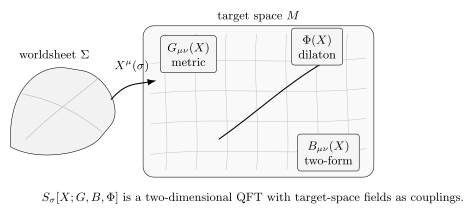
The background fields are worldsheet couplings. Changing , , or changes the two-dimensional quantum field theory whose path integral defines string propagation.
For slowly varying fields, the sigma-model action is the natural covariant completion of the flat-space action. For example, expanding around flat space gives
and the linearized coupling to is
When , this is precisely the integrated graviton vertex operator. Thus the nonlinear sigma model is the natural way to turn on coherent backgrounds of the massless closed-string fields.
Weyl invariance and beta functions
Section titled “Weyl invariance and beta functions”Classically, the Polyakov action is invariant under Weyl rescalings
Quantum mechanically this symmetry can fail. In a general two-dimensional QFT with couplings , the trace of the stress tensor has the schematic form
For the string sigma model, the couplings are the functions , , and , and the corresponding beta functions are tensors on target space:
A consistent perturbative string background requires the Weyl anomaly to vanish, so one must impose
up to field redefinitions and target-space diffeomorphisms. This last caveat is important but not alarming: different renormalization schemes correspond to different spacetime field variables, just as different coordinate systems describe the same geometry.
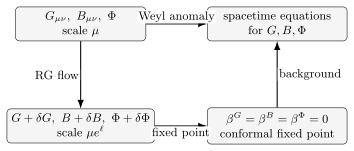
The renormalization-group flow of the two-dimensional theory acts on the background fields. A string background is a fixed point of this flow, modulo spacetime gauge redundancies.
Background-field expansion
Section titled “Background-field expansion”The one-loop beta functions are most cleanly derived by expanding around a slowly varying classical map . Write the quantum field as a tangent vector along the target-space geodesic issuing from :
Using Riemann normal coordinates at , the expansion of the metric begins as
The interaction quadratic in produces a one-loop logarithmic divergence proportional to the Ricci tensor. This is the geometric origin of the term
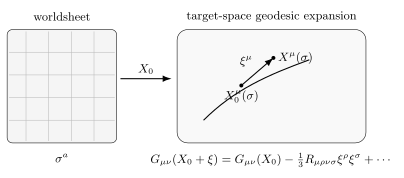
In the background-field method, the fluctuation is a tangent vector . The curvature of target space controls the one-loop divergence and hence the metric beta function.
This is already a striking result. A two-dimensional quantum loop knows about the Ricci tensor of the target space. The dilaton and -field complete the answer into the equations following from the spacetime effective action.
One-loop beta functions
Section titled “One-loop beta functions”To leading order in , the beta functions are
and
Here
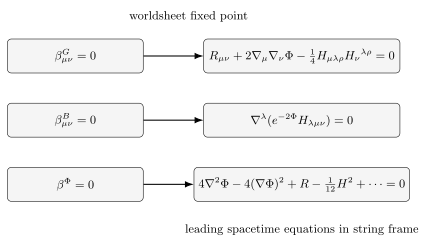
At leading order, , , and reproduce the Euler-Lagrange equations of the string-frame effective action.
The first equation says that the metric is not required to be Ricci-flat by itself; the dilaton gradient and -flux also source curvature. The second equation is the -field equation of motion with the characteristic string-frame measure . The last equation contains the central-charge deficit .
For , constant , and , the first beta function reduces to
so Weyl invariance gives
This is how Einstein’s vacuum equation emerges from the demand that a string worldsheet remain conformal at the quantum level.
Matching the spacetime action
Section titled “Matching the spacetime action”The beta-function equations above are equivalent, to this order, to the equations of motion from the string-frame action
There is a subtle but useful conceptual distinction:
- The amplitude argument determines the spacetime action by matching string scattering at small momentum.
- The sigma-model argument determines the same equations by requiring quantum Weyl invariance for arbitrary slowly varying backgrounds.
The two derivations are complementary. One uses on-shell scattering around flat space; the other treats the background fields as couplings of a two-dimensional quantum field theory.
Linear dilaton background
Section titled “Linear dilaton background”A particularly simple nontrivial background is a flat metric, zero -field, and a dilaton linear in the target-space coordinates:
Since , the metric beta function vanishes in flat space. The only nontrivial condition comes from :
Equivalently,
The same condition appears directly from the worldsheet stress tensor. The linear dilaton improves the holomorphic stress tensor to
This improvement changes the central charge to
Thus a nonzero dilaton gradient can compensate for a target-space dimension different from .
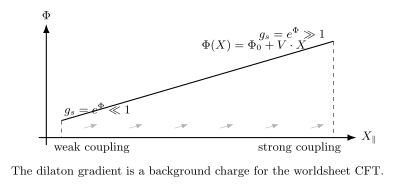
In a linear dilaton background, the local string coupling varies along the direction . One side of target space is weakly coupled; the other is strongly coupled.
For a vertex operator , the improved stress tensor shifts the conformal weight to
This shift is the CFT imprint of a background charge. In Euclidean Liouville conventions the momentum along the dilaton direction is often analytically continued, so the same formula is commonly written in terms of real exponential momenta rather than real plane-wave momenta.
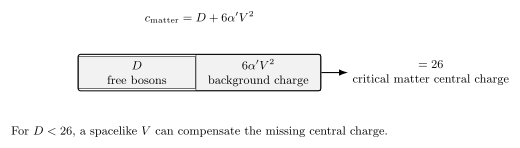
The linear dilaton contributes to the matter central charge. Criticality requires the total matter central charge to be in the bosonic string.
For , a spacelike dilaton gradient can restore criticality. For , the compensating gradient is timelike. In either case, the price of this exact CFT is a string coupling that changes exponentially in target space.
Exercises
Section titled “Exercises”Exercise 1. Ricci-flat backgrounds from the sigma model
Section titled “Exercise 1. Ricci-flat backgrounds from the sigma model”Set , take constant, and work in . Show that the leading condition gives .
Solution
For , . For constant , . The metric beta function becomes
At leading order, Weyl invariance requires , hence
Exercise 2. The -field equation from the string-frame action
Section titled “Exercise 2. The BBB-field equation from the string-frame action”Vary the term
with respect to and show that the equation of motion is
Solution
Since , the variation is
The variation of the action is proportional to
Integrating by parts gives
Since is arbitrary, the equation of motion is
This is equivalent to the leading condition .
Exercise 3. Central charge of the linear dilaton
Section titled “Exercise 3. Central charge of the linear dilaton”Assume the improved stress tensor
Using
show that the improvement shifts the central charge by .
Solution
The free part gives . The central term from the improvement comes from the double contraction in
Differentiating the logarithmic OPE twice in and twice in gives
In the OPE, the coefficient of is . Including the improvement contribution gives
so
Exercise 4. Conformal weight in a linear dilaton background
Section titled “Exercise 4. Conformal weight in a linear dilaton background”Derive the shift
for the operator .
Solution
The free stress tensor contributes the usual weight
The improvement term contributes through
Multiplying by gives an additional second-order pole
Therefore
Exercise 5. Why beta functions are equations, not just numbers
Section titled “Exercise 5. Why beta functions are equations, not just numbers”Explain why the sigma-model beta functions are tensor fields such as rather than ordinary numerical beta functions.
Solution
In an ordinary QFT with finitely many couplings , the beta functions are ordinary functions . In the string sigma model, the couplings are functions on target space:
Renormalization can change these functions at every point of target space. Therefore the beta functions are also target-space fields:
Setting them to zero gives differential equations for the background fields, which are precisely the spacetime equations of motion to leading order in .