
Ten-Dimensional Spinors and Ramond Ground States
The Ramond sector of the NSR string is the first place where spacetime spinors appear. This is not put in by hand. It follows from one elementary fact: Ramond worldsheet fermions have zero modes, and those zero modes obey a spacetime Clifford algebra.
The previous page found
Therefore the Ramond ground state is not a single scalar state. It is a degenerate multiplet on which the gamma matrices act:
where is a spacetime spinor. The physical-state condition then becomes the massless Dirac equation,
This page supplies the spinor technology needed to understand this statement in ten dimensions.
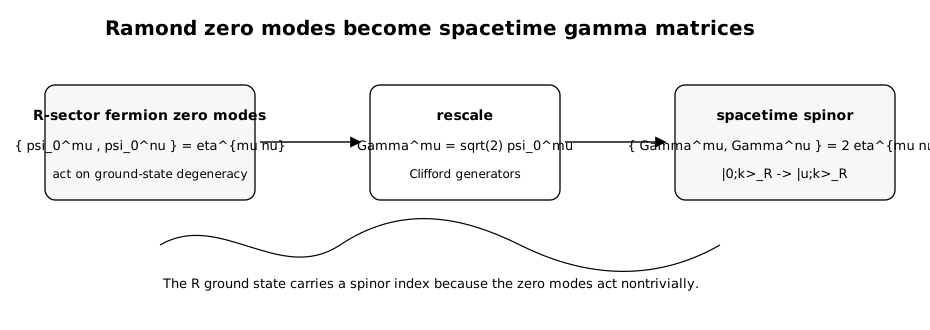
The Ramond zero modes act on the degenerate ground states. After , their algebra is exactly the spacetime Clifford algebra.
Clifford algebras and spinor modules
Section titled “Clifford algebras and spinor modules”Let be the spacetime dimension, with mostly-plus metric
The Lorentzian Clifford algebra is generated by matrices satisfying
A spinor is an element of a vector space on which these gamma matrices act. The group is generated inside the Clifford algebra by
and spinors transform under these generators rather than as tensors under vector indices.
For the Ramond ground state, this is precisely what happens. The zero modes act on the degeneracy labels of the ground state, and the Lorentz generators acting on the spinor part are built from
So the Ramond sector produces spacetime spinors because the worldsheet fermion zero modes are gamma matrices.
Building spinors as a fermionic Fock space
Section titled “Building spinors as a fermionic Fock space”The quickest way to count spinor components is to temporarily work in even Euclidean dimension . Pair the gamma matrices into fermionic creation and annihilation operators,
The Clifford algebra implies
Starting from a Clifford vacuum satisfying
one obtains all states by acting with the creation operators:
Each can appear at most once, so the complex Dirac spinor has
components.
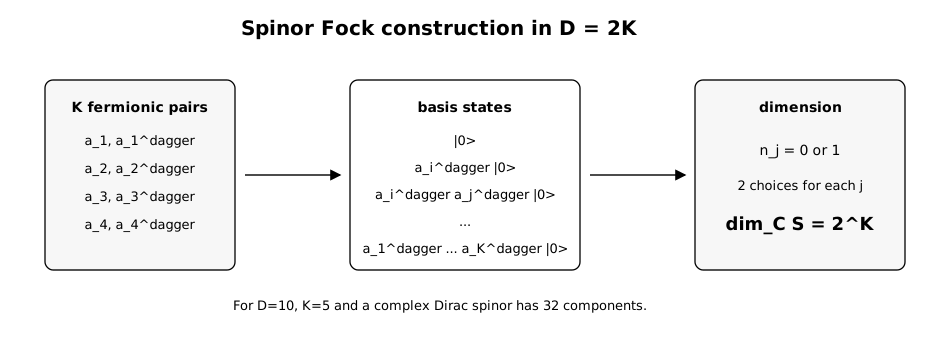
Pairing gamma matrices into fermionic creation and annihilation operators gives a -dimensional spinor module. Occupation number parity becomes chirality.
Chirality
Section titled “Chirality”In even dimension there is a chirality matrix. In Lorentzian we use
up to the standard phase convention chosen so that
The eigenvalues of split a Dirac spinor into two Weyl spinors,
In the Fock construction, chirality is essentially the parity of the number of creation operators:
up to an overall convention. Thus even occupation-number states form one Weyl representation and odd occupation-number states form the other.
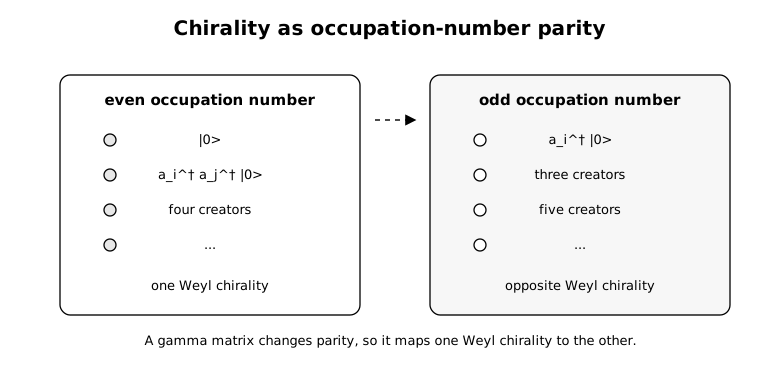
For even , the chirality operator separates the spinor Fock space into even and odd occupation-number sectors. The overall label or is conventional.
A small caution: the labels and , or and , depend on a chirality convention. What is invariant is that there are two inequivalent chiral spinor representations and the GSO projection chooses one of them.
Ten-dimensional Majorana-Weyl spinors
Section titled “Ten-dimensional Majorana-Weyl spinors”For , a complex Dirac spinor has
complex components. A Weyl projection halves this to
complex components.
Lorentzian ten-dimensional spinors also admit a Majorana reality condition. In a suitable basis, this can be written schematically as
where charge conjugation is defined using a charge-conjugation matrix . The detailed matrix conventions are not important for the spectrum; the important structural fact is that in one may impose Majorana and Weyl conditions simultaneously. A ten-dimensional Majorana-Weyl spinor has
real off-shell components.
For a massless particle, the Dirac equation halves the physical polarizations:
This is the number that must match the transverse polarizations of a massless vector in ten dimensions.
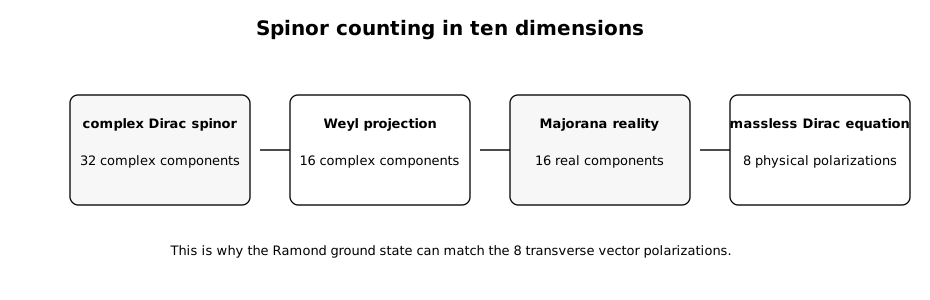
In , the Majorana and Weyl conditions are compatible. A Majorana-Weyl spinor has real components off shell, and the massless Dirac equation leaves on-shell polarizations.
The massless little group and spinors
Section titled “The massless little group and SO(8)SO(8)SO(8) spinors”For a massless particle in , choose a frame with momentum along the light-cone direction. The subgroup preserving this momentum acts on the eight transverse directions. The physical little group is
The transverse vector polarizations of a massless gauge boson form the representation
The two chiral spinor representations are
A useful way to label spinor weights is by four signs,
There are sign choices. They split into two sets of eight: one with an even number of minus signs and one with an odd number of minus signs. These are the two chiral spinor representations and .
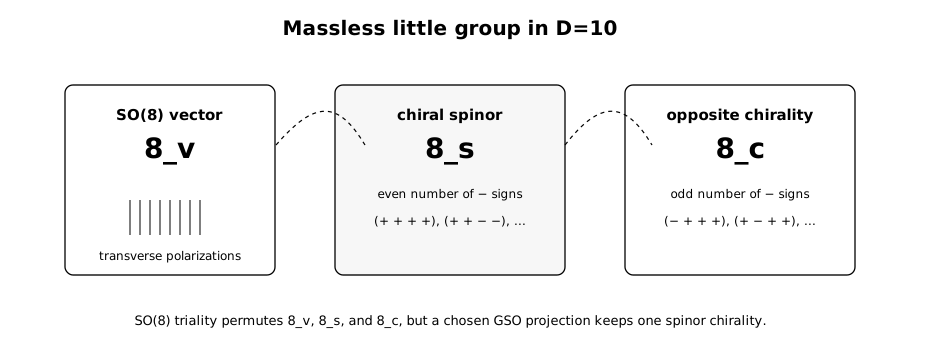
The ten-dimensional massless little group is . The physical open-string vector gives , while a chiral Ramond ground state gives either or .
The special feature of is triality: the three eight-dimensional representations , , and are permuted by outer automorphisms. This is why the equality of bosonic and fermionic degrees of freedom in the open superstring can be so economical.
Back to the Ramond ground state
Section titled “Back to the Ramond ground state”The open R ground state before the GSO projection is a ten-dimensional spinor subject to
After imposing the GSO projection on the next page, one keeps a single ten-dimensional Majorana-Weyl chirality. On shell this leaves exactly
fermionic polarizations, matching the polarizations of the NS massless vector.
This is the key representation-theoretic fact behind the ten-dimensional open-superstring vector multiplet.
Exercises
Section titled “Exercises”Exercise 1. Ramond zero modes generate gamma matrices
Section titled “Exercise 1. Ramond zero modes generate gamma matrices”Starting from
show that obeys the spacetime Clifford algebra.
Solution
Compute
This is exactly the Clifford algebra for mostly-plus Lorentzian signature.
Exercise 2. Dimension of a Dirac spinor in even dimension
Section titled “Exercise 2. Dimension of a Dirac spinor in even dimension”Use the fermionic oscillator construction with creation operators to show that a complex Dirac spinor in dimensions has dimension .
Solution
Each creation operator is fermionic, so it can either be absent or present. Thus a basis is labeled by occupation numbers,
The number of basis states is therefore
Since , this is .
Exercise 3. Chirality from occupation-number parity
Section titled “Exercise 3. Chirality from occupation-number parity”Show that the spinor Fock space splits into two equal halves according to the parity of the number of creation operators.
Solution
The full Fock space has states with occupation numbers . The operator
has eigenvalue on even occupation number and on odd occupation number. Since multiplying by any gamma matrix changes the occupation number by one, this parity operator anticommutes with all gamma matrices, just like chirality.
The even and odd subspaces have equal dimension because
implies, for ,
Thus chirality splits the Dirac spinor into two Weyl spinors of equal dimension.
Exercise 4. Ten-dimensional Majorana-Weyl counting
Section titled “Exercise 4. Ten-dimensional Majorana-Weyl counting”Explain why a ten-dimensional Majorana-Weyl spinor has real off-shell components and massless on-shell polarizations.
Solution
A complex Dirac spinor in has
complex components. The Weyl condition halves this to complex components. In one can also impose a Majorana reality condition compatible with chirality, turning the complex components into real components.
For a massless spinor, the Dirac equation
removes half the independent components. Therefore the physical on-shell polarizations are
Exercise 5. Count chiral spinor weights
Section titled “Exercise 5. Count SO(8)SO(8)SO(8) chiral spinor weights”Use the weights with to show that each chiral spinor representation of has dimension .
Solution
There are four independent signs, so there are
weights. Chirality separates these into two classes: even number of minus signs and odd number of minus signs. The number of weights with an even number of minus signs is
The number with an odd number of minus signs is
Thus the two chiral spinor representations are both eight-dimensional.