
Weyl Anomaly
Why Weyl anomalies matter
Section titled “Why Weyl anomalies matter”A CFT is locally insensitive to changes of scale. On flat space this is usually summarized by
after possible improvement of the stress tensor. On a curved background this statement becomes subtler. The metric is not just geometry; it is the source for the stress tensor. Once the theory is regulated, the path-integral measure and the counterterms needed to define the generating functional may fail to be invariant under local Weyl transformations. The result is a Weyl anomaly, also called a trace anomaly.
The anomaly is one of the cleanest places where a CFT remembers both quantum mechanics and geometry:
This is not a small technical correction. In two dimensions, the coefficient of the Weyl anomaly is the central charge . In four dimensions, the anomaly contains the central charges and . In holography, the same anomaly is produced by logarithmic divergences of the bulk on-shell action. So the Weyl anomaly is simultaneously a CFT observable, a curved-space Ward identity, and a diagnostic of the bulk gravitational dynamics.
Metric source and Weyl variation
Section titled “Metric source and Weyl variation”We use the Euclidean convention introduced earlier:
The one-point function of the stress tensor is defined by the response to the metric source,
or equivalently
A local Weyl transformation is
so infinitesimally
Plugging this into the metric variation gives
Therefore Weyl invariance of the full quantum generating functional would imply
as a local operator statement, up to contact terms. A Weyl anomaly is precisely the failure of this equation on curved space:
Here is a local scalar built from background sources. It is not an ordinary operator expectation value caused by a state. It is a property of how the CFT is defined in background fields.
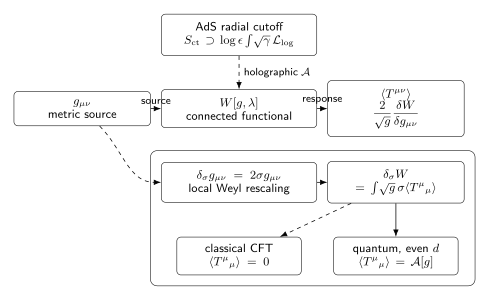
The metric is the source for . A Weyl variation probes the trace response . Classically this trace can vanish at a fixed point; quantum mechanically, in even spacetime dimension and on curved backgrounds, it may equal a local curvature functional . In AdS/CFT the same local functional is encoded by the logarithmic counterterm of the regulated bulk action.
The local Callan-Symanzik equation
Section titled “The local Callan-Symanzik equation”Away from a fixed point, the trace of the stress tensor also contains beta functions. For scalar sources coupled to operators , the schematic local trace identity is
At a CFT fixed point,
but can remain nonzero on curved space. This is the key conceptual distinction:
The Weyl anomaly is compatible with conformal invariance because it vanishes on flat space at separated points. It appears when the theory is coupled to background geometry, or equivalently when one asks for contact terms and finite parts of correlation functions involving stress tensors.
What can an anomaly look like?
Section titled “What can an anomaly look like?”The anomaly density must be local and have Weyl weight , because
is dimensionless. It must also satisfy Wess-Zumino consistency: two Weyl transformations commute,
This severely restricts the possible terms.
For a CFT without boundary, the basic pattern is:
| Dimension | Local Weyl anomaly? | Typical data |
|---|---|---|
| odd | no ordinary local anomaly | finite sphere free energy, parity-odd/contact subtleties |
| even | yes | Euler term, Weyl invariants, scheme-dependent total derivatives |
The phrase “no ordinary local anomaly” in odd dimensions assumes a closed manifold and no defects or boundaries. Boundaries and defects introduce additional anomaly structures.
There are three useful classes of anomaly terms.
Type A anomalies are proportional to the Euler density. In even dimension they are tied to topology and are controlled by a coefficient usually called .
Type B anomalies are Weyl-invariant scalar densities, such as in four dimensions. Their coefficients are physical CFT data.
Trivial anomalies are Weyl variations of local counterterms. Their coefficients are scheme-dependent, because one can change them by changing the finite local terms used to define .
Two dimensions
Section titled “Two dimensions”In two dimensions the anomaly is fixed by one number, the central charge :
in the Euclidean sign convention used here. If another convention is used for or for the stress tensor, the overall sign may be reversed. The magnitude and the coefficient are invariant information.
The integrated Weyl variation is therefore
For a constant Weyl rescaling, , this becomes
Using Gauss-Bonnet,
we get
On the sphere, , so a global change of radius has
This is a compact way to see that the central charge measures the response of the theory to changing the size of a curved two-dimensional space.
The Polyakov action
Section titled “The Polyakov action”The two-dimensional anomaly can be integrated to obtain the nonlocal Polyakov effective action. Its anomaly-sensitive part is
This expression is nonlocal because the anomaly is local but cannot be written as the Weyl variation of a local diffeomorphism-invariant functional in two dimensions.
For a Weyl-related metric
the same information is often written in local Wess-Zumino form:
Varying this with respect to gives
which is exactly the two-dimensional trace anomaly.
This formula also explains why the cylinder vacuum energy knows about . The map from the plane to the cylinder is a Weyl transformation plus a coordinate transformation. The anomalous part of the stress tensor transformation is the Schwarzian derivative. The same central charge controls both
and the cylinder Casimir energy
So the trace anomaly, the Schwarzian derivative, and the finite-size Casimir term are three faces of the same central charge.
Four dimensions
Section titled “Four dimensions”In four-dimensional CFTs, the anomaly has the standard form
when no background flavor fields are turned on. Here
is the four-dimensional Euler density, and is the Weyl tensor.
The coefficients and are physical. The coefficient is scheme-dependent. Indeed, adding a finite local counterterm
shifts the anomaly by a multiple of . Therefore is not intrinsic CFT data in the same sense as and .
The coefficient controls the normalization of the stress-tensor two-point function in four dimensions. The coefficient controls the Euler anomaly and plays a deep role in RG flow; in unitary relativistic four-dimensional QFTs it decreases along RG flows from UV to IR. For holographic CFTs, both and are read from the bulk gravitational action.
With background gauge fields for global symmetries, additional terms may appear, schematically
with normalization depending on the convention for the current two-point function and for the background gauge field. These terms encode flavor-current data and, in supersymmetric theories, often sit in the same multiplets as ordinary ‘t Hooft anomalies.
Scheme dependence and contact terms
Section titled “Scheme dependence and contact terms”A useful rule of thumb is:
The generating functional is defined only after choosing local counterterms. Finite counterterms can change local terms in the anomaly and contact terms in stress-tensor correlators. They cannot change the nontrivial anomaly coefficients such as in two dimensions or in four dimensions.
For example, the four-dimensional counterterm
is local and diffeomorphism invariant. Its Weyl variation is also local, so it shifts a local anomaly term. This is why the term is called trivial. By contrast, the Euler term and the Weyl-squared term cannot be removed by finite local counterterms without changing the theory.
This distinction is especially important in AdS/CFT. Holographic renormalization requires adding counterterms at the radial cutoff. Power-law counterterms remove power divergences. Logarithmic counterterms encode anomalies. Finite counterterms change the renormalization scheme but not the nontrivial anomaly coefficients.
Holographic origin of the anomaly
Section titled “Holographic origin of the anomaly”Use Fefferman-Graham coordinates near the boundary of an asymptotically AdS spacetime:
with boundary metric
Regulate the bulk at . The on-shell action has divergences as :
For even boundary dimension , the logarithmic term is present. Its coefficient is local in the boundary sources and gives the Weyl anomaly. Schematically,
and
The reason is geometric. A boundary Weyl transformation is realized in the bulk by a radial diffeomorphism, roughly
Power divergences can be subtracted covariantly. The logarithmic term is different: under a Weyl rescaling, shifts by a finite amount. That finite shift is exactly the anomaly.
Two famous holographic examples are:
and, for five-dimensional Einstein gravity dual to a four-dimensional CFT,
Higher-derivative terms in the bulk action generally make and differ. Thus the equality is not a theorem of all holographic CFTs; it is a special feature of the simplest two-derivative Einstein gravity duals.
Weyl anomaly versus global conformal symmetry
Section titled “Weyl anomaly versus global conformal symmetry”A common confusion is to think that a Weyl anomaly destroys conformal invariance. It does not, at least not in the flat-space sense relevant for ordinary CFT correlators.
On flat space without sources,
so the local curvature anomaly vanishes:
The separated-point conformal Ward identities on flat space remain valid. What changes is the curved-space generating functional and the contact terms obtained by differentiating it with respect to the metric.
This is why the anomaly is often invisible in elementary flat-space correlators but unavoidable in stress-tensor physics. In two dimensions, appears both in the OPE and in the trace anomaly. In four dimensions, and appear in stress-tensor correlators, entanglement across spheres, and curved-space partition functions.
AdS/CFT checkpoint
Section titled “AdS/CFT checkpoint”The Weyl anomaly is one of the sharpest tests of the AdS/CFT dictionary because it compares a purely quantum CFT effect with a classical bulk computation.
On the CFT side:
On the bulk side:
and the anomalous Weyl variation comes from logarithmic counterterms in . The radial cutoff remembers the boundary scale. This is the gravitational version of renormalization.
For later AdS/CFT applications, remember the following dictionary:
This is why every serious holographic computation of stress tensors or partition functions includes holographic renormalization.
Common pitfalls
Section titled “Common pitfalls”The first pitfall is to confuse a Weyl anomaly with RG running. A nonzero beta function means the theory is not at a fixed point. A Weyl anomaly can exist even at an exact fixed point when the theory is placed on a curved background.
The second pitfall is to treat all anomaly terms as equally physical. In four dimensions, and are intrinsic; the coefficient of is not. Finite local counterterms can shift it.
The third pitfall is to forget contact terms. Differentiating the anomaly with respect to gives contact contributions to stress-tensor correlators. These are essential for Ward identities, even though they may not affect separated-point correlators.
The fourth pitfall is to assume odd-dimensional CFTs have no universal curved-space data. They have no ordinary local Weyl anomaly on closed manifolds, but they can still have universal finite quantities, such as the sphere free energy in three dimensions.
Exercises
Section titled “Exercises”Exercise 1 — Weyl variation and the stress-tensor trace
Section titled “Exercise 1 — Weyl variation and the stress-tensor trace”Using
show that an infinitesimal Weyl transformation gives
Solution
Substitute
into the variation of :
The factor of cancels the , and
Therefore
Exercise 2 — Integrated two-dimensional anomaly
Section titled “Exercise 2 — Integrated two-dimensional anomaly”For a two-dimensional CFT with
show that a constant Weyl rescaling changes by
Solution
For constant ,
Using the anomaly,
Gauss-Bonnet gives
Hence
Exercise 3 — Vary the Polyakov Wess-Zumino action
Section titled “Exercise 3 — Vary the Polyakov Wess-Zumino action”Let
Show that varying with respect to gives the trace anomaly
Solution
Vary the Wess-Zumino action:
Integrating by parts gives
For in two dimensions,
Thus
Comparing with
gives
Exercise 4 — Why is scheme-dependent in four dimensions
Section titled “Exercise 4 — Why □R\Box R□R is scheme-dependent in four dimensions”Show that adding
shifts the four-dimensional Weyl anomaly by a term proportional to .
Solution
In dimensions,
and
In ,
Substituting gives
On a closed manifold, integrate by parts:
Therefore
So the anomaly shifts by
This proves that the coefficient of depends on the finite local counterterm convention.
Exercise 5 — The Euler anomaly on
Section titled “Exercise 5 — The Euler anomaly on S4S^4S4”Assume a four-dimensional CFT on a conformally flat closed manifold, so , and ignore the scheme-dependent term. Use
and
to find the change of under a constant Weyl rescaling.
Solution
For constant ,
Substituting the Euler anomaly gives
Using Gauss-Bonnet in four dimensions,
For , , so
Exercise 6 — Why the holographic anomaly comes from a logarithm
Section titled “Exercise 6 — Why the holographic anomaly comes from a logarithm”Suppose the regulated bulk on-shell action contains
Explain why this term can produce a finite Weyl anomaly after renormalization.
Solution
A boundary Weyl transformation is equivalent near the boundary to a radial rescaling of the cutoff,
at least for constant and locally for general . Therefore
The logarithmic counterterm shifts by a finite amount,
After the divergent part has been subtracted, this finite shift remains. It is interpreted as the Weyl variation of the renormalized CFT generating functional:
Thus is determined by the coefficient of the logarithmic term, up to sign conventions in the definition of and counterterms.
Takeaway
Section titled “Takeaway”The Weyl anomaly is the curved-space remnant of scale symmetry after quantization:
In two dimensions, is controlled by . In four dimensions, it is controlled by , , and scheme-dependent local terms. In AdS/CFT, the anomaly is the finite Weyl variation left behind by logarithmic divergences of the bulk on-shell action.
Further reading
Section titled “Further reading”For the two-dimensional trace anomaly, the Polyakov action, and the relation to the stress tensor, see standard 2D CFT references, especially the sections on the central charge, trace anomaly, and finite-size effects. For four-dimensional anomalies and holographic renormalization, the natural next references are reviews of conformal anomalies, local RG, and holographic counterterms. The next page uses the same source-functional logic to study thermal CFT.