
Primaries and Descendants
The first real simplification of conformal field theory is not a formula for a correlator. It is a classification principle:
Each family begins with a primary operator. Everything else in the family is obtained by differentiating it. These derivatives are called descendants. In a generic QFT, differentiating an operator gives another local operator, but there is no reason for those operators to be organized into a finite-dimensional symmetry pattern. In a CFT, they are organized by the representation theory of the conformal algebra.
For AdS/CFT, this is the first place where the CFT spectrum begins to look like a bulk spectrum. A primary operator is the boundary avatar of a single bulk species. Its descendants are not new particles; they are the same bulk excitation with different spacetime dependence, or equivalently the same conformal representation viewed at higher cylinder energy.
The local operator viewpoint
Section titled “The local operator viewpoint”A local operator is an object that can be inserted at a point:
The word “operator” should not be interpreted too narrowly. Depending on context, may be a fundamental field, a composite field, a conserved current, a stress tensor, a defect operator, or a properly renormalized product of fields. In CFT we usually treat local operators as the basic observables, not as secondary objects constructed only from a Lagrangian.
The conformal algebra in Lorentzian signature is generated by
where generates translations, Lorentz transformations, dilatations, and special conformal transformations. In Euclidean signature, replace the Lorentz group by , and the complexified algebraic statements are the same.
The commutators most relevant for local operators are
with conventional factors of depending on whether one uses Hermitian or anti-Hermitian generators. These relations say that raises scaling dimension by one, while lowers scaling dimension by one.
That is the algebraic reason descendants have dimensions shifted by integers.
Scaling operators
Section titled “Scaling operators”A local operator is called a scaling operator if it transforms diagonally under dilatations. At the origin, this means
up to the same convention-dependent factors of just mentioned. The number is the scaling dimension of .
Away from the origin, a scalar scaling operator transforms under a finite scale transformation as
or, equivalently,
inside a scale-covariant correlator. A spinning operator also transforms under the rotation or Lorentz representation carried by its indices.
An operator is therefore labeled at least by
where is a representation of the spacetime rotation group or Lorentz group , and denotes representations of internal global symmetries. For many pages we suppress unless it matters.
Primary operators
Section titled “Primary operators”A primary operator is a local scaling operator that is killed by the special conformal generators at the origin:
This condition is not arbitrary. It is the conformal analogue of a highest-weight condition.
The analogy is:
The slight linguistic trap is that raises the dilatation eigenvalue, while lowers it. In radial quantization, is the Hamiltonian, so raises the cylinder energy and lowers it. A primary is therefore a lowest-energy state inside its conformal family.
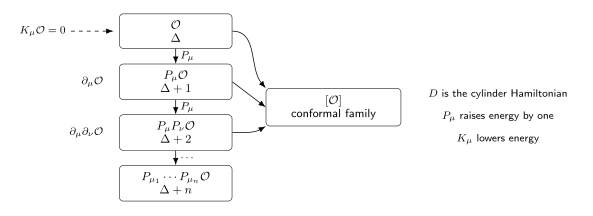
A primary operator is annihilated by at the origin. Acting with generates descendants such as , , and so on. Under radial quantization, is the cylinder Hamiltonian, so descendants have dimensions .
Descendants
Section titled “Descendants”Given a primary , its descendants are obtained by acting with translations:
In position space, translations act as derivatives, so descendants correspond to
If has dimension , then a level- descendant has dimension
The descendants are not arbitrary new data. Once the primary and its transformation properties are known, the conformal algebra fixes how the descendants appear in correlators. This is why conformal blocks can sum over an entire family: a block is the contribution of one primary plus all of its descendants.
This distinction is essential. A CFT spectrum is usually listed by primary operators, not by every derivative of every operator. The complete Hilbert space contains descendants, but the independent spectral data are the primaries and their OPE coefficients.
Conformal families
Section titled “Conformal families”The conformal family generated by a primary is denoted
As a vector space, it is spanned schematically by
In a unitary CFT, this family should be thought of as a representation of the conformal algebra. The primary is the lowest-weight state with respect to . The descendants fill out the rest of the representation.
For a scalar primary, the first few descendants look like
For spinning primaries, the derivative indices must also be decomposed into irreducible representations. This decomposition is often tedious, but conceptually it is just the tensor product of the spin representation of with symmetric derivative indices.
Transformation law for scalar primaries
Section titled “Transformation law for scalar primaries”A scalar primary has a particularly simple transformation law. Under a conformal map
with local scale factor defined by
a scalar primary transforms as
This equation is one of the main reasons primaries are useful. Once the transformation law is known, conformal symmetry almost fixes two- and three-point functions.
For spinning primaries, one must also rotate the spin indices by the local orthogonal transformation associated with the conformal map. If transforms in a representation of , then schematically
where is the local rotation part of the Jacobian.
Quasi-primaries and the special role of two dimensions
Section titled “Quasi-primaries and the special role of two dimensions”In , the global conformal group is finite-dimensional, and the term primary usually refers to the transformation law under the full conformal group.
In two dimensions, there is a sharper distinction. The global conformal group is generated by
but the local conformal algebra is the full Virasoro algebra. A field can transform simply under the global subgroup but not under all Virasoro transformations. Such a field is often called quasi-primary. A true Virasoro primary obeys
This course will use the higher-dimensional convention unless we are explicitly in the 2D CFT modules. There, “primary” usually means Virasoro primary unless stated otherwise.
Examples
Section titled “Examples”Scalar primary
Section titled “Scalar primary”The simplest example is a scalar primary with dimension :
Its two-point function can be normalized as
Conserved current
Section titled “Conserved current”A conserved current in dimensions has dimension
It is a spin-one primary, except for contact-term subtleties inside Ward identities. Conservation gives
This is a shortening condition. The descendant vanishes as an operator equation at separated points.
Stress tensor
Section titled “Stress tensor”The stress tensor has
spin two, conservation
and, in a CFT on flat space,
up to anomalies and contact terms. The stress tensor is not just another primary: it generates spacetime symmetries through Ward identities. Still, as an operator in a CFT spectrum, it belongs to a short conformal multiplet.
Exactly marginal operator
Section titled “Exactly marginal operator”An exactly marginal scalar primary has
Deforming the action by
preserves conformal invariance if the beta function for vanishes exactly. In holography, such operators are dual to massless scalar fields in AdS.
Shortening and null descendants
Section titled “Shortening and null descendants”A generic primary generates a long conformal multiplet: none of its descendants vanish. But special values of and spin can make some descendants null. When this happens, the representation shortens.
The most important examples are conserved currents. For a spin-one current,
removes one level-one descendant. For the stress tensor,
remove descendants and trace components. In two-dimensional CFT, null descendants play an even more dramatic role: they lead to differential equations for correlation functions in minimal models.
In AdS language, shortening often reflects gauge redundancy or masslessness. A conserved current is dual to a bulk gauge field. The stress tensor is dual to the graviton. BPS shortening in supersymmetric CFTs corresponds to protected supergravity multiplets.
Primaries and the OPE
Section titled “Primaries and the OPE”The operator product expansion is organized by conformal families:
The sum is over primary operators . The descendants are not assigned independent OPE coefficients. Their coefficients are fixed by conformal symmetry once , spin, and are known.
This is why the basic dynamical data of a CFT are
The descendant structure is kinematics. The primary spectrum and OPE coefficients are dynamics.
AdS/CFT checkpoint
Section titled “AdS/CFT checkpoint”The primary-descendant distinction becomes the boundary version of the single-particle state structure in AdS.
A scalar primary of dimension corresponds to a bulk scalar field with mass
The primary state is the lowest-energy state of that bulk field in global AdS. Descendants correspond to acting with spacetime momentum generators, producing higher global-AdS excitations in the same representation.
Thus one should not read
as a new bulk particle. It is part of the same conformal multiplet as .
For conserved currents and the stress tensor, shortening has the bulk interpretation
This is the first clean explanation of why a CFT with global symmetry has gauge fields in the AdS dual, and why every holographic CFT has gravity in the bulk.
Common pitfalls
Section titled “Common pitfalls”A derivative of a primary is usually not another primary. It is a descendant. For example, if is primary, then is generally not primary, because does not annihilate it.
A primary is not necessarily a fundamental field in a Lagrangian. Many important primaries are composite operators, and many CFTs have no known Lagrangian at all.
A conserved current is primary only modulo contact-term subtleties in Ward identities. At separated points, it behaves as a spin-one primary of dimension .
In two dimensions, “primary” can mean global primary or Virasoro primary. Virasoro primary is stronger.
Exercises
Section titled “Exercises”Exercise 1. Descendant dimensions
Section titled “Exercise 1. Descendant dimensions”Let be a primary of dimension . Use
to show that has dimension .
Solution
At the origin, suppose
Then
Using , we get
Thus the level-one descendant has dimension . Repeating the argument gives dimension for a level- descendant.
Exercise 2. Why is usually not primary
Section titled “Exercise 2. Why ∂μO\partial_\mu\mathcal O∂μO is usually not primary”Let be a scalar primary, so at the origin. Use
to show that is generally not primary.
Solution
Compute
The first term vanishes because is primary. For a scalar primary, , so
Unless , this is nonzero. Therefore , or equivalently , is generally a descendant, not a primary.
Exercise 3. Current shortening
Section titled “Exercise 3. Current shortening”A conserved current satisfies . Explain why this is a statement about a descendant of .
Solution
The current is a spin-one operator. Acting with a translation generator gives a level-one descendant:
Contracting the derivative index with the vector index gives
Current conservation says that this particular descendant vanishes:
The multiplet is therefore shorter than a generic spin-one multiplet. This shortening is why conserved currents sit at the unitarity bound and why they are dual to massless gauge fields in AdS.
Exercise 4. Primary data versus descendant data
Section titled “Exercise 4. Primary data versus descendant data”Why is the OPE coefficient of a descendant not independent CFT data?
Solution
The OPE is organized by conformal families. Once a primary appears in the OPE
conformal symmetry fixes how all descendants of appear. Their coefficients are determined by the primary coefficient , the dimension , and the spin representation of .
Equivalently, the descendants are obtained by acting with symmetry generators. Their contribution is kinematic. The independent dynamical choice is whether the primary appears and with what coefficient.