
The OPE as Operator Algebra
The operator product expansion is where CFT stops being only a theory of symmetry constraints and becomes a theory of dynamics.
Conformal symmetry fixes two-point functions and three-point functions up to constants. It strongly constrains four-point functions, but it does not determine them. The OPE is the principle that organizes all higher-point functions in terms of two kinds of data:
Together with consistency conditions such as crossing symmetry, this is the modern definition of a CFT. A CFT is not primarily a Lagrangian. It is a consistent local operator algebra.
The basic statement is that when two local operators approach each other, their product can be expanded in local operators at one point:
The coefficient is a differential operator. It contains singular powers of and a series of derivatives acting on . In a CFT, the sum may be reorganized into conformal families:
where denotes the primary together with all of its descendants.
For AdS/CFT, this is the boundary version of the statement that bulk states can be decomposed into particles, multi-particle states, and their interactions. The spectrum of CFT primaries is the spectrum of bulk fields and multi-particle states. The OPE coefficients are the boundary data that, at large , become bulk interaction vertices.
The OPE inside correlation functions
Section titled “The OPE inside correlation functions”The OPE should first be understood inside correlation functions. Given additional insertions , the statement is
In Euclidean radial quantization, this is not merely an asymptotic expansion. It is a convergent expansion when the two operators being expanded are closer to each other than to every other insertion. If the OPE is centered at the origin, the convergence condition is
More geometrically, choose a sphere centered at the origin such that
Then the pair creates a state on . Expanding that state in a complete basis of dilatation eigenstates gives the OPE.
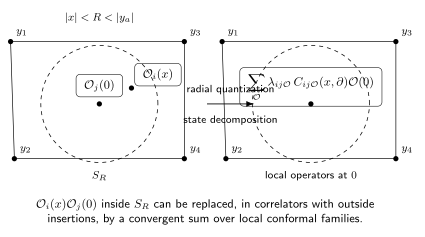
Radial quantization proof idea for the OPE. If and lie inside a sphere and all other insertions lie outside, the state created on can be expanded in a complete basis of conformal-family states. This gives a convergent expansion of inside correlators for .
This convergence is one of the quiet miracles of Euclidean CFT. It is much stronger than the usual short-distance asymptotic expansions in generic QFT. It is the reason the conformal bootstrap can be formulated as an exact consistency problem rather than as a perturbative approximation.
Why radial quantization gives an operator algebra
Section titled “Why radial quantization gives an operator algebra”Recall the state-operator correspondence:
Acting with two local operators inside a sphere gives a state:
Insert a complete set of states in radial quantization:
The states decompose into conformal multiplets:
Each conformal family is generated by repeatedly acting with on a primary:
In position space this becomes a derivative expansion:
Thus the OPE has two nested structures:
The first structure is dynamical: which primaries appear, and with which OPE coefficients? The second structure is kinematical: once a primary appears, conformal symmetry fixes the relative contribution of all descendants.
CFT data and normalization conventions
Section titled “CFT data and normalization conventions”Let be primary operators. If the two-point functions are diagonal and normalized as
then the scalar three-point function has the form
The constants are the OPE coefficients in an orthonormal basis. In a non-orthonormal basis, the two-point function defines a metric on operator space:
and the OPE coefficient with an upper index is obtained by raising an index:
This is why one often says that the CFT data are
where denotes the spin and global-symmetry representation. In a unit-normalized basis, , and the data reduce to the spectrum and the three-point coefficients.
The leading scalar OPE
Section titled “The leading scalar OPE”For two scalar primaries and , suppose a scalar primary of dimension appears in their OPE. The leading terms are
The only dynamical number here is . The coefficient of the first descendant is fixed by conformal symmetry. So are all higher descendant coefficients.
For a symmetric traceless spin- primary , the leading tensor structure in the OPE of two scalar primaries is schematically
The numerator supplies the spin. The denominator supplies the correct scaling dimension.
Identity, currents, and the stress tensor
Section titled “Identity, currents, and the stress tensor”Every unitary CFT has an identity operator with dimension
For a unit-normalized scalar primary of dimension , the identity contribution is
This is just the two-point function written as an OPE coefficient.
If the theory has a continuous global symmetry, there is a conserved current with
If the theory is local and has a stress tensor, there is a conserved symmetric tensor with
The appearances of and in OPEs are not arbitrary. Their coefficients are constrained by Ward identities. For example, the OPE of a current with a charged operator encodes the action of the symmetry generator, while the OPE of the stress tensor with a primary encodes translations, rotations, dilatations, and special conformal transformations.
Schematic examples are
and
The precise numerical coefficients depend on normalization conventions for and . The invariant statement is that conserved currents and the stress tensor are universal operators whose OPEs implement symmetry.
Selection rules
Section titled “Selection rules”The OPE is constrained by all symmetries, not only conformal symmetry. If the CFT has a global symmetry group , and operators transform in representations , , and , then can appear in only if
Equivalently, the three-point coefficient must be a -invariant tensor:
Spin and parity impose further rules. For example, in a parity-invariant theory, the OPE of two parity-even scalar operators contains only parity-even scalar primaries in its scalar sector. For identical scalar operators, Bose symmetry also constrains the allowed spins. In the OPE
only even-spin symmetric traceless primaries can appear when is a real bosonic scalar and no additional antisymmetric internal tensor is present.
These selection rules matter enormously in bootstrap and AdS/CFT applications. They determine which bulk fields are allowed to couple and which exchange diagrams can appear.
The OPE is not an ordinary algebra product
Section titled “The OPE is not an ordinary algebra product”The phrase “operator algebra” is powerful but slightly dangerous. The OPE is not an ordinary finite-dimensional algebra multiplication.
First, the coefficients are functions or distributions of the separation:
They are often singular as .
Second, the OPE is a statement inside correlation functions, with a domain of convergence in Euclidean signature. The operator product is not a well-defined local operator at coincident points without renormalization.
Third, contact terms can appear when operators collide under spacetime integrals. These contact terms are invisible in separated-point correlators but important for Ward identities, anomalies, and conformal perturbation theory.
Fourth, in Lorentzian signature the ordering matters. The Euclidean OPE gives radially ordered products. Lorentzian Wightman, time-ordered, retarded, and commutator correlators are obtained by analytic continuation with different prescriptions. The same formal OPE data appear, but their Lorentzian interpretation depends on operator ordering and causal separation.
A safer slogan is therefore:
The operator-algebra interpretation comes from the fact that this local expansion is associative.
Associativity and crossing
Section titled “Associativity and crossing”The deepest property of the OPE is associativity. Consider four operators. We may first fuse with , or first fuse with , or use another channel. The final correlator must be the same.
Schematically,
Inside a four-point function, this becomes crossing symmetry. For identical scalar operators , write
where
The OPE channel gives
where is the conformal block for the family . Exchanging gives the crossing equation
Equivalently,
This equation is the seed of the conformal bootstrap. The next page explains the conformal blocks that appear in this expansion.
Example: free scalar OPE
Section titled “Example: free scalar OPE”Let be a canonically normalized free scalar in with
Wick’s theorem gives
Expanding the normal-ordered product near the origin gives
This example is simple but instructive. The singular identity term reproduces the two-point function. The regular terms contain composite local operators. In an interacting CFT, the same logic survives, but the composite operators are replaced by scaling operators with definite conformal dimensions.
Holographic interpretation
Section titled “Holographic interpretation”In AdS/CFT, the OPE is the boundary signature of bulk locality.
A single-trace primary corresponds, at large , to a single-particle bulk field . A double-trace primary schematically of the form
corresponds to a two-particle bulk state with radial excitation number and angular momentum . At leading order in a large- CFT, its dimension is approximately
The correction is an anomalous dimension, interpreted in the bulk as an interaction energy.
The rough dictionary is
| CFT OPE concept | AdS interpretation |
|---|---|
| primary operator | bulk particle species or multi-particle state |
| conformal family | descendants generated by boundary translations |
| OPE coefficient | bulk cubic coupling, after normalization |
| anomalous dimension | binding energy or interaction effect |
| crossing symmetry | consistency of bulk scattering, causality, and locality |
This dictionary is not exact at finite or finite gap, but it is the correct intuition for why OPE data are the raw material of holography.
What to remember
Section titled “What to remember”The OPE is the central multiplication rule of a CFT:
It is local, convergent in Euclidean radial quantization, and controlled by conformal representation theory. The primary spectrum and OPE coefficients determine all correlation functions, provided the OPE is associative. Associativity becomes crossing symmetry, and crossing symmetry becomes the bootstrap.
For AdS/CFT, the same data encode the bulk spectrum and interactions. Learning to read OPE data is learning to read the boundary imprint of quantum gravity in AdS.
Exercises
Section titled “Exercises”Exercise 1: Identity contribution
Section titled “Exercise 1: Identity contribution”Let be a unit-normalized scalar primary of dimension :
Show that the identity contribution to the OPE is
Solution
Take the vacuum expectation value of the OPE:
In the CFT vacuum on flat space, the only operator with nonzero one-point function is the identity:
Therefore the coefficient of must reproduce the two-point function:
Thus
Exercise 2: First descendant coefficient
Section titled “Exercise 2: First descendant coefficient”Suppose two scalar primaries and have an OPE contribution from a scalar primary of dimension :
Use the scalar three-point function to show that
Solution
Take the three-point function with and assume
Using the OPE and the unit-normalized two-point function,
we get
Since
this gives
On the other hand, the exact three-point function is
Expanding
we find
Therefore
Exercise 3: Convergence domain
Section titled “Exercise 3: Convergence domain”Consider
Use radial quantization around the origin to explain why the OPE of converges when
Solution
Choose a sphere centered at the origin such that
The two operators and lie inside the sphere, while all other insertions lie outside. In radial quantization, the inside insertions create a state on the sphere:
The Hilbert space on has a complete basis of dilatation eigenstates. Expanding in that basis gives a sum over conformal families. Since the outside insertions only test this state from outside the sphere, the resulting expansion gives the same correlator.
The expansion parameter is controlled by the ratio between the size of the inner configuration and the radius to the nearest outside insertion. Therefore it converges when the inner separation is smaller than the distance to every external insertion:
Exercise 4: Crossing from OPE associativity
Section titled “Exercise 4: Crossing from OPE associativity”For identical scalar primaries of dimension , define
Show that exchanging implies
Solution
The same four-point function can also be written after exchanging and :
because the exchange swaps the cross-ratios:
The fields are identical bosonic scalars, so the correlator is unchanged by the exchange. Therefore
Multiplying by gives
Using
we obtain
Exercise 5: Generalized free field preview
Section titled “Exercise 5: Generalized free field preview”A generalized free scalar has a two-point function
and its four-point function is defined by Wick-like factorization:
Show that
What does this suggest about the OPE spectrum?
Solution
By definition,
The three Wick contractions are
Factoring out gives
Using the cross-ratios,
The identity operator accounts for the in the OPE channel. The remaining terms require an infinite tower of double-trace operators, schematically
with even spin for identical real scalars. In holography, this is the leading large- spectrum of two-particle states in AdS.
Further reading
Section titled “Further reading”For the classic two-dimensional operator-algebra viewpoint, read Di Francesco, Mathieu, and Sénéchal, especially the parts on radial ordering, OPE, conformal families, conformal blocks, and crossing symmetry. For the higher-dimensional bootstrap viewpoint, read Rychkov’s EPFL Lectures on Conformal Field Theory in and Simmons-Duffin’s TASI Lectures on the Conformal Bootstrap. For the AdS/CFT connection, keep this page in mind before studying Witten diagrams, large- factorization, and double-trace operators.