
Page Curves, Islands, and Modern Lessons
The main idea
Section titled “The main idea”The previous page explained why AdS/CFT makes the black-hole information problem sharper: the exact boundary theory is unitary, but the semiclassical Hawking calculation seems to predict that the entropy of the radiation keeps increasing. The modern island story gives a remarkably concrete answer to the entropy question.
For a radiation region coupled to a gravitating system, the fine-grained entropy is not computed only by the ordinary entropy of quantum fields in the exterior. Instead, in semiclassical gravity one must extremize a generalized entropy over possible interior regions :
The region is called an island. Its boundary is a quantum extremal surface. At early times, the dominant saddle is usually the empty island, , and the entropy agrees with the Hawking result. At late times, a nonempty island near or behind the horizon can dominate. Then the radiation entropy stops following the naive Hawking growth and instead follows the Page curve required by unitarity.
The deep lesson is not that Hawking radiation becomes nonthermal in an obvious local way. The lesson is subtler:
In other words, the late-time interior is not an independent Hilbert-space factor that can be freely traced over while also treating the radiation as a complete external subsystem. This is exactly the kind of statement one expects from the quantum-error-correcting structure of holography.
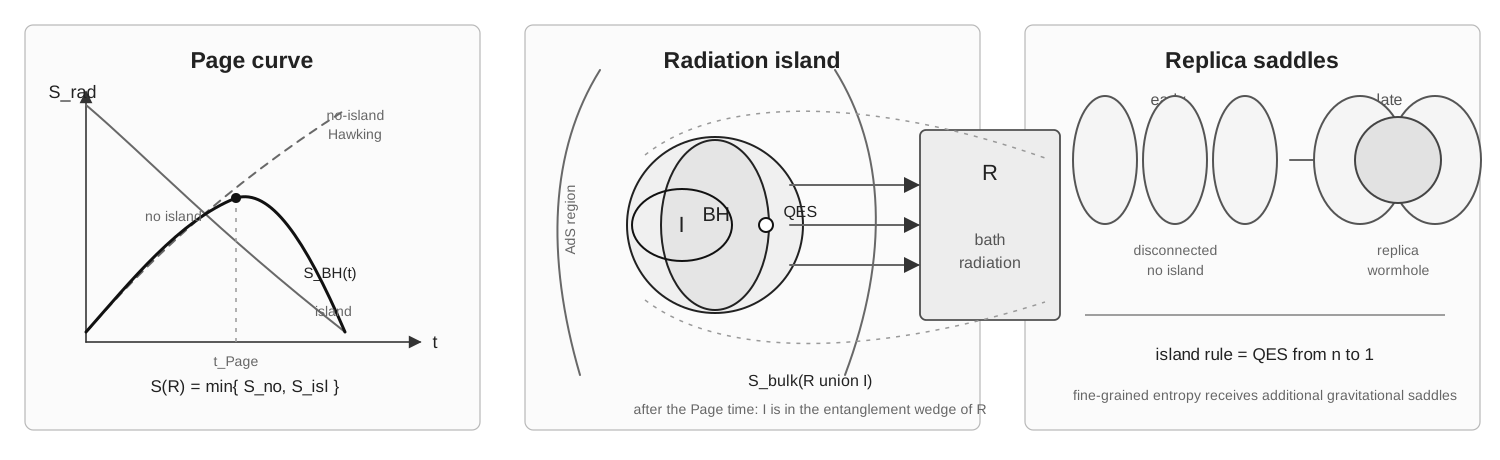
The island mechanism. The fine-grained radiation entropy is the lower envelope of competing quantum extremal surface saddles. Before the Page time, dominates and the entropy follows Hawking’s semiclassical growth. After the Page time, a nonempty island dominates, and the interior region belongs to the entanglement wedge of the radiation region . Replica wormholes give a gravitational path-integral derivation of the island saddle.
This page explains the island formula, its derivation from replica wormholes, and the precise lessons one should take away from the modern Page-curve calculations.
Page’s question
Section titled “Page’s question”Consider a black hole formed from collapse in a pure state and evaporating into radiation. Let denote the radiation emitted up to time , and let denote the remaining black-hole system. If the total system is closed and unitary, then the state on remains pure:
At early times, the radiation Hilbert space is much smaller than the black-hole Hilbert space. A typical pure state on has radiation entropy approximately equal to the maximum possible entropy of :
At late times, the remaining black hole is the smaller subsystem, so the same typicality logic gives
Thus a unitary evaporation process predicts the schematic Page curve
The Page time is the time at which the coarse-grained entropy of the emitted radiation becomes comparable to the Bekenstein-Hawking entropy of the remaining black hole:
Hawking’s leading semiclassical calculation instead gives an entropy that keeps growing as more thermal radiation is emitted. In the simplest cartoon,
That result is natural if one traces over interior partners of Hawking quanta and assumes that those partners remain independent of the early radiation. The island formula changes the entropy calculation precisely when that assumption becomes inconsistent with the finite black-hole entropy.
The setup: an evaporating AdS black hole with a bath
Section titled “The setup: an evaporating AdS black hole with a bath”A technical nuisance is that a large AdS black hole with reflecting boundary conditions does not evaporate away in the same way as an asymptotically flat black hole. Radiation reaches the AdS boundary and returns. To model evaporation while retaining holographic control, one often couples the boundary CFT to a nongravitating auxiliary bath.
Schematically,
with an interaction that allows energy to leak from the CFT into the bath. In the bulk, this corresponds to an AdS gravitational region connected to an exterior nongravitating reservoir. The radiation subsystem is chosen as a region in the bath.
The exact statement of unitarity is for the combined CFT-plus-bath system:
The entropy of the bath radiation is not conserved, because is only a subsystem. It can grow and later decrease, while the total system remains pure.
This setup is not a mere trick. It separates three notions that are often blurred:
| Quantity | Meaning | Holographic description |
|---|---|---|
| coarse-grained black-hole entropy | horizon area over | |
| semiclassical matter entropy | QFT entropy on a fixed or slowly varying geometry | |
| fine-grained entropy of radiation | quantum extremal surface prescription | |
| thermodynamic entropy carried by outgoing radiation | Hawking flux entropy |
The information paradox arises when one uses the second line to compute the third line beyond its regime of validity.
Generalized entropy and quantum extremal surfaces
Section titled “Generalized entropy and quantum extremal surfaces”The classical RT/HRT formula says that, for a boundary region in a holographic CFT,
at leading order in large . Quantum corrections replace the area alone by the generalized entropy
where is the bulk region bounded by the boundary subsystem and the candidate surface . The counterterm contribution is often suppressed in notation, but conceptually it is important: the area term and the bulk entanglement entropy are separately UV divergent, while the properly renormalized generalized entropy is finite.
A quantum extremal surface is a codimension-two surface satisfying
The quantum-corrected entropy prescription is then
For ordinary boundary regions in AdS/CFT, this is the quantum RT/HRT prescription. For Hawking radiation in a nongravitating bath, the new possibility is that the bulk region whose entropy is computed may include a disconnected gravitational region :
The notation is crucial. The matter entropy is not but . The island degrees of freedom are counted as part of the radiation subsystem for the purpose of computing the fine-grained entropy.
This sounds bizarre only if one expects a fixed microscopic tensor factorization between the black-hole interior and the radiation. Holography teaches that such a factorization is not fundamental in quantum gravity.
Empty island versus nonempty island
Section titled “Empty island versus nonempty island”The island formula is most transparent when viewed as a competition between saddles.
The empty-island saddle
Section titled “The empty-island saddle”For ,
This is the Hawking calculation of the entropy of the outgoing radiation. It grows as more Hawking quanta are emitted. In a simple approximation,
At early times this is the correct dominant answer. The radiation is a small subsystem of a much larger remaining black hole, and its entropy should grow.
The island saddle
Section titled “The island saddle”At late times, there can be a nonempty island whose boundary lies near the horizon. Its generalized entropy has the schematic form
Because includes the interior partners of much of the outgoing Hawking radiation, the bulk entropy does not keep growing in the same way as . The dominant time dependence is often approximately the decreasing black-hole area:
The physical entropy is the smaller of the competing extrema:
Thus
up to model-dependent constants and subleading corrections. This is the Page curve.
A useful toy model of the saddle competition
Section titled “A useful toy model of the saddle competition”A deliberately simple model captures the logic. Suppose the no-island entropy grows linearly,
while the island entropy follows the decreasing black-hole entropy,
The island formula gives
The Page time is
Of course real black-hole evaporation is not exactly linear. The point of the toy model is only the saddle structure. A new extremum does not need to dominate immediately. It can be present but subdominant, then take over when the naive Hawking entropy exceeds the generalized entropy of the island saddle.
This is similar in spirit to a Hawking-Page transition: two semiclassical saddles can both exist, but the physical answer is determined by the dominant one. Here the saddles are not thermal geometries but entropy saddles in a replica computation.
What is an island?
Section titled “What is an island?”An island is not a literal island of matter floating in the radiation bath. It is a region of the gravitating spacetime that is included in the entanglement wedge of the nongravitating radiation region.
More precisely, for a radiation region , a candidate island contributes to the generalized entropy
The island is selected by extremizing and minimizing this quantity. Once the island saddle dominates, the entanglement wedge of contains . Operators in , within the appropriate code subspace, can then be reconstructed from the radiation degrees of freedom.
This is the entropy version of a strong reconstruction statement:
The island therefore resolves a counting problem. The interior Hawking partners that were naively traced out are not independent of the radiation in the fine-grained entropy calculation. They are included in the radiation wedge.
Replica trick and replica wormholes
Section titled “Replica trick and replica wormholes”The island formula can be motivated from quantum extremal surfaces, but its gravitational origin becomes sharper through the replica trick. For an ordinary quantum system,
In nongravitational QFT, is computed by gluing replicas cyclically along . In a theory with dynamical gravity, one must also sum over geometries compatible with the replica boundary conditions.
The traditional Hawking calculation effectively uses disconnected gravitational replicas. Each copy has its own independent black-hole interior. This gives the empty-island answer.
Replica wormholes are additional saddles in which the gravitational replicas are connected through the interior. These saddles are not visible if one insists on the disconnected topology from the start. When analytically continued to , the fixed locus of the replica symmetry becomes the quantum extremal surface bounding the island.
Schematic path integral:
Then
At early times the disconnected saddle dominates. At late times the replica-wormhole saddle dominates. This is the gravitational path-integral origin of the Page transition.
Two points are worth emphasizing.
First, replica wormholes are saddles of an entropy calculation, not ordinary Lorentzian wormholes through which a signal travels. They do not make the black hole traversable.
Second, the island result is semiclassical but nonperturbative in the sense relevant to entropy. The leading area term is , and the difference between competing saddles is also . Selecting the correct saddle is not captured by perturbing the Hawking saddle order by order in small local corrections.
A minimal derivation of the island rule from replicas
Section titled “A minimal derivation of the island rule from replicas”The derivation is conceptually parallel to the Lewkowycz-Maldacena derivation of RT, upgraded to include bulk quantum fields and nongravitating radiation regions.
Start with the replicated entropy computation. If the dominant -replica gravitational saddle has a replica symmetry, one can quotient by that symmetry. The quotient geometry contains a codimension-two defect with opening angle
Equivalently, in the quotient one has a cosmic brane with tension
Taking sends the brane tension to zero but keeps its first variation finite. The condition that the saddle be smooth under variations of the brane location gives extremality of the generalized entropy:
For radiation regions coupled to gravity, the replica boundary conditions allow saddles whose fixed locus is not anchored directly to the radiation region. The corresponding region enclosed by the fixed locus is the island.
Thus the island rule is not an independent rule pasted onto Hawking’s calculation. It is the quantum extremal surface prescription applied to the correct gravitational replica problem.
Entanglement wedge interpretation
Section titled “Entanglement wedge interpretation”Before the Page time, the entanglement wedge of the radiation region is essentially just the radiation region in the bath. The black-hole interior is not reconstructable from .
After the Page time, the island saddle dominates and
in the semiclassical description. This means that some interior operators are encoded in the radiation.
This statement resolves the monogamy tension in a very holographic way. The late outgoing Hawking mode appears, in local semiclassical QFT, to be entangled with an interior partner . After the Page time, unitarity says that must also be correlated with the early radiation . If and were independent systems, this would violate entanglement monogamy.
The island story says that the interior partner is not independent of . It lies in the entanglement wedge of and can be reconstructed from in the appropriate code subspace:
So the same logical information can have two semiclassical descriptions: as an interior partner mode in the bulk effective theory and as encoded information in the radiation. This is not ordinary local quantum field theory on a fixed background; it is gravitational quantum error correction.
Islands and the Page curve in one equation
Section titled “Islands and the Page curve in one equation”A compact way to summarize the result is
where is the nonempty island solving
At early times,
so the empty island dominates. At late times,
so the island dominates.
The transition is a change in the dominant entropy saddle. It is not necessarily a dramatic local event at the horizon. A freely falling observer need not see anything special at the Page time in the semiclassical approximation.
What the island calculations establish
Section titled “What the island calculations establish”The modern Page-curve calculations are powerful because they show that semiclassical gravitational entropy calculations can reproduce unitary behavior when the entropy is computed correctly. They establish several lessons.
1. The Hawking calculation used the wrong fine-grained entropy after the Page time
Section titled “1. The Hawking calculation used the wrong fine-grained entropy after the Page time”The Hawking calculation correctly computes local radiation production and coarse-grained entropy flux. It does not correctly compute the fine-grained von Neumann entropy of the radiation after the Page time.
The difference is not a small correction to the local stress tensor. It is a different saddle in the entropy computation.
2. The Bekenstein-Hawking area is part of a fine-grained entropy formula
Section titled “2. The Bekenstein-Hawking area is part of a fine-grained entropy formula”The area term is not merely thermodynamic bookkeeping. In the generalized entropy,
the area term competes directly with matter entanglement. It controls which regions are included in the entanglement wedge.
3. The interior can be encoded in the radiation
Section titled “3. The interior can be encoded in the radiation”After the Page time, the radiation entanglement wedge contains an island. This gives a precise semiclassical version of the slogan that the black-hole interior is encoded in the Hawking radiation.
The statement is not that every observer can easily decode the interior. Reconstruction may be extraordinarily complex, code-subspace dependent, and sensitive to nonperturbative data.
4. Entropy can be corrected without large local violations of effective field theory
Section titled “4. Entropy can be corrected without large local violations of effective field theory”The Page curve does not require order-one corrections to local Hawking emission at the horizon. Instead, it requires using the correct nonlocal gravitational entropy prescription.
This is why the island story is compatible with an approximately smooth horizon in suitable states, at least at the level of entropy.
5. The information problem is not fully solved by entropy alone
Section titled “5. The information problem is not fully solved by entropy alone”Computing the Page curve is a huge achievement, but it does not automatically provide a microscopic time-dependent decoding map, a full nonperturbative bulk Hilbert space, or a complete description of the endpoint of evaporation in realistic four-dimensional quantum gravity.
The entropy calculation tells us that the information is not lost. It does not by itself hand us a practical decoding algorithm.
What remains subtle
Section titled “What remains subtle”The island formula is now a central tool, but several conceptual issues remain active research topics.
Factorization and ensemble averaging
Section titled “Factorization and ensemble averaging”In simple models such as Jackiw-Teitelboim gravity, wormhole contributions often resemble ensemble-averaged behavior. This raises a factorization puzzle: a single boundary theory should have factorized products of independent partition functions, while gravitational wormholes can connect apparently independent boundaries.
In AdS/CFT with a specific microscopic CFT, exact factorization must be restored by nonperturbative effects or by a more refined understanding of the bulk path integral. Replica wormholes are therefore both a solution to the entropy problem and a diagnostic of what semiclassical gravity does not fully define by itself.
State dependence and code subspaces
Section titled “State dependence and code subspaces”Entanglement-wedge reconstruction is normally a statement within a code subspace. After the Page time, interior reconstruction from radiation may depend on which family of black-hole microstates is being considered. This is not necessarily pathological, but it means one must be careful about asking for a single interior operator acting correctly on all possible black-hole states.
The endpoint of evaporation
Section titled “The endpoint of evaporation”The island formula captures the entropy curve through the Page transition and often through late semiclassical evaporation. The final Planckian endpoint still requires physics beyond the semiclassical approximation.
Operational decoding
Section titled “Operational decoding”The island formula says that the radiation contains the relevant information. It does not mean that the information is easy to extract. Hayden-Preskill-style decoding can be exponentially complex in generic systems. The existence of a reconstruction map is not the same as practical access.
Realistic black holes
Section titled “Realistic black holes”Most sharp island calculations use lower-dimensional gravity, baths, branes, special couplings, or holographic matter sectors. The general principles are expected to be broader, but realistic four-dimensional evaporating black holes remain technically much harder.
Relation to AdS/CFT
Section titled “Relation to AdS/CFT”AdS/CFT enters the island story in two complementary ways.
First, it provides a nonperturbative unitary definition of quantum gravity in asymptotically AdS settings. Thus the exact answer must be compatible with a Page curve.
Second, it supplies the entanglement-wedge and quantum-error-correction logic that makes islands natural. In ordinary holographic subregion duality,
The island formula is the same logic applied when the boundary subsystem includes a nongravitating radiation region coupled to a gravitating system. Once the radiation region is allowed to have a gravitational entanglement wedge, islands are not an exotic extra ingredient; they are quantum extremal surfaces doing their job.
This is why the modern information story fits so well with the previous module on entanglement wedges and quantum error correction.
Common mistakes
Section titled “Common mistakes”Mistake 1: Thinking an island is a new physical object placed behind the horizon
Section titled “Mistake 1: Thinking an island is a new physical object placed behind the horizon”The island is not a new brane, membrane, or matter distribution. It is a region selected by an entropy extremization problem.
Mistake 2: Saying Hawking radiation is locally nonthermal at leading order
Section titled “Mistake 2: Saying Hawking radiation is locally nonthermal at leading order”The island formula does not require large local deviations from Hawking’s near-horizon calculation. It changes the fine-grained entropy computation by changing the dominant gravitational entropy saddle.
Mistake 3: Ignoring the minimization
Section titled “Mistake 3: Ignoring the minimization”Extremizing is not enough. One must choose the dominant extremum. The Page transition occurs because the minimum switches from the empty island to a nonempty island.
Mistake 4: Confusing coarse-grained entropy with fine-grained entropy
Section titled “Mistake 4: Confusing coarse-grained entropy with fine-grained entropy”The radiation can carry a large thermodynamic entropy flux while its fine-grained entropy eventually decreases. This is standard in unitary evolution: a subsystem can look locally thermal while being globally purified by subtle correlations.
Mistake 5: Treating the island formula as a complete microscopic solution
Section titled “Mistake 5: Treating the island formula as a complete microscopic solution”The island formula computes entropy. It strongly constrains the microscopic story, but it is not itself a complete microscopic dynamics of black-hole evaporation.
Summary
Section titled “Summary”The island formula gives a modern semiclassical mechanism for the Page curve:
At early times, and the radiation entropy agrees with Hawking’s growing result. At late times, a nonempty island dominates, the radiation entanglement wedge includes part of the black-hole interior, and the entropy follows the decreasing black-hole entropy rather than growing without bound.
Replica wormholes explain how the island saddle arises in the gravitational replica trick. Entanglement-wedge reconstruction explains why the island should be interpreted as interior information encoded in the radiation. The Page curve is therefore not obtained by breaking semiclassical physics locally at the horizon, but by applying the correct fine-grained entropy prescription in quantum gravity.
The modern lesson is precise but humbling:
Exercises
Section titled “Exercises”Exercise 1: Page’s typicality estimate
Section titled “Exercise 1: Page’s typicality estimate”Consider a pure state on a bipartite Hilbert space
For a typical highly entangled state, estimate the entropy in the two regimes and . Explain why this gives a Page-curve shape during evaporation.
Solution
For a typical pure state, the smaller subsystem is nearly maximally mixed. Thus
Equivalently,
During evaporation, represents the effective dimension of the emitted radiation subsystem and grows with time, while represents the effective dimension of the remaining black-hole subsystem and decreases with time. Therefore initially grows, reaches a maximum near , and then decreases. This is the Page curve.
Exercise 2: A toy island transition
Section titled “Exercise 2: A toy island transition”Suppose the empty-island and island entropies are approximated by
with . Find the Page time and the physical entropy .
Solution
The physical entropy is the minimum of the two branches:
The transition occurs when the two branches are equal:
Therefore
For , . For , . The result rises and then falls, giving a Page-curve shape.
Exercise 3: Why the island is included in
Section titled “Exercise 3: Why the island is included in Sbulk(R∪I)S_{\mathrm{bulk}}(R\cup I)Sbulk(R∪I)”The island formula contains rather than . Explain why this is essential for obtaining a Page curve.
Solution
If one used only , one would reproduce the Hawking calculation: the radiation entropy would keep increasing as more locally thermal radiation is emitted. Including changes the subsystem whose bulk entropy is computed. The island contains interior partners of Hawking modes, so correlations that appeared to be lost behind the horizon are included in the entropy calculation for the radiation wedge.
The area term charges a gravitational cost for including :
At early times this cost is too large, so dominates. At late times the cost is smaller than the growing Hawking entropy, so the island saddle dominates. This produces the Page curve.
Exercise 4: Replica wormholes and the von Neumann entropy
Section titled “Exercise 4: Replica wormholes and the von Neumann entropy”Starting from
explain in words why the gravitational computation of can include saddles not present in an ordinary nongravitational QFT calculation.
Solution
In nongravitational QFT, the background spacetime is fixed. Replicas are glued according to the branch structure of the density matrix, but one does not sum over spacetime geometries. In quantum gravity, the metric itself is dynamical. Therefore the path integral for must include all gravitational saddles compatible with the replicated boundary conditions.
Some of these saddles have disconnected gravitational replicas, reproducing the Hawking answer. Others have connected interiors: replica wormholes. When continued to , these connected saddles produce quantum extremal surfaces and islands. Thus the gravitational entropy calculation has more saddle points than the fixed-background QFT calculation.
Exercise 5: Monogamy and island reconstruction
Section titled “Exercise 5: Monogamy and island reconstruction”Let be a late outgoing Hawking mode, its interior partner in semiclassical effective field theory, and the early radiation. Explain how the island story avoids the claim that must be independently maximally entangled with both and .
Solution
If and were independent Hilbert-space factors, maximal entanglement of with both would violate monogamy of entanglement. The island story changes the factorization assumption. After the Page time, the interior region containing can lie in the entanglement wedge of the radiation region :
Therefore is not independent of in the exact quantum-gravitational description. It is encoded in , in the sense of entanglement-wedge reconstruction within an appropriate code subspace. The apparent monogamy conflict arises only if one treats the semiclassical interior and the early radiation as independent microscopic systems.
Exercise 6: Extremizing a toy generalized entropy
Section titled “Exercise 6: Extremizing a toy generalized entropy”Consider a toy candidate island labeled by a coordinate with generalized entropy
Find the extremum and determine when it exists at positive .
Solution
Differentiate:
The extremum satisfies
so
If , , and , then . This toy model illustrates the balance between an increasing geometric area/dilaton term and a decreasing matter-entanglement term. Real island calculations have more complicated coordinate dependence, but the extremization logic is the same.
Further reading
Section titled “Further reading”- D. N. Page, Average Entropy of a Subsystem.
- D. N. Page, Information in Black Hole Radiation.
- G. Penington, Entanglement Wedge Reconstruction and the Information Paradox.
- A. Almheiri, N. Engelhardt, D. Marolf, and H. Maxfield, The Entropy of Bulk Quantum Fields and the Entanglement Wedge of an Evaporating Black Hole.
- A. Almheiri, R. Mahajan, J. Maldacena, and Y. Zhao, The Page Curve of Hawking Radiation from Semiclassical Geometry.
- C. Akers, N. Engelhardt, and D. Harlow, Simple Holographic Models of Black Hole Evaporation.
- G. Penington, S. H. Shenker, D. Stanford, and Z. Yang, Replica Wormholes and the Black Hole Interior.
- A. Almheiri, T. Hartman, J. Maldacena, E. Shaghoulian, and A. Tajdini, Replica Wormholes and the Entropy of Hawking Radiation.
- A. Almheiri, T. Hartman, J. Maldacena, E. Shaghoulian, and A. Tajdini, The Entropy of Hawking Radiation.
- N. Engelhardt and A. C. Wall, Quantum Extremal Surfaces: Holographic Entanglement Entropy beyond the Classical Regime.
- T. Faulkner, A. Lewkowycz, and J. Maldacena, Quantum Corrections to Holographic Entanglement Entropy.